The big picture
David, the young shepherd chosen by God as a future king, has been serving Saul, Israel's present king, with his music. He also returns home to tend his father's sheep. Now Israel faces the Philistines, a neighbouring enemy people, across the valley of Elah, where both armies have gathered. Goliath, their heavily armed champion, challenges Israel to send one fighter. David reaches the camp on an errand and hears the challenge himself.
In this chapter
- Goliath Challenges the Frightened Army 1 Samuel 17:1-11
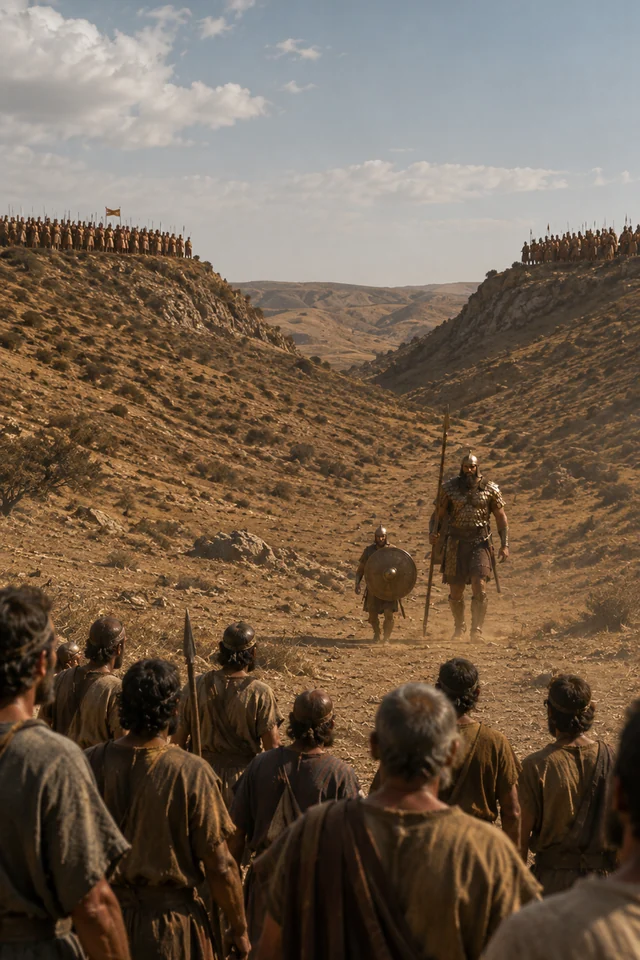
The two armies occupy facing hills with a valley between them.
- David Brings Food to His Brothers 1 Samuel 17:12-22
David's three eldest brothers serve in Saul's army, while he moves between Saul's service and tending sheep for his father Jesse.
- David Questions the Fear Around Him 1 Samuel 17:23-30
While David speaks with his brothers, Goliath repeats his challenge and Israel's men retreat in fear.
- David Chooses Familiar Tools Over Armour 1 Samuel 17:31-40
Saul hears of David's words and sends for him.
- David Says the Battle Belongs to God 1 Samuel 17:41-47
Goliath sees David approach and scorns his youth and staff.
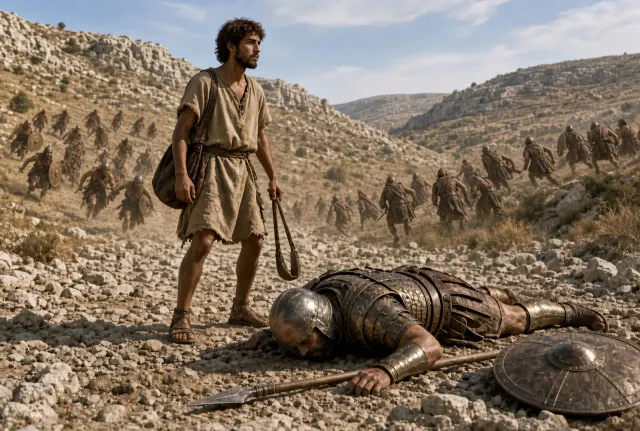
- One Stone Brings the Champion Down 1 Samuel 17:48-54
David runs toward Goliath, takes a stone from his bag, and strikes his forehead with the sling.
- Saul Asks About David's Father 1 Samuel 17:55-58
As David goes out to fight, Saul asks Abner, his army commander, whose son the young man is.
Central truth
The champion who terrifies Israel falls before David, declaring that the outcome depends on God rather than weapons or physical strength.

Scripture beside the summary
1 Samuel · King James Version · 581 Samuel 17:1-11
Goliath Challenges the Frightened Army
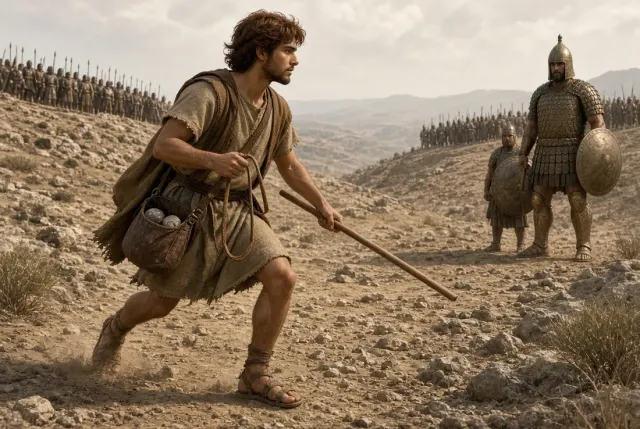
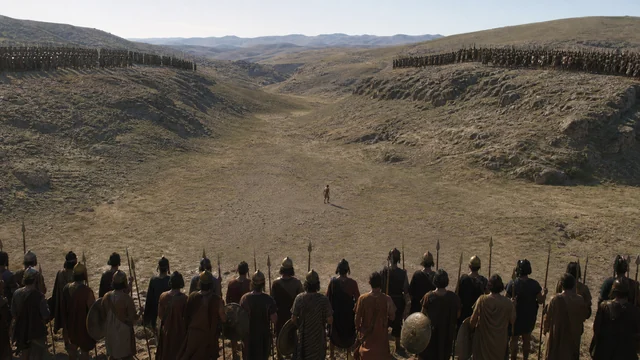
The two armies occupy facing hills with a valley between them. Goliath comes out from the Philistine camp wearing heavy armour and carrying a huge spear. A shield bearer goes before him. He demands that Israel choose one man to fight him. The losing side, he says, will serve the winner. His challenge insults Israel's army and reduces the conflict to a contest against his imposing size and equipment. Saul and the whole army hear him and become deeply afraid. No one steps forward.
In everyday life
A towering debt collector fills the doorway of a small repair shop and demands that one worker answer for the whole business. The staff stop moving, their eyes fixed on him and the men behind him. His presence makes resistance feel impossible. Goliath's challenge is a fight to the death between armies, not debt collection.
Notice
1 Samuel 17:11 Saul shares the army's fear. The king chosen partly for his impressive height offers no answer when a still more imposing opponent appears.
1 Samuel 17:1-11
King James Version1Now the Philistines gathered together their armies to battle, and were gathered together at Shochoh, which belongeth to Judah, and pitched between Shochoh and Azekah, in Ephes-dammim.
2And Saul and the men of Israel were gathered together, and pitched by the valley of Elah, and set the battle in array against the Philistines.
3And the Philistines stood on a mountain on the one side, and Israel stood on a mountain on the other side: and there was a valley between them.
4And there went out a champion out of the camp of the Philistines, named Goliath, of Gath, whose height was six cubits and a span.
5And he had an helmet of brass upon his head, and he was armed with a coat of mail; and the weight of the coat was five thousand shekels of brass.
6And he had greaves of brass upon his legs, and a target of brass between his shoulders.
7And the staff of his spear was like a weaver’s beam; and his spear’s head weighed six hundred shekels of iron: and one bearing a shield went before him.
8And he stood and cried unto the armies of Israel, and said unto them, Why are ye come out to set your battle in array? am not I a Philistine, and ye servants to Saul? choose you a man for you, and let him come down to me.
9If he be able to fight with me, and to kill me, then will we be your servants: but if I prevail against him, and kill him, then shall ye be our servants, and serve us.
10And the Philistine said, I defy the armies of Israel this day; give me a man, that we may fight together.
11When Saul and all Israel heard those words of the Philistine, they were dismayed, and greatly afraid.
1 Samuel 17:12-22
David Brings Food to His Brothers
David's three eldest brothers serve in Saul's army, while he moves between Saul's service and tending sheep for his father Jesse. Goliath repeats his challenge morning and evening for forty days. Jesse sends David with grain, bread, and cheese for his brothers and their commander. He wants news of how his sons are doing. David leaves the flock with another keeper, reaches camp as the army goes out, and leaves the food with the supplies keeper. Then he runs to greet his brothers.

In everyday life
One college student carries packed meals into the depot where her brothers are helping with an emergency response. Her father has asked for news, not heroics. She leaves the bags with the coordinator and looks for familiar faces among the crews. An ordinary family errand brings her close to danger. David will personally enter the battle.
Notice
1 Samuel 17:20 David leaves the sheep with a keeper before departing. His arrival at battle does not require him to abandon the task already entrusted to him.
1 Samuel 17:12-22
King James Version12Now David was the son of that Ephrathite of Beth-lehem-judah, whose name was Jesse; and he had eight sons: and the man went among men for an old man in the days of Saul.
13And the three eldest sons of Jesse went and followed Saul to the battle: and the names of his three sons that went to the battle were Eliab the firstborn, and next unto him Abinadab, and the third Shammah.
14And David was the youngest: and the three eldest followed Saul.
15But David went and returned from Saul to feed his father’s sheep at Beth-lehem.
16And the Philistine drew near morning and evening, and presented himself forty days.
17And Jesse said unto David his son, Take now for thy brethren an ephah of this parched corn, and these ten loaves, and run to the camp to thy brethren;
18And carry these ten cheeses unto the captain of their thousand, and look how thy brethren fare, and take their pledge.
19Now Saul, and they, and all the men of Israel, were in the valley of Elah, fighting with the Philistines.
20And David rose up early in the morning, and left the sheep with a keeper, and took, and went, as Jesse had commanded him; and he came to the trench, as the host was going forth to the fight, and shouted for the battle.
21For Israel and the Philistines had put the battle in array, army against army.
22And David left his carriage in the hand of the keeper of the carriage, and ran into the army, and came and saluted his brethren.
1 Samuel 17:23-30
David Questions the Fear Around Him
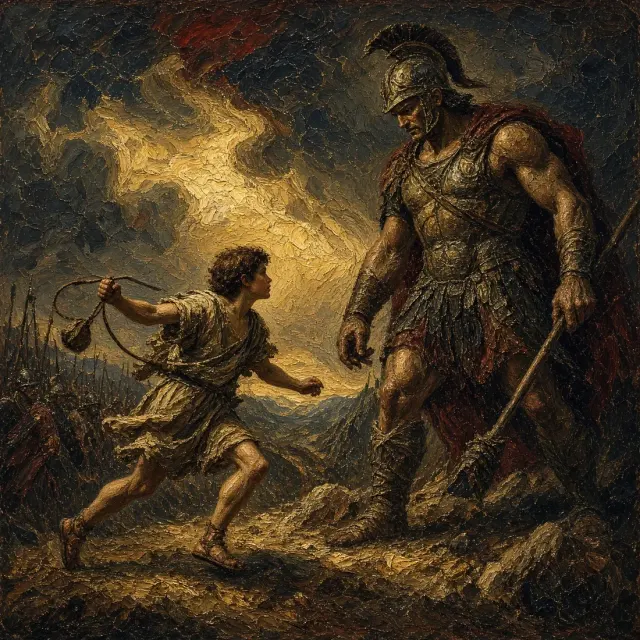
While David speaks with his brothers, Goliath repeats his challenge and Israel's men retreat in fear. They discuss the king's promised rewards for killing him: wealth, marriage to his daughter, and freedom for the victor's family. David asks about those rewards but also questions how this outsider can defy the living God's army. Eliab, his eldest brother, angrily accuses him of pride and neglecting the sheep to watch battle. David denies the charge and continues asking others. His questions disturb the camp's accepted fear.
In everyday life
The youngest dock worker asks why everyone accepts a dangerous demand from the shipping agent. His older brother snaps that he has come only to show off and should return to sweeping. He turns to another worker and repeats the question. A lower position does not silence his concern. David's concern centres on defiance of God.
Notice
1 Samuel 17:28 Eliab claims to know David's motives, but the account has already said his father sent him. His accusation does not match the errand described.
1 Samuel 17:23-30
King James Version23And as he talked with them, behold, there came up the champion, the Philistine of Gath, Goliath by name, out of the armies of the Philistines, and spake according to the same words: and David heard them.
24And all the men of Israel, when they saw the man, fled from him, and were sore afraid.
25And the men of Israel said, Have ye seen this man that is come up? surely to defy Israel is he come up: and it shall be, that the man who killeth him, the king will enrich him with great riches, and will give him his daughter, and make his father’s house free in Israel.
26And David spake to the men that stood by him, saying, What shall be done to the man that killeth this Philistine, and taketh away the reproach from Israel? for who is this uncircumcised Philistine, that he should defy the armies of the living God?
27And the people answered him after this manner, saying, So shall it be done to the man that killeth him.
28And Eliab his eldest brother heard when he spake unto the men; and Eliab’s anger was kindled against David, and he said, Why camest thou down hither? and with whom hast thou left those few sheep in the wilderness? I know thy pride, and the naughtiness of thine heart; for thou art come down that thou mightest see the battle.
29And David said, What have I now done? Is there not a cause?
30And he turned from him toward another, and spake after the same manner: and the people answered him again after the former manner.
1 Samuel 17:31-40
David Chooses Familiar Tools Over Armour
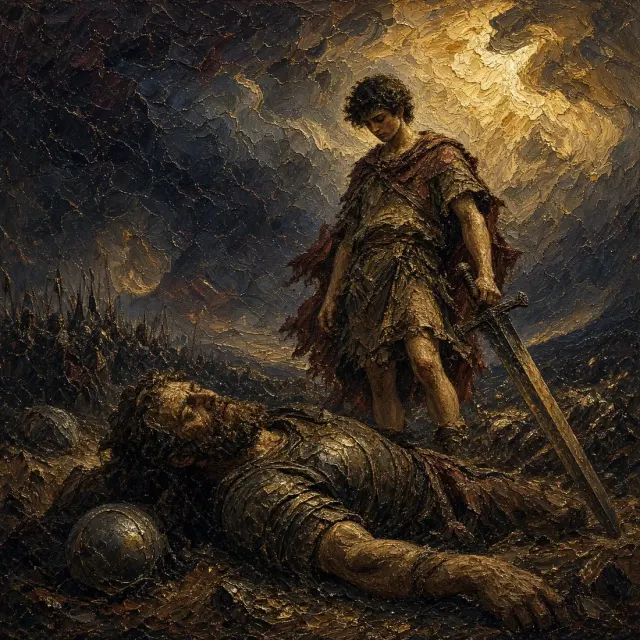
Saul hears of David's words and sends for him. David volunteers to fight, but Saul points out the gap between a young man and an experienced soldier. David recalls rescuing sheep from a lion and a bear. He trusts that the God who rescued him then will rescue him now. Saul permits him to go and provides armour, but David cannot use equipment he has not tested. He removes it and takes his staff, sling, and five smooth stones from the stream.
In everyday life
An experienced tree surgeon arrives at a storm site with her own climbing ropes. A supervisor offers heavier unfamiliar equipment, but she checks it and sets it aside. She uses the tools with which she has already worked through danger. Familiar skill matters under pressure. David also places his confidence in God's rescue, beyond his equipment.
Notice
1 Samuel 17:39 David refuses the armour because he has not tested it. The choice does not reject all preparation; he takes tools he knows how to use.
1 Samuel 17:31-40
King James Version31And when the words were heard which David spake, they rehearsed them before Saul: and he sent for him.
32And David said to Saul, Let no man’s heart fail because of him; thy servant will go and fight with this Philistine.
33And Saul said to David, Thou art not able to go against this Philistine to fight with him: for thou art but a youth, and he a man of war from his youth.
34And David said unto Saul, Thy servant kept his father’s sheep, and there came a lion, and a bear, and took a lamb out of the flock:
35And I went out after him, and smote him, and delivered it out of his mouth: and when he arose against me, I caught him by his beard, and smote him, and slew him.
36Thy servant slew both the lion and the bear: and this uncircumcised Philistine shall be as one of them, seeing he hath defied the armies of the living God.
37David said moreover, The LORD that delivered me out of the paw of the lion, and out of the paw of the bear, he will deliver me out of the hand of this Philistine. And Saul said unto David, Go, and the LORD be with thee.
38And Saul armed David with his armour, and he put an helmet of brass upon his head; also he armed him with a coat of mail.
39And David girded his sword upon his armour, and he assayed to go; for he had not proved it. And David said unto Saul, I cannot go with these; for I have not proved them. And David put them off him.
40And he took his staff in his hand, and chose him five smooth stones out of the brook, and put them in a shepherd’s bag which he had, even in a scrip; and his sling was in his hand: and he drew near to the Philistine.
1 Samuel 17:41-47
David Says the Battle Belongs to God
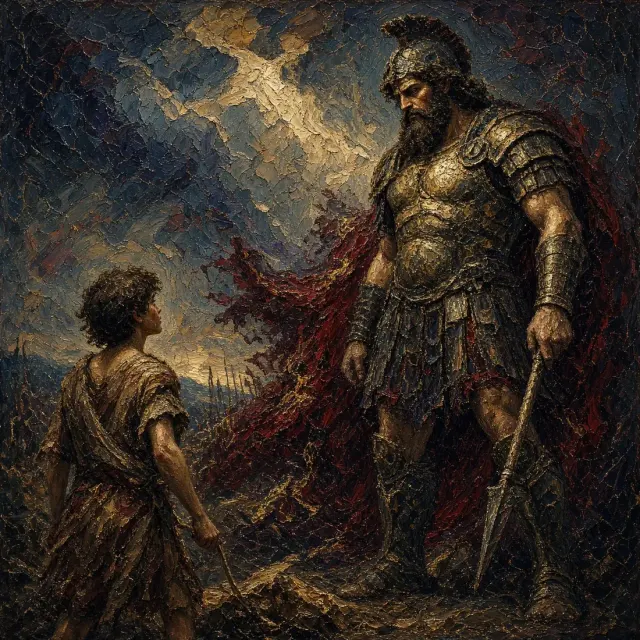
Goliath sees David approach and scorns his youth and staff. He curses him by his gods and threatens to leave his body for birds and animals. David answers that Goliath comes with weapons, while he comes in the name of Israel's God. He says God will deliver Goliath to him, and he will kill him and cut off his head. The defeat will show that God is present in Israel. Everyone watching will learn that God does not depend on swords and spears to save.
In everyday life
An intimidated witness walks into the hearing room carrying only her statement while the opposing side fills a bench with expensive advisers. She speaks because she trusts the court's authority over their intimidation. Their greater resources do not settle the case. David claims God's promised victory and threatens lethal battle, not a legal judgment.
Notice
1 Samuel 17:47 David speaks about what the whole gathering will learn. His aim reaches beyond personal survival to recognition that the outcome rests with God.
1 Samuel 17:41-47
King James Version41And the Philistine came on and drew near unto David; and the man that bare the shield went before him.
42And when the Philistine looked about, and saw David, he disdained him: for he was but a youth, and ruddy, and of a fair countenance.
43And the Philistine said unto David, Am I a dog, that thou comest to me with staves? And the Philistine cursed David by his gods.
44And the Philistine said to David, Come to me, and I will give thy flesh unto the fowls of the air, and to the beasts of the field.
45Then said David to the Philistine, Thou comest to me with a sword, and with a spear, and with a shield: but I come to thee in the name of the LORD of hosts, the God of the armies of Israel, whom thou hast defied.
46This day will the LORD deliver thee into mine hand; and I will smite thee, and take thine head from thee; and I will give the carcases of the host of the Philistines this day unto the fowls of the air, and to the wild beasts of the earth; that all the earth may know that there is a God in Israel.
47And all this assembly shall know that the LORD saveth not with sword and spear: for the battle is the LORD’s, and he will give you into our hands.
1 Samuel 17:48-54
One Stone Brings the Champion Down
David runs toward Goliath, takes a stone from his bag, and strikes his forehead with the sling. Goliath falls face down. David has no sword of his own, so he takes Goliath's sword and cuts off his head. The Philistines flee when they see their champion is dead. Israel pursues them, leaving many enemies fallen along the route, then plunders their camp. David takes the head to Jerusalem, a city in the land, and keeps the armour in his tent.
In everyday life
Their mine rescue technician frees a jammed release with one carefully placed tool movement. The waiting crews surge into action once the blocked route opens. A crisis that held everyone still changes within seconds, though much work remains. Goliath's death opens a lethal pursuit, so a mechanical rescue captures only the sudden turning point.
Notice
1 Samuel 17:50 The account stresses that David had no sword when he prevailed. That detail directly supports his earlier claim that God does not need sword and spear.
1 Samuel 17:48-54
King James Version48And it came to pass, when the Philistine arose, and came and drew nigh to meet David, that David hasted, and ran toward the army to meet the Philistine.
49And David put his hand in his bag, and took thence a stone, and slang it, and smote the Philistine in his forehead, that the stone sunk into his forehead; and he fell upon his face to the earth.
50So David prevailed over the Philistine with a sling and with a stone, and smote the Philistine, and slew him; but there was no sword in the hand of David.
51Therefore David ran, and stood upon the Philistine, and took his sword, and drew it out of the sheath thereof, and slew him, and cut off his head therewith. And when the Philistines saw their champion was dead, they fled.
52And the men of Israel and of Judah arose, and shouted, and pursued the Philistines, until thou come to the valley, and to the gates of Ekron. And the wounded of the Philistines fell down by the way to Shaaraim, even unto Gath, and unto Ekron.
53And the children of Israel returned from chasing after the Philistines, and they spoiled their tents.
54And David took the head of the Philistine, and brought it to Jerusalem; but he put his armour in his tent.
1 Samuel 17:55-58
Saul Asks About David's Father
As David goes out to fight, Saul asks Abner, his army commander, whose son the young man is. Abner does not know, so Saul tells him to find out. After the victory, Abner brings David before the king while David still holds Goliath's head. Saul asks directly, and David names Jesse of Bethlehem as his father. Earlier David served Saul, so the reason for this question is not fully explained. The question itself concerns his family, which is now drawn into royal attention.
In everyday life
A tournament registrar watches an unexpected finalist leave the floor and asks the coach which family he belongs to. She has seen him at practice but does not know his household details. The win brings questions that routine attendance did not. Saul's question follows a killing and concerns a family promised royal rewards.
Notice
1 Samuel 17:58 David identifies himself through his father and home town. The answer supplies family information rather than a new account of how he defeated Goliath.
1 Samuel 17:55-58
King James Version55And when Saul saw David go forth against the Philistine, he said unto Abner, the captain of the host, Abner, whose son is this youth? And Abner said, As thy soul liveth, O king, I cannot tell.
56And the king said, Enquire thou whose son the stripling is.
57And as David returned from the slaughter of the Philistine, Abner took him, and brought him before Saul with the head of the Philistine in his hand.
58And Saul said to him, Whose son art thou, thou young man? And David answered, I am the son of thy servant Jesse the Beth-lehemite.
Details worth noticing
The opening image
1 Samuel 17:1 begins with “Now the Philistines gathered together their armies to battle, and were gathered together at Shochoh, which belongeth to Judah, and pitched between Shochoh…”
Where the chapter turns
1 Samuel 17:29 forms a natural hinge: “And David said, What have I now done? Is there not a cause?”
The final note
1 Samuel 17:58 leaves the reader with “And Saul said to him, Whose son art thou, thou young man? And David answered, I am the son of thy servant Jesse the Beth-lehemite.”
A word trail through the chapter
The words David, Philistine, Saul, Israel, Philistines, battle help reveal the chapter’s repeated concerns.
KJV words made clear
- greaves
- Protective armour worn over the lower legs, here made of brass.
Music and video connected to the passage
Related media appears when its Scripture reference overlaps this study. Music and video can illuminate a theme while the biblical text remains the foundation.