
1 Samuel

31 Chapters
1 Samuel: The Whole Book, Chapter by Chapter
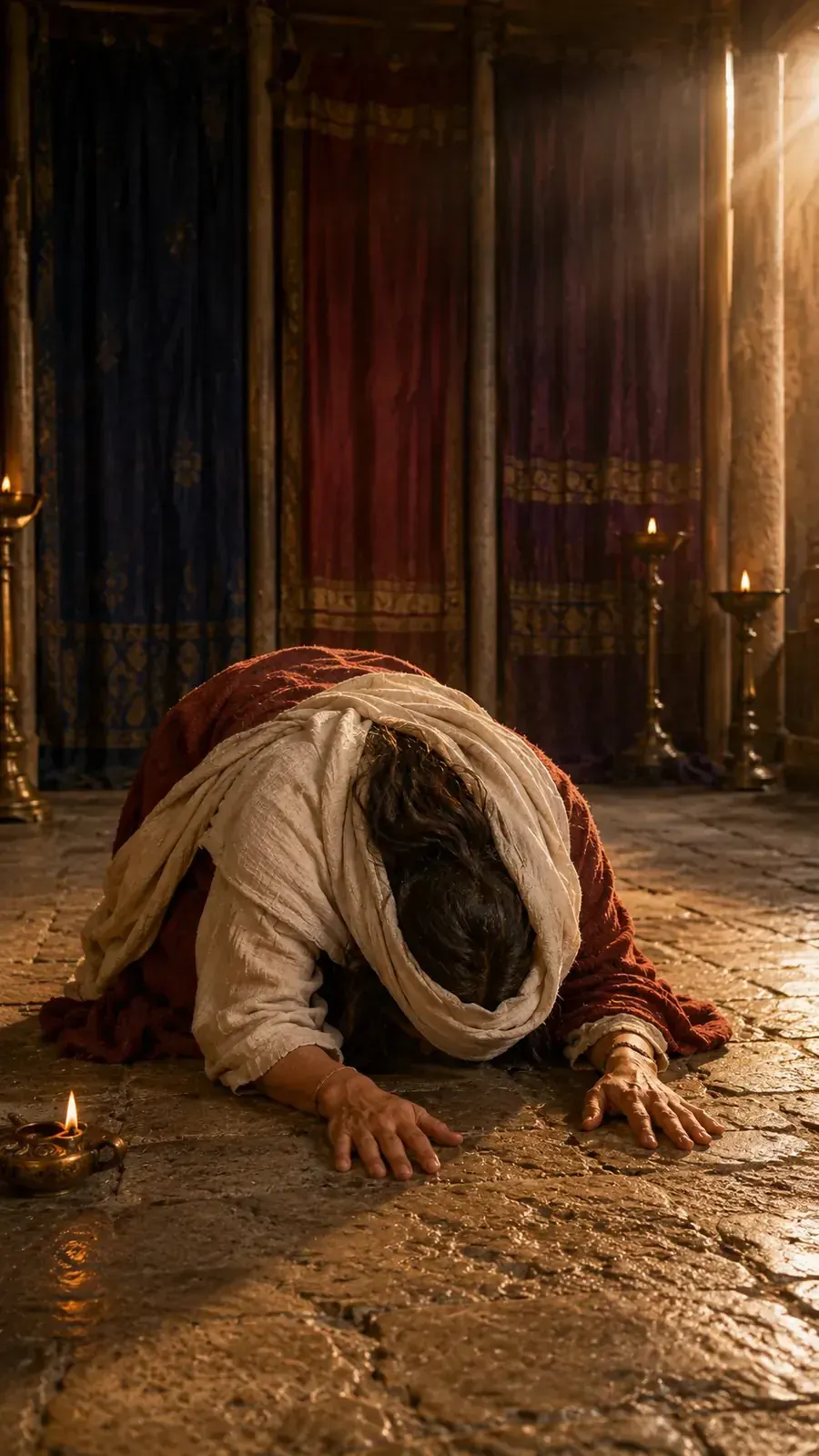
A Prayer Nobody Else Can Hear
The Book of 1 Samuel opens far from a battlefield or throne. Hannah cannot eat at the yearly feast, Elkanah cannot solve her grief with affection, and Eli mistakes silent prayer for drunkenness. The chapter keeps placing visible facts beside mistaken conclusions. Hannah's moving lips look suspicious to Eli, but her prayer reaches beyond the priest's hearing. When Samuel is born, the answer does not end in possession. Hannah nurses him, waits until he is weaned, then returns to the place of her humiliation and identifies herself simply as the woman who once stood there praying. The child she asked for is the child she gives to lifelong service. Asking, receiving, nursing, and giving all belong to the same act of faithfulness.
One complete chapter pageOpen chapter →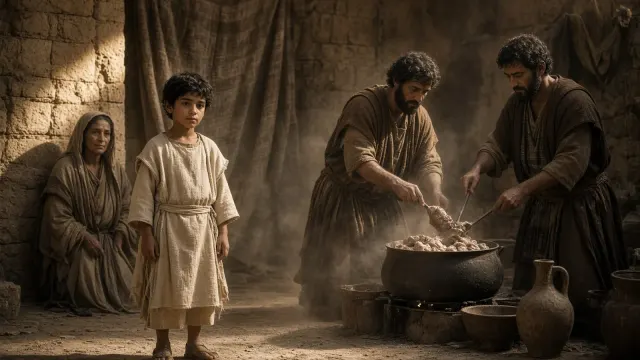
Hannah Sings the Reversals That the House of Eli Will Face
Hannah's prayer begins with her own deliverance and expands until it reaches broken bows, hungry people, lifted beggars, a coming king, and the LORD's thunder. The rest of the chapter then begins turning those reversals into household history at Shiloh. Hophni and Phinehas have office but do not know the LORD; Samuel is a child, yet he grows before him. The priests seize meat, abuse worshippers, and refuse correction, while Hannah quietly brings a little coat each year. Eli rebukes his sons but does not restrain them, and an unnamed man of God announces the consequence: the house that has made itself fat from offerings will someday beg for bread. The chapter does not let corruption occupy all of Shiloh. It places faithful service beside institutional failure until the contrast becomes impossible to ignore.
One complete chapter pageOpen chapter →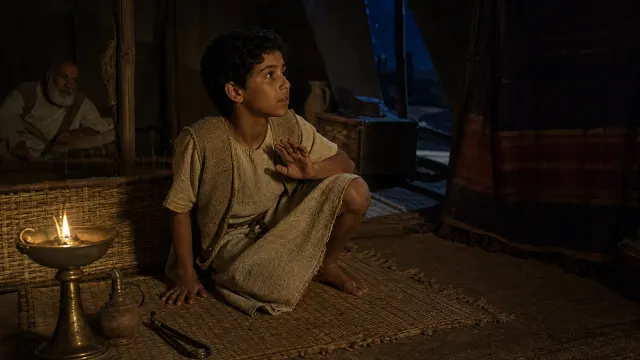
The Voice Returns to Shiloh
The Book of 1 Samuel begins the chapter with a scarce word and ends with revelation restored at Shiloh. Samuel is already serving there, but he does not yet recognize the voice calling him in the night. Three times he runs to Eli, and the old priest eventually understands what the child does not. The guidance is genuine even though Eli's house is under judgment. Samuel's first message is therefore painfully close to home: the LORD confirms the sentence against the man who has just taught him how to listen. Morning brings doors to open, fear to carry, and a demand from Eli that nothing be hidden. Samuel tells him everything. From that private and difficult beginning, his reliability becomes public until all Israel recognizes him as a prophet.
One complete chapter pageOpen chapter →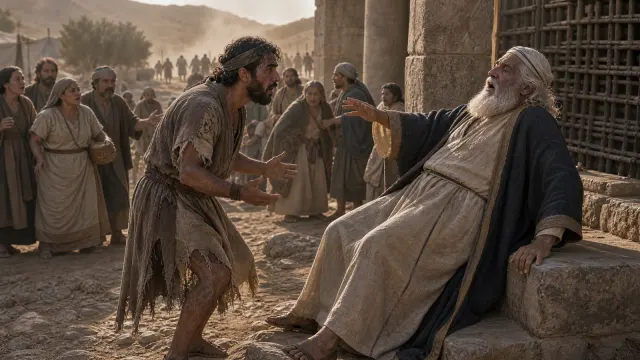
The Ark Is Taken, and Shiloh Hears the News
The Book of 1 Samuel moves from a restored prophetic word to a military disaster in which Israel asks the right first question and supplies its own answer. After defeat, the elders wonder why the LORD has struck them, then fetch the ark without a reported command to do so. Its arrival produces a roar of confidence and Philistine panic, yet the second battle is worse than the first. Hophni and Phinehas die on the same day, the ark is taken, and the message reaches Shiloh item by item until Eli falls at the news of the ark. The final scene compresses national catastrophe into childbirth. Phinehas's dying wife does not allow the birth of a son to cancel the loss she names. Ichabod becomes a living name for departed glory.
One complete chapter pageOpen chapter →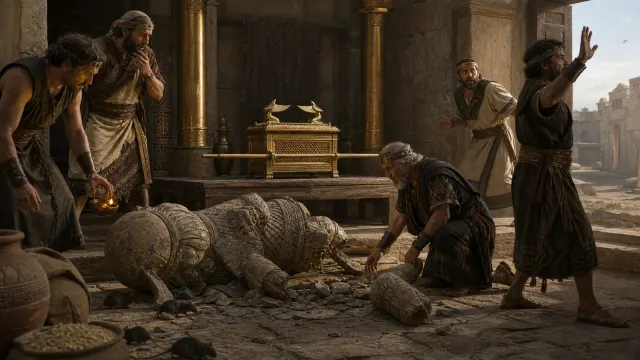
The Captive Ark Leaves Its Captors Asking for Release
The Philistines have captured the ark, but the Book of 1 Samuel immediately dismantles the idea that capture means control. Set beside Dagon, the ark becomes the still center of a humiliating sequence: the image falls, is put back by its worshippers, then falls again with head and hands severed. The trouble spreads beyond the temple. Ashdod suffers, the ark is moved to Gath, Gath suffers, and Ekron protests before the transfer is even complete. Philistine rulers can decide where to send their prize, but they cannot decide where it will be harmless. Israel never mounts a rescue. No army crosses the border. By the end, the captors themselves are asking that the ark be sent “to his own place,” while the cry of the afflicted city rises to heaven.
One complete chapter pageOpen chapter →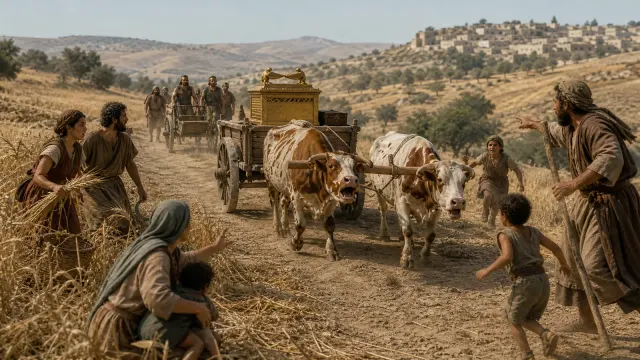
The Straight Road Home Is Not the End of the Danger
Seven months after the capture, the Philistines arrange the ark's return with a mixture of confession, religious counsel, and experiment. Their golden offerings acknowledge the affliction, but the new cart and untrained milk cows are designed to test whether the LORD's hand truly caused it. The animals take the straight road to Beth-shemesh, lowing while their calves remain behind, and the Philistine rulers follow as witnesses. Israel receives the ark with rejoicing and sacrifice, yet the chapter refuses an easy homecoming. Judgment falls when men look into the ark, and the survivors ask who can stand before this holy God. The ark's return has proved that Philistine possession was dangerous, but it also proves that Israelite possession is not automatically safe. Recovery does not turn holiness into familiarity.
One complete chapter pageOpen chapter →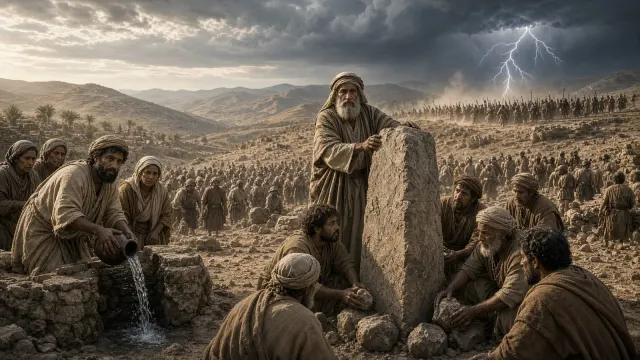
A Different Answer to the Philistine Threat
The ark is settled at Kirjath-jearim, but the Book of 1 Samuel makes clear that putting sacred furniture in the right place is not the same as putting Israel's worship in order. Samuel calls the people away from Baalim and Ashtaroth, and at Mizpeh they gather in confession, fasting, and prayer. When the Philistines advance, Israel is afraid, but its response is different from chapter 4. No one calls for the ark. They ask Samuel not to stop crying to the LORD for them. The LORD thunders, the Philistines are discomfited, and Israel pursues. Samuel then names a stone Ebenezer, fixing the victory to help received. The chapter closes not with permanent triumph but with Samuel's yearly circuit, as ordinary judgment continues after the dramatic rescue.
One complete chapter pageOpen chapter →
The King They Ask for Will Also Make Demands
The request for a king begins with a grievance the Book of 1 Samuel does not dismiss. Samuel's sons take bribes and pervert judgment. The elders are right to name the failure, but their proposed solution reaches beyond replacing bad judges. They want a king “like all the nations,” and the LORD interprets that desire within Israel's longer pattern of rejecting his rule. Samuel is told both to listen and to warn. His warning is built around the verb “take”: sons, daughters, fields, produce, servants, animals, and finally the people's own service. They hear the cost and still insist on the benefits they imagine, especially a king who will go before them in battle. The chapter ends with permission granted but no candidate named, leaving the national demand to meet a man still looking for lost donkeys.
One complete chapter pageOpen chapter →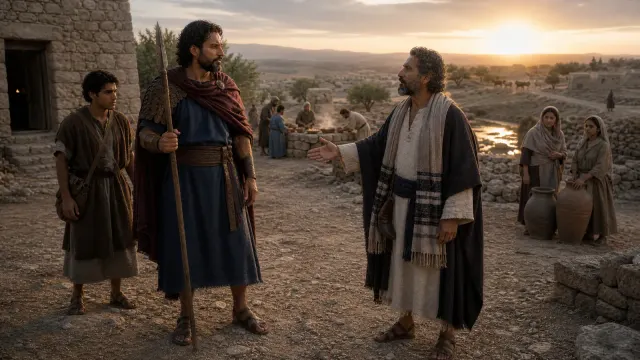
Missing Donkeys and a Reserved Place at the Table
Saul enters the Book of 1 Samuel not looking for a crown but for his father's missing donkeys. His search fails repeatedly until an unnamed servant knows one more useful thing: a man of God is nearby. While Saul worries about directions and a proper gift, Samuel already knows a man from Benjamin is coming. The chapter keeps the two levels of knowledge side by side. Saul reaches the gate asking where the seer lives while speaking to the seer himself, then learns that the lost animals have already been found and that a far stranger matter concerns him. A reserved seat and portion reveal preparation he never saw. By the end, even the servant who got him there is sent ahead, and Saul is told to stand still for the word of God.
One complete chapter pageOpen chapter →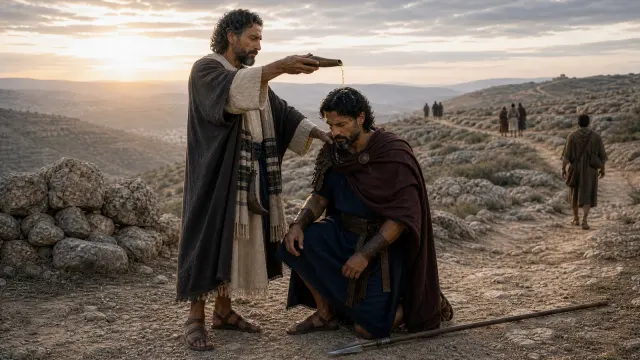
Anointed in Private, Found Among the Baggage
Saul's kingship begins in private and is confirmed in public, but the Book of 1 Samuel refuses to make either scene simple. Samuel anoints Saul as captain over the LORD's inheritance and gives signs that unfold exactly as promised, including the coming of the Spirit. Saul returns home changed but does not tell his uncle about the kingdom. At Mizpeh, the public selection identifies the same man, only for him to be missing among the baggage. The LORD must point out where the chosen king is hiding before the people can fetch him and shout their acclaim. Samuel then writes the manner of the kingdom and sends everyone home. Saul leaves with supporters whose hearts God has touched and critics who despise him. Kingship has arrived, but not as a finished institution or unanimous settlement.
One complete chapter pageOpen chapter →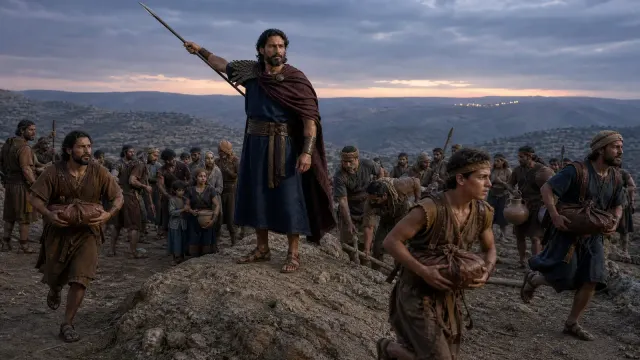
The New King Answers a City's Cry
The threat against Jabesh-gilead gives Saul's newly acclaimed kingship its first public test. Nahash does not merely demand service. He demands the right eyes of the men as a humiliation “upon all Israel,” and the city's messengers reach Gibeah to find people weeping. Saul comes in from the field behind the herd, hears the news, and the Spirit of God comes upon him. His summons gathers Israel, and the rescue arrives by the time he promised. Yet the chapter's most revealing royal decision comes after victory. When supporters want Saul's earlier critics executed, he refuses to turn deliverance into a purge and says the LORD has wrought salvation. Samuel then gathers the people at Gilgal to renew the kingdom. Saul's reign receives a strong beginning without allowing the king to become the source of the salvation he helped accomplish.
One complete chapter pageOpen chapter →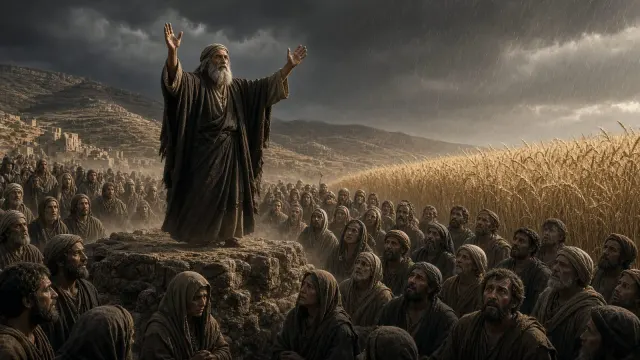
A King Does Not Cancel the Covenant
Samuel stands before Israel with the new king already walking before the people and asks for an accounting of his own public life. No one can name an ox, donkey, bribe, fraud, or act of oppression he has taken. From there, the Book of 1 Samuel widens the hearing into a review of Israel's history, where the LORD repeatedly raised deliverers before monarchy existed. Samuel places the people's chosen king and the people themselves under the same command to hear and obey. Thunder and rain during wheat harvest confirm the seriousness of their request, and Israel responds with fear and confession. Yet Samuel does not announce his departure from responsibility. He says ceasing to pray for them would itself be sin. Kingship changes Israel's government without cancelling covenant, prophetic intercession, teaching, or the possibility of judgment on king and people together.
One complete chapter pageOpen chapter →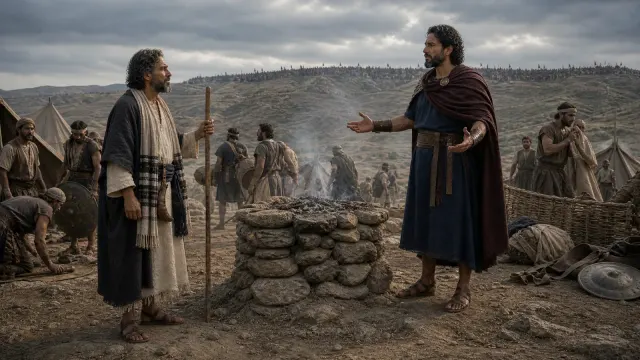
An Offering Made Before the Waiting Is Over
Renewed Philistine pressure places Saul in a crisis that is both real and revealing. Jonathan's attack draws a massive response, Israelites hide or cross the Jordan, and those who remain with Saul are trembling. The Book of 1 Samuel does not make the danger imaginary in order to explain Saul's failure. At Gilgal he waits through the stated interval, watches his force scatter, and then offers the burnt offering before Samuel arrives. Samuel appears almost immediately and identifies the issue as a command not kept. The announced consequence concerns the future of Saul's kingdom, not an instant removal from command. The chapter then returns to military reality with brutal clarity: Philistine raiders move freely, Israel depends on enemy smiths even for tools, and only Saul and Jonathan are reported with sword and spear.
One complete chapter pageOpen chapter →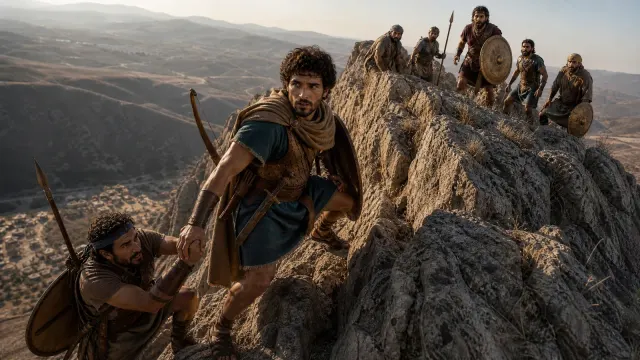
Jonathan Opens a Battle That Saul Nearly Closes Against Him
Jonathan breaks the military stalemate with one armourbearer and a conviction carefully phrased as possibility: the LORD can save by many or by few. His attack becomes the opening through which a much larger Philistine collapse occurs, and the Book of 1 Samuel credits the day's salvation to the LORD. Saul then creates a second crisis inside the victorious army by binding hungry soldiers under an oath not to eat until evening. Jonathan, who never heard the command, tastes honey and later becomes the target of his father's death sentence when divine inquiry falls silent. The people refuse that sentence and rescue the man who helped rescue them. The chapter closes by refusing a simple portrait of Saul. It records real victories, a functioning royal household, and effective military leadership alongside an oath that weakened his own army and nearly killed his son.
One complete chapter pageOpen chapter →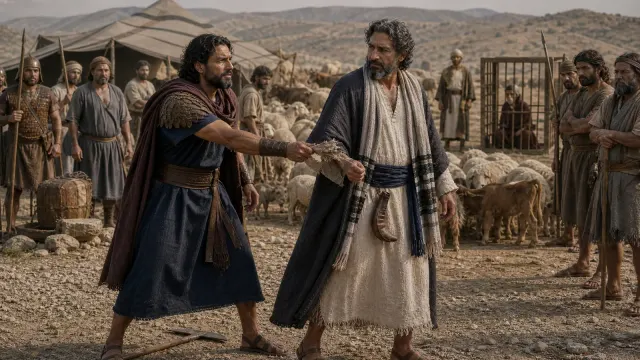
The Sheep Interrupt Saul's Account of Obedience
The Amalekite campaign turns on a clash between Saul's repeated claim that he obeyed and the visible, audible evidence that he altered the command. Agag lives, valuable livestock survives, and sheep are still bleating when Saul tells Samuel, “I have performed the commandment of the LORD.” The Book of 1 Samuel does not hide the severity of the original command, including its reach beyond combatants, but it is equally direct about what Saul and the people chose to spare. Samuel's confrontation moves beneath sacrifice to the issue of hearing: obedience cannot be manufactured afterward by giving a religious purpose to what was kept. Saul confesses, yet the rejection of his kingship stands. A torn mantle gives the verdict physical form. The chapter closes with separation rather than triumph, as Samuel mourns Saul and the LORD's regret frames the loss.
One complete chapter pageOpen chapter →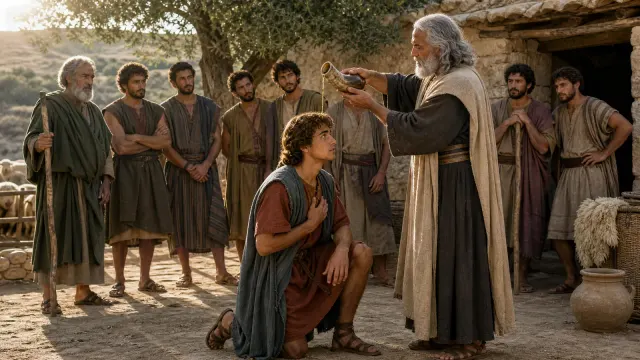
The Chosen Son Is Still Out with the Sheep
Samuel is still mourning Saul when the LORD sends him to Bethlehem to anoint another king. The Book of 1 Samuel makes the transition deliberately indirect. Samuel goes under the public purpose of a real sacrifice, fears Saul's reaction, and does not know which of Jesse's sons will be chosen until the LORD identifies him. Samuel first reaches for the familiar visual measure and assumes Eliab must be the man, only to be corrected. Seven sons pass. The chosen one is still with the sheep. David is summoned, anointed, and receives the Spirit, while Saul subsequently loses that royal empowerment. Yet David does not march toward the throne. He is called to court as a skilled musician, wins Saul's affection, and brings him relief. The newly chosen king enters the rejected king's household first as a servant.
One complete chapter pageOpen chapter →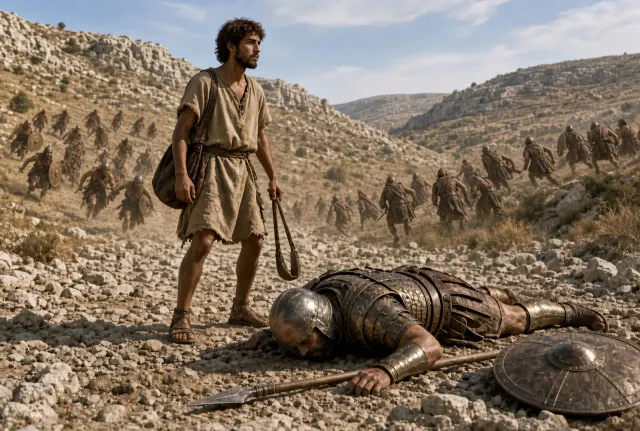
The Challenge Everyone Hears and David Answers Differently
For forty days Goliath has taught both armies to read the valley his way: one enormous champion, one mountain of bronze, one bargain that turns a national battle into a single contest. David arrives carrying bread and cheese, hears exactly the words everyone else has heard, and assigns them a different meaning. Where the soldiers see a terrifying man and a royal reward, David hears defiance of "the armies of the living God." His confidence is not detached from experience. He argues from the lion and bear, rejects armour he has never tested, and walks out with tools he actually knows. The Book of 1 Samuel spends far more time on the speeches than on the strike itself, because the speeches explain what the brief combat is supposed to mean. One stone ends the champion's advance, Goliath's own sword completes his defeat, and the frightened army becomes a pursuing one. The chapter closes not with David announcing his anointing, but with Saul asking whose son the young victor is.
One complete chapter pageOpen chapter →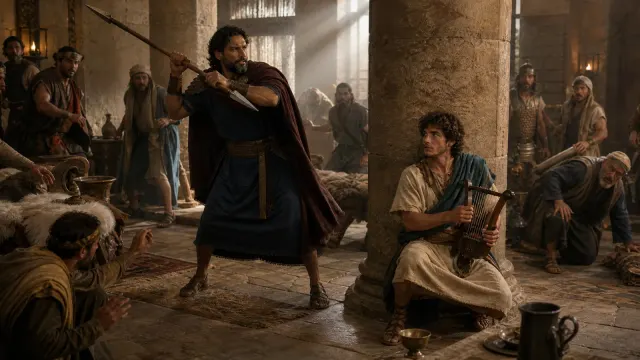
The Welcome That Becomes a Threat to Saul
David's victory does not produce one clean line of promotion. It produces affection, visibility, and fear all at once. Jonathan binds himself to David by covenant and gives him robe, garments, and weapons. Saul keeps David in royal service, and David's conduct wins approval among soldiers and people. Then a celebratory song becomes arithmetic in Saul's mind: "thousands" for Saul, "ten thousands" for David, and from there the king calculates the kingdom. The result is a chapter in which attempts to reduce David repeatedly enlarge his position. A javelin misses and a command over a thousand puts him before more people. A marriage offer becomes a concealed death plan. A deadly bride-price brings David into Saul's family when he returns with twice the required proof. The Book of 1 Samuel keeps setting Saul's private designs beside facts he cannot erase: Jonathan loves David, Michal loves David, Israel and Judah love David, David behaves wisely, and the LORD is with him. Recognition does not calm Saul. It sharpens his fear.
One complete chapter pageOpen chapter →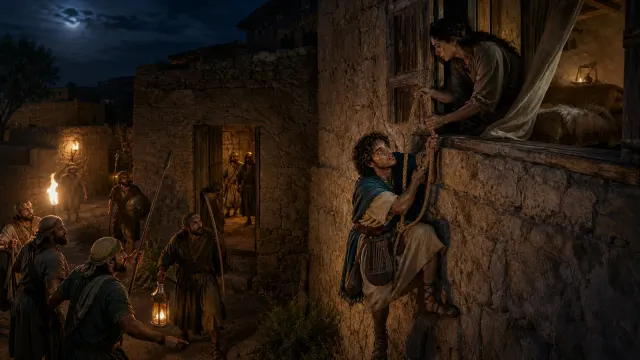
Saul's Household and the Prophets Frustrate His Pursuit
Saul's campaign against David stops pretending to be indirect. He tells Jonathan and his servants to kill him, then briefly reverses course when Jonathan forces him to remember David's faithful service and the deliverance he once celebrated. The oath of safety lasts only until another victory and another javelin. David escapes the palace, then his own guarded house, where Michal lowers him through a window and leaves a dressed image to occupy the bed his killers expect to carry away. The pursuit finally reaches Samuel at Ramah, and there the chapter changes weapons entirely. Saul sends three groups of messengers, and each mission dissolves into prophesying. He goes himself and meets the same interruption. The Book of 1 Samuel keeps narrowing Saul's control: Jonathan will not cooperate, Michal works against the command, a javelin cannot hold its target, household watchers find a decoy, and royal messengers cannot finish their assignment. Saul ends not with David in custody, but exposed before Samuel while the old proverb about Saul among the prophets returns in a darker setting.
One complete chapter pageOpen chapter →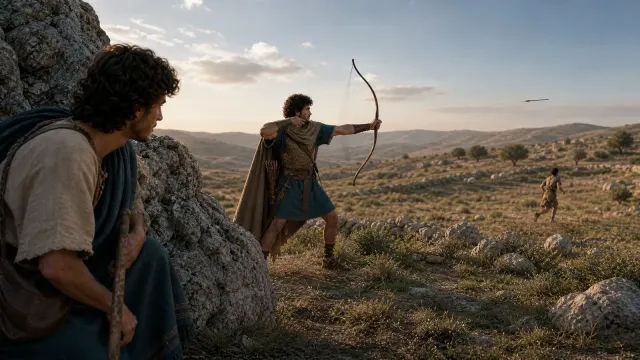
An Empty Seat Reveals the Cost of Jonathan's Covenant
An empty chair at a royal meal becomes the instrument by which David and Jonathan test what safety means now. Jonathan begins from trust in his access to Saul, while David insists the king may be hiding his plan precisely because he knows of their friendship. The two move from immediate danger to future obligation, renewing a covenant that must protect Jonathan's household even if David one day holds the power. The practical test is almost modest: David misses the new moon feast, Jonathan offers the agreed explanation, and Saul's response will reveal his intent. What follows is not subtle. Saul declares that David must die, tells Jonathan that David's life threatens Jonathan's kingdom, and then throws a javelin at the son whose future he claims to be defending. Jonathan no longer needs a report. The arrow signal tells David what the spear has told him. Their farewell joins grief to covenant, and the chapter ends with two friends bound before the LORD precisely as they are forced to go in opposite directions.
One complete chapter pageOpen chapter →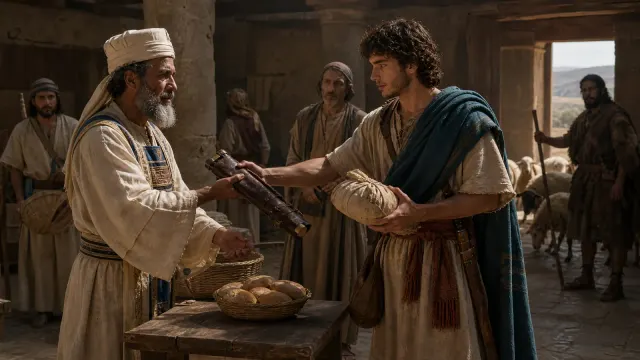
Bread and a Borrowed Account of the King's Business
David's escape from Saul now forces him into spaces where every answer carries danger. At Nob, Ahimelech sees an unaccompanied royal servant and receives a false explanation about secret king's business. The priest gives David sacred bread and then Goliath's sword, never having been told that helping him may be treated as treason. Doeg's quiet presence turns the visit into something that will not remain private. David then crosses into Gath carrying the weapon of its fallen champion, only to discover that his reputation has arrived before him. Achish's servants know the song about David's ten thousands, and the famous fighter becomes afraid enough to perform madness at the city gate. The chapter is full of reversals: sacred bread is obtained through deception, a trophy from victory becomes equipment for flight, and public fame becomes a liability. David survives, but the means of survival are increasingly tangled, and the danger he carries into Nob does not end when he leaves.
One complete chapter pageOpen chapter →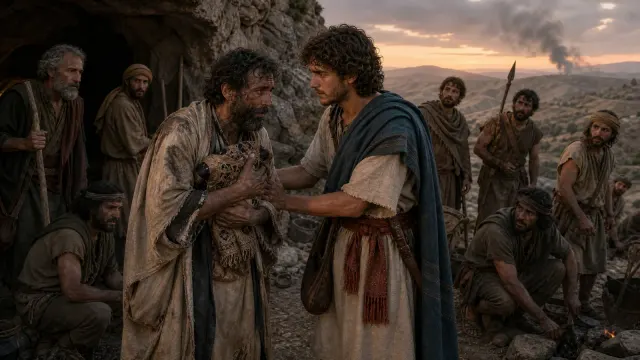
A Refuge Forms While Nob Is Destroyed
David's refuge begins to look like a community just as Saul's court begins to look like a machine for suspicion. Distressed, indebted, and embittered people gather around David, his family joins him, and a prophet directs him back into Judah. Saul, meanwhile, sits with spear in hand asking what rival could possibly offer his Benjamite servants more than fields, vineyards, and offices. Doeg answers not with proof of a plot but with a report about bread, inquiry, and Goliath's sword at Nob. Ahimelech then gives the chapter its clearest clash of interpretations. What Saul calls conspiracy, the priest understood as ordinary service to one of the king's most trusted men. Saul refuses the distinction. His own guards will not kill the priests, so Doeg does, and the violence spreads through Nob. Abiathar alone reaches David. David does not pretend the disaster has nothing to do with his visit. He says plainly that his presence before Doeg "occasioned" the deaths and gives the surviving priest refuge beside him.
One complete chapter pageOpen chapter →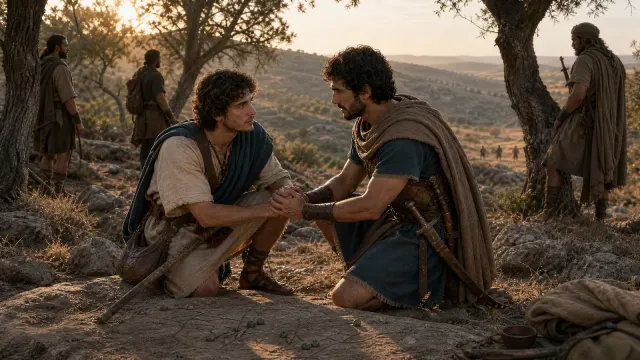
The City David Saves Cannot Promise Him Shelter
David is a hunted man doing the work a king ought to do. When Philistines raid Keilah's threshingfloors, he asks the LORD whether to intervene, asks again when his men fear the risk, and saves the city. Yet rescue does not buy him shelter. Saul hears that David is behind gates and bars and declares that God has delivered him into his hand. The Book of 1 Samuel shortly answers that claim directly: God did not deliver David to him. David learns that Saul will come and Keilah will surrender him, so he leaves before either event occurs. In the wilderness, Jonathan reaches the man Saul cannot catch and openly says David will be king. Then the Ziphites offer Saul the local intelligence he needs, and the hunt tightens until the two forces are moving around opposite sides of the same mountain. Escape comes not from David defeating Saul but from news of a Philistine invasion. The chapter keeps asking who really has whom "in hand," and every easy answer slips away.
One complete chapter pageOpen chapter →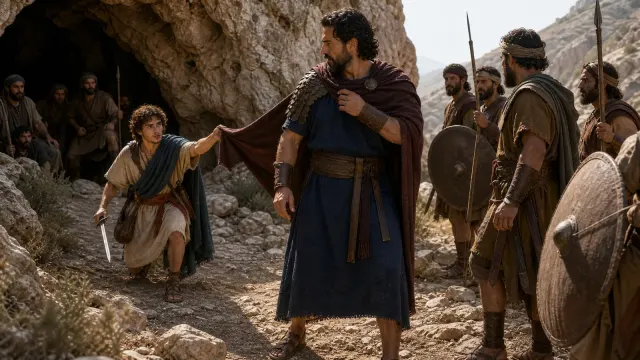
A Piece of Robe Becomes Evidence for Mercy
The cave at Engedi gives David what his men consider a perfect providential opportunity. Saul walks in alone, unaware that the people he has been hunting are hidden inside. David gets close enough to cut the edge of the king's robe and then is troubled even by that act. He refuses to kill "the LORD's anointed" and stops his men from doing it for him. Once Saul is safely outside, David follows and turns the cloth into evidence. He had access and did not use it to take the king's life. Saul cannot dismiss the proof. He weeps, admits that David has repaid his evil with good, and acknowledges that David will become king. Yet the Book of 1 Samuel does not confuse confession with restored trust. David swears to preserve Saul's descendants, Saul goes home, and David goes back to the stronghold. Mercy, admission, and distance all remain in the final scene. The chapter treats restraint as concrete action, not sentiment, and lets the separate destinations say what the conversation has not solved.
One complete chapter pageOpen chapter →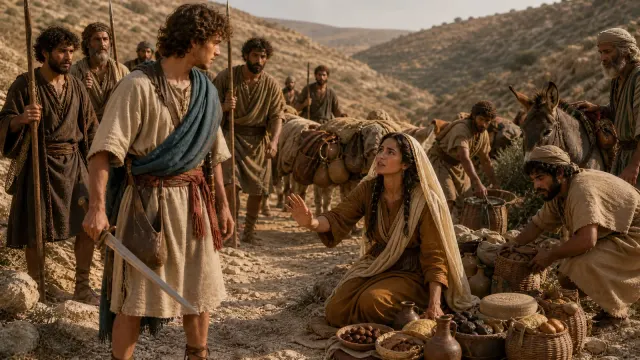
Abigail Keeps David from the Bloodshed He Has Sworn to Commit
Samuel's death removes a major figure of guidance, and the Book of 1 Samuel immediately turns to a crisis in which David himself must be stopped. Nabal has wealth, a prosperous shearing season, and a harsh answer for men who protected his shepherds. David answers insult with four hundred swords and an oath to destroy every male in the household. Abigail sees the disaster from both sides. She gathers provisions, rides out without waiting for Nabal's consent, and gives David an argument larger than wounded honour: the man expected to rule Israel should not reach that future carrying blood shed without cause or vengeance taken with his own hand. David listens. He blesses the LORD for sending her, blesses her judgment, and admits she has kept him from evil. Nabal later dies after the LORD strikes him, allowing David to see his grievance answered without committing the massacre he had planned. The chapter ends with Abigail becoming David's wife, while Ahinoam is also named and Michal has been given away, leaving the royal household already complicated by new bonds and broken ones.
One complete chapter pageOpen chapter →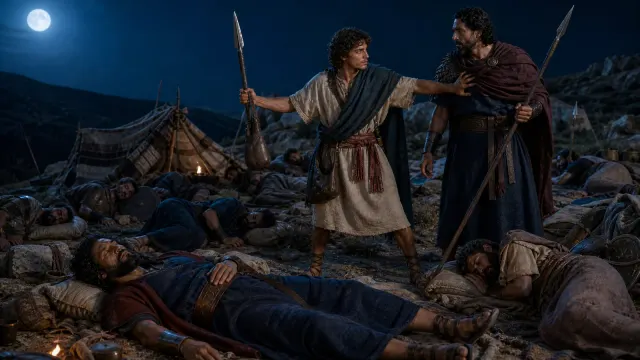
The Spear Beside Saul Becomes David's Second Witness
Saul's confession at the cave did not end the pursuit. The Ziphites locate David again, Saul arrives again with three thousand chosen men, and David now enters the sleeping camp rather than waiting for the king to enter his shelter. Abishai sees the sleeping Saul and interprets access as divine permission for one clean killing. David refuses that conclusion. The deep sleep is indeed from the LORD, but opportunity does not become authorization. He takes the spear and water vessel instead, then uses them from a safe distance to expose the failure of Saul's guard and the reality of his own restraint. Saul again confesses, this time saying, "I have sinned" and "I have played the fool." David still does not return to court. He lets a young man retrieve the spear and asks the LORD, not Saul, to value his life as he has valued the king's. Their final recorded conversation in 1 Samuel ends with blessing and separation. Recognition has become clear, but trust has not been rebuilt enough to erase the distance between them.
One complete chapter pageOpen chapter →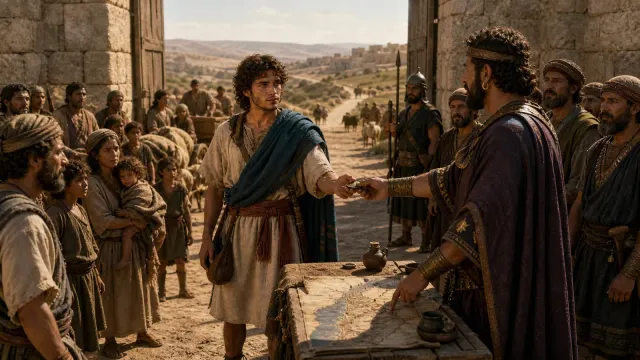
Safety in Philistia Rests on a Concealed Campaign
David finally says in his own heart what years of pursuit have taught him: one day Saul may succeed, and Philistine territory seems safer than Israel. The calculation works in the narrow sense. He moves to Achish with six hundred men and their households, Saul stops hunting him, and David receives Ziklag as a separate base. What follows, however, is survival built on managed information. David raids southern populations, kills the inhabitants who could report what happened, and tells Achish that his targets were communities associated with Judah. Achish believes the deception and concludes that David has made himself permanently hateful to Israel. The Book of 1 Samuel refuses to clean this arrangement up by inventing an unreported divine command for the killings or by turning Achish into a fool without evidence. His trust is reasonable from what he has been allowed to know. David has found freedom from Saul's reach, but the refuge now depends on keeping his Philistine patron convinced that Israel has become his enemy. That confidence will soon create an obligation David cannot easily fulfill.
One complete chapter pageOpen chapter →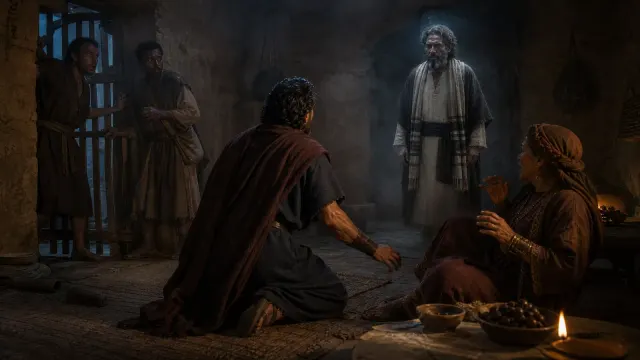
Saul Seeks a Different Route to the Word He Has Rejected
The Philistine campaign forces both David and Saul into the consequences of earlier choices. Achish expects the man he trusts to march against Israel, while Saul faces the same enemy army without Samuel and without an answer from dreams, Urim, or prophets. He then seeks guidance through a practice he himself outlawed, travelling in disguise to a woman at Endor and swearing in the LORD's name that she will not be punished for helping him violate his own prohibition. The appearance identified throughout the chapter as Samuel does not give Saul a new tactic. It gives him the old judgment again, now with a date close enough to terrify him: the kingdom is gone, the Amalekite disobedience still matters, Israel will fall, and Saul and his sons will die. The final scene is unexpectedly domestic. Saul collapses, exhausted and afraid, and the woman whose life was endangered by his law prepares a substantial meal. He leaves strengthened enough to walk, but with no restored oracle, no changed military outcome, and no escape from the word he had already resisted.
One complete chapter pageOpen chapter →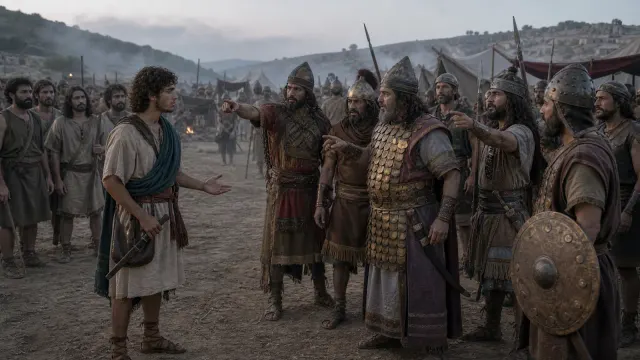
The Philistine Commanders Refuse the Ally Achish Trusts
The Book of 1 Samuel returns to the Philistine deployment and resolves David's immediate danger through people who do not trust him. Achish thinks he knows David well because the fugitive has served him for more than a year without visible disloyalty. The other Philistine commanders remember a different David, the man celebrated for killing their people, and they refuse to let him enter battle where he might change sides. Their suspicion blocks the obligation Achish created in chapter 28. David protests in language that preserves his role as loyal servant without revealing what he would actually have done on the field. The account never supplies the missing intention. Achish repeats his praise and sends David away at first light. The armies then move in opposite directions: the Philistines toward Jezreel, David back toward Philistine territory. His exclusion keeps him out of the battle that will kill Saul and Jonathan, but the chapter does not name the commanders as unwitting divine agents. It simply lets their distrust remove a choice the text never tells us David had settled.
One complete chapter pageOpen chapter →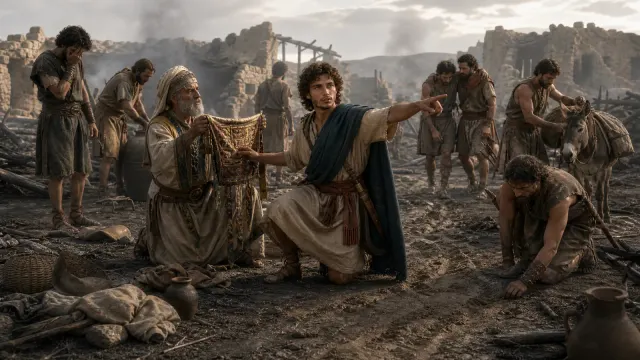
The Rescued Company Must Decide How to Share Its Rescue
David returns from dismissal to find Ziklag burned, every household taken, and the men who followed him talking about stoning him. The chapter answers that devastation with a sequence of recovery built from inquiry, limits, mercy, and distribution. David asks the LORD whether to pursue and receives assurance that all will be recovered, yet two hundred exhausted men still cannot cross the brook Besor. The remaining four hundred find an abandoned Egyptian servant, feed him before questioning him, and gain the guide who can lead them to the raiders. The promise is fulfilled with striking completeness: wives, children, and possessions are recovered, with additional spoil besides. Then the rescue creates a political and moral problem inside the victorious company. Some fighters want the exhausted men excluded from the gain. David refuses, saying the victory is what the LORD has given, and makes equal sharing between fighters and baggage guards a standing rule. Finally the recovered wealth travels outward to Judah, back toward the very places that had sustained David during his fugitive years.
One complete chapter pageOpen chapter →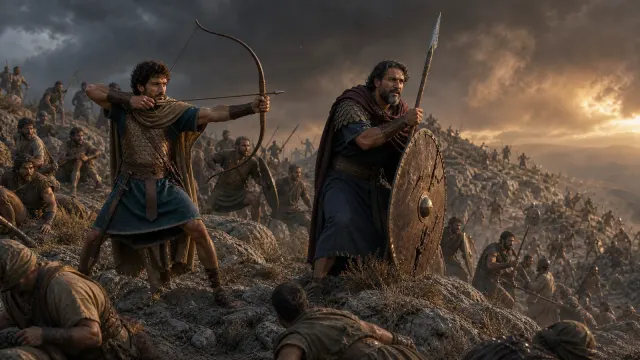
A Fallen King Is Remembered by the City He Rescued
The Book of 1 Samuel ends not with David crowned but with Saul defeated, Jonathan dead, Israeli towns abandoned, and a night rescue of bodies from a Philistine wall. The battle on Gilboa fulfills the judgment announced at Endor. Jonathan, Abinadab, and Malchishua fall before Saul, and the wounded king takes his own life after his armourbearer refuses to kill him. The defeat spreads beyond the army as civilians leave their cities and Philistines occupy them. Saul's head, armour, and body become instruments of enemy celebration, displayed in temples and at Beth-shan. Yet the final act belongs to Jabesh-gilead, a city whose own history with Saul is older than his collapse. Its valiant men travel through the night, recover the bodies, bury the bones, and fast seven days. That ending refuses two easy reductions at once. Saul's failures and rejection are not erased by honour at his death, but neither do those failures erase the memory that he once rescued Jabesh. The book closes with judgment, gratitude, grief, and unresolved succession all still present.
One complete chapter pageOpen chapter →Source: eBible.org · eng-kjv2006