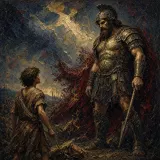
The big picture
David, the officer whom King Saul has tried to kill, leaves the refuge he found with Samuel, God's prophet. He turns to Jonathan, Saul's son and his close friend. Jonathan still struggles to believe that his father intends murder. A royal meal will test Saul's response to David's absence. The friends must arrange both a safe warning and a lasting promise, because loyalty to David now puts Jonathan at odds with his own father.
In this chapter
- David Proposes a Test of Saul 1 Samuel 20:1-11
David asks Jonathan what he has done to deserve death.
- Their Promise Reaches Beyond Their Lives 1 Samuel 20:12-17
Jonathan calls God as witness to his promise.
- Arrows Will Carry a Hidden Warning 1 Samuel 20:18-23
Jonathan explains how David's empty seat will draw notice at the royal meal.
- Saul's Anger Reveals His Intent 1 Samuel 20:24-34
David's seat stays empty.
- The Friends Part with Tears 1 Samuel 20:35-42
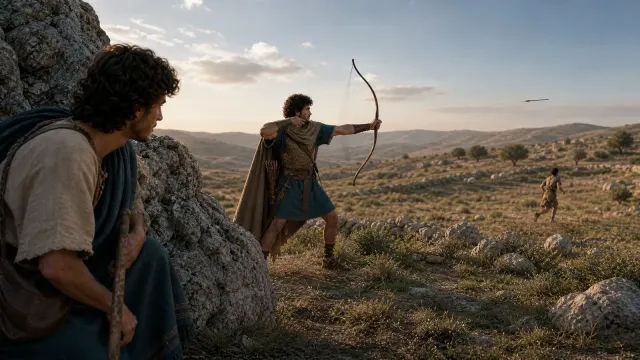
Next morning Jonathan takes a boy into the field and shoots an arrow beyond him.
Central truth
Jonathan confirms his father's intent to kill David and protects his friend, placing their sworn loyalty above his own royal advantage.
Scripture beside the summary
1 Samuel · King James Version · 421 Samuel 20:1-11
David Proposes a Test of Saul
David asks Jonathan what he has done to deserve death. Jonathan thinks his father would not hide such a plan from him. David answers that Saul knows their friendship and has reason to conceal it. They arrange for David to miss the new moon meal, a gathering marking the month's beginning. Jonathan will explain his absence with a claim about a family sacrifice. Saul's response will reveal whether David is safe. Jonathan promises help, and the two go into a field to speak privately.
In everyday life
A long-serving chauffeur tells the owner's daughter that her father plans to have him arrested on a false charge. She cannot believe it. They agree she will ask about his absence at tomorrow's breakfast and watch the response. A trusted family member seeks evidence instead of dismissing the warning. David faces a direct threat of murder.
Notice
1 Samuel 20:3 David explains why Jonathan has been kept uninformed: Saul knows their bond. Lack of warning to Jonathan therefore does not prove that David is safe.
1 Samuel 20:1-11
King James Version1And David fled from Naioth in Ramah, and came and said before Jonathan, What have I done? what is mine iniquity? and what is my sin before thy father, that he seeketh my life?
2And he said unto him, God forbid; thou shalt not die: behold, my father will do nothing either great or small, but that he will shew it me: and why should my father hide this thing from me? it is not so.
3And David sware moreover, and said, Thy father certainly knoweth that I have found grace in thine eyes; and he saith, Let not Jonathan know this, lest he be grieved: but truly as the LORD liveth, and as thy soul liveth, there is but a step between me and death.
4Then said Jonathan unto David, Whatsoever thy soul desireth, I will even do it for thee.
5And David said unto Jonathan, Behold, to morrow is the new moon, and I should not fail to sit with the king at meat: but let me go, that I may hide myself in the field unto the third day at even.
6If thy father at all miss me, then say, David earnestly asked leave of me that he might run to Beth-lehem his city: for there is a yearly sacrifice there for all the family.
7If he say thus, It is well; thy servant shall have peace: but if he be very wroth, then be sure that evil is determined by him.
8Therefore thou shalt deal kindly with thy servant; for thou hast brought thy servant into a covenant of the LORD with thee: notwithstanding, if there be in me iniquity, slay me thyself; for why shouldest thou bring me to thy father?
9And Jonathan said, Far be it from thee: for if I knew certainly that evil were determined by my father to come upon thee, then would not I tell it thee?
10Then said David to Jonathan, Who shall tell me? or what if thy father answer thee roughly?
11And Jonathan said unto David, Come, and let us go out into the field. And they went out both of them into the field.
1 Samuel 20:12-17
Their Promise Reaches Beyond Their Lives
Jonathan calls God as witness to his promise. He will find out his father's intentions and tell David whether the news is good or bad. If danger is certain, he will send David away safely. He also asks David to show God's kindness to him and to his household in the future. Their covenant extends beyond the present crisis and beyond one man's lifetime. Jonathan renews the promise because he loves David as himself. He seeks enduring care, not payment for a warning.
In everyday life
Two business partners sign a mutual care agreement beside a newborn's cot. One is leaving a troubled firm and needs help now; the other asks that his children remain protected if circumstances later reverse. Their friendship includes people who cannot yet understand the promise. Jonathan's covenant is sworn before God amid a struggle over kingship.
Notice
1 Samuel 20:15 Jonathan asks for kindness to his household even after David's enemies are removed. He imagines David's future strength and seeks protection that will outlast the crisis.
1 Samuel 20:12-17
King James Version12And Jonathan said unto David, O LORD God of Israel, when I have sounded my father about to morrow any time, or the third day, and, behold, if there be good toward David, and I then send not unto thee, and shew it thee;
13The LORD do so and much more to Jonathan: but if it please my father to do thee evil, then I will shew it thee, and send thee away, that thou mayest go in peace: and the LORD be with thee, as he hath been with my father.
14And thou shalt not only while yet I live shew me the kindness of the LORD, that I die not:
15But also thou shalt not cut off thy kindness from my house for ever: no, not when the LORD hath cut off the enemies of David every one from the face of the earth.
16So Jonathan made a covenant with the house of David, saying, Let the LORD even require it at the hand of David’s enemies.
17And Jonathan caused David to swear again, because he loved him: for he loved him as he loved his own soul.
1 Samuel 20:18-23
Arrows Will Carry a Hidden Warning
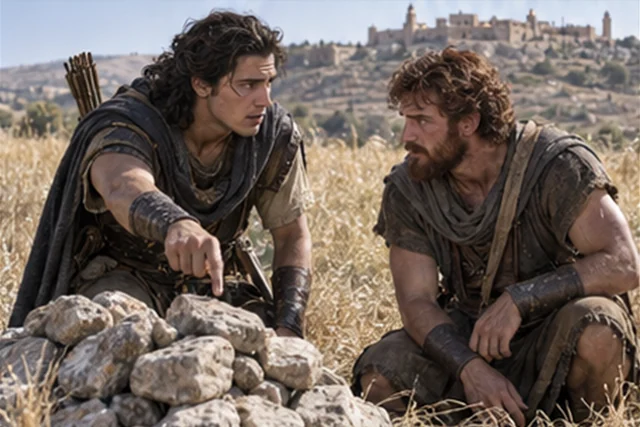
Jonathan explains how David's empty seat will draw notice at the royal meal. David is to hide near a known stone while Jonathan comes out to shoot three arrows. A boy will collect them. Words saying the arrows are nearby will mean safety; words sending the boy farther on will mean David must leave. The boy will hear instructions about arrows, while David hears the agreed message. Jonathan closes by placing their promise under God's lasting witness, beyond whatever the test reveals.
In everyday life
The railway signal trainee watches his colleague place a red folder in the ticket window. To passing passengers it is ordinary paperwork. To him it is their agreed warning that the supervisor has returned and the private meeting must wait. A shared plan gives routine actions another meaning. Jonathan's message determines whether David must flee for his life.
Notice
1 Samuel 20:22 The warning uses words addressed to the arrow collector. David can learn the result without coming out of hiding or being named aloud.
1 Samuel 20:18-23
King James Version18Then Jonathan said to David, To morrow is the new moon: and thou shalt be missed, because thy seat will be empty.
19And when thou hast stayed three days, then thou shalt go down quickly, and come to the place where thou didst hide thyself when the business was in hand, and shalt remain by the stone Ezel.
20And I will shoot three arrows on the side thereof, as though I shot at a mark.
21And, behold, I will send a lad, saying, Go, find out the arrows. If I expressly say unto the lad, Behold, the arrows are on this side of thee, take them; then come thou: for there is peace to thee, and no hurt; as the LORD liveth.
22But if I say thus unto the young man, Behold, the arrows are beyond thee; go thy way: for the LORD hath sent thee away.
23And as touching the matter which thou and I have spoken of, behold, the LORD be between thee and me for ever.
1 Samuel 20:24-34
Saul's Anger Reveals His Intent
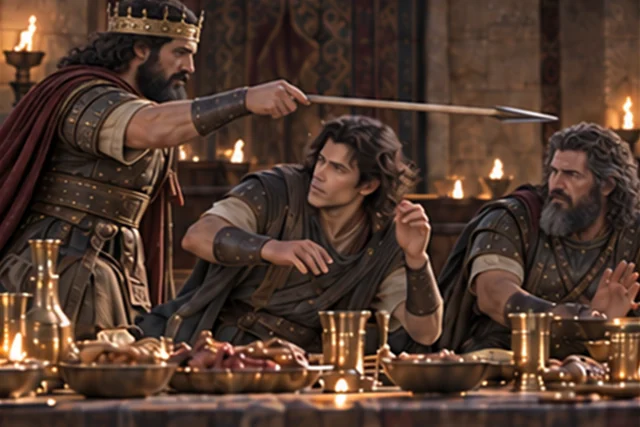
David's seat stays empty. Saul first assumes he is ritually unclean, temporarily unable to join a sacred meal under worship rules. On the second day he asks Jonathan, who gives the agreed explanation. Saul erupts in insults and says Jonathan's kingdom cannot last while David lives. He orders David brought for death. Jonathan asks what wrong David has done. Saul throws his spear at his own son. Jonathan leaves the table angry and grieving, now certain of his father's intent toward David.
In everyday life
A daughter asks at a family restaurant meeting why her father's trusted assistant has been barred from work. He answers that she will never inherit the business while the assistant stays. When she asks for evidence of wrongdoing, he turns his rage on her. David's danger and Saul's spear make this far more than a succession dispute.
Notice
1 Samuel 20:31 Saul argues that David threatens Jonathan's future kingdom. Jonathan's continued defence of David therefore runs against the personal advantage his father offers him.
1 Samuel 20:24-34
King James Version24So David hid himself in the field: and when the new moon was come, the king sat him down to eat meat.
25And the king sat upon his seat, as at other times, even upon a seat by the wall: and Jonathan arose, and Abner sat by Saul’s side, and David’s place was empty.
26Nevertheless Saul spake not any thing that day: for he thought, Something hath befallen him, he is not clean; surely he is not clean.
27And it came to pass on the morrow, which was the second day of the month, that David’s place was empty: and Saul said unto Jonathan his son, Wherefore cometh not the son of Jesse to meat, neither yesterday, nor to day?
28And Jonathan answered Saul, David earnestly asked leave of me to go to Beth-lehem:
29And he said, Let me go, I pray thee; for our family hath a sacrifice in the city; and my brother, he hath commanded me to be there: and now, if I have found favour in thine eyes, let me get away, I pray thee, and see my brethren. Therefore he cometh not unto the king’s table.
30Then Saul’s anger was kindled against Jonathan, and he said unto him, Thou son of the perverse rebellious woman, do not I know that thou hast chosen the son of Jesse to thine own confusion, and unto the confusion of thy mother’s nakedness?
31For as long as the son of Jesse liveth upon the ground, thou shalt not be established, nor thy kingdom. Wherefore now send and fetch him unto me, for he shall surely die.
32And Jonathan answered Saul his father, and said unto him, Wherefore shall he be slain? what hath he done?
33And Saul cast a javelin at him to smite him: whereby Jonathan knew that it was determined of his father to slay David.
34So Jonathan arose from the table in fierce anger, and did eat no meat the second day of the month: for he was grieved for David, because his father had done him shame.
1 Samuel 20:35-42
The Friends Part with Tears
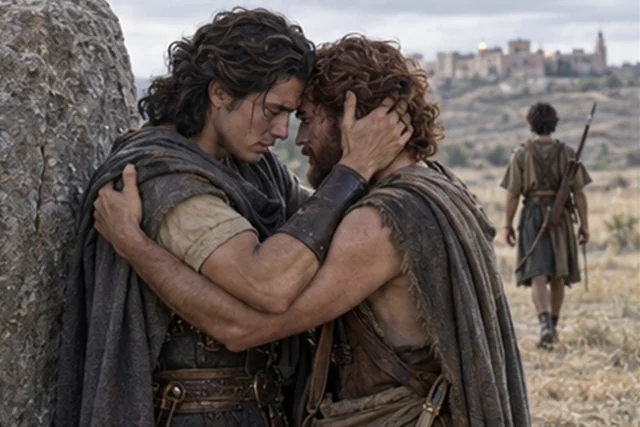
Next morning Jonathan takes a boy into the field and shoots an arrow beyond him. His shouted directions give David the warning to leave. The boy collects the arrows without knowing their hidden purpose and is sent back with the equipment. David emerges, bows three times, and embraces Jonathan with tears. David weeps especially hard. Jonathan sends him away in peace, recalling their promise before God for themselves and their descendants. David departs, while Jonathan returns to the city and his father's household.
In everyday life
One departing migrant clasps her closest friend's hands beside a quiet bus stop after the children have gone ahead. They have already arranged the practical details, but neither can speak steadily now. They repeat their promise to care for each other's families. David's departure is flight from a king intent on killing him.
Notice
1 Samuel 20:39 The boy does not know what the arrow exchange means. The warning remains private even though another person has taken part in carrying it.
1 Samuel 20:35-42
King James Version35And it came to pass in the morning, that Jonathan went out into the field at the time appointed with David, and a little lad with him.
36And he said unto his lad, Run, find out now the arrows which I shoot. And as the lad ran, he shot an arrow beyond him.
37And when the lad was come to the place of the arrow which Jonathan had shot, Jonathan cried after the lad, and said, Is not the arrow beyond thee?
38And Jonathan cried after the lad, Make speed, haste, stay not. And Jonathan’s lad gathered up the arrows, and came to his master.
39But the lad knew not any thing: only Jonathan and David knew the matter.
40And Jonathan gave his artillery unto his lad, and said unto him, Go, carry them to the city.
41And as soon as the lad was gone, David arose out of a place toward the south, and fell on his face to the ground, and bowed himself three times: and they kissed one another, and wept one with another, until David exceeded.
42And Jonathan said to David, Go in peace, forasmuch as we have sworn both of us in the name of the LORD, saying, The LORD be between me and thee, and between my seed and thy seed for ever. And he arose and departed: and Jonathan went into the city.
Details worth noticing
The opening image
1 Samuel 20:1 begins with “And David fled from Naioth in Ramah, and came and said before Jonathan, What have I done? what is mine iniquity? and what is my sin before thy father, that…”
Where the chapter turns
1 Samuel 20:22 forms a natural hinge: “But if I say thus unto the young man, Behold, the arrows are beyond thee; go thy way: for the LORD hath sent thee away.”
The final note
1 Samuel 20:42 leaves the reader with “And Jonathan said to David, Go in peace, forasmuch as we have sworn both of us in the name of the LORD, saying, The LORD be between me and thee, and…”
A word trail through the chapter
The words Jonathan, David, father, LORD, arrows, field help reveal the chapter’s repeated concerns.
KJV words made clear
- artillery
- Weapons or equipment, here Jonathan's bow and arrows rather than modern large guns.
Music and video connected to the passage
Related media appears when its Scripture reference overlaps this study. Music and video can illuminate a theme while the biblical text remains the foundation.