
1 Kings 18:16–39
Elijah and the fire from heaven

Ages 8 to 11
The account
King Ahab went to meet Elijah. Ahab blamed Elijah for troubling Israel, but Elijah said the trouble came because Ahab and his father's house had left the Lord's commandments and followed Baal.
Elijah told Ahab to gather the people of Israel and the prophets of Baal at Mount Carmel. Elijah asked the people how long they would keep going between two choices. Then he proposed a test. The prophets of Baal would prepare a bull on wood without lighting a fire. Elijah would do the same. The God who answered with fire would be shown to be God.
The prophets of Baal called from morning until evening, but no answer came. Some even cut themselves, as their custom was, but still there was no answer.
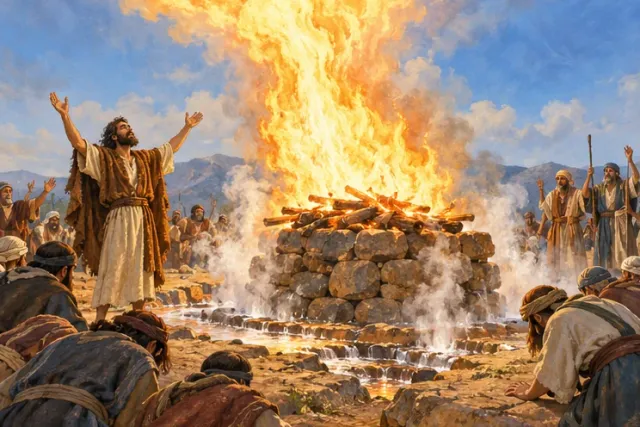
Then Elijah repaired the Lord's altar with twelve stones. He placed the sacrifice and wood on it. Water was poured over everything three times, until the trench around the altar was full. Elijah prayed that the people would know that the Lord was God.
Fire from the Lord fell. It consumed the sacrifice, wood, stones, dust and the water in the trench. When the people saw it, they fell on their faces and said that the Lord is God.
Memory verse
And when all the people saw it, they fell on their faces: and they said, The LORD, he is the God; the LORD, he is the God.
1 Kings 18:39
Talk about it
- What test did Elijah set up on Mount Carmel?
- What happened when the prophets of Baal called out?
- What happened after Elijah prayed?
Try this
Draw two simple altars on a sheet of paper. Beside Elijah's altar, draw twelve stones, water around the altar and the fire that came from the Lord, then label the parts from the account.
What can we learn?
A lesson we can draw from this account is that truth does not depend on how many people support an idea. The account points to the Lord as the one who answered Elijah and turned the people's attention back to him.
Ages 12 to 15
The account
Ahab met Elijah after Obadiah reported where Elijah was. Ahab accused Elijah of troubling Israel. Elijah answered that Ahab and his father's house had forsaken the commandments of the Lord and followed Baalim. This was a public question of loyalty. He told Ahab to gather Israel at Mount Carmel, along with the prophets of Baal and the prophets of the groves connected with Jezebel's table.
When the people gathered, Elijah asked how long they would halt between two opinions. If the Lord was God, they should follow him. If Baal was, they should follow Baal. The people gave no answer.
Elijah proposed a public test. Two bullocks would be prepared on wood, but no fire would be placed under either sacrifice. The prophets of Baal would call on their god, and Elijah would call on the Lord. The God who answered by fire would be God.
The prophets of Baal prepared their sacrifice and called from morning until noon. No voice answered. Elijah mocked them, and they cried louder. They cut themselves with knives and lancets, according to their custom. They continued until the time of the evening sacrifice, but there was still no voice or answer.
Elijah then called the people near. He repaired the broken altar of the Lord and used twelve stones, matching the number of the tribes descended from Jacob, whose name had been changed to Israel. He dug a trench, arranged the wood and sacrifice, then had four barrels of water poured over it three times. Water filled the trench.
At the time of the evening sacrifice, Elijah prayed to the Lord God of Abraham, Isaac and Israel. He asked that the people know that the Lord was God in Israel, that Elijah was his servant, and that he had acted at the Lord's word. He also asked that the people know the Lord had turned their heart back again.
Then the fire of the Lord fell. It consumed the sacrifice, wood, stones and dust, and licked up the water in the trench. The people fell on their faces and declared that the Lord is God.
Memory verse
And when all the people saw it, they fell on their faces: and they said, The LORD, he is the God; the LORD, he is the God.
1 Kings 18:39
Think about it
- Why did Elijah make sure no fire was placed under either sacrifice?
- What does the long silence after the prophets of Baal called out show about their god?
- Why do you think Elijah used twelve stones when he repaired the altar?
- What does Elijah's prayer show about what he wanted the people to understand?
Going deeper
The twelve stones connect the moment on Mount Carmel with the twelve tribes of Israel. Elsewhere in the Bible, fire from the Lord also marks God's acceptance of an offering, including Leviticus 9:24 and 2 Chronicles 7:1. Mount Carmel fits that wider pattern of God making his presence and authority known to his people.
What can we learn?
One lesson drawn from the account is that loyalty to God cannot be treated as a half-choice between competing masters. It also shows that Elijah's goal was not simply to win a contest, but to make clear who God is and to turn Israel's attention back to him.