
Esther 2–9
Esther saves her people
Ages 8 to 11
The account
Esther was a Jewish woman raised by Mordecai after her parents died. She was brought into the king's house and later became queen. Mordecai had told her not to reveal that she was Jewish.
Later Haman became powerful in the kingdom. Mordecai would not bow to him, and Haman became angry. Instead of attacking Mordecai alone, Haman planned to destroy all the Jews in the king's provinces. A royal order was sent out setting a day for this to happen.
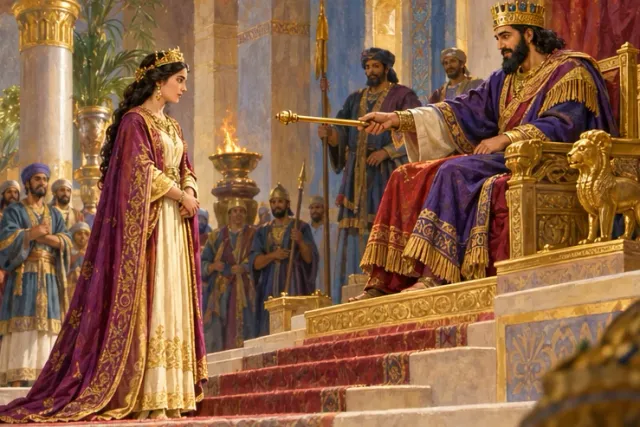
Mordecai asked Esther to speak to the king. Esther explained that going to the king without being called could lead to death unless the king held out his golden sceptre. She asked the Jews in Shushan to fast for her for three days. Then she went.
The king held out the sceptre. Esther invited the king and Haman to banquets. At the second banquet she told the king that she and her people were marked for destruction and named Haman as the enemy. Haman was later put to death.
Because the first royal order could not simply be reversed, a new order allowed the Jews to gather and defend themselves. There was fighting, and many enemies of the Jews were killed. Then the Jews had rest. Mordecai and Esther helped establish the days of Purim as days of feasting, joy, sharing portions and giving gifts to the poor.
Memory verse
The Jews had light, and gladness, and joy, and honour.
Esther 8:16
Talk about it
- What danger did Haman plan for the Jews?
- Why was it risky for Esther to go to the king?
- What happened after Esther told the king about Haman's plan?
Try this
Make a four-box timeline labeled Esther becomes queen, Haman's plan, Esther speaks and The Jews have rest. Draw one simple picture or write one sentence in each box.
What can we learn?
A lesson we can draw from this account is that courage can mean speaking at the right time even when the outcome is uncertain. Esther also shows careful action: she fasted, approached the king and made her request step by step.
Ages 12 to 15
The account
Esther, also called Hadassah, had lost both parents, and Mordecai raised her as his own daughter. She was brought into the royal household at Shushan and eventually became queen to Ahasuerus. At Mordecai's instruction, she had not revealed her Jewish people or family. Around the same time, Mordecai uncovered a plot against the king, and his service was written in the royal records.
Later Haman was promoted above the other princes. Mordecai would not bow or give him reverence. When Haman learned that Mordecai was a Jew, he did not seek only Mordecai's death. He planned to destroy the Jews throughout the kingdom. A date was chosen by casting Pur, or the lot, and the king's sealed decree was sent through the provinces.
Mordecai mourned and sent word to Esther. She explained that approaching the king without being called could mean death unless he extended the golden sceptre. Mordecai answered that she should not think the palace made her safe, and asked who knew whether she had come to the kingdom for such a time as this. Esther told the Jews in Shushan to fast for her for three days, and she and her maidens would fast too.
On the third day Esther entered the inner court. The king held out the sceptre. Esther invited the king and Haman to a banquet, then to a second banquet. Meanwhile the king could not sleep and had the royal records read. He discovered that Mordecai had never been honored for exposing the earlier plot. Haman was required to lead a public honor for Mordecai.
At Esther's second banquet, she asked for her life and the life of her people. She identified Haman as the enemy. Haman was put to death on the gallows he had prepared for Mordecai.
The first decree could not be reversed, so a new decree, sealed in the king's name, allowed the Jews across the kingdom to gather and defend their lives. When the appointed day came, they stood against those seeking to harm them. Many enemies were killed, and afterward the Jews rested and celebrated. Mordecai and Esther established Purim to remember the change from sorrow to joy, with feasting, gifts to one another and gifts to the poor.
Memory verse
The Jews had light, and gladness, and joy, and honour.
Esther 8:16
Think about it
- Why did Haman's anger at one man become a threat against an entire people?
- What does Esther's decision to fast and then approach the king show about how she handled danger?
- Why does the account include the king's sleepless night and the forgotten record about Mordecai?
- What does the final change from mourning to feasting show about how completely the situation was reversed?
Going deeper
Esther fits a repeated biblical pattern in which the people of Israel face a threat of destruction but are preserved. The Book of Exodus gives an earlier large-scale example of threatened destruction followed by deliverance. In Esther, the preservation of the Jewish people continues the long biblical history through which God's covenant people remain in place for what comes later.
What can we learn?
One lesson drawn from the account is that courage can include patience, timing and careful speech, not only bold action. The account also shows how decisions made by powerful people can threaten many lives, and how one person's position can become an opportunity to act for others.