
John 6:1–14
Feeding the five thousand
Ages 8 to 11
The account
Jesus crossed the sea of Galilee, also called the sea of Tiberias. A great crowd followed him because they had seen the miracles he did for people who were sick. Jesus went up a mountain and sat there with his disciples. The Passover was near.
When Jesus saw the large crowd coming, he asked Philip where they could buy bread for everyone to eat. John explains that Jesus asked this to test Philip, because Jesus already knew what he would do.
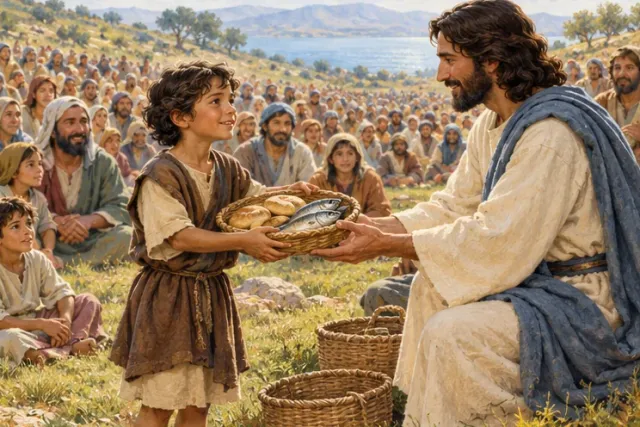
Philip answered that a very large amount of money would not buy enough bread for everyone to have even a little. Andrew, Simon Peter's brother, pointed out a lad who had five barley loaves and two small fishes. Andrew also asked what so little food could do among so many people.
Jesus told the disciples to have the men sit down. There was plenty of grass there, and about five thousand men sat down.
Jesus took the loaves and gave thanks. He distributed food to those who were seated, and did the same with the fishes. Everyone had as much as they wanted.
When they were full, Jesus told the disciples to gather the leftover pieces so nothing would be lost. They filled twelve baskets with pieces from the five barley loaves.
After seeing the miracle, the men said Jesus was truly that prophet who should come into the world.
Memory verse
When they were filled, he said unto his disciples, Gather up the fragments that remain, that nothing be lost.
John 6:12
Talk about it
- What food did the lad have?
- About how many men sat down to eat?
- What did the disciples collect after everyone had eaten?
Try this
Draw five loaves and two fish, then draw twelve baskets underneath them. Use the picture to retell the account in order without adding any details that John does not give.
What can we learn?
This account can teach us that what looks far too small to meet a need is not beyond Jesus' power. It also shows care for what remained, since Jesus told the disciples to gather the fragments so nothing would be lost.
Ages 12 to 15
The account
Jesus crossed the sea of Galilee, which John also calls the sea of Tiberias. A great multitude followed him because they had seen the miracles he performed on people who were diseased. Jesus went up a mountain and sat there with his disciples. John adds that the Passover, a Jewish feast, was near.
Jesus looked up and saw a great company coming toward him. He asked Philip where they could buy bread so the people could eat. John immediately explains that Jesus asked this to prove Philip, because Jesus already knew what he would do.
Philip answered by pointing to the size of the problem. Even two hundred pennyworth of bread would not be enough for everyone to take a little. Then Andrew, Simon Peter's brother, mentioned a lad who had five barley loaves and two small fishes. Andrew's question made the same point from another direction: what was that amount of food among so many?
Jesus told the disciples to make the men sit down. John notes that there was much grass in the place. About five thousand men sat down.
Jesus took the loaves, gave thanks, and distributed them to the disciples, who distributed them to those who were seated. He did the same with the fishes. The people received as much as they wanted. The problem was not solved by giving everyone a tiny sample. John says they were filled.
Afterward, Jesus told the disciples to gather the remaining fragments so that nothing would be lost. They collected the pieces and filled twelve baskets with fragments from the five barley loaves that remained after the people had eaten.
The crowd's response closes the account. After seeing the miracle, the men said that Jesus truly was that prophet who should come into the world. John presents the event as more than a meal for a large crowd. It is another sign that causes people to make a claim about Jesus' identity.
The passage also keeps the scale in view: five barley loaves, two small fishes, about five thousand men, everyone filled, and twelve baskets left over. John uses those concrete details to show the size of what happened.
Memory verse
When they were filled, he said unto his disciples, Gather up the fragments that remain, that nothing be lost.
John 6:12
Think about it
- Why does John tell us that Jesus already knew what he would do when he questioned Philip?
- What do Philip's and Andrew's answers show about how they saw the problem?
- Why is it important that John says the people were filled rather than merely receiving a small portion?
- What does the crowd's response show about what they thought the miracle meant?
Going deeper
This account echoes earlier passages where God provides food in ways people cannot supply for themselves. In Exodus 16, Israel receives manna in the wilderness. In 2 Kings 4:42–44, a small amount of barley bread feeds a larger group and food remains. Later in John 6, Jesus uses the feeding as the setting for further teaching about bread and who he is.
What can we learn?
A lesson drawn from this account is that large needs should not be measured only by the resources people can see. The command to gather the leftovers also gives a simple picture of treating provision carefully rather than wasting what remains.