
Genesis 37
Joseph's dreams and his coat of many colors

Ages 8 to 11
The account
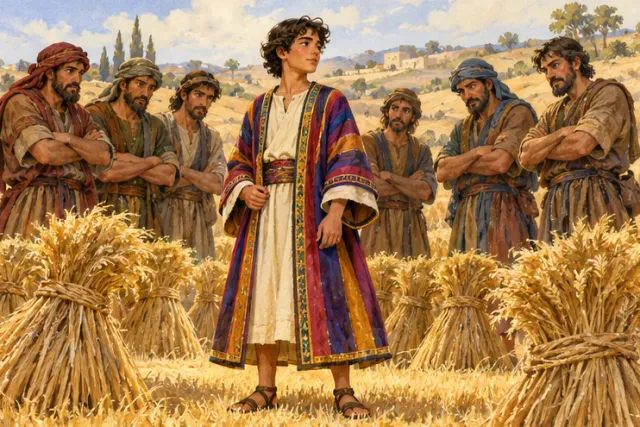
Joseph was seventeen and helped care for his father’s flock with his brothers. He brought his father an evil report about some of them. Israel loved Joseph more than all his children and made him a coat of many colours. His brothers saw this, hated Joseph, and could not speak peaceably to him.
Joseph dreamed that he and his brothers were tying bundles of grain in a field. His bundle stood upright, while theirs gathered around and bowed to it. His brothers hated him even more. Then Joseph dreamed that the sun, moon, and eleven stars bowed to him. His father rebuked him, his brothers envied him, and his father remembered what Joseph had said.
Later, his brothers took their father’s flock to Shechem. Israel sent Joseph from Hebron to check on them. Joseph learned that they had gone to Dothan and followed them.
When the brothers saw Joseph coming, they planned to kill him. Reuben told them not to shed his blood and said to put him into an empty pit, planning to rescue him later. They took Joseph’s coat and put him in the pit.
A company of Ishmaelites was traveling toward Egypt. Judah suggested selling Joseph instead of killing him. Midianite merchants passed by, Joseph was lifted from the pit, and he was sold for twenty pieces of silver and taken to Egypt. His brothers dipped his coat in goat’s blood. Jacob believed an evil beast had killed Joseph and mourned. In Egypt, Joseph was sold to Potiphar, an officer of Pharaoh.
Memory verse
And his brethren envied him; but his father observed the saying.
Genesis 37:11
Talk about it
- Why did Joseph’s brothers hate him?
- What happened in Joseph’s two dreams?
- What happened after Joseph was put into the empty pit?
Try this
Fold a sheet of paper into four boxes. Draw four moments in order: the coat, the dreams, the empty pit, and the caravan going to Egypt, then write one sentence under each picture in your own words.
What can we learn?
A lesson we can draw is that favoritism, envy, and hatred can badly damage a family. When those attitudes are allowed to grow, harmful choices can follow.
Ages 12 to 15
The account
Genesis 37 begins in Canaan with Jacob’s family. Joseph was seventeen years old and was feeding the flock with his brothers, including the sons of Bilhah and Zilpah. Joseph brought their father an evil report about them. Joseph’s father is called both Jacob and Israel in the chapter. Israel loved Joseph more than all his children because Joseph was the son of his old age. He made Joseph a coat of many colours. When Joseph’s brothers saw that their father loved him more, they hated Joseph and could not speak peaceably to him.
Joseph then had two dreams. In the first, he and his brothers were binding sheaves in a field. Joseph’s sheaf stood upright, and his brothers’ sheaves gathered around and bowed to it. His brothers understood the dream as suggesting that Joseph might rule over them, and they hated him even more. In the second dream, the sun, moon, and eleven stars bowed to Joseph. He told his father and brothers. His father rebuked him and asked whether the family would really bow to him. The brothers envied Joseph, while his father kept the matter in mind.
The account then follows the family’s flocks and travel. Joseph’s brothers went to feed their father’s flock in Shechem. Israel sent Joseph from the vale of Hebron to see whether his brothers and the flocks were well and to bring word back. At Shechem, a man found Joseph wandering in a field and told him that his brothers had gone to Dothan. Joseph followed and found them there.
The brothers saw Joseph from far away and conspired to kill him. Reuben told them not to shed blood but to put Joseph into a pit in the wilderness. Genesis explains that Reuben intended to rescue Joseph and return him to his father. When Joseph arrived, they stripped off his coat and put him into the empty pit, which had no water.
While they ate, they saw a company of Ishmaelites coming from Gilead with camels carrying spicery, balm, and myrrh toward Egypt. Judah proposed selling Joseph rather than killing him. Midianite merchants passed by, Joseph was lifted out of the pit, and he was sold to the Ishmaelites for twenty pieces of silver. Joseph was taken to Egypt.
Reuben later returned to the pit and found Joseph gone. The brothers killed a young goat, dipped Joseph’s coat in its blood, and sent the coat to their father. Jacob recognized it and concluded that an evil beast had devoured Joseph. He mourned for many days. The chapter closes by saying that the Midianites sold Joseph in Egypt to Potiphar, an officer of Pharaoh and captain of the guard.
Memory verse
And his brethren envied him; but his father observed the saying.
Genesis 37:11
Think about it
- Why did the brothers’ hatred of Joseph grow before they reached the point of trying to kill him?
- Why might Joseph’s dreams have been especially difficult for his brothers to hear after they saw their father’s greater love for him?
- What do Reuben’s and Judah’s choices show about how people can reject one wrong action while still allowing another wrong?
- What does this account show about the effects of envy, favoritism, and deception within a family?
Going deeper
Later in Genesis, Joseph’s brothers bow before him in Egypt, echoing the first dream (Genesis 42:6; 43:26). Joseph’s being taken to Egypt also becomes part of how Jacob’s household later comes there during the famine (Genesis 45–46). Near the end of Genesis, Joseph tells his brothers that although they meant evil against him, God meant it for good so that many people would be kept alive (Genesis 50:20). The wider account shows that the painful events of Genesis 37 became part of the preservation of Jacob’s family and the continuation of the family line through which God’s promises to Abraham were being carried forward.
What can we learn?
A lesson we can draw is that envy and favoritism can feed choices that lead to cruelty and deception. Reuben’s attempt to prevent murder also reminds us that stopping one terrible action does not make a lesser wrong acceptable. Choices made in anger or jealousy can affect many people, not only the person first targeted.