
Exodus 16; 17:1–7
Manna from heaven and water from the rock
Ages 8 to 11
The account
In the second month after leaving Egypt, the children of Israel came into the wilderness of Sin. The people complained to Moses and Aaron about hunger. The Lord told Moses that he would rain bread from heaven. Each day the people were to gather what they needed. On the sixth day they were to gather twice as much.
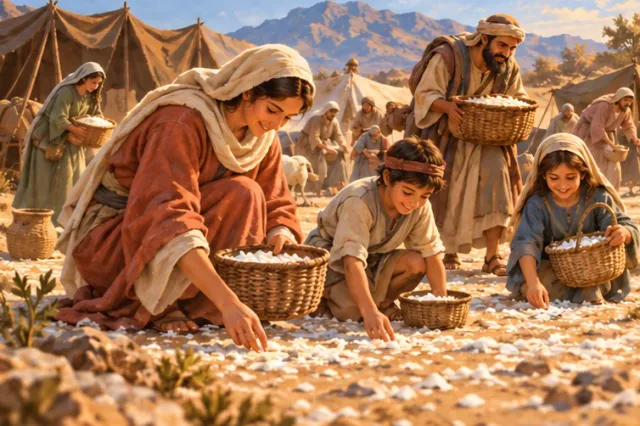
That evening quails covered the camp. In the morning, after the dew was gone, a small round thing lay on the ground. The people did not know what it was. Moses told them it was the bread the Lord had given them to eat. They called it manna. It was white like coriander seed, and its taste was like wafers made with honey.
The people gathered manna each morning. If they tried to keep ordinary daily manna until morning, it spoiled. But the extra gathered on the sixth day kept for the sabbath. On the seventh day there was none to gather. Israel ate manna for forty years.
Later the people camped at Rephidim, where there was no water to drink. They complained again. Moses cried to the Lord. The Lord told him to take his rod and some elders to a rock in Horeb. Moses struck the rock as commanded, and water came out for the people to drink.
Memory verse
And when the children of Israel saw it, they said one to another, It is manna: for they wist not what it was. And Moses said unto them, This is the bread which the LORD hath given you to eat.
Exodus 16:15
Talk about it
- What did the people find on the ground in the morning?
- What was different about gathering manna on the sixth and seventh days?
- How did the Lord provide water at Rephidim?
Try this
Fold a sheet of paper into seven boxes, one for each day of a week. Draw manna in the first six boxes, twice as much in the sixth, and leave the seventh box without manna to help remember the pattern in the account.
What can we learn?
A lesson we can draw is that real needs do not have to be ignored, but fear and complaint can make it harder to notice provision. The account also shows the importance of following instructions one day at a time.
Ages 12 to 15
The account
In the second month after leaving Egypt, the children of Israel traveled from Elim into the wilderness of Sin. The whole congregation complained against Moses and Aaron because they were hungry. They remembered the food of Egypt and accused their leaders of bringing them into the wilderness to die of hunger.
The Lord told Moses that he would rain bread from heaven. The people were to gather a daily portion, with twice as much on the sixth day. Moses and Aaron told Israel that the Lord had heard their complaints. The glory of the Lord appeared in the cloud, and the Lord promised flesh in the evening and bread in the morning.
Quails came over the camp that evening. In the morning, when the dew had lifted, a small round thing lay on the ground. The people asked what it was, and Moses told them it was the bread the Lord had given them. They called it manna. It was white like coriander seed and tasted like wafers made with honey.
Each person gathered according to need. Those who gathered much had nothing left over, and those who gathered little had no lack. Moses told them not to keep it until morning, but some did. That manna bred worms and stank. On the sixth day they gathered twice as much. This time the extra remained good for the sabbath, when no manna would be found. Some still went out to look on the seventh day, but they found none. A portion of manna was kept for future generations, and Israel ate manna for forty years.
The next account takes place at Rephidim. There was no water for the people to drink. They argued with Moses and asked whether the Lord was among them. Moses cried to the Lord. The Lord told him to take his rod and some of Israel's elders to the rock at Horeb. Moses struck the rock in their sight, and water came out for the people.
Moses named the place Massah and Meribah because Israel had argued and tested the Lord there. Together, the two chapters show repeated needs for food and water, repeated complaints from the people, and repeated provision from the Lord.
Memory verse
And when the children of Israel saw it, they said one to another, It is manna: for they wist not what it was. And Moses said unto them, This is the bread which the LORD hath given you to eat.
Exodus 16:15
Think about it
- Why did the people complain to Moses and Aaron in the wilderness?
- Why do you think the daily gathering rules required the people to pay attention each morning?
- What does the repeated provision of food and water show about the Lord in these chapters?
- What does the question "Is the Lord among us, or not?" reveal about the people's response to hardship?
Going deeper
Deuteronomy 8 later reminds Israel of the manna when looking back on the wilderness years. Psalm 78 also remembers the food God provided from heaven. In 1 Corinthians 10:4, Paul refers to the wilderness rock while reflecting on Israel's experience.
What can we learn?
A lesson we can draw is that dependence can be difficult when people want certainty far into the future. The manna account shows a daily pattern of provision and instruction, while the water account shows how quickly fear can return when a new need appears. Both encourage careful memory of what has already happened.