
Exodus 19–20
The Ten Commandments
Ages 8 to 11
The account
In the third month after leaving Egypt, the children of Israel came to the wilderness of Sinai and camped before the mountain. Moses went up to God. The Lord reminded Israel that he had brought them out of Egypt. He said that if they obeyed his voice and kept his covenant, they would be a special treasure to him, a kingdom of priests and a holy nation. The people answered that they would do what the Lord had spoken.
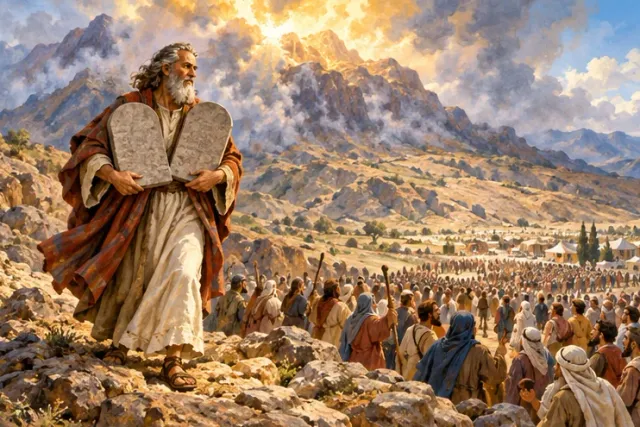
The Lord told Moses to prepare the people. They washed their clothes, and a boundary was set around the mountain. On the third day there was thunder, lightning, a thick cloud and a very loud trumpet sound. Mount Sinai smoked and shook. The people trembled.
God then spoke his commands. Israel was to have no other gods, make no idols to worship, and not take the Lord's name in vain. They were to remember the sabbath day and keep it holy. They were to honor father and mother. They were not to kill, commit adultery, steal, bear false witness against a neighbor, or covet what belonged to a neighbor.
The people saw the thunder and lightning, heard the trumpet, and stood far away. Moses told them not to fear, and he went nearer to the thick darkness where God was.
Memory verse
Remember the sabbath day, to keep it holy.
Exodus 20:8
Talk about it
- Where did the children of Israel camp before God gave the commandments?
- What sights and sounds happened at Mount Sinai?
- What are some of the commands God gave the people?
Try this
Write the ten commands in your own simple words on a sheet of paper, using Exodus 20 as your guide. Draw a small symbol beside each one that helps you remember what it says.
What can we learn?
A lesson we can draw is that freedom is not the same as having no boundaries. These commands show a pattern of honoring God and treating other people with care and truth.
Ages 12 to 15
The account
Three months after the children of Israel came out of Egypt, they reached the wilderness of Sinai and camped before the mountain. Moses went up to God, and the Lord reminded Israel of what they had already seen: he had acted against Egypt and had brought them to himself. He then set covenant words before them. If they obeyed his voice and kept his covenant, they would be his special treasure among all peoples, a kingdom of priests and a holy nation. The people answered together that they would do what the Lord had spoken.
The Lord told Moses to prepare the people for the third day. They were to be sanctified, wash their clothes, and respect a boundary around the mountain. When the third morning came, there were thunders, lightnings, a thick cloud and an extremely loud trumpet. Mount Sinai smoked because the Lord descended upon it in fire, and the mountain shook greatly. The people in the camp trembled. Moses brought them to the foot of the mountain, while the Lord again warned that they were not to break through the boundary.
Then God spoke the words recorded in Exodus 20. He began by identifying himself as the Lord who had brought Israel out of Egypt and bondage. The commands required Israel to have no other gods, make no images for worship, and not take the Lord's name in vain. They were to remember the sabbath day and keep it holy, and to honor father and mother. They were commanded not to kill, commit adultery, steal, bear false witness against a neighbor, or covet a neighbor's house, wife, servants, animals, or anything belonging to that neighbor.
The order of the account is important: the Lord first reminded Israel of his rescue from Egypt, then gave them these covenant commands for life with him and with one another.
After hearing and seeing the thunder, lightning, trumpet and smoking mountain, the people moved back and stood far away. They asked Moses to speak with them instead of hearing God directly. Moses told them not to fear, explaining that God had come to prove them and that his fear should be before them so that they would not sin. The people remained at a distance while Moses drew near to the thick darkness where God was.
Memory verse
Remember the sabbath day, to keep it holy.
Exodus 20:8
Think about it
- Why did the Lord remind Israel of the rescue from Egypt before giving the commandments?
- Why were boundaries placed around Mount Sinai?
- What do the commandments show about worship, family life and treatment of other people?
- Why did the people ask Moses to speak with them after hearing and seeing what happened at the mountain?
Going deeper
Deuteronomy 5 repeats these commandments to Israel before the people enter the land. Jesus later cites several of them in Matthew 19, and Paul refers to several in Romans 13:9 while discussing how people should treat their neighbors. The commands continue to appear throughout the Bible's teaching about worship and human relationships.
What can we learn?
A lesson we can draw is that boundaries can give shape to freedom rather than simply take freedom away. The commands connect worship of God with concrete treatment of parents, spouses, neighbors and possessions. They also show that outward actions and inward desires both matter.