
Luke 17:11–19
Ten lepers, and the one who said thank you

Ages 8 to 11
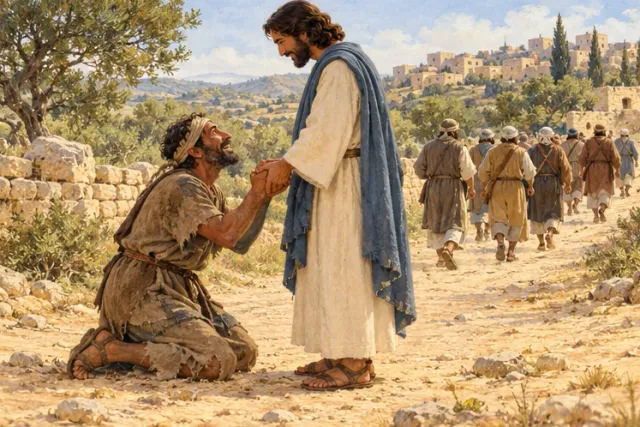
The account
As Jesus traveled toward Jerusalem, he passed through the area between Samaria and Galilee. When he entered a village, ten men who were lepers met him. They stood at a distance and called out to Jesus, asking him to have mercy on them.
Jesus saw them and told them to go show themselves to the priests. The men went. While they were on their way, they were cleansed.
One of the ten noticed that he had been healed. He turned back. He praised God with a loud voice, fell down at Jesus' feet, and thanked him. Luke tells us that this man was a Samaritan.
Jesus asked about the other nine. All ten had been cleansed, but only this man had returned to give glory to God. Jesus pointed out that the one who came back was a stranger.
Then Jesus told the man to arise and go on his way. He said that the man's faith had made him whole.
The account is very simple, but one detail stands out. Ten men received cleansing, and one turned around to give thanks. Luke does not tell us what the other nine thought or why they did not return. He keeps our attention on the man who came back, glorified God, and thanked Jesus.
Memory verse
And fell down on his face at his feet, giving him thanks: and he was a Samaritan.
Luke 17:16
Talk about it
- What did the ten men ask Jesus to do?
- When were the ten men cleansed?
- What did the Samaritan do when he saw that he had been healed?
Try this
Write the numbers one through ten on a sheet of paper. Circle one number to represent the man who returned, then beside it list three things Luke says he did when he came back.
What can we learn?
A lesson we can draw is that receiving help and remembering to give thanks are not the same thing. The man who returned noticed what had happened and took time to express his thanks.
Ages 12 to 15
The account
As Jesus traveled toward Jerusalem, he passed through the area of Samaria and Galilee. Near a village, ten men described as lepers met him. They stood at a distance and raised their voices together, asking Jesus, their Master, to have mercy on them.
Jesus did not move toward them or perform a visible action at that moment. He saw them and told them to go show themselves to the priests. That instruction mattered because the law of Moses gave priests a role in examining people after a skin disease or condition had cleared and in declaring them clean. The ten men obeyed the direction and started on their way.
As they went, they were cleansed.
One of the ten saw that he had been healed and turned back. He glorified God with a loud voice, fell down on his face at Jesus' feet, and thanked him. Luke then adds a detail that makes the man's return stand out even more: he was a Samaritan.
Jesus responded with three questions. Had not all ten been cleansed? Where were the other nine? Why had no one returned to give glory to God except this stranger? The text gives no explanation for the nine who did not come back, so it is best not to invent one. Their absence simply forms a contrast with the man who returned.
Jesus then told the Samaritan to arise and go on his way, saying that his faith had made him whole.
The setting gives the account an extra edge. Samaria and Galilee met along the route, and Luke specifically identifies the thankful man as a Samaritan rather than leaving his background unmentioned. In the wider Gospel record, relations between Jews and Samaritans could be strained, yet this man is the one Jesus publicly notices for returning to glorify God. The sequence is also important: all ten call for mercy, all ten are cleansed as they go, but only one turns back to give thanks. Luke does not reduce the moment to polite manners. The man glorifies God, falls at Jesus' feet, and gives thanks. Jesus notices both the cleansing and the one who returned.
Memory verse
And fell down on his face at his feet, giving him thanks: and he was a Samaritan.
Luke 17:16
Think about it
- Why did Jesus tell the ten men to show themselves to the priests?
- Why is it important that the cleansing happened while the men were going?
- What does the returning Samaritan's response show about the difference between receiving something and giving thanks for it?
- Why do you think Luke makes sure readers know that the man who returned was a Samaritan?
Going deeper
The command to show themselves to the priests connects with Leviticus 13 and 14, where priests had responsibilities concerning people described as having leprosy and concerning their cleansing. Luke also gives Samaritans significant attention elsewhere, including the compassionate Samaritan in Luke 10 and the spread of the gospel into Samaria in the Book of Acts.
What can we learn?
A lesson we can draw is that gratitude involves noticing what we have received and choosing to respond. The passage also warns us not to invent motives for people when Scripture does not tell us what they were thinking.