
Luke 10:25–37
The good Samaritan

Ages 8 to 11
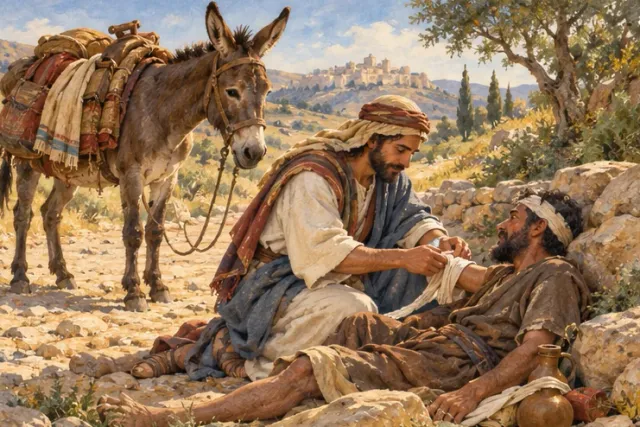
The account
A certain lawyer stood up and tested Jesus. He asked what he should do to inherit eternal life. Jesus asked him what was written in the law. The lawyer answered that a person should love God with all his heart, soul, strength, and mind, and love his neighbour as himself. Jesus said he had answered correctly.
The lawyer then asked who his neighbour was.
Jesus answered by telling about a man traveling from Jerusalem to Jericho. Thieves attacked him, took his clothing, hurt him, and left him half dead.
A priest came down the road, saw the man, and passed by on the other side. A Levite also came, looked at him, and passed by.
Then a Samaritan came to the place. When he saw the injured man, he had compassion. He treated the man's wounds with oil and wine, put him on his own animal, brought him to an inn, and cared for him. The next day he gave the innkeeper two pence and asked him to keep caring for the man. He promised to repay any extra cost when he returned.
Jesus asked which of the three had been a neighbour to the injured man. The lawyer answered that it was the one who showed mercy. Jesus told him to go and do likewise.
Memory verse
And he said, He that shewed mercy on him. Then said Jesus unto him, Go, and do thou likewise.
Luke 10:37
Talk about it
- What question did the lawyer ask Jesus about his neighbour?
- What did the priest and the Levite do when they saw the injured man?
- What different things did the Samaritan do to help him?
Try this
Draw a road with four stopping places. At each place, write what the injured man, the priest, the Levite and the Samaritan did, then circle the actions that showed mercy.
What can we learn?
A lesson we can draw is that being a neighbour is shown by what we do when someone needs mercy. Compassion in this account becomes practical help.
Ages 12 to 15
The account
The account begins with a question. A certain lawyer stood up and tested Jesus by asking what he should do to inherit eternal life. Jesus answered with a question of his own: what was written in the law, and how did the man read it?
The lawyer replied by joining two commands: love God with all the heart, soul, strength, and mind, and love one's neighbour as oneself. Jesus told him that he had answered correctly. The lawyer, wanting to justify himself, then asked the question that led to the familiar account: who is my neighbour?
Jesus described a man traveling down from Jerusalem to Jericho. Thieves attacked him, stripped him of his clothing, wounded him, and left him half dead. A priest happened to come down that road. He saw the injured man and passed by on the other side. A Levite came to the same place, looked at the man, and also passed by.
Then a Samaritan came along. When he saw the wounded traveler, he had compassion. He went to him, treated his wounds with oil and wine, placed him on his own animal, brought him to an inn, and cared for him. The next day the Samaritan gave the innkeeper two pence and asked him to continue the care. He also promised that if the innkeeper spent more, he would repay him when he returned.
The choice of a Samaritan mattered. Elsewhere, John's Gospel notes that Jews did not normally have dealings with Samaritans. Jesus makes the Samaritan, not the priest or the Levite, the person who stops and acts with compassion.
Jesus then turned the question around. Instead of giving the lawyer a list defining exactly who counted as a neighbour, he asked which of the three had acted as a neighbour to the man who fell among the thieves. The lawyer answered that it was the one who showed mercy. Jesus told him to go and do likewise.
The account moves from correct words about love to a concrete picture of mercy. The Samaritan notices suffering, interrupts his journey, uses what he has, brings the man somewhere safe, pays for continued care, and accepts responsibility for further cost. Jesus' final question focuses attention on what a neighbour does.
Memory verse
And he said, He that shewed mercy on him. Then said Jesus unto him, Go, and do thou likewise.
Luke 10:37
Think about it
- Why does Jesus answer the lawyer's question by asking him first what is written in the law?
- Why is the Samaritan an important choice for the person who stops to help?
- What does the Samaritan's response show about the difference between noticing a need and acting on it?
- Why does Jesus ask which person became a neighbour instead of simply giving the lawyer a list of people who count as neighbours?
Going deeper
The lawyer's answer draws from two parts of the law: loving God from Deuteronomy 6 and loving one's neighbour from Leviticus 19. The tension surrounding Samaritans also appears elsewhere in the Gospels, including John 4. Jesus' answer brings these larger biblical themes into one practical picture of mercy.
What can we learn?
A lesson we can draw is that compassion becomes meaningful when it moves into action. The Samaritan did not merely notice the injured man; he gave time, supplies, transportation, care and money to help him.