
John 2:1–11
Water into wine
Ages 8 to 11
The account
Jesus, his mother, and his disciples were at a marriage in Cana of Galilee. During the feast, the wine ran out. Jesus' mother told him that there was no wine left. Jesus answered her, and she then told the servants to do whatever Jesus told them.
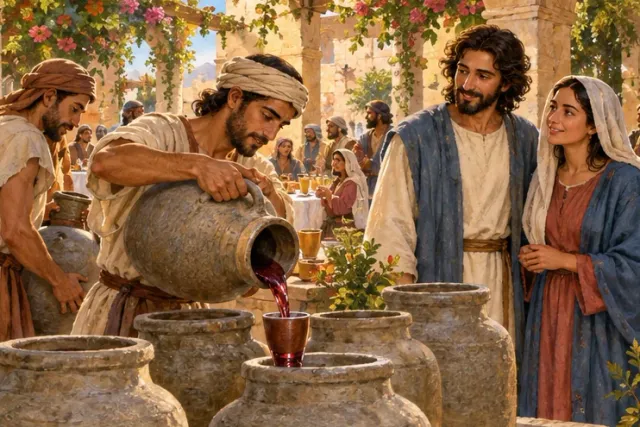
Nearby were six large stone waterpots. They were there for the Jewish way of purifying. Jesus told the servants to fill the pots with water, and they filled them to the brim. Then he told them to draw some out and take it to the ruler of the feast.
The ruler tasted it. The water had become wine. He did not know where it had come from, but the servants who had drawn the water knew. The ruler called the bridegroom and remarked that the good wine had been kept until that time.
John tells us that this was the beginning of Jesus' miracles in Cana of Galilee. Through it, Jesus showed his glory, and his disciples believed on him.
The account is simple, but the change was remarkable. The servants filled ordinary waterpots with water. What reached the ruler of the feast was wine. John points our attention to what this sign showed about Jesus.
Memory verse
His mother saith unto the servants, Whatsoever he saith unto you, do it.
John 2:5
Talk about it
- Where was Jesus when the wine ran out?
- What did Jesus tell the servants to put into the waterpots?
- What did the ruler of the feast discover when he tasted what was brought to him?
Try this
Draw six large waterpots on a sheet of paper. Under them, write the steps in the account in order, from filling the pots with water to the ruler tasting the wine.
What can we learn?
This account can remind us to pay attention to what Jesus says and to notice what his works reveal about him.
Ages 12 to 15
The account
John places this account at a marriage in Cana of Galilee. Jesus' mother was there, and Jesus and his disciples had also been called to the marriage. During the feast, the wine ran out. Jesus' mother told him that they had no wine. Jesus answered that his hour had not yet come. His mother then told the servants to do whatever he told them.
Six stone waterpots stood there. John explains that they were used according to the Jewish manner of purifying. Each could hold a large amount. Jesus told the servants to fill them with water, and they filled them all the way to the brim.
Next, Jesus told the servants to draw some out and carry it to the governor of the feast. They did. When the ruler tasted what they brought, the water had become wine. He did not know where it had come from, although the servants who had drawn the water knew.
The ruler called the bridegroom. He observed that people normally served the good wine first and the poorer wine later, but this bridegroom had kept the good wine until then. The ruler's words show that what he tasted was not merely different from water. He regarded it as good wine.
John then explains why this event matters in his Gospel. He calls it the beginning of Jesus' miracles in Cana of Galilee. Through this sign, Jesus manifested his glory, and his disciples believed on him. John does not add a long speech or explanation from Jesus. Instead, he lets the sign itself stand as evidence.
The sequence also matters. The servants did not create the result. They followed Jesus' directions: fill the waterpots, draw from them, and carry what was drawn to the ruler. The ruler tasted the result without knowing its source. The servants knew where the water had come from, and the disciples saw a sign that strengthened their belief in Jesus.
John carefully separates what different people knew. The ruler knew the quality of the wine but not its source. The servants knew that they had filled the pots with water. The disciples were there to see the sign, and John tells us the meaning he wants readers to notice: Jesus revealed his glory, and his disciples believed on him.
Memory verse
His mother saith unto the servants, Whatsoever he saith unto you, do it.
John 2:5
Think about it
- Why do you think John tells us that the servants knew where the wine had come from while the ruler did not?
- What does this sign show about Jesus according to John 2:11?
- Why might John call this event the beginning of Jesus' miracles rather than simply describing an unusual event at a feast?
- What do the servants' actions show about how the event unfolded?
Going deeper
John later explains that he recorded Jesus' signs so that readers might believe that Jesus is the Christ, the Son of God (John 20:30–31). Cana is the first sign John identifies. It begins a pattern in which Jesus' works reveal who he is, while people respond in different ways to what they see.
What can we learn?
A lesson drawn from this account is that Jesus' works deserve careful attention because John presents them as signs of his identity and glory. The servants also give a simple picture of following clear instructions even before they know what the result will be.