
Judges

21 Chapters
Judges: The Whole Book, Chapter by Chapter

A Promising Beginning Weakened by Incomplete Obedience
Judges 1 opens with Israel doing the right first thing: asking the LORD who should advance after Joshua’s death. Judah goes with Simeon, victories follow, and Caleb’s household receives its inheritance, including Achsah’s practical request for springs that make southern land livable. Then the chapter’s vocabulary changes. Iron chariots remain in the valleys, Benjamin does not remove the Jebusites, and tribe after tribe leaves Canaanite populations in place. Some are made tributaries, which can look like control while still falling short of the commission. By the end, Dan is being forced into the hill country. A chapter that begins with direction and conquest therefore closes with accommodation, incomplete possession, and a striking reversal of who is pushing whom.
One complete chapter pageOpen chapter →
The Covenant Charge and the Cycle of the Judges
Judges 2 supplies the interpretive key for the rest of the book. The angel of the LORD begins with God’s covenant faithfulness and asks Israel why it has not obeyed. The people weep at Bochim, but the chapter quickly shows that sorrow alone will not preserve covenant memory. Joshua’s generation passes away, another generation does not know the LORD or his works, and Israel turns to Baal and Ashtaroth. From there the cycle becomes explicit: rebellion brings oppression, distress leads to divine compassion, the LORD raises judges, and deliverance lasts while the judge lives. Afterward the people return to corruption, often worse than before. The remaining nations become a test, exposing whether Israel will walk in the way of the LORD rather than merely desire relief from its enemies.
One complete chapter pageOpen chapter →
The Cycle Begins with Othniel, Ehud, and Shamgar
Judges 3 moves from explanation to examples. The nations left in the land test whether Israel will obey, but ordinary proximity becomes intermarriage and service to other gods. Othniel then provides the cycle in its cleanest form: Israel forgets the LORD, falls under foreign domination, cries out, receives a deliverer empowered by the Spirit, and enjoys forty years of rest. Ehud’s account is stranger and more detailed. His left hand, concealed dagger, Eglon’s private chamber, and the servants’ delay turn royal confidence into humiliation before Ehud rallies Israel and seizes the Jordan crossings. The chapter ends with only one line for Shamgar and his ox goad. Three deliverers receive radically different amounts of attention, but each is remembered because Israel was delivered.
One complete chapter pageOpen chapter →
Deborah, Barak, and Jael Defeat Sisera
Judges 4 places Deborah, Barak, Sisera, and Jael inside a reversal of apparent strength. Deborah is already judging Israel when she summons Barak with the LORD’s command. Sisera possesses nine hundred iron chariots, the kind of military advantage that earlier seemed immovable, yet Deborah announces the day of deliverance and Barak descends from Mount Tabor. Sisera’s army collapses, and the commander abandons his chariot to flee on foot. He seeks safety in Jael’s tent because of peace between households, only to die there by a tent peg in the hands of the woman controlling the encounter. The chapter closes by widening the lens from one tent to Jabin’s whole power. What looked secure in army, alliance, and technology is steadily stripped away.
One complete chapter pageOpen chapter →
A Victory Song Remembers Courage, Hesitation, and Deliverance
Judges 5 retells the victory of chapter 4 as song, and poetry changes what comes into focus. Deborah and Barak praise the LORD alongside leaders and people who willingly offered themselves. The remembered crisis is social as well as military: highways empty, travelers use byways, village life ceases, and war reaches the gates. The tribal roll call then turns participation into a moral map. Some tribes come, Reuben searches his heart without moving, and others remain with ships, sheepfolds, or shore. The battle itself expands into cosmic and natural imagery as stars fight and Kishon sweeps enemies away. Jael is blessed, while Sisera’s mother waits at a window and imagines plunder, including captive women. The song ends with forty years of rest and a sharp contrast between the LORD’s enemies and those who love him.
One complete chapter pageOpen chapter →
Gideon Is Called Amid Fear, Oppression, and Idolatry
Judges 6 introduces Gideon by showing how thoroughly Midian has reduced Israel. People hide in caves, crops disappear, livestock is stripped away, and Gideon threshes wheat where it can be concealed. When Israel cries out, the first answer is not a soldier but a prophet who recalls the exodus and names disobedience. Gideon’s call follows with questions, fear, a sign, and the promise “Surely I will be with thee.” His first assigned act is not against Midian but against Baal’s altar in his own household. He obeys at night because he is afraid, and the city wakes to a religious confrontation. Only then do enemy armies gather. The Spirit comes upon Gideon before the fleece signs, which confirm an already spoken promise rather than create a new command.
One complete chapter pageOpen chapter →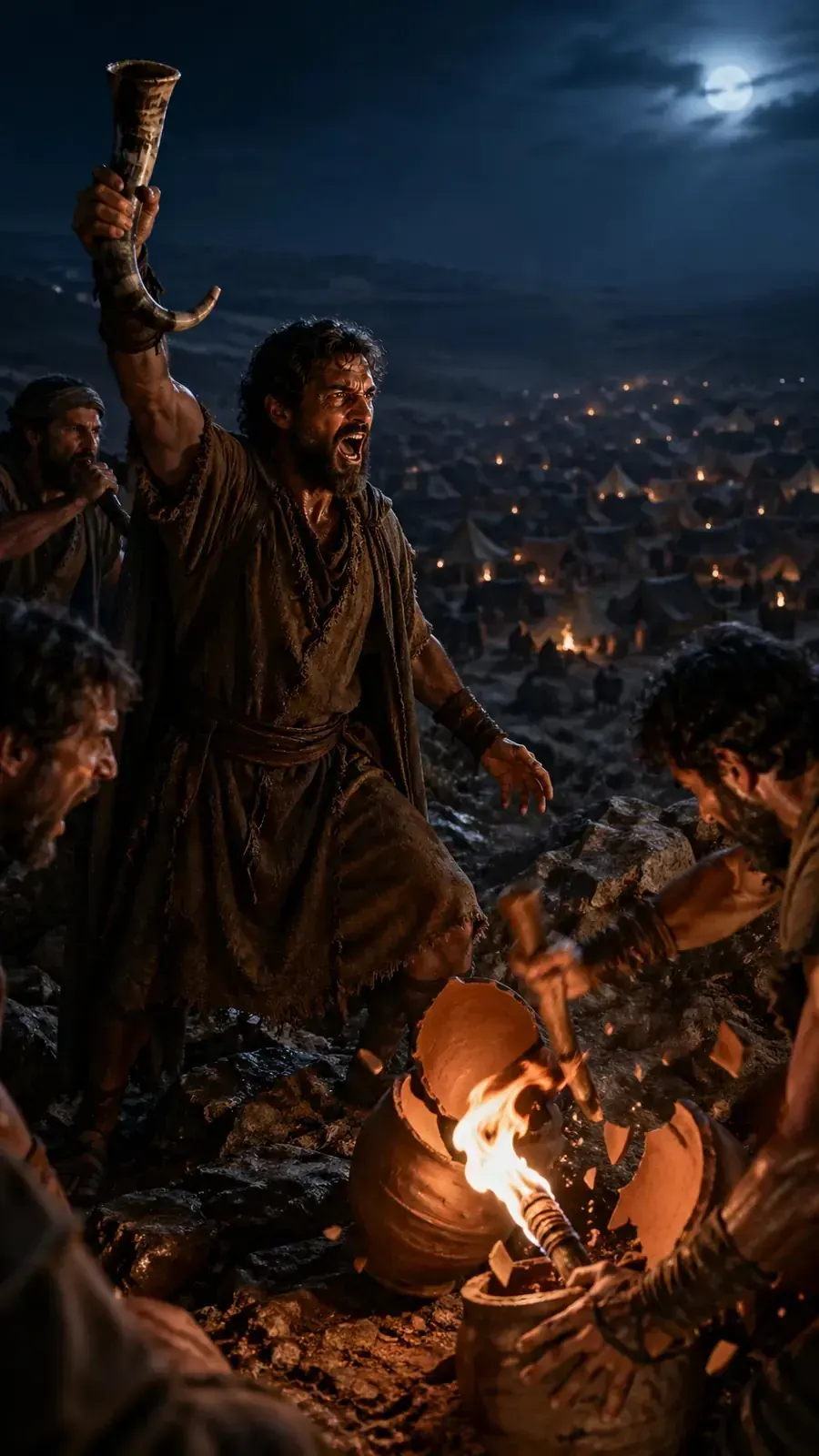
A Reduced Army Receives an Unexpected Victory
Judges 7 deliberately makes Gideon’s army too small for the victory to be credited to Israel’s strength. Thousands leave because they are afraid, then a water test reduces the force again until only three hundred remain. Gideon still fears, and the LORD accommodates that fear by sending him with Purah to hear a Midianite dream. A barley cake topples a tent in the dream, and the enemy’s own interpretation says Midian has been delivered into Gideon’s hand. Gideon worships and returns ready to act. The three hundred surround the camp with trumpets, pitchers, and lamps, while the LORD turns Midianite swords against one another. Israel’s pursuit then expands beyond the original force. The chapter keeps human preparation visible but makes self-congratulation impossible as the final explanation.
One complete chapter pageOpen chapter →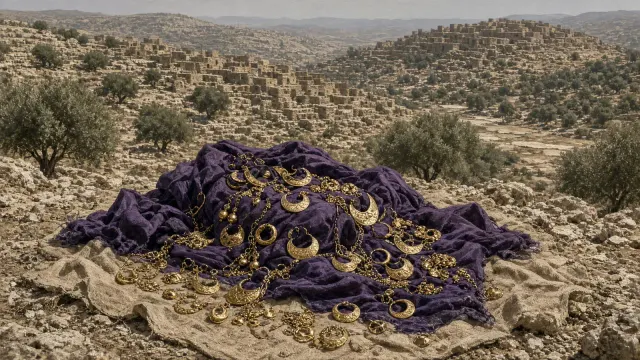
Victory Gives Way to Retaliation, Wealth, and a Snare
Judges 8 begins with Gideon at his most restrained and ends with his legacy badly complicated. Ephraim confronts him angrily, and Gideon defuses the dispute by honoring their contribution. Crossing the Jordan, however, the same leader answers Succoth and Penuel’s refusal of aid with threats he later carries out. His pursuit of Zebah and Zalmunna becomes openly personal when he learns they killed his brothers. Israel then asks Gideon to establish hereditary rule. He refuses in words, saying the LORD shall rule, yet accepts royal wealth, maintains a vast household, and makes an ephod from collected gold. That object becomes a snare to Gideon and Israel. Forty years of quiet follow, but after his death the people return to Baal and forget both the LORD’s deliverance and kindness toward Gideon’s house.
One complete chapter pageOpen chapter →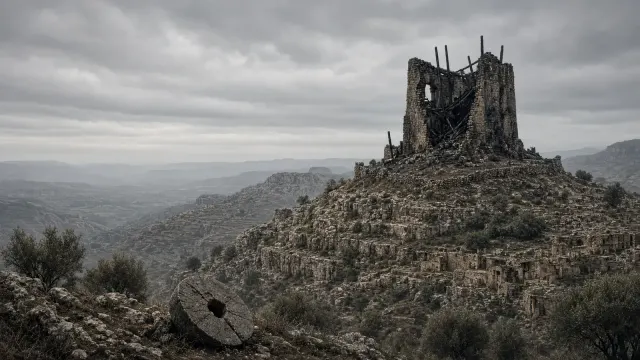
Abimelech’s Violent Kingship Destroys Itself
Judges 9 is the book’s anti-deliverer chapter. Abimelech does not answer a divine call or rescue Israel from an oppressor. He builds power through family loyalty in Shechem, money from Baal-berith’s temple, hired followers, and the murder of his brothers on one stone. Jotham escapes and answers with a fable in which productive trees refuse rule while the bramble accepts a crown and threatens fire. Three years later, the alliance turns inward exactly as the warning anticipated. Treachery, boasting, ambush, and revenge consume Shechem, and Abimelech burns people in a tower after destroying the city. At Thebez he tries the same tactic, but an unnamed woman drops a millstone on his head. His final concern for reputation cannot prevent Judges from identifying both his wickedness and the judgment that overtakes him.
One complete chapter pageOpen chapter →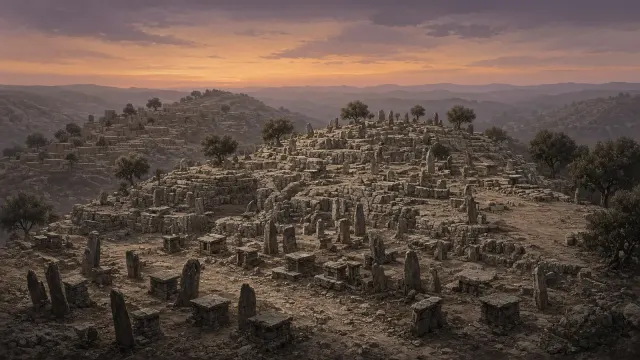
Brief Judges, Renewed Apostasy, and a Cry Beyond Words
Judges 10 gives forty-five years of leadership in only a few verses before returning to the larger cycle. Tola and Jair receive no dramatic battle account, though their years, locations, families, and influence are remembered. Israel then serves an unusually long list of surrounding gods and suffers under Philistine and Ammonite power. The people confess that they have forsaken the LORD, but the first response is severe: let the gods they chose deliver them. Their second confession accepts God’s judgment, and action follows words as they remove foreign gods and serve the LORD. The chapter says his soul is grieved for Israel’s misery. Even then, the military crisis remains unresolved. Ammon gathers in Gilead, Israel assembles at Mizpeh, and Gilead offers headship to whoever will begin the fight, setting up Jephthah’s return.
One complete chapter pageOpen chapter →
Jephthah Rises, Negotiates, Wins, and Makes a Terrible Vow
Judges 11 places Jephthah between rejection, political ambition, careful argument, military victory, and a catastrophic vow. His brothers expel him from inheritance because of his mother, yet Gilead’s elders later seek the very man they rejected when Ammon threatens them. Jephthah negotiates for more than command: victory must make him head. Before battle he sends a long historical argument, distinguishing Ammonite and Moabite land from territory taken from the Amorite king Sihon, but the Ammonite king will not listen. The Spirit of the LORD comes upon Jephthah before he makes any vow. He nevertheless bargains concerning whatever comes from his doors. Victory follows, then his only daughter comes out with timbrels and dancing. The chapter ends in grief around words God never required him to add.
One complete chapter pageOpen chapter →
Civil Conflict Turns a Word Into a Boundary of Death
Judges 12 shows how quickly conflict with an external enemy can turn inward. Ephraim confronts Jephthah over the Ammonite war and threatens his house with fire. Jephthah answers with his own account of having called for help, and the dispute becomes civil war. Gilead controls the Jordan crossings, where a small pronunciation difference in the word Shibboleth identifies fleeing Ephraimites for death. Forty-two thousand fall before Jephthah’s six-year judgeship ends. The rest of the chapter changes pace sharply. Ibzan, Elon, and Abdon pass in rapid succession, remembered through years of service, burial places, family networks, marriages, and visible signs of status. After the savagery of a tribal boundary enforced by speech, twenty-five quieter years are preserved without a recorded deliverance scene.
One complete chapter pageOpen chapter →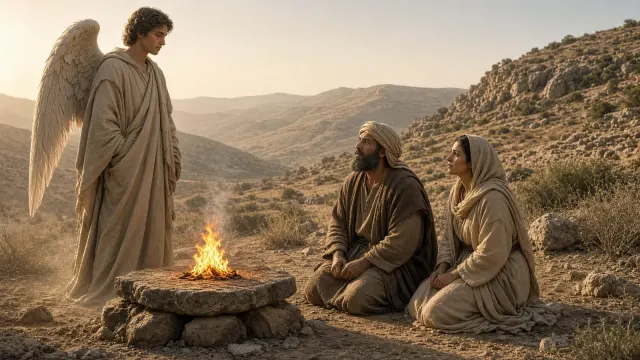
Samson’s Birth Is Announced Before Israel Cries Out
Judges 13 begins Samson’s account before Samson can make a single choice. Israel is under Philistine rule for forty years, yet no national cry for deliverance appears. The angel of the LORD comes first to Manoah’s unnamed wife, names her barrenness, promises a son, and gives instructions connected with his Nazirite consecration. The promise itself is limited: he will begin to deliver Israel. Manoah asks for the messenger to return, and God hears him, but the angel again appears first to the woman and points Manoah back to the instructions already given her. An offering rises in flame, the angel ascends with it, and Manoah fears death. His wife reasons more steadily from the accepted offering and promised future. Samson is born, blessed, and the Spirit begins to move him.
One complete chapter pageOpen chapter →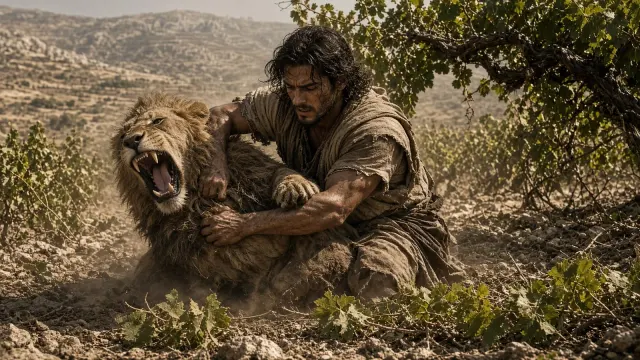
Desire, a Riddle, and a Compromised Beginning
Judges 14 brings Samson’s consecrated calling into contact with appetite, secrecy, and Philistine conflict. He sees a woman in Timnath and insists that his parents get her because she pleases him. Judges notes that the situation will provide an occasion against Philistia, without turning Samson’s desire into a model of wisdom. On the road, the Spirit empowers him to tear a lion, and later he secretly takes honey from the carcass. At the wedding feast he converts that private experience into a riddle with garments at stake. The companions cannot solve it, so they threaten his bride and her father with fire. Under pressure she obtains the answer from Samson and passes it on. Samson pays the wager through violence at Ashkelon, leaves angry, and his wife is given to his companion.
One complete chapter pageOpen chapter →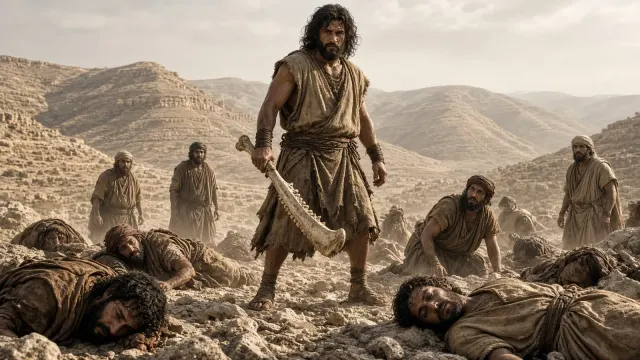
Retaliation Consumes the Philistine Conflict
Judges 15 is driven by the logic of retaliation. Samson returns to his wife and learns she has been given to another man. He answers by burning Philistine crops, vineyards, and olives with animals carrying firebrands. The Philistines then burn the woman and her father, fulfilling the very threat that had hung over the wedding feast. Samson retaliates again. When Philistine forces enter Judah, three thousand Judahites do not mobilize against their rulers but to bind Samson and surrender him. The Spirit comes mightily upon him, the cords fall away, and he strikes a thousand men with a fresh jawbone. Triumph is immediately followed by thirst, and Samson must cry to the LORD for life-giving water. The chapter ends by preserving both his extraordinary deliverance and his continuing dependence.
One complete chapter pageOpen chapter →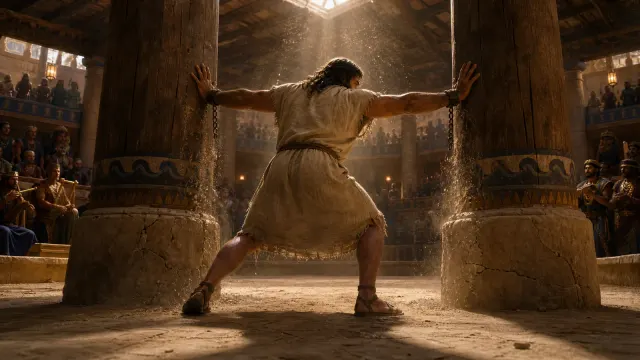
Strength, Betrayal, Blindness, and Samson’s Final Act
Judges 16 places Samson’s greatest visible strength beside his deepest vulnerability. At Gaza he escapes an ambush by carrying away the city gate, a public humiliation of Philistine security. Later he loves Delilah, who is paid by Philistine rulers to discover the source of his strength. Samson repeatedly gives false answers, and Delilah repeatedly tests them in front of hidden enemies. He eventually tells her all his heart and connects his uncut hair with consecration from the womb. Once he is shaved, the decisive loss is that the LORD departs. Samson is blinded, bound, and made to grind in prison. At a feast to Dagon, the Philistines display him as proof of their god’s victory. Samson prays once more for strength, pulls down the supporting pillars, and dies with his captors.
One complete chapter pageOpen chapter →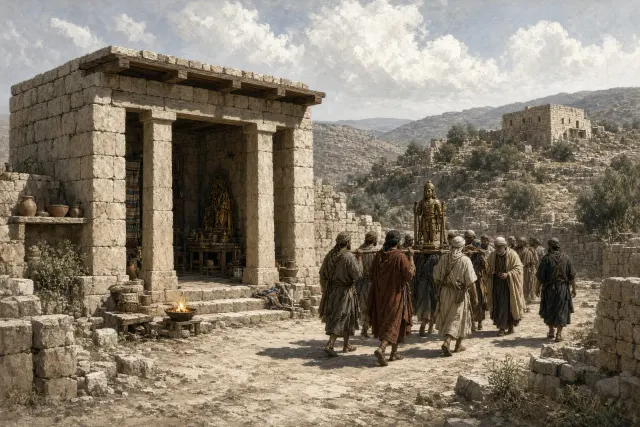
A Private Shrine Reveals Israel’s Religious Confusion
Judges 17 leaves battlefield deliverance behind and enters one household, where religious confusion is almost casual. Micah admits taking his mother’s silver. She blesses him in the LORD’s name and dedicates part of the money to the LORD by making an image, joining covenant language to a forbidden practice in the same breath. Micah adds a shrine, ephod, teraphim, and first appoints his own son as priest. When a wandering Levite arrives, Micah hires him with wages, clothing, food, and the title of father and priest. The Levite is content with the arrangement, and Micah concludes that the LORD must now prosper him because he has the right kind of religious specialist in the house. The chapter’s diagnosis is blunt: everyone does what is right in his own eyes.
One complete chapter pageOpen chapter →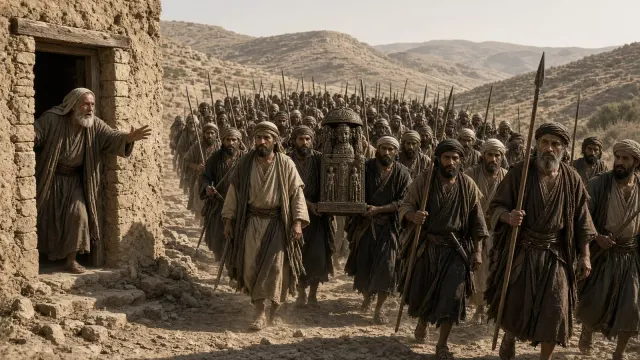
Dan Seizes a City and Carries Micah’s Shrine with It
Judges 18 scales Micah’s private disorder up to the level of a tribe. Danite spies seeking territory stop at Micah’s shrine, recognize the hired Levite, and receive his assurance that their way is before the LORD. They then identify Laish as wealthy, quiet, secure, and isolated. Six hundred armed men return, steal Micah’s images and ephod, and offer the Levite a promotion from serving one household to serving an entire tribe. He is glad to go. Micah protests until superior force silences him. The Danites then destroy Laish, rebuild the city as Dan, and establish the stolen image with a hereditary priesthood. The chapter closes by setting this rival worship beside the house of God at Shiloh. Military success and expanded religious status never correct the compromised foundation.
One complete chapter pageOpen chapter →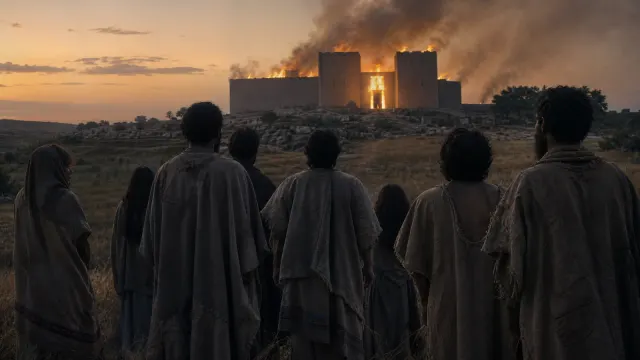
Hospitality Collapses Into Sexual Violence and National Outrage
Judges 19 opens with “no king in Israel” and proceeds toward the book’s most horrifying evidence of social collapse. A Levite travels to bring his concubine back from her father’s house, where generous hospitality repeatedly delays departure until late in the day. The travelers refuse Jebus because it is a foreign city and continue to Israelite Gibeah, only to find no welcome in the square until an elderly outsider receives them. Men of the city surround the house and demand the male guest. The host offers women, and the Levite sends out his concubine. She is abused through the night and collapses at the threshold. He later dismembers her body and sends the pieces through Israel, producing national shock while continuing the chapter’s grim pattern of using her body for male purposes.
One complete chapter pageOpen chapter →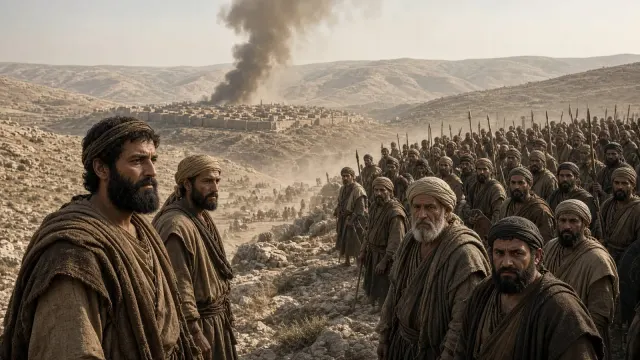
War Against Benjamin Brings Devastating Loss
Judges 20 begins with Israel united in outrage and ends with one tribe almost erased. The Levite describes Gibeah’s crime but omits that he personally surrendered the woman to the mob. Israel nevertheless identifies a real atrocity and asks Benjamin to hand over the offenders. Benjamin refuses, turning accountability for one city into tribal war. Israel asks the LORD who should go first, yet suffers two devastating defeats. After weeping, fasting, sacrifices, and a fuller inquiry, the assembly receives assurance of victory. An ambush finally breaks Benjamin’s force, and only six hundred men reach the rock Rimmon. Then the violence expands beyond the battlefield. Israel turns against Benjamin’s towns, inhabitants, livestock, and property. The pursuit of justice has reached a scale that creates the next chapter’s crisis: a tribe is nearly gone.
One complete chapter pageOpen chapter →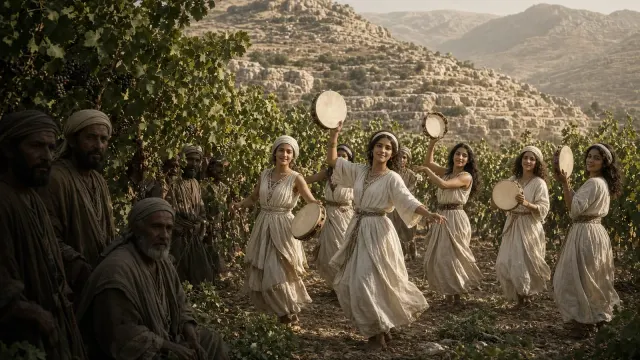
Rash Oaths and Violent Remedies Leave Israel Fractured
Judges 21 is a chain of attempted repairs that keeps producing new victims. Israel mourns the near destruction of Benjamin, but an oath made at Mizpeh prevents the people from simply giving daughters in marriage to the survivors. Another oath identifies absence from the assembly as a capital offense, so Jabesh-gilead is attacked and four hundred young women are preserved for forced transfer to Benjamin. Even that number is insufficient. The elders then exploit the wording of the first oath by allowing the remaining Benjaminites to seize women who come out to dance at Shiloh. The distinction between giving and taking preserves a technicality while sacrificing the women’s freedom. Benjamin rebuilds, the tribes disperse, and Judges closes where its final chapters have been heading: no king, fragmented authority, and everyone doing what is right in his own eyes.
One complete chapter pageOpen chapter →Source: eBible.org · eng-kjv2006