
The big picture
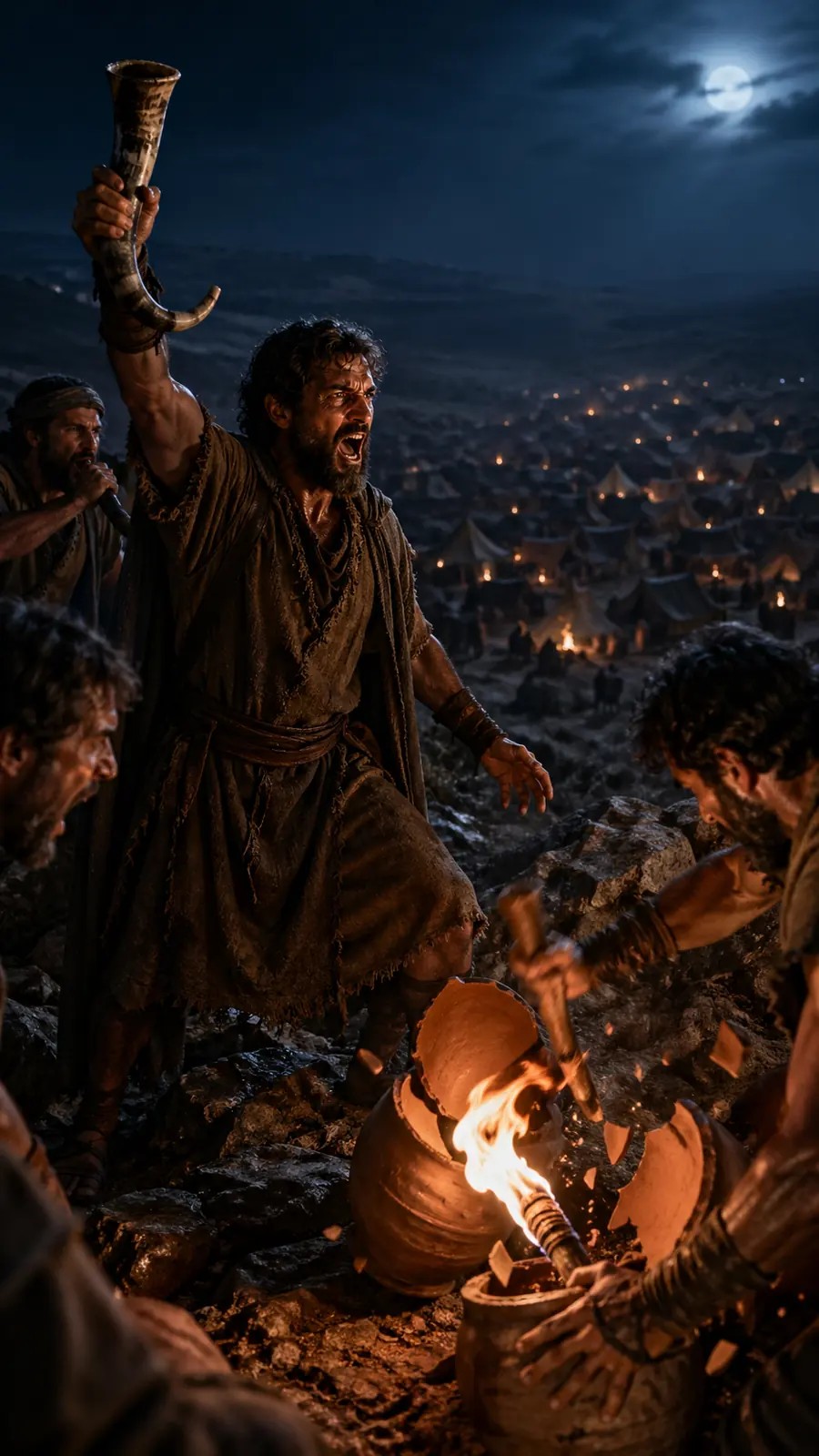
The LORD reduces Gideon’s force so Israel cannot claim self-deliverance. A Midianite dream strengthens Gideon, three hundred men surround the camp with trumpets, pitchers, and lamps, and the enemy army collapses in panic before Israel pursues the survivors.
Scripture beside the summary
Judges · King James Version · 25Judges 7:1-8
The army is made too small for boasting
Those who are fearful return home, and a water test reduces the remaining force to three hundred. The LORD explicitly states that the reduction prevents Israel from claiming that its own hand saved it.
Context that brings the passage to life
“Then Jerubbaal, who is Gideon, and all the people that were with him, rose up early, and pitched beside the well of…” Naming Gideon and Harod keeps the account rooted in particular people or places. Follow where the name returns and what changes around it.
“Now therefore go to, proclaim in the ears of the people, saying, Whosoever is fearful and afraid, let him return and…” The number twenty makes the report concrete. Ask whether it measures time, people, distance, repetition, or completeness before deciding what weight it carries.
“So he brought down the people unto the water: and the LORD said unto Gideon, Every one that lappeth of the water with…” This line supplies a reason, result, or conclusion. It should stay attached to the claim or action that gives it meaning.
“And the LORD said unto Gideon, By the three hundred men that lapped will I save you, and deliver the Midianites into…” The number three makes the report concrete. Ask whether it measures time, people, distance, repetition, or completeness before deciding what weight it carries.
“So the people took victuals in their hand, and their trumpets: and he sent all the rest of Israel every man unto his…” This line supplies a reason, result, or conclusion. It should stay attached to the claim or action that gives it meaning.
The controlling explanation appears in verse 2. The army is not reduced because small groups are always wiser or holier, and the manner of drinking is not presented as a timeless personality test. The stated purpose is theological: victory must not become evidence for self-congratulation. Israel’s history already shows how quickly a gift can be detached from its giver.
Judges 7:1-8
King James Version1Then Jerubbaal, who is Gideon, and all the people that were with him, rose up early, and pitched beside the well of Harod: so that the host of the Midianites were on the north side of them, by the hill of Moreh, in the valley.
2And the LORD said unto Gideon, The people that are with thee are too many for me to give the Midianites into their hands, lest Israel vaunt themselves against me, saying, Mine own hand hath saved me.
3Now therefore go to, proclaim in the ears of the people, saying, Whosoever is fearful and afraid, let him return and depart early from mount Gilead. And there returned of the people twenty and two thousand; and there remained ten thousand.
4And the LORD said unto Gideon, The people are yet too many; bring them down unto the water, and I will try them for thee there: and it shall be, that of whom I say unto thee, This shall go with thee, the same shall go with thee; and of whomsoever I say unto thee, This shall not go with thee, the same shall not go.
5So he brought down the people unto the water: and the LORD said unto Gideon, Every one that lappeth of the water with his tongue, as a dog lappeth, him shalt thou set by himself; likewise every one that boweth down upon his knees to drink.
6And the number of them that lapped, putting their hand to their mouth, were three hundred men: but all the rest of the people bowed down upon their knees to drink water.
7And the LORD said unto Gideon, By the three hundred men that lapped will I save you, and deliver the Midianites into thine hand: and let all the other people go every man unto his place.
8So the people took victuals in their hand, and their trumpets: and he sent all the rest of Israel every man unto his tent, and retained those three hundred men: and the host of Midian was beneath him in the valley.
Judges 7:9-15
An enemy’s dream becomes encouragement
God sends Gideon into the camp with Purah if he is still afraid. Gideon hears one Midianite describe a barley-cake dream and another interpret it as Gideon’s victory, then worships and returns ready to act.
Context that brings the passage to life
“And it came to pass the same night, that the LORD said unto him, Arise, get thee down unto the host; for I have…” This familiar narrative signal moves the clock forward. What follows is a new scene, consequence, or answer to an earlier tension.
“But if thou fear to go down, go thou with Phurah thy servant down to the host:” Naming Phurah keeps the account rooted in particular people or places. Follow where the name returns and what changes around it.
“And thou shalt hear what they say; and afterward shall thine hands be strengthened to go down unto the host. Then went…” The command cannot be understood from the verb alone. Its recipient, purpose, and place in the larger covenant or argument define the responsibility.
“And the Midianites and the Amalekites and all the children of the east lay along in the valley like grasshoppers for…” Naming Amalekites and Midianites keeps the account rooted in particular people or places. Follow where the name returns and what changes around it.
“And when Gideon was come, behold, there was a man that told a dream unto his fellow, and said, Behold, I dreamed a…” Naming Gideon and Midian keeps the account rooted in particular people or places. Follow where the name returns and what changes around it.
Judges 7:9-15
King James Version9And it came to pass the same night, that the LORD said unto him, Arise, get thee down unto the host; for I have delivered it into thine hand.
10But if thou fear to go down, go thou with Phurah thy servant down to the host:
11And thou shalt hear what they say; and afterward shall thine hands be strengthened to go down unto the host. Then went he down with Phurah his servant unto the outside of the armed men that were in the host.
12And the Midianites and the Amalekites and all the children of the east lay along in the valley like grasshoppers for multitude; and their camels were without number, as the sand by the sea side for multitude.
13And when Gideon was come, behold, there was a man that told a dream unto his fellow, and said, Behold, I dreamed a dream, and, lo, a cake of barley bread tumbled into the host of Midian, and came unto a tent, and smote it that it fell, and overturned it, that the tent lay along.
14And his fellow answered and said, This is nothing else save the sword of Gideon the son of Joash, a man of Israel: for into his hand hath God delivered Midian, and all the host.
15And it was so, when Gideon heard the telling of the dream, and the interpretation thereof, that he worshipped, and returned into the host of Israel, and said, Arise; for the LORD hath delivered into your hand the host of Midian.
Judges 7:16-25
Trumpets and lamps surround a confused camp
Three companies break pitchers, reveal lamps, sound trumpets, and announce the sword of the LORD and Gideon. The Midianites turn their swords against one another, flee, and are pursued as Ephraim captures and kills Oreb and Zeeb.
Context that brings the passage to life
“And he divided the three hundred men into three companies, and he put a trumpet in every man’s hand, with empty…” The number three makes the report concrete. Ask whether it measures time, people, distance, repetition, or completeness before deciding what weight it carries.
“When I blow with a trumpet, I and all that are with me, then blow ye the trumpets also on every side of all the camp…” Naming Gideon keeps the account rooted in particular people or places. Follow where the name returns and what changes around it.
“And the three companies blew the trumpets, and brake the pitchers, and held the lamps in their left hands, and the…” The number three makes the report concrete. Ask whether it measures time, people, distance, repetition, or completeness before deciding what weight it carries.
“And the three hundred blew the trumpets, and the LORD set every man’s sword against his fellow, even throughout all…” The number three makes the report concrete. Ask whether it measures time, people, distance, repetition, or completeness before deciding what weight it carries.
“And Gideon sent messengers throughout all mount Ephraim, saying, Come down against the Midianites, and take before…” Naming Beth and Ephraim keeps the account rooted in particular people or places. Follow where the name returns and what changes around it.
“And they took two princes of the Midianites, Oreb and Zeeb; and they slew Oreb upon the rock Oreb, and Zeeb they slew…” The number two makes the report concrete. Ask whether it measures time, people, distance, repetition, or completeness before deciding what weight it carries.
Judges 7:16-25
King James Version16And he divided the three hundred men into three companies, and he put a trumpet in every man’s hand, with empty pitchers, and lamps within the pitchers.
17And he said unto them, Look on me, and do likewise: and, behold, when I come to the outside of the camp, it shall be that, as I do, so shall ye do.
18When I blow with a trumpet, I and all that are with me, then blow ye the trumpets also on every side of all the camp, and say, The sword of the LORD , and of Gideon.
19So Gideon, and the hundred men that were with him, came unto the outside of the camp in the beginning of the middle watch; and they had but newly set the watch: and they blew the trumpets, and brake the pitchers that were in their hands.
20And the three companies blew the trumpets, and brake the pitchers, and held the lamps in their left hands, and the trumpets in their right hands to blow withal: and they cried, The sword of the LORD , and of Gideon.
21And they stood every man in his place round about the camp: and all the host ran, and cried, and fled.
22And the three hundred blew the trumpets, and the LORD set every man’s sword against his fellow, even throughout all the host: and the host fled to Beth-shittah in Zererath, and to the border of Abel-meholah, unto Tabbath.
23And the men of Israel gathered themselves together out of Naphtali, and out of Asher, and out of all Manasseh, and pursued after the Midianites.
24And Gideon sent messengers throughout all mount Ephraim, saying, Come down against the Midianites, and take before them the waters unto Beth-barah and Jordan. Then all the men of Ephraim gathered themselves together, and took the waters unto Beth-barah and Jordan.
25And they took two princes of the Midianites, Oreb and Zeeb; and they slew Oreb upon the rock Oreb, and Zeeb they slew at the winepress of Zeeb, and pursued Midian, and brought the heads of Oreb and Zeeb to Gideon on the other side Jordan.
Details worth noticing
The opening image
Judges 7:1 begins with “Then Jerubbaal, who is Gideon, and all the people that were with him, rose up early, and pitched beside the well of Harod: so that the host of the…”
Where the chapter turns
Judges 7:10 forms a natural hinge: “But if thou fear to go down, go thou with Phurah thy servant down to the host:”
The final note
Judges 7:25 leaves the reader with “And they took two princes of the Midianites, Oreb and Zeeb; and they slew Oreb upon the rock Oreb, and Zeeb they slew at the winepress of Zeeb, and pursued…”
A word trail through the chapter
The words Gideon, host, LORD, people, hand, Midianites help reveal the chapter’s repeated concerns.
What links this event with creation?
Waters overwhelm the inhabited world, reversing the separations that made life possible.
What details show continuity rather than total abandonment?
The named household and preserved kinds of living creatures survive within the ark.
KJV words made clear
- behold
- look, or pay close attention
- unto
- to
- thee
- you
- thou
- you
- thy
- your
Text first
Where readers differ
The chapter summary begins with what the passage says and how its parts fit together. It does not assume one denomination has already settled every question. Where a conclusion depends on a tradition, literary theory, or historical reconstruction, that dependence is named openly.
The KJV text is presented first. Interpretive conclusions are labeled, and differences are introduced only when they help a reader understand why serious communities do not always reach the same answer.
Comparative interpretive notes for this chapter are in preparation. Until reviewed notes are ready, this page separates the KJV text from summary and application without claiming that serious readers agree on every question.