
The big picture
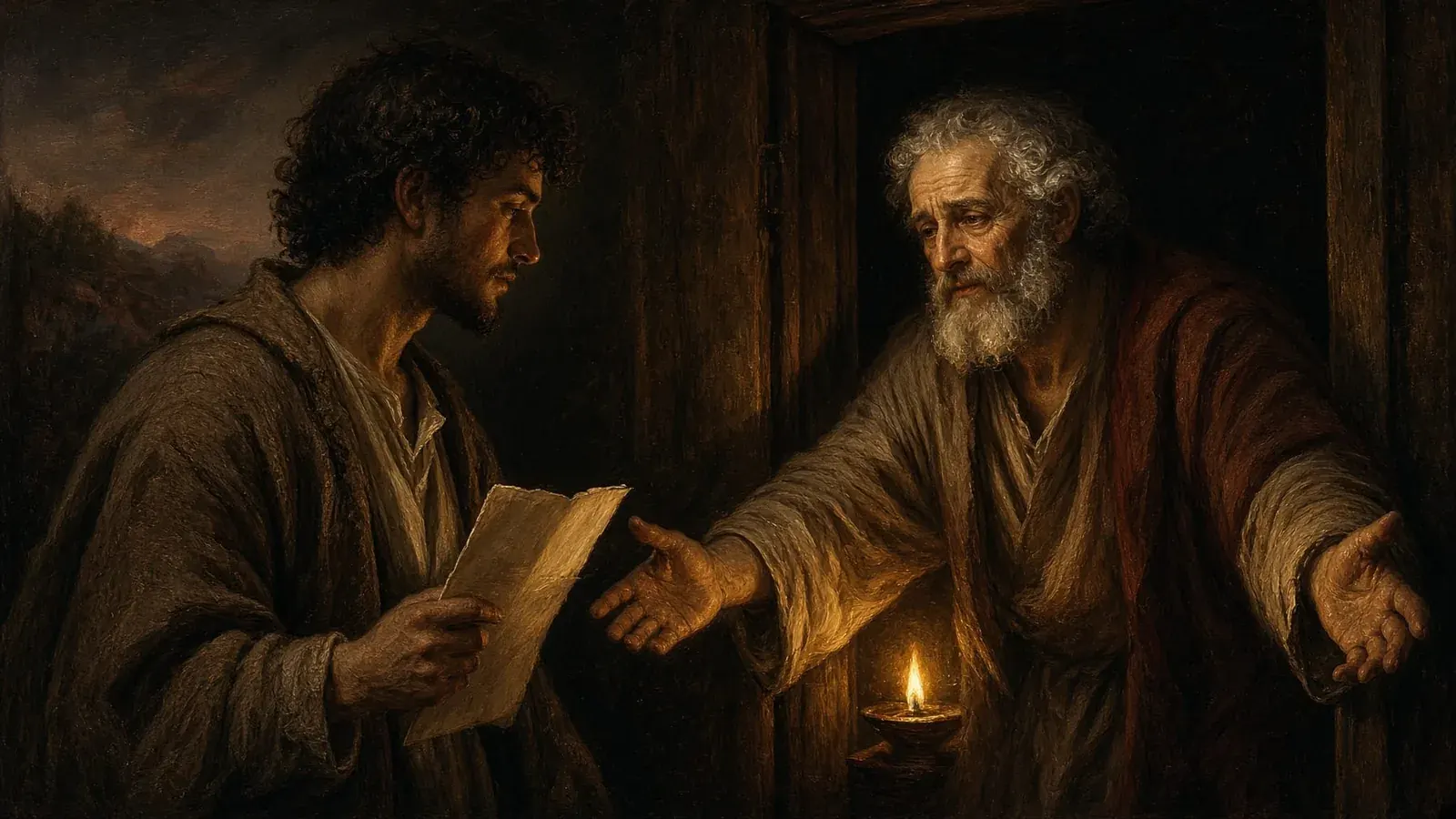
Paul, a prisoner who serves Jesus Christ, addresses Philemon, a fellow Christian whose home hosts a church. Jesus is the Lord both men follow. Paul also names Timothy, a fellow believer who joins the greeting. A personal request soon comes into view. Onesimus, an enslaved man connected to Philemon, has become dear to Paul during his imprisonment. Paul sends him back with an appeal that puts their shared faith beside their unequal social position. He asks for a welcome shaped by love.
In this chapter
- Thanks for Love Already Shown Philemon 1:1-7
The greeting includes Apphia, a beloved member of the group, and Archippus, a fellow worker.
- Paul Appeals Instead of Ordering Philemon 1:8-14
Paul says he has grounds to give Philemon an order, yet chooses an appeal through love.
- Receive Him as a Loved Brother Philemon 1:15-17
Paul suggests that the brief separation may have led to a lasting bond.
- Paul Offers to Carry the Debt Philemon 1:18-21
If Onesimus has caused harm or owes anything, Paul tells Philemon to charge it to him.
- A Visit and Final Greetings Philemon 1:22-25
Paul asks Philemon to prepare a place for him to stay.
Central truth
Paul appeals to Philemon to receive Onesimus as a loved brother and offers to take responsibility for any debt.

Scripture beside the summary
Philemon · King James Version · 25Philemon 1:1-7
Thanks for Love Already Shown
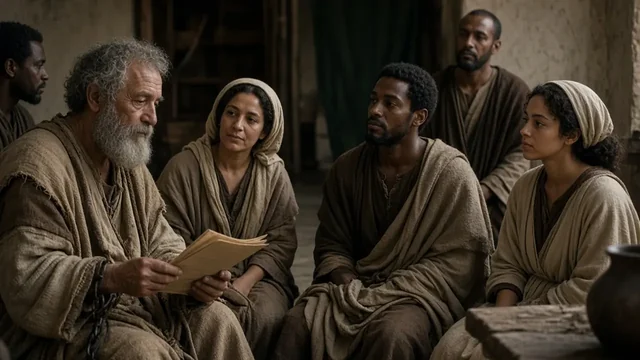
The greeting includes Apphia, a beloved member of the group, and Archippus, a fellow worker. Paul also addresses the church that meets in Philemon's house. This personal letter therefore reaches a gathered community too. Paul thanks God when he remembers Philemon in prayer. Reports of his trust in Jesus and love for other believers have brought Paul joy and comfort. He prays that Philemon's shared faith will bear fruit as he recognises the good they have in Christ. His care has already brought relief to other Christians.
In everyday life
A blood donor greets the volunteer who steadied her nerves on her first visit to the donation van. Other donors nearby add their thanks for the same quiet care. The volunteer hears how practical kindness has helped people return. A record of care is already present before the next request arrives. Philemon is being thanked for love within Christian faith, not volunteer work alone.
Notice
Philemon 1:7 Paul names relief that other believers have already received from Philemon. His appeal starts with real evidence of love rather than praise with no stated basis.
Philemon 1:1-7
King James Version1Paul, a prisoner of Jesus Christ, and Timothy our brother, unto Philemon our dearly beloved, and fellowlabourer,
2And to our beloved Apphia, and Archippus our fellowsoldier, and to the church in thy house:
3Grace to you, and peace, from God our Father and the Lord Jesus Christ.
4I thank my God, making mention of thee always in my prayers,
5Hearing of thy love and faith, which thou hast toward the Lord Jesus, and toward all saints;
6That the communication of thy faith may become effectual by the acknowledging of every good thing which is in you in Christ Jesus.
7For we have great joy and consolation in thy love, because the bowels of the saints are refreshed by thee, brother.
Philemon 1:8-14
Paul Appeals Instead of Ordering
Paul says he has grounds to give Philemon an order, yet chooses an appeal through love. He speaks as an old man who is now in prison. Onesimus became his son in faith during that confinement, meaning Paul helped him become a believer. Once of little use to Philemon, he now serves both men well. Paul sends him back as someone deeply dear to him. He would like to keep Onesimus as a helper in prison. But he refuses to act without Philemon's consent, so that any help will be freely given rather than forced.
In everyday life
The band leader stops rehearsal in a garage and asks a guitarist to lend her amplifier for a benefit performance. He has arranged the event and can pressure her, but waits for an answer. She has room to agree without being cornered in front of the group. Onesimus is a human being under slavery, not equipment available for loan.
Notice
Philemon 1:14 Paul wants willing action and says he will not act without Philemon's agreement. Yet his deeply personal appeal also makes the weight of the request clear.
Philemon 1:8-14
King James Version8Wherefore, though I might be much bold in Christ to enjoin thee that which is convenient,
9Yet for love’s sake I rather beseech thee, being such an one as Paul the aged, and now also a prisoner of Jesus Christ.
10I beseech thee for my son Onesimus, whom I have begotten in my bonds:
11Which in time past was to thee unprofitable, but now profitable to thee and to me:
12Whom I have sent again: thou therefore receive him, that is, mine own bowels:
13Whom I would have retained with me, that in thy stead he might have ministered unto me in the bonds of the gospel:
14But without thy mind would I do nothing; that thy benefit should not be as it were of necessity, but willingly.
Philemon 1:15-17
Receive Him as a Loved Brother
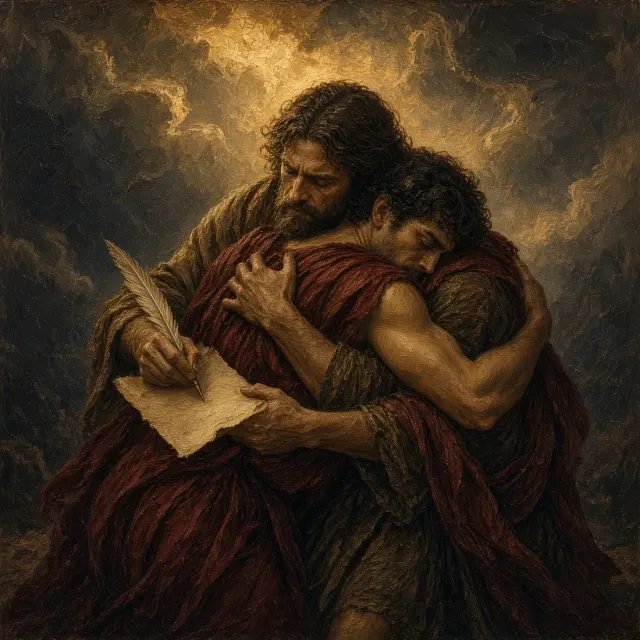
Paul suggests that the brief separation may have led to a lasting bond. He presents that as a possibility, not a claim to know every reason behind events. Onesimus should now be received as more than a slave: a beloved brother. He is dear to Paul and should be dearer still to Philemon in daily life and in their shared Lord. Paul asks Philemon to welcome Onesimus as he would welcome Paul himself. The letter does not state in clear terms whether Philemon must legally free him.

In everyday life
An estranged cousin reaches the family picnic carrying a note from the grandmother. She asks the hosts to seat him at her own table and give him the welcome they give her. The chairs are rearranged, and the greeting changes from guarded distance to family welcome. Paul asks this recognition across the much harsher divide between master and slave.
Notice
Philemon 1:16 Brotherhood is to matter in ordinary human relations as well as in faith. Paul does not describe a bond that can stay hidden during daily life.
Philemon 1:15-17
King James Version15For perhaps he therefore departed for a season, that thou shouldest receive him for ever;
16Not now as a servant, but above a servant, a brother beloved, specially to me, but how much more unto thee, both in the flesh, and in the Lord?
17If thou count me therefore a partner, receive him as myself.
Philemon 1:18-21
Paul Offers to Carry the Debt
If Onesimus has caused harm or owes anything, Paul tells Philemon to charge it to him. That condition matters: the letter does not state that Onesimus stole. Paul adds his own written promise to repay. He also reminds Philemon of a deeper debt to him, even his own self. The reminder gives the appeal added force without cancelling the offer. Paul asks for the joy and relief that a generous response would bring. He writes with confidence that Philemon will obey and do even more than the request spells out.
In everyday life
One pet owner stands beside a neighbour at the veterinary billing desk and signs a promise to cover an unpaid charge. The receptionist moves the balance onto his account. His willingness removes a financial obstacle without pretending the bill never existed. He still waits for the neighbour to receive fair treatment. Paul also appeals to a shared life in Christ, which no payment can purchase.
Notice
Philemon 1:18 The offer begins with a condition about harm or debt. It gives no warrant to turn a possible debt into a definite account of theft.
Philemon 1:18-21
King James Version18If he hath wronged thee, or oweth thee ought, put that on mine account;
19I Paul have written it with mine own hand, I will repay it: albeit I do not say to thee how thou owest unto me even thine own self besides.
20Yea, brother, let me have joy of thee in the Lord: refresh my bowels in the Lord.
21Having confidence in thy obedience I wrote unto thee, knowing that thou wilt also do more than I say.
Philemon 1:22-25
A Visit and Final Greetings
Paul asks Philemon to prepare a place for him to stay. He hopes the prayers of these believers will lead to his release and return to them. This is hope, not a report that freedom has already been granted. Epaphras, another prisoner for Christ, sends greetings. So do Marcus, Aristarchus, Demas, and Lucas, whom Paul calls fellow workers. The letter closes with a wish for the grace of Jesus Christ to be with them. A personal appeal ends within a network of people bound by the same faith.

In everyday life
Two sisters wait on a railway platform after hearing that their brother hopes to visit. One checks the spare room key while the other reads his message again. The bed is ready, though his departure is still uncertain. Their preparation gives practical form to hope. Paul awaits release from imprisonment and links that hope to the prayers of believers.
Notice
Philemon 1:22 The request for lodging assumes an expected personal meeting. Philemon will not answer only a distant letter; Paul hopes to see him face to face.
Philemon 1:22-25
King James Version22But withal prepare me also a lodging: for I trust that through your prayers I shall be given unto you.
23There salute thee Epaphras, my fellowprisoner in Christ Jesus;
24Marcus, Aristarchus, Demas, Lucas, my fellowlabourers.
25The grace of our Lord Jesus Christ be with your spirit. Amen.
Details worth noticing
The opening image
Philemon 1:1 begins with “Paul, a prisoner of Jesus Christ, and Timothy our brother, unto Philemon our dearly beloved, and fellowlabourer,”
Where the chapter turns
Philemon 1:14 forms a natural hinge: “But without thy mind would I do nothing; that thy benefit should not be as it were of necessity, but willingly.”
The final note
Philemon 1:25 leaves the reader with “The grace of our Lord Jesus Christ be with your spirit. Amen.”
A word trail through the chapter
The words Christ, Jesus, Lord, brother, beloved, bowels help reveal the chapter’s repeated concerns.
KJV words made clear
- bowels
- The deepest feelings of affection or compassion, not bodily organs here.
- enjoin
- Order someone to do something with the force of authority.
- beseech
- Ask earnestly and urgently for someone to act.
Music and video connected to the passage
Related media appears when its Scripture reference overlaps this study. Music and video can illuminate a theme while the biblical text remains the foundation.