The big picture
A call to clap and sing gathers all peoples before the Lord. The song celebrates his rule over the whole earth and his care for the people he has chosen. Jacob, the ancestor also known as Israel, names that people and its inheritance. Abraham, an earlier ancestor linked with God's promises, appears near the end. The widening gathering of rulers places every earthly claim to power beneath God's holy throne.
In this chapter
- All Peoples Are Called to Applaud Psalms 47:1-4
The opening summons every people to clap and raise a shout of joy.
- Music Welcomes the Ascending King Psalms 47:5-7
God is pictured going up amid shouts and trumpet sound.
- Rulers Gather Beneath One Throne Psalms 47:8-9
The Lord reigns over the nations from a holy throne.
Central truth
The Lord rules all the earth, gives his people their inheritance, and receives the praise of nations and rulers.


Scripture beside the summary
Psalms · King James Version · 9Psalms 47:1-4
All Peoples Are Called to Applaud
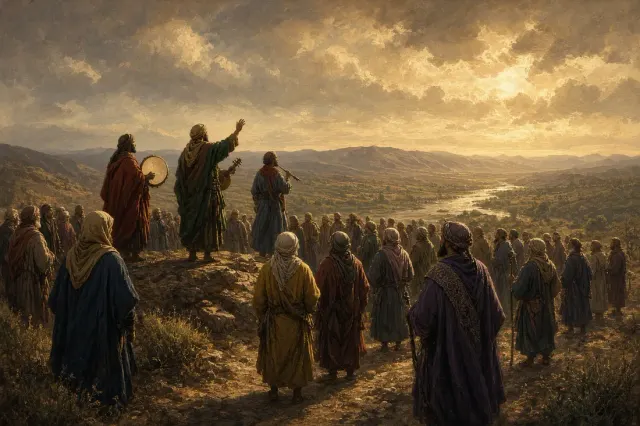
The opening summons every people to clap and raise a shout of joy. The Lord Most High is fearsome in greatness and king over the entire earth. The singers celebrate his defeat of nations beneath them and his choice of an inheritance for the people he loves. This is praise from a people who see their place as given by God. Yet the opening audience is wider than that one community. The same king who chooses their share claims the honour of all peoples.
In everyday life
The village musician raises his hands to gather applause at the opening of a shared public hall. Families from several neighbourhoods fill the room, though one group first received the land for it. He names the donor whose gift made their gathering possible. The welcome reaches beyond the first recipients. The psalm praises worldwide divine kingship and also celebrates conquest.
Notice
Psalms 47:4 God chooses the inheritance rather than the people claiming it solely by force. Their place is presented as a gift linked with his love.
Psalms 47:1-4
King James Version1O clap your hands, all ye people; shout unto God with the voice of triumph.
2For the LORD most high is terrible; he is a great King over all the earth.
3He shall subdue the people under us, and the nations under our feet.
4He shall choose our inheritance for us, the excellency of Jacob whom he loved. Selah.
Psalms 47:5-7
Music Welcomes the Ascending King
God is pictured going up amid shouts and trumpet sound. Repeated calls to sing give the scene a full public voice. The singers name him as their king, then immediately widen the claim: he rules the whole earth. They are told to sing with understanding, so the sound is joined to recognition of whom they praise. The poem does not explain every detail of the ascent. Its focus is the honour due to the king whose rule reaches beyond the worshippers' own borders.

In everyday life
A brass-band leader lifts her trumpet as the gathered musicians stand for a formal welcome. She has explained the reason for the ceremony before rehearsing the fanfare. Now the full sound carries shared recognition rather than noise without meaning. The players know whom the music honours. The psalm's ascending king is God, not a visiting human dignitary.
Notice
Psalms 47:7 Understanding is requested alongside repeated singing. The praise is meant to engage recognition of God's rule as well as the voice and instruments.
Psalms 47:5-7
King James Version5God is gone up with a shout, the LORD with the sound of a trumpet.
6Sing praises to God, sing praises: sing praises unto our King, sing praises.
7For God is the King of all the earth: sing ye praises with understanding.
Psalms 47:8-9
Rulers Gather Beneath One Throne
The Lord reigns over the nations from a holy throne. Their princes gather with the people associated with Abraham's God. The psalm then says that the earth's shields belong to God, using protection and power as a picture of earthly rulers. Their authority does not place them outside his ownership. The ending lifts him high above the gathered powers. What began with a call to all peoples ends with their leaders included under the same divine rule, rather than standing as rival centres of ultimate strength.

In everyday life
A team of district fire chiefs places its helmets on a long bench before a joint briefing. Each commands a separate crew, but the map before them covers a danger none can manage as an isolated unit. They listen under a shared command. Their local authority remains real but limited. God's rule owns every earthly power, not merely a joint operation.
Notice
Psalms 47:9 The shields belong to God. The image places protective power itself under his rule, so even those who guard others remain subject to him.
Psalms 47:8-9
King James Version8God reigneth over the heathen: God sitteth upon the throne of his holiness.
9The princes of the people are gathered together, even the people of the God of Abraham: for the shields of the earth belong unto God: he is greatly exalted.
Details worth noticing
The opening image
Psalms 47:1 begins with “O clap your hands, all ye people; shout unto God with the voice of triumph.”
Where the chapter turns
Psalms 47:5 forms a natural hinge: “God is gone up with a shout, the LORD with the sound of a trumpet.”
The final note
Psalms 47:9 leaves the reader with “The princes of the people are gathered together, even the people of the God of Abraham: for the shields of the earth belong unto God: he is greatly…”
A word trail through the chapter
The words praises, sing, people, earth, King, LORD help reveal the chapter’s repeated concerns.
KJV words made clear
- terrible
- Awe-inspiring and fearsome in greatness, rather than morally bad.
Music and video connected to the passage
Related media appears when its Scripture reference overlaps this study. Music and video can illuminate a theme while the biblical text remains the foundation.