The big picture
The psalm speaks of living under God's shelter and trusting him as a strong refuge. A voice then addresses the protected person with assurances against traps, disease, weapons, and dangerous creatures. Angels are described as guardians along the way. In the closing lines, God himself promises rescue, a hearing, and presence in trouble. The assurances are sweeping, yet the final promise still names trouble as a place where divine company is needed.
In this chapter
- A Stronghold with Protective Wings Psalms 91:1-4
The opening describes someone dwelling close to the Most High under his protective shadow.
- Terror Does Not Hold the Final Claim Psalms 91:5-8
The assurances cover night and day: hidden terror, flying arrows, disease in darkness, and destruction at noon.
- Guardians Keep the Path Psalms 91:9-13
Because the person has made the Lord a dwelling place, the voice promises protection from evil and plague.
- God Promises Presence and an Answer Psalms 91:14-16
God now speaks directly about the person who loves him and knows his name.
Central truth
The person who trusts God is promised shelter and rescue, with the final assurance that God will answer and remain present in trouble.


Scripture beside the summary
Psalms · King James Version · 16Psalms 91:1-4
A Stronghold with Protective Wings
The opening describes someone dwelling close to the Most High under his protective shadow. The speaker claims the Lord personally as refuge and fortress. Assurance follows that God will rescue from the bird-catcher's trap and deadly disease. Feathers and wings give the shelter a tender image, while divine faithfulness becomes a shield. The pictures combine strength with close care. This is not safety produced by the protected person's own resources. The confidence rests on the character and presence of the God in whom trust is placed.

In everyday life
A rescue volunteer draws a soaked child beneath a broad shelter sheet while others secure the damaged campsite. She stays close enough to keep the covering in place as wind pushes at its edges. The child receives both a barrier and attentive care. Shelter is more than being told to feel safe. The psalm's protection belongs to God and reaches beyond one storm.
Notice
Psalms 91:4 Wings and shield appear together. The verse combines tender closeness with defensive strength, giving two different pictures of the same trusted care.
Psalms 91:1-4
King James Version1He that dwelleth in the secret place of the most High shall abide under the shadow of the Almighty.
2I will say of the LORD, He is my refuge and my fortress: my God; in him will I trust.
3Surely he shall deliver thee from the snare of the fowler, and from the noisome pestilence.
4He shall cover thee with his feathers, and under his wings shalt thou trust: his truth shall be thy shield and buckler.
Psalms 91:5-8
Terror Does Not Hold the Final Claim
The assurances cover night and day: hidden terror, flying arrows, disease in darkness, and destruction at noon. Even vast numbers falling nearby will not bring the same fate to the addressed person. He will see the judgement of the wicked. The words give a broad and firm promise of God's care. It speaks confidence into a world where dangers fill every hour. The psalm does not describe a small precaution against one isolated risk; it places life under the care of the refuge already named.

In everyday life
An emergency-shelter worker sits with families as reports of widespread danger arrive through the night. She checks that each person has a safe place to rest and stays at the door during the morning shift change. The threats outside remain serious, but care continues across the hours. The psalm's sweeping assurance of divine protection exceeds any shelter's guarantee.
Notice
Psalms 91:6 Darkness and noon both appear in the list of dangers. The promise is framed across the full day rather than limited to hours when threats are visible.
Psalms 91:5-8
King James Version5Thou shalt not be afraid for the terror by night; nor for the arrow that flieth by day;
6Nor for the pestilence that walketh in darkness; nor for the destruction that wasteth at noonday.
7A thousand shall fall at thy side, and ten thousand at thy right hand; but it shall not come nigh thee.
8Only with thine eyes shalt thou behold and see the reward of the wicked.
Psalms 91:9-13
Guardians Keep the Path
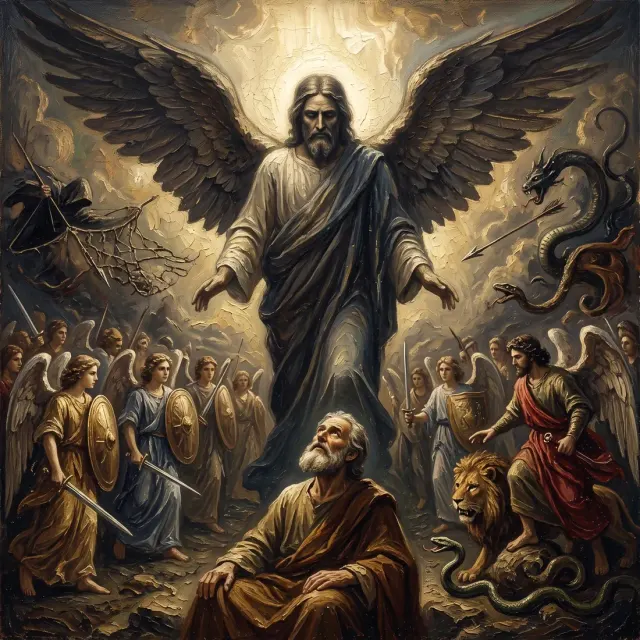
Because the person has made the Lord a dwelling place, the voice promises protection from evil and plague. God commands angels to guard the person's ways and bear him up against a stumbling stone. Lions and poisonous creatures are then pictured underfoot rather than overcoming him. The sequence moves from home to path and from disease to attack. Every picture attributes care to God's command. The person is protected as one who has chosen refuge in him, not presented as independently invulnerable or able to command the guardians.

In everyday life
A mountain guide assigns two experienced helpers to steady a walker across a narrow rocky stretch. One watches the next foothold while the other holds the safety line. The walker follows their direction instead of claiming the path has no danger. Their care comes through the guide's arrangement. The psalm describes angels guarding under God's command.
Notice
Psalms 91:11 The angels receive their charge from God. The focus is divine initiative in guarding the person, rather than an instruction to seek control over heavenly beings.
Psalms 91:9-13
King James Version9Because thou hast made the LORD, which is my refuge, even the most High, thy habitation;
10There shall no evil befall thee, neither shall any plague come nigh thy dwelling.
11For he shall give his angels charge over thee, to keep thee in all thy ways.
12They shall bear thee up in their hands, lest thou dash thy foot against a stone.
13Thou shalt tread upon the lion and adder: the young lion and the dragon shalt thou trample under feet.
Psalms 91:14-16
God Promises Presence and an Answer
God now speaks directly about the person who loves him and knows his name. He promises rescue and a secure place. When that person calls, God will answer and be with him in trouble. Deliverance and honour follow, along with satisfying length of life and the sight of divine rescue. The closing voice makes the earlier assurances personal. Trouble is still named, so the final picture is not merely a world without difficulty. It is a relationship in which the one called upon stays present and acts.
In everyday life
The long-term support worker answers a frightened client's call after another setback. She reminds him of the plan they made and stays with him through the next appointment. He is not promised that no hard day will ever return. The help includes her presence inside the difficult day. God's promise also includes rescue, honour, and satisfying life.
Notice
Psalms 91:15 Presence in trouble is stated before deliverance from it. The promise includes God's company during distress, not only the condition after rescue.
Psalms 91:14-16
King James Version14Because he hath set his love upon me, therefore will I deliver him: I will set him on high, because he hath known my name.
15He shall call upon me, and I will answer him: I will be with him in trouble; I will deliver him, and honour him.
16With long life will I satisfy him, and shew him my salvation.
Details worth noticing
The opening image
Psalms 91:1 begins with “He that dwelleth in the secret place of the most High shall abide under the shadow of the Almighty.”
Where the chapter turns
Psalms 91:8 forms a natural hinge: “Only with thine eyes shalt thou behold and see the reward of the wicked.”
The final note
Psalms 91:16 leaves the reader with “With long life will I satisfy him, and shew him my salvation.”
A word trail through the chapter
The words deliver, High, lion, LORD, nigh, pestilence help reveal the chapter’s repeated concerns.
KJV words made clear
- fowler
- A person who traps or catches birds.
- pestilence
- A deadly outbreak of disease spreading among people.
- buckler
- A protective shield carried against attack.
Music and video connected to the passage
Related media appears when its Scripture reference overlaps this study. Music and video can illuminate a theme while the biblical text remains the foundation.