

The big picture
Paul now applies the priority of love to what happens when the church gathers and people speak. Prophecy is preferred to an uninterpreted tongue for a simple reason: the congregation can understand it and be built up. Instruments, military signals, ordinary languages, prayer, song, and even the outsider walking into worship all make the same point from different angles. Audible sound is not enough. Meaning has to reach someone. Paul therefore regulates tongues and prophecy without abolishing either, requiring interpretation, evaluation, limits on speakers, and the willingness to be silent when order demands it. The disputed instruction about women's speech must be held beside the earlier reference to women praying and prophesying rather than allowed to erase it. The chapter ends with a balance Corinth needs badly: desire prophecy, do not forbid tongues, and let everything be done decently and in order.
Central truth
Paul orders the gathered church's speech toward intelligible instruction and shared strengthening, requiring interpretation, discernment, and self-control rather than competitive spiritual display.
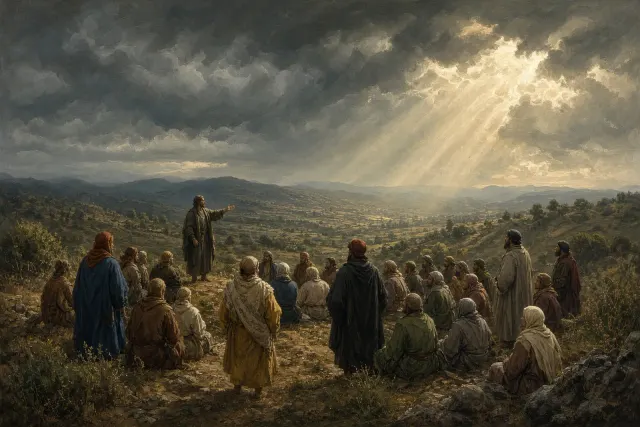

The study notes have a page of their own
The movement by movement analysis, the words to trace, the verse by verse notes and where readers differ are written for someone studying alone. They are on the Deep Personal Reflections page for this chapter. This page is the lesson.
A chapter-specific teaching brief
These anchors come from this chapter itself. They help a teacher use the Level 1 overview, the Level 2 study, and the Scripture text as one lesson.
Open with the chapter’s first image
1 Corinthians 14:1: “Follow after charity, and desire spiritual gifts, but rather that ye may prophesy.”
Slow down at the turning point
1 Corinthians 14:23: “If therefore the whole church be come together into one place, and all speak with tongues, and there come in those that are unlearned, or unbelievers, will…”
Keep this word trail visible
speaketh, tongue, tongues, church, understanding, unknown
What to explain, in order
Teach the passage in this order. Each step names the verses it rests on, so every point can be shown in the text before it is applied.
1 Corinthians 14:1-5
The rule of edification
Start with the word that governs the chapter. Explain "edification" as building up, like the building of a house. Count with the class how often Paul uses it and its forms in 14:3-26. Then read 14:1-5: tongues speak to God and edify the speaker; prophecy speaks to people and edifies the church. Explain "unknown tongue" as speech not understood by the hearers. Teach this first because every instruction later in the chapter is measured by the same rule, which Paul states at the end of the gatherings paragraph: "Let all things be done unto edifying" (14:26).
1 Corinthians 14:6-19
Sound that communicates
Read the comparisons of 14:7-11: pipe and harp, trumpet, foreign language. Explain "barbarian" (14:11) as one who speaks a language another cannot follow. Then read 14:13-19 and show Paul's own practice: praying and singing "with the spirit" and "with the understanding also" (14:15). Point out the Amen of 14:16 as the hearer's participation. Teach this step second because it gives the reason for the rule: worship in the assembly is shared, so what is said must be understood by others, and Paul is willing to measure even his own gift by that.
1 Corinthians 14:20-25
Two visitors
Read 14:20 and its contrast between children in malice and adults in understanding. Then read Isaiah 28:11-12 before 14:21, so that the class sees the sign of other tongues came to a people who "would not hear". Explain verse 22 carefully and say that it is one of the hardest in the chapter; let the two scenes of 14:23-25 explain it. Teach this step here because it moves the argument from believers to outsiders and shows that intelligible worship is not only for the church's own benefit but for the visitor who may meet God there.
1 Corinthians 14:26-33
Make room, take turns
Read 14:26 and its picture of a gathering where each one brings something: a psalm, a teaching, a tongue, a revelation, an interpretation. Then the limits for tongues (14:27-28) and prophecy (14:29-31). Explain "by course" as in turn, and "judge" in 14:29 as weigh or test what is said. Read 14:32-33 and explain that the speaker remains in control. Teach this step as the practical centre of the chapter: Paul does not abolish participation to cure disorder; he orders it so that "all may learn, and all may be comforted" (14:31).
1 Corinthians 14:34-38
The instruction to women and the authority of the letter
Read 14:34-35 as written and do not soften or hide it. Then read 11:5 beside it, where women pray and prophesy in worship. Present the main readings fairly: Paul restricts disruptive questioning during the meeting, since "let them ask their husbands at home" points to learning; or he restricts women from the weighing of prophecies just described in 14:29; or he gives a broader restriction on women speaking in the assembly, which some traditions apply to preaching and teaching. Say that traditions practise this differently. Then read 14:36-38, Paul's claim that he writes "the commandments of the Lord".
1 Corinthians 14:39-40
Decently and in order
Close with Paul's own summary. "covet to prophesy, and forbid not to speak with tongues" (14:39), and "Let all things be done decently and in order" (14:40). Explain "decently" as fittingly. Show that Paul refuses both errors: banning the gifts to keep things quiet, and defending disorder as spiritual freedom. Teach this last, because it gathers three chapters into one sentence: gifts given by one Spirit (12), used in love (13), for building up the church in an orderly way (14).
Where learners get stuck
The misreadings this passage tends to produce, and how to answer each from the text.
"Paul thinks speaking in tongues is bad."
Paul says "I would that ye all spake with tongues" (14:5), "I thank my God, I speak with tongues more than ye all" (14:18), and "forbid not to speak with tongues" (14:39). His concern is the use of uninterpreted tongues in the gathered church, where others cannot understand and are not built up (14:17, 14:19). Traditions differ on whether tongues continue today; this chapter cannot be used to say Paul despised them.
"When the Spirit moves me I cannot help it, so order would quench the Spirit."
Paul answers this directly: "the spirits of the prophets are subject to the prophets" (14:32). A tongue speaker without an interpreter is to "keep silence in the church" (14:28), and a prophet is to stop when another receives a revelation (14:30). The reason is the character of God himself: "God is not the author of confusion, but of peace" (14:33). The Spirit's gifts are given for others' good and are used with self-control.
"The women passage proves Paul did not let women take part in worship at all."
In 11:5 Paul assumes women pray and prophesy in the gathering and only regulates how. So 14:34-35 must be read in a way that fits that. Traditions differ: some see a restriction on disruptive questions, some a restriction on judging prophecies (14:29), some a wider limit on women's speaking or teaching in the assembly, applied in different ways. Every reading must account for both passages. Present them honestly and do not caricature those who hold another view.
"Tongues are a sign, so they prove to unbelievers that God is real."
Verse 22 says tongues are "for a sign, not to them that believe, but to them that believe not", but Paul quotes Isaiah 28 where strange tongues were a sign of judgment on a people who refused to listen (14:21). The next verses show the actual effect of uninterpreted tongues on an unbeliever: "will they not say that ye are mad?" (14:23). It is prophecy, understood speech, that convinces and leads to worship (14:24-25). Read verse 22 through the scenes Paul gives to explain it.
Learning objectives
- Explain why prophecy benefits the gathering more than uninterpreted tongues.
- Apply the instrument comparisons to intelligible speech.
- Explain why another worshipper must understand the thanksgiving.
- Compare outsiders' responses to the two imagined gatherings.
- Identify rules for interpreting, taking turns, and judging contributions.
- Distinguish the chapter's silence instructions without erasing 11:5.
Teacher preparation
- Read 1 Corinthians 13:13–14:40; mark every appeal to edification so the disputed details do not swallow Paul's stated purpose.
- Explain 'edification' as building up, 'by course' as in turn, and 'unlearned' as unfamiliar with the proceedings, not unintelligent.
- Prepare an invented meeting agenda with overlapping contributions, an uninterpreted tongue, and no opportunity for discernment; ask for textual revisions, not a reenactment.
- Read Isaiah 28:11–13 before teaching 14:21–25; distinguish a sign involving judgment and failed hearing from a guaranteed persuasive demonstration.
- Place 11:5 beside 14:34–35 and list interpretations of the speech restricted; do not hide either passage or present a proposed reconstruction as the missing transcript.
Evidence and interpretation checks
Explicit
Mark 1 Corinthians 14:5,27–29,39–40: interpretation enables shared benefit, contributions require order and discernment, and Paul does not simply forbid tongues.
Scripture-supported
Compare Isaiah 28:11–12 with 1 Corinthians 14:21; Paul's citation includes people not hearing, so 'sign' cannot automatically mean successful persuasion.
Strong inference
Infer from 1 Corinthians 14:16–19 that understandable speech enables another person's participation, not merely the delivery of information; the listener must be able to say Amen.
Possible or traditional reading
Compare readings restricting disruptive questions, the weighing of prophecy, or a broader category of women's speech in 1 Corinthians 14:34–35; require engagement with 11:5.
Limit
Do not claim 1 Corinthians 14:34–35 supplies a transcript of the disruption; nor does 14:32 permit speakers to excuse disorder as behaviour beyond their control.
Discussion with answer guidance
1. Why does Paul prefer prophecy while making an exception for interpreted tongues?
What a good answer contains
Because in the assembly what matters is that the church is built up, and that requires understanding. "He that speaketh in an unknown tongue edifieth himself; but he that prophesieth edifieth the church" (14:4). Prophecy speaks "unto men to edification, and exhortation, and comfort" (14:3). The exception follows: tongues interpreted serve the church just as well, "except he interpret, that the church may receive edifying" (14:5). A good answer keeps Paul's positive words about tongues: "I would that ye all spake with tongues" (14:5), "I speak with tongues more than ye all" (14:18), and "forbid not to speak with tongues" (14:39). A weak answer says Paul despised tongues.
Show teacher guidance
Use 14:1–6: the church receives edification through understandable communication. Correct the claim that Paul despises tongues; retain 14:18,39.
2. What do the pipe, harp, and uncertain trumpet have in common?
What a good answer contains
Each makes sound, and none is any use unless the sound can be told apart. "except they give a distinction in the sounds, how shall it be known what is piped or harped?" (14:7). "For if the trumpet give an uncertain sound, who shall prepare himself to the battle?" (14:8). Then Paul applies it: "except ye utter by the tongue words easy to be understood, how shall it be known what is spoken? for ye shall speak into the air" (14:9). A good answer sees that meaning, not volume or intensity, is what helps the hearer. A weak answer turns the comparison into a rule about musical styles in worship, which is not Paul's subject.
Show teacher guidance
Read 14:7–11. Sound must communicate a discernible meaning; volume cannot repair an unintelligible signal. Do not turn the comparison into a rule about musical styles.
3. Why does the other person's Amen matter more than the speaker's word count?
What a good answer contains
Because the Amen is the sign that another believer has understood and joined in. "how shall he that occupieth the room of the unlearned say Amen at thy giving of thanks, seeing he understandeth not what thou sayest?" (14:16). Explain "unlearned" as one not familiar with what is going on, not unintelligent. "thou verily givest thanks well, but the other is not edified" (14:17). Paul would "rather speak five words with my understanding, that by my voice I might teach others also, than ten thousand words in an unknown tongue" (14:19). A good answer keeps both spirit and understanding (14:15). A weak answer sets devotion against the mind.
Show teacher guidance
Connect 14:13–19: understanding permits participation and teaching. Keep prayer and song with both spirit and understanding, rather than opposing devotion to thought.
4. Why do the two imagined gatherings produce such different responses from outsiders?
What a good answer contains
Because one gathering sounds like noise and the other speaks to the heart. If all speak in tongues and an outsider comes in, "will they not say that ye are mad?" (14:23). If all prophesy, the unbeliever "is convinced of all, he is judged of all" (14:24), the secrets of his heart are revealed, and "falling down on his face he will worship God, and report that God is in you of a truth" (14:25). A good answer reads verse 22 in light of these two scenes and of Isaiah 28:11-12, where foreign speech was a sign of judgment on those who would not hear. A weak answer lifts "sign" out of the paragraph and makes tongues an evangelistic proof.
Show teacher guidance
Read 14:21–25 together. Contrast the judgment of madness with conviction and worship; do not isolate 'sign' in verse 22 from either scene.
5. What limits apply to tongues and prophecy in the assembly?
What a good answer contains
Order, turns, interpretation and discernment. Tongues: "by two, or at the most by three, and that by course; and let one interpret" (14:27), and if no interpreter, silence (14:28). Prophecy: "Let the prophets speak two or three, and let the other judge" (14:29), with the first speaker yielding to a new revelation (14:30). The reason: "the spirits of the prophets are subject to the prophets" (14:32) and "God is not the author of confusion, but of peace" (14:33). A good answer sees that speakers remain responsible for what they do. A weak answer claims that the Spirit's prompting cannot be restrained.
Show teacher guidance
Collect 14:26–33: interpretation, two or three speakers, turns, judging, and yielding. Reject the claim that an asserted spiritual impulse removes responsibility for conduct.
6. Who receives silence instructions, and which earlier passage matters when reading the instruction to women?
What a good answer contains
Three groups receive a word about silence: the tongue speaker with no interpreter (14:28), the prophet when another receives a revelation (14:30), and the women in 14:34-35. Paul writes, "Let your women keep silence in the churches", and adds, "if they will learn any thing, let them ask their husbands at home" (14:35). A good answer states the instruction honestly and also recalls 11:5, where women pray and prophesy. Traditions read the scope of the silence differently: disruptive questions, the weighing of prophecy, or a broader restriction. A weak answer either hides one passage or treats its own reconstruction as certain.
Show teacher guidance
Distinguish 14:28,30,34–35 and retain women praying or prophesying in 11:5. State the restriction honestly while labelling proposed explanations of its scope.
Responsible application
Heart and habits
Ask learners to revise a fictional speaker's preference for impressive obscurity into a contribution another worshipper can understand and use.
Relationships and community
Have the group repair the invented meeting agenda using interpretation, turns, and discernment; preserve participation rather than solving disorder by cancelling every contribution.
Room for the listener
Invite a plan for explaining unfamiliar vocabulary to a visitor without treating unfamiliarity as inferiority; use 14:16–19.
Session plans
Two timings of the same lesson. The shorter keeps the reading, the central discussion and one response; the longer gives the confusions and the application their own time.
45 minutes
An uncertain trumpet
Read 14:7-9 and ask what a trumpet call must do. Take question two.
Five words that help
Read 14:1-19. Take questions one and three and the confusion that Paul thinks tongues are bad.
Two visitors
Read Isaiah 28:11-12 and 1 Corinthians 14:20-25. Take question four and the sign confusion.
Turns and testing
Read 14:26-33. Take question five and the confusion about not being able to help it.
The hard verses, and order
Read 14:34-40 with 11:5. Take question six and the confusion about women. Hand out the sheet and pray.
90 minutes
Can you understand me
Read a sentence aloud in a language the group does not know, then the same sentence in their own. Ask what changed. Read 14:9.
Edification
Read 14:1-6. Take question one and the confusion that Paul thinks tongues are bad. Count the uses of "edify".
Pipe, harp, trumpet
Read 14:7-12. Take question two. Explain "barbarian".
Spirit and understanding
Read 14:13-19. Take question three and explain "unlearned".
Two visitors
Read Isaiah 28:11-12 and 1 Corinthians 14:20-25. Take question four and the sign confusion.
Make room, take turns
Read 14:26-33. Take question five and the confusion about not being able to help it. Repair the invented meeting agenda.
The women passage
Read 11:5 and then 14:34-38. Take question six and the confusion about women. Present each reading fairly and let the group say what each must explain.
Decently and in order
Read 14:39-40. Read the key verse together, point to the take-home line, and pray for the church's gatherings.
Adapting the lesson
Children
Play a short game: one child gives instructions in made-up words, then in clear words, and the group sees which helps. Read 14:9 and 14:26 simply: when we meet together, we speak so others can understand and be helped. Talk about taking turns and listening. Leave out the debates about tongues and women's silence for young children.
Youth
Youth may have strong experiences or strong opinions about tongues and prophecy. Let them find Paul's rule themselves in 14:12 and 14:26. Ask how their own gatherings help or confuse a visitor. Teach 14:34-35 honestly with 11:5 and present the readings fairly; many will have heard only one. Do not mock any church's practice.
Adults
Adults can follow the chapter's structure and should be given its main rule before its disputed details. Present the traditions on tongues and prophecy today, and the readings of 14:34-35, fairly and without ranking them, and say where your own church stands without dismissing others. Ask how the church's gatherings could better serve understanding, participation and the visitor.
One to one
Ask the person what they have experienced of tongues, prophecy or worship that confused or helped them. Listen without judging. Read 14:12 and 14:26 and ask what would build them up when the church meets. If their question is about 14:34-35, read it with 11:5, explain the readings honestly, and encourage them to ask their own church leaders how they understand it.
Song and video learning lab
A song or video may interpret, compress, or dramatize the text. Its value becomes clearer when its choices are compared with Scripture.
- Before the media: the exact passage and its central movement.
- During the media: the words, people, events, and emotions the artist emphasizes.
- After the media: what it clarifies, what it leaves out, and what belongs back in the biblical text.
Handout
One page for learners to take home. The print button prints this section alone.
1 Corinthians 14
The passage in brief
In 1 Corinthians 14 Paul teaches the church how to use spiritual gifts when it gathers. Speech in an unknown tongue needs interpretation, because what helps the church is speech that others can understand. Prophecy builds up, encourages and comforts. Speakers should take turns, and what is said should be weighed. Paul also gives an instruction about women keeping silence, which Christians understand in different ways. God is not a God of confusion but of peace, so everything must be done in order and for building up.
A verse to keep
For God is not the author of confusion, but of peace, as in all churches of the saints.
1 Corinthians 14:33 · King James Version
Questions to take home
Why does Paul say speech in church must be understood by others (14:6-19)?
What limits does Paul give for tongues and prophecy in 14:27-32?
What does it mean that God is not the author of confusion, but of peace?
This week
At your next church gathering, offer one thing that helps someone else understand or take part, and listen well to others.
Music and video connected to the passage
No exact media match is cataloged for this passage yet. New material can be connected when it becomes available.