The big picture
The Book of 1 Corinthians reaches its longest sustained argument by asking what is left if resurrection is removed from the gospel. Paul begins with the proclamation Corinth already received, then follows denial until preaching, faith, forgiveness, apostolic testimony, and hope for the dead all collapse with it. His answer is not that death has become unimportant, but that Christ is risen as firstfruits and death itself is the last enemy to be destroyed. The question of the resurrection body then receives images of seed, created variety, corruption giving way to incorruption, and the earthly image giving way to the heavenly. Both the dead and the living require transformation. The chapter ends by turning that future victory back toward present labor: because death will not keep what it takes, work in the Lord is not empty.
Central truth
Christ's resurrection is the firstfruits of his people's bodily resurrection, assuring death's defeat and making steadfast labour in the Lord worthwhile.

The study notes have a page of their own
The movement by movement analysis, the words to trace, the verse by verse notes and where readers differ are written for someone studying alone. They are on the Deep Personal Reflections page for this chapter. This page is the lesson.
A chapter-specific teaching brief
These anchors come from this chapter itself. They help a teacher use the Level 1 overview, the Level 2 study, and the Scripture text as one lesson.
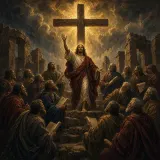
Open with the chapter’s first image
1 Corinthians 15:1: “Moreover, brethren, I declare unto you the gospel which I preached unto you, which also ye have received, and wherein ye stand;”
Slow down at the turning point
1 Corinthians 15:29: “Else what shall they do which are baptized for the dead, if the dead rise not at all? why are they then baptized for the dead?”
Keep this word trail visible
Christ, dead, raised, body, glory, vain
What to explain, in order
Teach the passage in this order. Each step names the verses it rests on, so every point can be shown in the text before it is applied.
1 Corinthians 15:1-11
The gospel received and handed on
Begin with the vocabulary of tradition: "delivered", "received", "first of all" (15:3). Paul is not inventing; he hands on what was handed to him. Write the four verbs on the board: died, buried, rose, seen. Explain "according to the scriptures" as fulfilling the Old Testament, and read Isaiah 53:5 and Psalm 16:10 as examples. Then list the witnesses, and explain "born out of due time" (15:8) as one born abnormally or late. Teach this first because the rest of the chapter argues from this gospel; the Corinthians accepted Christ's resurrection but doubted their own.
1 Corinthians 15:12-19
If Christ be not risen
Read 15:12 and name the problem: "some among you" said there is no resurrection of the dead. Then build the chain on the board, one consequence per line, with the repeated "if" and "vain". Explain "vain" as empty or useless. Let the class feel the force of 15:17, "ye are yet in your sins", and 15:19. Teach this second because Paul wants his hearers to see the cost of the denial before he gives the answer. The stakes are not abstract: forgiveness, the honesty of the apostles, and the hope of those who have died are all on the line.
1 Corinthians 15:20-28
But now is Christ risen
Read 15:20 with emphasis on "But now". Then explain firstfruits from Leviticus 23:10-11 and the Adam and Christ comparison of 15:21-22. Read the order of 15:23-24, and then the reign of 15:25-28, with Psalm 110:1 and Psalm 8:6 behind it. Explain "put down" as abolish. Mark death as "The last enemy" (15:26). Explain 15:28 as Paul does, the Son's handing over of the kingdom so that "God may be all in all", and note that traditions explain this verse within their confession of the Son's full deity. Teach this as the turning point.
1 Corinthians 15:29-34
Why risk anything
Read 15:29 and say plainly: no one knows for certain what this practice was. Proposals include proxy baptism for believers who died unbaptised, baptism in hope of reunion with believers who had died, and others; Paul mentions it without approving it. Then read 15:30-32 and explain "fought with beasts" as either literal or a figure for violent opponents. Explain "evil communications corrupt good manners" (15:33) as bad company corrupts good character. Teach this here as Paul's practical argument, and close on 15:34, "Awake to righteousness", which shows that denial of resurrection was changing how the Corinthians lived.
1 Corinthians 15:35-49
Sown and raised
Hold up a seed and a picture of the grown plant. Read 15:35-38 and explain "quickened" as made alive. Then read the kinds of flesh and glory in 15:39-41, and the four contrasts of 15:42-44. Explain "spiritual body" as a body fully given life by the Spirit, not a body made of spirit. Then read 15:45-49 and the two Adams. Teach this step after the argument of 15:12-34, because Paul answers the objector's question in 15:35 only after showing that resurrection is certain; here he shows that it is not crude, either.
1 Corinthians 15:50-58
Death swallowed up, therefore keep working
Read 15:50 and explain "flesh and blood" as human nature as it is now, mortal and corruptible. Then 15:51-53, the mystery of change for both the dead and the living. Read Isaiah 25:8 and Hosea 13:14 behind 15:54-55, and explain the sting of death as sin, and sin's strength as the law (15:56). Then let 15:57 be thanksgiving, and read 15:58 as the whole chapter's conclusion. Teach this last, and slowly, so the class sees that the deepest hope of the letter lands in ordinary faithful work, in a city where they had wondered whether any of it mattered.
Where learners get stuck
The misreadings this passage tends to produce, and how to answer each from the text.
"When we die we become spirits in heaven, and that is the whole hope."
Paul's hope is resurrection of the body: "It is sown a natural body; it is raised a spiritual body" (15:44), and "this mortal must put on immortality" (15:53). The model is Christ, who was buried and rose (15:4) and is "the firstfruits of them that slept" (15:20). Paul elsewhere speaks of being with Christ after death (Philippians 1:23), but the hope of this chapter is the raising of the dead at Christ's coming (15:23, 15:52). A spiritual body is a body given life by the Spirit, not the absence of a body.
"Baptism for the dead means we should be baptized on behalf of people who have died."
Paul mentions the practice to make an argument, "what shall they do which are baptized for the dead, if the dead rise not at all?" (15:29), and he speaks of "they", not "we". Nowhere does he command or approve it, and no other passage of Scripture describes it. Its meaning is uncertain, and many proposals exist. A teacher should say so honestly and keep the verse in the role Paul gives it: one of several examples showing that denying the resurrection makes Christian practice pointless.
"If there is a resurrection, what I do in my body now does not matter."
Paul draws the opposite conclusion. Because the dead are raised, "Awake to righteousness, and sin not" (15:34), and "be ye stedfast, unmoveable, always abounding in the work of the Lord" (15:58). Earlier he said the body is for the Lord because "God hath both raised up the Lord, and will also raise up us" (6:14). The resurrection gives the body and its work lasting meaning. Present labour is "not in vain in the Lord".
"Paul expected Jesus to come back in his lifetime, so he was wrong."
Paul says "We shall not all sleep, but we shall all be changed" (15:51), which includes both those alive at Christ's coming and those who have died. He does not give a date, and elsewhere he says the day comes "as a thief in the night" (1 Thessalonians 5:2). Living as though the Lord might come soon is the stance Jesus himself taught (Mark 13:32-33). Traditions read Paul's "we" in different ways; none needs to make him set a date he never set.
Learning objectives
- State the gospel Paul received and delivered.
- Trace the consequences of denying resurrection.
- Explain firstfruits and the order Paul describes.
- Explain why verse 29 does not command proxy baptism.
- Explain bodily transformation through the seed and Adam comparisons.
- Connect victory over death with steadfast work.
Teacher preparation
- Read 1 Corinthians 15:1–58 in five movements: gospel, denial, firstfruits, transformed bodies, and victory; reserve time for 'Therefore'.
- Use a seed and mature-plant picture; explain Paul's analogy of continuity and transformation, not a complete biological explanation.
- Explain 'quickened' as made alive and 'incorruption' as freedom from decay; keep 'spiritual body' distinct from 'no body'.
- Mark disputed 'baptized for the dead' in 15:29 and literal or figurative beasts in 15:32; neither uncertainty overturns the argument surrounding it.
- Prepare a fictional discouraged worker for application; do not require bereavement accounts, promise immediate relief, or use resurrection to rebuke grief.
Evidence and interpretation checks
Explicit
Mark 1 Corinthians 15:3–8,20–23: Paul names Christ's death for sins, burial, resurrection, appearances, and the future resurrection of those who belong to him.
Scripture-supported
Compare Isaiah 25:8 with 1 Corinthians 15:54; the promised swallowing of death is brought to pass when mortality puts on immortality.
Strong inference
Infer from 'vain' in 1 Corinthians 15:14,17 and 'not in vain' in 15:58 that resurrection grounds both the gospel's truth and the worth of labour.
Possible or traditional reading
Label proxy baptism and readings connected with believers facing death as proposals for 1 Corinthians 15:29; distinguish description from endorsement.
Limit
Do not claim 1 Corinthians 15:29 commands baptism for deceased people, or 15:50–53 teaches bodily abandonment; Paul explicitly describes bodies changed and raised.
Discussion with answer guidance
1. What does Paul deliver, and why does he name witnesses and his own past?
What a good answer contains
He delivers the gospel he himself received: "that Christ died for our sins according to the scriptures; And that he was buried, and that he rose again the third day according to the scriptures" (15:3-4). Then he lists the appearances: Cephas, the twelve, more than five hundred at once, James, all the apostles, and last Paul himself (15:5-8). The witnesses are named because the resurrection is a public event that could be checked, many of them still alive (15:6). His own past as persecutor shows grace at work (15:9-10). A good answer adds 15:11: "so we preach, and so ye believed". A weak answer makes this a private vision of Paul's.
Show teacher guidance
Use 15:1–11: received gospel, appearances, former persecution, and transforming grace. Correct the claim that Paul invents a private message different from the other apostles.
2. What collapses if the dead do not rise?
What a good answer contains
Everything Paul lists. If there is no resurrection of the dead, "then is Christ not risen" (15:13); preaching and faith are "vain" (15:14); the apostles are "false witnesses of God" (15:15); "ye are yet in your sins" (15:17); those who died in Christ "are perished" (15:18); and "If in this life only we have hope in Christ, we are of all men most miserable" (15:19). A good answer follows the chain one link at a time and sees that the Corinthians' denial of the future resurrection unravels Christ's own. A weak answer treats resurrection as a pleasant extra to the Christian faith, instead of the hinge it all turns on.
Show teacher guidance
Trace 15:12–19: Christ's resurrection, apostolic testimony, effective faith, release from sins, and hope for the dead. Let the argument's stakes stand; this is not a decorative doctrine.
3. What does firstfruits promise, and which enemy is destroyed last?
What a good answer contains
Firstfruits promises a harvest of the same kind. "But now is Christ risen from the dead, and become the firstfruits of them that slept" (15:20). Explain firstfruits as the first sheaf, offered to God as the pledge of the rest (Leviticus 23:10). The order follows: "Christ the firstfruits; afterward they that are Christ's at his coming" (15:23). Then the end, when every enemy is put down, and "The last enemy that shall be destroyed is death" (15:26). A good answer keeps the order and notes the exception in 15:27: the Father is not among the things put under the Son. A weak answer flattens "all" into a statement Paul does not make.
Show teacher guidance
Read 15:20–28. Follow Christ, those belonging to him at his coming, and death's defeat; retain the Father's stated exception rather than flattening every use of 'all'.
4. Why mention baptism for the dead and daily danger here?
What a good answer contains
Both expose the inconsistency of denying the resurrection. If the dead do not rise, why are some "baptized for the dead" (15:29)? Why, Paul asks, "stand we in jeopardy every hour?" (15:30) Paul says "I die daily" (15:31) and that he has "fought with beasts at Ephesus" (15:32); if there is no resurrection, "let us eat and drink; for to morrow we die". A good answer says plainly that the meaning of baptism for the dead is unknown and debated, and that Paul describes the practice without commanding it. The point is the argument from what people were already doing and risking. A weak answer builds a doctrine on the verse.
Show teacher guidance
Use 15:29–34: practices and costly risks expose inconsistency in denying resurrection. Do not turn the disputed practice into a command.
5. How do the seed and two Adams answer the question about the resurrection body?
What a good answer contains
The seed shows that what is raised is the same person in a transformed body. "that which thou sowest, thou sowest not that body that shall be, but bare grain" (15:37), and "God giveth it a body as it hath pleased him" (15:38). Then the contrasts: "It is sown in corruption; it is raised in incorruption" (15:42), in weakness and in power, "a natural body" and "a spiritual body" (15:44). The two Adams explain the change: we bore the image of the earthy, and "we shall also bear the image of the heavenly" (15:49). A good answer keeps continuity and transformation together. A weak answer hears "spiritual body" as no body at all.
Show teacher guidance
Follow 15:35–49: God gives a body, weakness becomes power, and corruption becomes incorruption. Keep continuity and transformation together; 'spiritual' does not cancel 'body'.
6. Why does victory over death lead to 'Therefore' and work?
What a good answer contains
Because victory over death makes present labour meaningful. Paul announces the mystery that "we shall all be changed" (15:51), quotes Isaiah 25:8, "Death is swallowed up in victory" (15:54), and gives thanks to God, "which giveth us the victory through our Lord Jesus Christ" (15:57). Then: "Therefore, my beloved brethren, be ye stedfast, unmoveable, always abounding in the work of the Lord, forasmuch as ye know that your labour is not in vain in the Lord" (15:58). A good answer connects "vain" in 15:14 and 15:17 with "not in vain" in 15:58. A weak answer turns the hope into a timetable or a reason to stop working.
Show teacher guidance
Read 15:50–58. Connect transformation, victory through Christ, and labour not in vain; reject both a dated timetable and the conclusion that present service is pointless.
Responsible application
Heart and habits
Ask learners to answer the fictional worker's claim that unnoticed service is wasted, using 15:58 rather than promising applause or visible success.
Relationships and community
Draft resurrection hope for an imagined grieving congregation without pretending death is harmless or demanding cheerfulness.
Bodies are not disposable
Invite a care practice consistent with 15:42–49's promised transformation; distinguish honouring vulnerable bodies now from guaranteeing immediate healing.
Session plans
Two timings of the same lesson. The shorter keeps the reading, the central discussion and one response; the longer gives the confusions and the application their own time.
45 minutes
The gospel received
Read 15:1-11. Take question one. Write died, buried, rose, seen on the board.
If Christ be not risen
Read 15:12-19. Take question two and build the chain of consequences on the board.
But now
Read 15:20-34. Take questions three and four and the baptism for the dead confusion.
Sown and raised
Hold up a seed and read 15:35-49. Take question five and the confusion about becoming spirits.
Victory and therefore
Read 15:50-58. Take question six and the confusion about the body not mattering. Hand out the sheet and pray.
90 minutes
What if it were not true
Ask the group what would change in their lives if Christ had not risen. Write their answers down, then read 15:12-19.
The gospel received
Read 15:1-11 with Isaiah 53:5 and Psalm 16:10. Take question one. List the witnesses.
The chain of consequences
Take question two. Compare the chain on the board with the group's opening answers.
Firstfruits and the last enemy
Read 15:20-28 with Leviticus 23:10-11 and Psalm 110:1. Take question three.
Why risk anything
Read 15:29-34. Take question four and the baptism for the dead confusion. Explain "evil communications".
Seed and body
Hold up a seed and a grown plant. Read 15:35-49. Take question five and the confusion about becoming spirits.
Death swallowed up
Read 15:50-57 with Isaiah 25:8 and Hosea 13:14. Take the confusion about Paul's timing.
Therefore
Read 15:58. Take question six and the confusion about the body not mattering. Hand out the sheet, read the key verse together and pray.
Adapting the lesson
Children
Plant a seed in a cup and show a picture of the grown plant. Read 15:42-44 simply: the seed goes into the ground, and God gives it a new body. Say that Jesus died and God raised him to life, and that one day God will raise all who belong to Jesus. Be gentle with any child who has lost someone, and do not say anything about the dead that the passage does not say.
Youth
Youth meet the claim that the resurrection is a myth. Let them read 15:3-8 and see that Paul names witnesses, many still alive when he wrote. Work through 15:12-19 as a logical argument. Then read 15:58 and ask what work feels pointless to them, and what the resurrection says about it. Treat grief with care and do not demand cheerfulness from anyone.
Adults
Adults can follow the whole argument: gospel, denial, consequences, firstfruits, objection, seed, victory, therefore. Give time to the disputed verses (15:29, 15:32) and show that the argument stands whichever reading is taken. Discuss how the hope of bodily resurrection changes care for the body, for the dying and for the grieving, and how it gives worth to work no one sees.
One to one
Ask the person whether they have lost someone, or fear death, and listen. Read 15:20-22 and 15:51-57 slowly. Do not hurry them out of grief; Paul calls death an enemy (15:26). Then read 15:58 and ask what work they do for the Lord that feels wasted. Pray with them, naming the one who died if they wish.
Song and video learning lab
A song or video may interpret, compress, or dramatize the text. Its value becomes clearer when its choices are compared with Scripture.
- Before the media: the exact passage and its central movement.
- During the media: the words, people, events, and emotions the artist emphasizes.
- After the media: what it clarifies, what it leaves out, and what belongs back in the biblical text.
Handout
One page for learners to take home. The print button prints this section alone.
1 Corinthians 15
The passage in brief
In 1 Corinthians 15 Paul reminds the church of the gospel: Christ died for our sins, was buried, rose on the third day, and was seen by many witnesses. Some in Corinth said the dead are not raised, but Paul shows that then Christ is not risen and faith is empty. But Christ is risen, the first of a great harvest. The dead will be raised with new, imperishable bodies, and death will be swallowed up in victory. So our work for the Lord is not wasted.
A verse to keep
Therefore, my beloved brethren, be ye stedfast, unmoveable, always abounding in the work of the Lord, forasmuch as ye know that your labour is not in vain in the Lord.
1 Corinthians 15:58 · King James Version
Questions to take home
What four things about Christ does Paul list in 15:3-5?
What would be lost if Christ were not risen (15:12-19)?
What will happen to our bodies, according to 15:42-44 and 15:51-53?
This week
Name one piece of work for the Lord that feels unnoticed, and do it again this week, trusting that it is not in vain.
Music and video connected to the passage
Related media appears when its Scripture reference overlaps this study. Music and video can illuminate a theme while the biblical text remains the foundation.