New · FreePlay The Witnesses The in-depth puzzle battle quest through Bible history

People of the Bible

Adam

The first man, given a garden to keep and a choice he did not have to make.

Also called The first man; in Paul's letters, the first Adam

Adam is the first human being in the Bible and, in the Hebrew of Genesis, his name is also the word for humanity. He is formed from the dust of the ground, receives the breath of life from God, and is placed in a garden in Eden to work it and to keep it. He names the animals, and when none of them answers him as an equal, God builds a woman from his side. He has one boundary, a single tree he may not eat from, and he crosses it.

Everything after that carries the weight of what he did. He hides, he blames, he hears the ground cursed for his sake, and he leaves the garden with a coat of skins on his back and a sword across the way home. He lives nine hundred and thirty years, fathers Cain, Abel and Seth and other children the text does not name, and dies. The rest of Scripture treats him not as a distant ancestor but as the pattern the whole human history repeats, and the pattern that one later man came to undo.

Where he appearsGenesis 1 to 5

Scroll down to the account
Adam

The movements, in the order the text gives them.

The Account of Adam

  1. 01

    Genesis 1:26-31

    Made in the image

    Humanity is created last, male and female together, blessed, and given charge of everything already made. The dignity is not earned. It is assigned before a single thing has been done.

    The sixth day is the only one that opens with God speaking to himself. Let us make man. Everything before has been called into being by a word aimed outward, let there be light, let the waters bring forth; here the maker pauses and takes counsel. Whatever the plural means, and readers have argued since the earliest centuries, the effect is that the creation of humanity is deliberate in a way nothing else in the chapter is.

    The word image is a royal word. Ancient kings set statues of themselves in the provinces to say whose rule that ground was under. Genesis says every human being is that statue, and then does something no king would do: it gives the image to both, male and female created he them. The command that follows, be fruitful, multiply, subdue, have dominion, is not a licence to consume but a job description, and the food given in verse 29 is seed and fruit, not flesh. Nothing dies in the first chapter of the Bible.

    Verse 31 is the verdict. Six times God has seen that a thing is good; with man in place he sees that the whole is very good. Adam has done nothing yet. The dignity is assigned before there is any record of a deed, which is the ground of everything the rest of Scripture will say about the worth of a person.

    Verse by verse

    1. 1:26

      Image and likeness are two words for one idea, not two grades of resemblance. The plural let us is read by the church as the first hint of the Trinity, by Jewish readers as God addressing his court.

    2. 1:27

      The verse is a short poem, three lines turning on created. The third line adds what the first two did not say: the image is male and female together.

    3. 1:28

      Subdue and have dominion are the language of a king and a steward. The same chapter has already given the sun and moon dominion over day and night; rule here means ordered care.

    4. 1:29-30

      Humans and animals share one table, green herb and fruit. Meat is not given until Noah, after the flood.

    5. 1:31

      Very good, not perfect. The garden still has to be kept, and a tree in it still has to be left alone.


    Genesis 1:26-31

    King James Version · 6 verses

    1:26And God said, Let us make man in our image, after our likeness: and let them have dominion over the fish of the sea, and over the fowl of the air, and over the cattle, and over all the earth, and over every creeping thing that creepeth upon the earth.

    1:27So God created man in his own image, in the image of God created he him; male and female created he them.

    1:28And God blessed them, and God said unto them, Be fruitful, and multiply, and replenish the earth, and subdue it: and have dominion over the fish of the sea, and over the fowl of the air, and over every living thing that moveth upon the earth.

    1:29And God said, Behold, I have given you every herb bearing seed, which is upon the face of all the earth, and every tree, in the which is the fruit of a tree yielding seed; to you it shall be for meat.

    1:30And to every beast of the earth, and to every fowl of the air, and to every thing that creepeth upon the earth, wherein there is life, I have given every green herb for meat: and it was so.

    1:31And God saw every thing that he had made, and, behold, it was very good. And the evening and the morning were the sixth day.

    Genesis 1:26-31: Made in the image
  2. 02

    Genesis 2:7-17

    Dust and breath

    God forms the man from the ground and breathes life into him, then plants a garden in Eden and puts him in it to work and to watch. Every tree is his to eat from but one, and the warning attached to it is death.

    The second chapter tells the same making from close up. In chapter 1 God speaks and man exists; in chapter 2 the LORD God kneels in the dirt. The Hebrew plays on the words: adam is formed from the adamah, the man from the ground, as a potter forms a vessel. What makes the clay a person is breath. God breathes into his nostrils, and the man becomes a living soul, the same phrase used of the animals in chapter 1 but here received mouth to mouth.

    The garden is planted after the man is made and then he is put into it, which means Eden is a gift and not his origin. The two trees are named in the middle, and the four rivers give the place a geography, two of them still on the map, so that the writer clearly means somewhere and not nowhere. Verse 15 gives the man his work, to dress it and to keep it, the two verbs later used of the priests' service in the tabernacle. Adam is a gardener and a guardian before he is anything else.

    The command in verses 16 and 17 is generous before it is strict. Of every tree thou mayest freely eat: the Hebrew doubles the verb, eating thou mayest eat. One tree is withheld, and the reason is not given; only the consequence. In the day that thou eatest thereof thou shalt surely die. This is the first thou shalt not in the Bible, and it is addressed to the man alone, before the woman exists. He will be the one responsible for passing it on.

    Verse by verse

    1. 2:7

      Formed is the potter's verb. Dust is what he is made of and, in 3:19, what he goes back to.

    2. 2:8

      Eastward in Eden: Eden is the region, the garden is a place within it. The word means delight.

    3. 2:9

      Every tree is pleasant to the sight and good for food first; the two special trees come after, in the midst. Beauty and use are given before prohibition.

    4. 2:10-14

      The Hiddekel is the Tigris; the Euphrates keeps its name. Pison and Gihon have been sought for three thousand years.

    5. 2:15

      Dress and keep: serve and guard. Work is given before the fall, not as its punishment.

    6. 2:16-17

      The permission is total and the prohibition single. Surely die is emphatic in Hebrew, dying thou shalt die.

    Genesis 2:7-17

    King James Version · 11 verses

    2:7And the LORD God formed man of the dust of the ground, and breathed into his nostrils the breath of life; and man became a living soul.

    2:8And the LORD God planted a garden eastward in Eden; and there he put the man whom he had formed.

    2:9And out of the ground made the LORD God to grow every tree that is pleasant to the sight, and good for food; the tree of life also in the midst of the garden, and the tree of knowledge of good and evil.

    2:10And a river went out of Eden to water the garden; and from thence it was parted, and became into four heads.

    2:11The name of the first is Pison: that is it which compasseth the whole land of Havilah, where there is gold;

    2:12And the gold of that land is good: there is bdellium and the onyx stone.

    2:13And the name of the second river is Gihon: the same is it that compasseth the whole land of Ethiopia.

    2:14And the name of the third river is Hiddekel: that is it which goeth toward the east of Assyria. And the fourth river is Euphrates.

    2:15And the LORD God took the man, and put him into the garden of Eden to dress it and to keep it.

    2:16And the LORD God commanded the man, saying, Of every tree of the garden thou mayest freely eat:

    2:17But of the tree of the knowledge of good and evil, thou shalt not eat of it: for in the day that thou eatest thereof thou shalt surely die.

    Genesis 2:7-17: Dust and breath
  3. 03

    Genesis 2:18-25

    The naming and the companion

    The man names every creature brought to him and finds no helper fit for him. God causes a deep sleep, takes from his side, and builds a woman. The first recorded human words are his recognition of her: bone of my bones, flesh of my flesh.

    It is not good. After seven verdicts of good in chapter 1, the first thing God calls not good is a man by himself. The remedy is announced before it is provided, an help meet for him, which means a helper corresponding to him, one who answers to him as his match. The animals are brought first, and Adam names them, which is the first exercise of the dominion promised in chapter 1: to name a thing is to know it and to have charge of it. But among all of them there was not found an help meet for him, and the search fails on purpose, so that the man will know what he lacks before he receives it.

    The deep sleep is God's anaesthetic and also his way of keeping the man out of the making of the woman. He does not watch it, choose it, or contribute anything but a rib. The woman is built, the Hebrew says, from his side, and then brought to him as a father brings a bride. Adam's response is the first human speech in the Bible, and it is a poem: bone of my bones, flesh of my flesh. He names her as he named the animals, but the name he gives is his own name with a feminine ending, ishshah from ish. He recognises himself in her.

    Verse 24 steps out of the account to draw the conclusion for every marriage after: leave, cleave, one flesh. Jesus quotes it as the maker's own intention, and Paul calls it a great mystery about Christ and the church. Verse 25 closes the scene with the nakedness that is not yet shame, the last sentence in the Bible before the serpent speaks.

    Verse by verse

    1. 2:18

      Help meet is two words, a help suitable for him. The word help is used of God himself in the Psalms; it does not mean an inferior.

    2. 2:19-20

      Naming is ruling. The man's first act of dominion is done with words, as God's creating was.

    3. 2:21-22

      Rib may also mean side. The old comment stands: not from his head to rule him, nor his feet to be trodden on, but from his side.

    4. 2:23

      This is now: at last. The line is verse, the first in Scripture spoken by a human.

    5. 2:24

      Therefore: the Book of Genesis's voice, applying the account. Cited in Matthew 19:5, Mark 10:7, 1 Corinthians 6:16 and Ephesians 5:31.

    6. 2:25

      Naked and not ashamed. The next chapter turns on the same word: naked, afraid, hidden.

    Genesis 2:18-25

    King James Version · 8 verses

    2:18And the LORD God said, It is not good that the man should be alone; I will make him an help meet for him.

    2:19And out of the ground the LORD God formed every beast of the field, and every fowl of the air; and brought them unto Adam to see what he would call them: and whatsoever Adam called every living creature, that was the name thereof.

    2:20And Adam gave names to all cattle, and to the fowl of the air, and to every beast of the field; but for Adam there was not found an help meet for him.

    2:21And the LORD God caused a deep sleep to fall upon Adam, and he slept: and he took one of his ribs, and closed up the flesh instead thereof;

    2:22And the rib, which the LORD God had taken from man, made he a woman, and brought her unto the man.

    2:23And Adam said, This is now bone of my bones, and flesh of my flesh: she shall be called Woman, because she was taken out of Man.

    2:24Therefore shall a man leave his father and his mother, and shall cleave unto his wife: and they shall be one flesh.

    2:25And they were both naked, the man and his wife, and were not ashamed.

    Genesis 2:18-25: The naming and the companion
  4. 04

    Genesis 3:1-13

    The one boundary

    The serpent questions the woman, she eats, and she gives to her husband with her, and he eats. Their eyes open to their nakedness and they sew fig leaves. When God walks in the garden they hide, and when God calls to Adam first, he answers with fear and then with blame.

    The serpent's first word is a question, and the question misquotes God. Hath God said ye shall not eat of every tree? God had said the opposite, eat freely of every tree but one. The woman corrects him, but she adds a clause of her own, neither shall ye touch it, and drops the word freely, so that the command already sounds narrower in her mouth than in God's. The serpent then contradicts God outright, ye shall not surely die, and offers a motive for the prohibition: God is keeping something from you. That is the lie under every temptation in Scripture, that the giver is a withholder.

    Verse 6 is built in three steps, saw, took, ate, and the tree is described with the same words that described every tree in the garden, good for food, pleasant to the eyes, with one addition, to be desired to make one wise. She gave also unto her husband with her. The words with her have made readers ask where Adam was all along, and the plain sense is that he was there, silent, and ate. Paul says Adam was not deceived; the woman was deceived, and the man went along knowing.

    The promised knowledge comes at once and is only this: they knew that they were naked. Fig leaves, then hiding among the trees, then a voice in the cool of the day. The first question God asks a human being is Where art thou, and it is not for information. Adam's answer names fear and nakedness but not the fruit. When pressed he blames the woman and, in the same breath, the one who gave her: the woman whom thou gavest to be with me. The woman blames the serpent. No one confesses. That, more than the eating, is what the sentences in the next verses answer.

    Verse by verse

    1. 3:1

      Subtil is not evil in itself; the same word is used for prudent in Proverbs. The serpent is a beast of the field which the LORD God had made, a creature, not a rival god.

    2. 3:2-3

      The woman's version adds touching and omits freely. Small edits to a command are how it becomes a burden.

    3. 3:4-5

      The first flat denial of God's word in the Bible, and the first promise of being as gods.

    4. 3:6

      Saw, took, ate, gave. James 1:14-15 describes the same sequence: desire, sin, death.

    5. 3:7

      Eyes opened, as promised, but what they see is themselves. Aprons of fig leaves are the first human clothing and the first human religion.

    6. 3:8-9

      Cool of the day: the evening breeze. God comes as he apparently always had; only the hiding is new. Where art thou is asked of a man who has never before been anywhere but with God.

    7. 3:12-13

      Thou gavest: the blame reaches God in the same sentence as the wife. The woman's answer is shorter and truer, but still a deflection.

    Genesis 3:1-13

    King James Version · 13 verses

    3:1Now the serpent was more subtil than any beast of the field which the LORD God had made. And he said unto the woman, Yea, hath God said, Ye shall not eat of every tree of the garden?

    3:2And the woman said unto the serpent, We may eat of the fruit of the trees of the garden:

    3:3But of the fruit of the tree which is in the midst of the garden, God hath said, Ye shall not eat of it, neither shall ye touch it, lest ye die.

    3:4And the serpent said unto the woman, Ye shall not surely die:

    3:5For God doth know that in the day ye eat thereof, then your eyes shall be opened, and ye shall be as gods, knowing good and evil.

    3:6And when the woman saw that the tree was good for food, and that it was pleasant to the eyes, and a tree to be desired to make one wise, she took of the fruit thereof, and did eat, and gave also unto her husband with her; and he did eat.

    3:7And the eyes of them both were opened, and they knew that they were naked; and they sewed fig leaves together, and made themselves aprons.

    3:8And they heard the voice of the LORD God walking in the garden in the cool of the day: and Adam and his wife hid themselves from the presence of the LORD God amongst the trees of the garden.

    3:9And the LORD God called unto Adam, and said unto him, Where art thou?

    3:10And he said, I heard thy voice in the garden, and I was afraid, because I was naked; and I hid myself.

    3:11And he said, Who told thee that thou wast naked? Hast thou eaten of the tree, whereof I commanded thee that thou shouldest not eat?

    3:12And the man said, The woman whom thou gavest to be with me, she gave me of the tree, and I did eat.

    3:13And the LORD God said unto the woman, What is this that thou hast done? And the woman said, The serpent beguiled me, and I did eat.

    Genesis 3:1-13: The one boundary
  5. 05

    Genesis 3:14-19

    The sentences

    The serpent is cursed and told of an enmity that will end with its head bruised. The woman hears of pain and of a struggle in her marriage. The man hears the ground cursed for his sake: thorns, sweat, and a return to the dust he was taken from.

    God asked questions of the man and the woman; he asks none of the serpent. The sentences come in the order of the sin, serpent, woman, man, and only the serpent and the ground are cursed. The man and woman are not cursed; their lives are made hard. In the middle of the serpent's sentence stands verse 15, which the church has called the first gospel: enmity between the serpent and the woman, between his seed and hers, and a wound to the head answered by a wound to the heel. Whoever the woman's seed is, he wins, and it costs him.

    The woman's sentence touches the two places where her calling lay, childbearing and her husband, and both become sorrow and struggle. The man's sentence begins with the reason, because thou hast hearkened unto the voice of thy wife, which is not a word against listening to wives but against listening to her over God's plain command. Then the ground he was taken from turns against him. Thorns, sweat, bread by toil, and at the end the sentence given in chapter 2 comes due: dust thou art, and unto dust shalt thou return. He does not die that day, and he does die.

    Nothing in these verses is arbitrary. Each sentence fits the offence and each is spoken to a creature God is still addressing by name. Paul reads them as the reason the whole creation groans, and reads verse 19 as the reason death reigned from Adam to Moses.

    Verse by verse

    1. 3:14

      Upon thy belly and dust: the serpent's posture becomes its sentence. Isaiah 65:25 keeps it in the new creation, dust shall be the serpent's meat.

    2. 3:15

      The protevangelium. Her seed is singular, it shall bruise; Romans 16:20 and Revelation 12 pick up the promise.

    3. 3:16

      Desire and rule: the same two words appear in 4:7, where sin desires Cain and he must rule over it. Marriage after the fall is a contest that was not meant to be one.

    4. 3:17-18

      Cursed is the ground for thy sake: the earth suffers on the man's account. Thorns are the first thing named that the ground now produces.

    5. 3:19

      Bread is mentioned for the first time as something earned. Dust to dust is the phrase read over every grave since.

    Genesis 3:14-19

    King James Version · 6 verses

    3:14And the LORD God said unto the serpent, Because thou hast done this, thou art cursed above all cattle, and above every beast of the field; upon thy belly shalt thou go, and dust shalt thou eat all the days of thy life:

    3:15And I will put enmity between thee and the woman, and between thy seed and her seed; it shall bruise thy head, and thou shalt bruise his heel.

    3:16Unto the woman he said, I will greatly multiply thy sorrow and thy conception; in sorrow thou shalt bring forth children; and thy desire shall be to thy husband, and he shall rule over thee.

    3:17And unto Adam he said, Because thou hast hearkened unto the voice of thy wife, and hast eaten of the tree, of which I commanded thee, saying, Thou shalt not eat of it: cursed is the ground for thy sake; in sorrow shalt thou eat of it all the days of thy life;

    3:18Thorns also and thistles shall it bring forth to thee; and thou shalt eat the herb of the field;

    3:19In the sweat of thy face shalt thou eat bread, till thou return unto the ground; for out of it wast thou taken: for dust thou art, and unto dust shalt thou return.

    Genesis 3:14-19: The sentences
  6. 06

    Genesis 3:20-24

    East of the garden

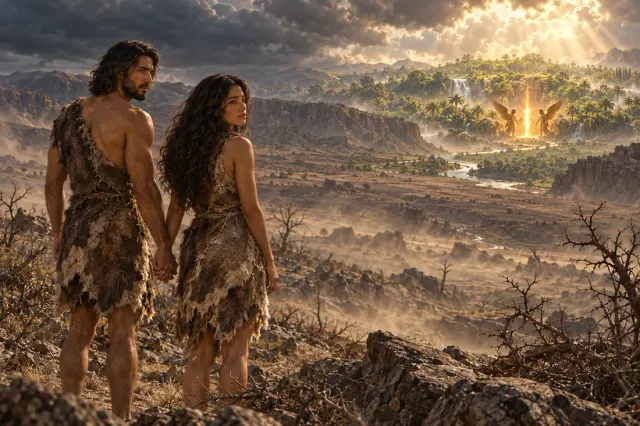
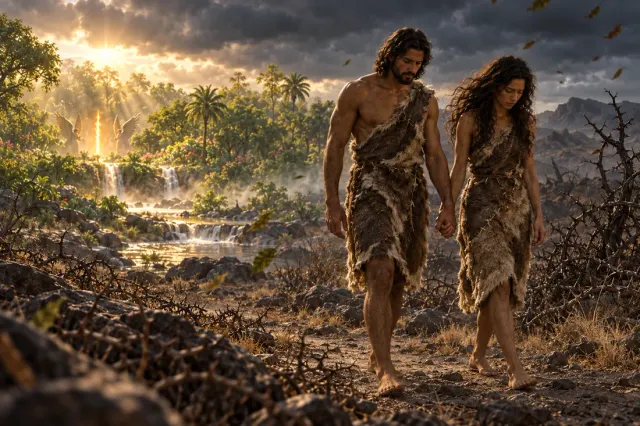
    Adam names his wife Eve, the mother of all living, and God clothes them both in coats of skins. Then the way to the tree of life is shut behind them with cherubim and a flaming sword, so that a fallen humanity will not live forever in its fallen state.

    The first thing Adam does after the sentence of death is give his wife a name that means life. Eve, because she was the mother of all living. It is an act of faith in the promise of verse 15; there will be children, and among them the seed. The second thing that happens is that God makes them clothes. Coats of skins means an animal died so that they could be covered, and the verb is the same one used later for the priests being clothed. The fig leaves they made are replaced by a covering God provides, which readers since the church fathers have taken as the first sacrifice and the first picture of atonement.

    Verse 22 gives the reason for the exile, and it is mercy dressed as severity. A man who has become as one of us, to know good and evil, must not now take of the tree of life and live for ever in that condition. Endless life in a fallen state would be the real curse. So the LORD God sent him forth, and then, more strongly, drove out the man, back to the ground he was taken from, to do the work he was always meant to do but now with sweat.

    The cherubim and the flaming sword close the way. They are guards, not decorations, and they face east, the direction Cain will go and the direction Israel's tabernacle will open toward. The tree of life is not destroyed; it is kept. It appears again in the last chapter of the Bible, in a city where there is no more curse and the gates are never shut.

    Verse by verse

    1. 3:20

      Eve is Chavvah, from the word for living. Adam names her in hope, after hearing that he will die.

    2. 3:21

      Coats of skins: the first death in Scripture is an animal's, for the sake of covering the guilty.

    3. 3:22

      As one of us: the plural of 1:26 returns. Knowing good and evil is now theirs, and it has not made them gods.

    4. 3:23

      To till the ground from whence he was taken: the same work as 2:15, now outside.

    5. 3:24

      Cherubims: the first appearance of the beings who will later overshadow the mercy seat. Revelation 22:14 gives the right to the tree of life back.

    Genesis 3:20-24

    King James Version · 5 verses

    3:20And Adam called his wife’s name Eve; because she was the mother of all living.

    3:21Unto Adam also and to his wife did the LORD God make coats of skins, and clothed them.

    3:22And the LORD God said, Behold, the man is become as one of us, to know good and evil: and now, lest he put forth his hand, and take also of the tree of life, and eat, and live for ever:

    3:23Therefore the LORD God sent him forth from the garden of Eden, to till the ground from whence he was taken.

    3:24So he drove out the man; and he placed at the east of the garden of Eden Cherubims, and a flaming sword which turned every way, to keep the way of the tree of life.

    Genesis 3:20-24: East of the garden
  7. 07

    Genesis 4:1-2, 25

    Three named sons

    Eve bears Cain and then Abel. After Cain kills Abel and is sent away, she bears Seth and names him as a seed appointed in Abel's place. The line that leads to Noah, to Abraham and to David runs through this third son.

    The promise of children comes true at once, and Eve's words at the first birth are a cry of faith and perhaps of hope that this is already the seed: I have gotten a man from the LORD. The name Cain sounds like gotten. Abel's name means breath or vapour, and the text gives no reason for it; his life will be as short as the word. The two trades, keeper of sheep and tiller of the ground, are the two oldest, and the account that follows will turn on their offerings.

    Adam disappears from the narrative between verse 2 and verse 25. The murder, the sentence on Cain, and the line of Cain's descendants happen without a word from him. When he returns it is to father a third son, and this time Eve names him with a sentence that looks back over the whole loss: God hath appointed me another seed instead of Abel, whom Cain slew. Seth means appointed. Through him the line of chapter 5 runs, and through him Noah, Abraham and, in Luke's genealogy, Christ, who is traced to Seth, which was the son of Adam, which was the son of God.

    Verse by verse

    1. 4:1

      Knew is the Bible's word for the marriage union. From the LORD: Eve credits God with the child, the first thanksgiving for a birth.

    2. 4:2

      Abel is named without a reason; Hebel, breath, is the word Ecclesiastes uses for vanity.

    3. 4:25

      Another seed: the word of 3:15 again. Eve sees the promise surviving the murder.

    Genesis 4:1-2, 25

    King James Version · 3 verses

    4:1And Adam knew Eve his wife; and she conceived, and bare Cain, and said, I have gotten a man from the LORD.

    4:2And she again bare his brother Abel. And Abel was a keeper of sheep, but Cain was a tiller of the ground.

    4:25And Adam knew his wife again; and she bare a son, and called his name Seth: For God, said she, hath appointed me another seed instead of Abel, whom Cain slew.

    Genesis 4:1-2, 25: Three named sons
  8. 08

    Genesis 5:1-5

    The book of the generations

    The record restates that God made man in his likeness, male and female, and called their name Adam. Adam fathers Seth in his own likeness, lives eight hundred years more, has other sons and daughters, and dies at nine hundred and thirty. His is the first of the deaths the chapter counts.

    Chapter 5 begins with a title, the book of the generations of Adam, and a summary that repeats chapter 1: in the likeness of God, male and female, blessed, and called their name Adam. The name belongs to both of them here, which is the text's last reminder that the image was given to the pair. Then comes a sentence that carries the whole doctrine of inheritance in it: Adam begat a son in his own likeness, after his image. The image of God passes on, and so does whatever Adam has become. Seth is born to a man already under sentence.

    The numbers that follow set the pattern for the chapter: years before the named son, years after, total, and he died. Adam lived nine hundred and thirty years, long enough to see Enoch walk with God and to be alive within a few decades of Noah's birth. The refrain and he died sounds eight times in the chapter, once for every man but Enoch, and it is the sentence of chapter 3 carried out line by line. Paul draws the conclusion in Romans 5: by one man sin entered into the world, and death by sin. The book of the generations of Adam is the first genealogy in Scripture, and Luke ends his with the same name.

    Verse by verse

    1. 5:1

      The book of the generations: the first of the toledoth headings that structure Genesis. Adam here is the man, and in verse 2 the pair.

    2. 5:2

      Called their name Adam: humanity is the shared name. Man, in the older English sense, meant both.

    3. 5:3

      In his own likeness, after his image: the words of 1:26 turned round. What God gave Adam, Adam gives Seth, marred.

    4. 5:5

      And he died. The first human death in the genealogy, and the proof that the serpent lied.

    Genesis 5:1-5

    King James Version · 5 verses

    5:1This is the book of the generations of Adam. In the day that God created man, in the likeness of God made he him;

    5:2Male and female created he them; and blessed them, and called their name Adam, in the day when they were created.

    5:3And Adam lived an hundred and thirty years, and begat a son in his own likeness, after his image; and called his name Seth:

    5:4And the days of Adam after he had begotten Seth were eight hundred years: and he begat sons and daughters:

    5:5And all the days that Adam lived were nine hundred and thirty years: and he died.

    Genesis 5:1-5: The book of the generations

The people, the places and the rest of Scripture.

Reading Adam closely

The people he dealt with

Adam's world is small and every person in it matters. Eve is built from his own side and is the only human being who ever knew him unfallen. He is the one God calls to first after the fruit is eaten, which the text uses to mark him as the one responsible, and his first move is to put the blame on her and, by implication, on God who gave her. That failure of nerve is recorded without comment and left to stand.

His sons tell the account of what he passed on. Cain is a farmer like his father, working the cursed ground, and becomes the first murderer. Abel keeps sheep and is the first man to die. Seth is born after that loss and named as a replacement, and it is in Seth's time, not Cain's, that people begin to call on the name of the LORD. Adam is alive for all of it. By the numbers in Genesis 5 he was still living when Lamech, Noah's father, was born, so eight generations of his descendants could have heard the garden described by the man who left it.

The serpent is the other party in his account, and Adam never speaks to it. The conversation is with the woman. He simply takes what is handed to him and eats, which is why later writers read his sin as a failure to guard what he had been given to keep.

Genesis 1
Genesis 1

What came before and what followed

Nothing comes before Adam except God and the world made ready for him. The first chapter of Genesis builds the stage, day by day, and the human pair is the last thing set on it. The second chapter tells the same beginning from the ground up, with the man formed before the garden is planted and the animals paraded before him so that his need for a companion is felt before it is met.

What follows is the whole Bible. The curse on the ground is the reason Lamech names his son Noah, hoping for comfort from the toil. The shutting of Eden is the reason the tabernacle and the temple are guarded by cherubim, the same figures that stood at the gate. The promise that the woman's seed would bruise the serpent's head is the first promise of a deliverer in Scripture, and the genealogies that follow are the record of that seed being kept alive through Seth, Noah, Shem, Abraham, Judah and David. Adam does not appear again as a character after Genesis 5, but the account never stops being about what he lost.

Genesis 1
Genesis 2

Where the rest of Scripture reaches back

Job protests that he has not hidden his sin the way Adam did. Hosea accuses Israel of breaking the covenant like Adam. The Chronicler opens his whole history with the single word Adam, as the first name in the record of Israel. Luke ends the genealogy of Jesus with him and calls him the son of God.

Paul does the most with him. In Romans 5 sin enters the world through one man and death through sin, and death reigns from Adam to Moses; Adam is the figure of the one to come, and the gift through Christ is set against the trespass. In 1 Corinthians 15 the first man Adam is a living soul and the last Adam a life-giving spirit; as we have borne the image of the earthy, we shall bear the image of the heavenly. In 1 Timothy 2 Paul notes that Adam was formed first and that it was Eve, not Adam, who was deceived. Jude counts Enoch as the seventh from Adam. In every case the writers assume their readers know his account in full, which is why it is worth knowing.

Genesis 2
Genesis 3

Why it matters

Adam sets the terms for everything the Bible says about people. The dignity of bearing God's image, the work of tending a world, the freedom to obey or refuse, and the death that follows refusing, are all stated first in his account and measured against it ever after. When Job wants a picture of hiding sin he reaches for Adam. When Hosea wants a picture of a broken covenant he reaches for Adam.

The New Testament makes him one half of its central comparison. Paul calls him the figure of the one who was to come, and sets one man's disobedience against one man's obedience, the first Adam who became a living soul against the last Adam who became a life-giving spirit. Luke traces the line of Jesus back through seventy-five generations and stops at Adam, the son of God. The account keeps his failure in full view, and that is the point: the promise made in the garden is a promise made to people who fail.

6 songs

The music

Every song in the catalogue whose passage falls inside these chapters.

  1. Genesis 1:1-2:3

    And There Was Light

  2. Genesis 1:1-2:25

    Before the First Dawn

  3. Genesis 2:4-25

    Bone of My Bone

  4. Genesis 3:1-5:32

    Blood in the Ground

  5. Genesis 3

    East of Eden

  6. Genesis 4:1-16

    The Blood Cries

The videos

The videos

Every release whose passage falls inside these chapters, playing here.

Nearby

All the people

Report an error on this page