New · FreePlay The Witnesses The in-depth puzzle battle quest through Bible history

People of the Bible

Eve

Built from the man's side, named the mother of all living, and the first to be lied to.

Also called The woman; in Hebrew, Chavvah, meaning life

Eve is the first woman, and the only person in Scripture made from another person rather than born. God says it is not good for the man to be alone, and after every creature has been named and none of them found fit, he causes a deep sleep, takes from Adam's side, and builds her. The word Genesis uses for her is a helper who answers to him, a counterpart, the same word the Psalms use of God as the help of Israel. Adam recognises her at once as bone of his bones.

She is the one the serpent chooses to speak to, and the whole exchange in Genesis 3 happens between the two of them while the man stands by. She eats, gives to her husband, and the two of them hide. Her sentence names pain in childbearing and a strained marriage. Adam then gives her the name Eve because she will be the mother of all living, and it is she, not he, who speaks at the birth of Cain and again at the birth of Seth. She is mentioned by name only four times in the whole Bible, twice in Genesis and twice in Paul's letters, and yet every human being in the account descends from her.

Where she appearsGenesis 2 to 4

Scroll down to the account
Eve

The movements, in the order the text gives them.

The Account of Eve

  1. 01

    Genesis 2:18-25

    Not good to be alone

    God names the first thing in creation that is not good: the man's solitude. The animals are brought and named and none will do. From Adam's side God builds the woman, brings her to him, and the man speaks for the first time to say she is his own flesh. The chapter ends with the two of them naked and unashamed.

    Eve enters the account as the answer to the first thing God calls not good. The man alone is incomplete, and the word chosen for what he lacks, an help meet for him, is not a word for a servant. Help is what the Psalms call God, and meet means fitting, corresponding, the one who stands opposite and answers. The parade of animals in verses 19 and 20 is not a failed search on God's part; it is a lesson for Adam, who names every creature and finds that none of them is his match. He must feel the lack before the gift.

    Her making is unlike his. He was formed of dust; she is built, the Hebrew verb, from a rib taken out of his side while he sleeps. He contributes nothing conscious. When he wakes God brings her to him, and his first recorded words are verse, bone of my bones, flesh of my flesh, and a name that is his own name with a feminine ending. She is not made from the ground but from the man, so that when he looks at her he sees himself answered.

    The Book of Genesis's conclusion in verse 24 is about every marriage since: a man leaves, cleaves, and becomes one flesh. Jesus quotes it as the creator's design, and Paul reads it as a mystery about Christ and the church. Verse 25 gives the last picture of innocence: naked, and not ashamed.

    Verse by verse

    1. 2:18

      Help meet: two words, a helper fit for him. The same word for help is used of God in Psalm 33:20 and 121:1.

    2. 2:20

      Not found: the naming shows Adam that no animal answers to him, and prepares him to recognise the one who will.

    3. 2:21-22

      Deep sleep is the word used of Abraham's trance in Genesis 15. Made is literally built. Brought her unto the man: God gives the bride away.

    4. 2:23

      Woman, ishshah, from man, ish. The first human poem is spoken about her.

    5. 2:24-25

      Cleave is the word for holding fast to God in Deuteronomy. Naked and not ashamed is the state that chapter 3 will end.

    Genesis 2:18-25

    King James Version · 8 verses

    2:18And the LORD God said, It is not good that the man should be alone; I will make him an help meet for him.

    2:19And out of the ground the LORD God formed every beast of the field, and every fowl of the air; and brought them unto Adam to see what he would call them: and whatsoever Adam called every living creature, that was the name thereof.

    2:20And Adam gave names to all cattle, and to the fowl of the air, and to every beast of the field; but for Adam there was not found an help meet for him.

    2:21And the LORD God caused a deep sleep to fall upon Adam, and he slept: and he took one of his ribs, and closed up the flesh instead thereof;

    2:22And the rib, which the LORD God had taken from man, made he a woman, and brought her unto the man.

    2:23And Adam said, This is now bone of my bones, and flesh of my flesh: she shall be called Woman, because she was taken out of Man.

    2:24Therefore shall a man leave his father and his mother, and shall cleave unto his wife: and they shall be one flesh.

    2:25And they were both naked, the man and his wife, and were not ashamed.

    Genesis 2:18-25: Not good to be alone
  2. 02

    Genesis 3:1-6

    The conversation with the serpent

    The serpent asks whether God really said they could not eat from any tree. The woman corrects it, adds that they may not even touch the tree, and hears the flat denial: you shall not surely die. She sees the fruit as good for food, pleasant to look at and desirable for wisdom, takes it, eats, and gives to her husband, who is with her.

    The serpent speaks to the woman, not the man, and his opening is a distortion dressed as a question. Hath God said ye shall not eat of every tree? Eve corrects him, and in correcting him she changes the command in two ways: she drops the generous word freely and she adds a prohibition God never gave, neither shall ye touch it. The command has already shrunk in her mouth. The serpent then denies the penalty outright and offers a motive: God is protecting his own position, and the fruit will make you like him. It is the first lie in Scripture, and its shape is the shape of every temptation after it, that God's boundary is his jealousy.

    Verse 6 records what she saw before what she did. The tree is good for food, pleasant to the eyes, desirable for wisdom. The first two phrases are exactly what chapter 2 said of every tree in the garden; only the third is new. She took, she ate, she gave, and the man with her ate too. The words with her mean Adam was present and silent. Paul says the woman was deceived and the man was not, which makes his eating the worse act. Her account is that of the one who was talked into it; his is that of the one who watched.

    Verse by verse

    1. 3:1

      The serpent addresses her with the plural ye: he is speaking to both of them through her.

    2. 3:3

      Neither shall ye touch it: not in God's command. Adding to a command is the first step in resenting it.

    3. 3:5

      As gods, or as God: the offer is to be like the one who made you, on your own terms.

    4. 3:6

      Saw, took, ate, gave: 1 John 2:16 names the same three pulls, the flesh, the eyes, and pride.

    Genesis 3:1-6

    King James Version · 6 verses

    3:1Now the serpent was more subtil than any beast of the field which the LORD God had made. And he said unto the woman, Yea, hath God said, Ye shall not eat of every tree of the garden?

    3:2And the woman said unto the serpent, We may eat of the fruit of the trees of the garden:

    3:3But of the fruit of the tree which is in the midst of the garden, God hath said, Ye shall not eat of it, neither shall ye touch it, lest ye die.

    3:4And the serpent said unto the woman, Ye shall not surely die:

    3:5For God doth know that in the day ye eat thereof, then your eyes shall be opened, and ye shall be as gods, knowing good and evil.

    3:6And when the woman saw that the tree was good for food, and that it was pleasant to the eyes, and a tree to be desired to make one wise, she took of the fruit thereof, and did eat, and gave also unto her husband with her; and he did eat.

    Genesis 3:1-6: The conversation with the serpent
  3. 03

    Genesis 3:7-13

    Eyes opened

    They know they are naked, sew fig leaves, and hide from the sound of God walking in the garden. When the questioning reaches her, she answers plainly: the serpent beguiled me, and I did eat. Her answer is shorter and more honest than her husband's.

    The eyes are opened, as the serpent promised, and the first thing the new knowledge shows them is their own nakedness. Fig leaves are sewn, the first clothing and the first attempt to cover guilt by human effort. Then the sound of God walking, which was apparently an ordinary thing in the garden, and the new response of hiding. God's question to Adam, Where art thou, is the first question in Scripture, and it is asked by one who knows the answer.

    Eve is questioned second, after Adam has already blamed her and, by implication, God for giving her. Her answer is the shortest of the three: the serpent beguiled me, and I did eat. She names the deceiver and admits the deed in one breath. Readers have noticed that she does not blame Adam for standing by, and that her confession, though it deflects, is truer than his. The serpent is not questioned at all.

    Verse by verse

    1. 3:7

      Aprons: girdles of leaves. The knowledge gained is knowledge of shame.

    2. 3:8

      Adam and his wife hid: the first thing the couple does together after the fall.

    3. 3:12

      Adam's answer blames the woman and the giver of the woman. The unity of 2:23 breaks in one sentence.

    4. 3:13

      Beguiled: deceived. Paul uses her words in 2 Corinthians 11:3 and 1 Timothy 2:14.

    Genesis 3:7-13

    King James Version · 7 verses

    3:7And the eyes of them both were opened, and they knew that they were naked; and they sewed fig leaves together, and made themselves aprons.

    3:8And they heard the voice of the LORD God walking in the garden in the cool of the day: and Adam and his wife hid themselves from the presence of the LORD God amongst the trees of the garden.

    3:9And the LORD God called unto Adam, and said unto him, Where art thou?

    3:10And he said, I heard thy voice in the garden, and I was afraid, because I was naked; and I hid myself.

    3:11And he said, Who told thee that thou wast naked? Hast thou eaten of the tree, whereof I commanded thee that thou shouldest not eat?

    3:12And the man said, The woman whom thou gavest to be with me, she gave me of the tree, and I did eat.

    3:13And the LORD God said unto the woman, What is this that thou hast done? And the woman said, The serpent beguiled me, and I did eat.

  4. 04

    Genesis 3:15-16

    The promise and the sentence

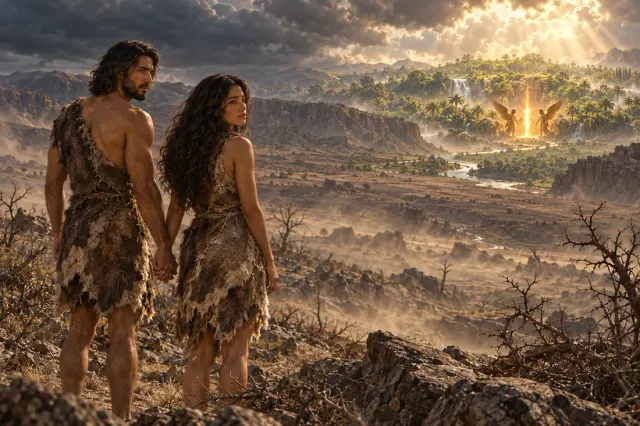
    Before her own sentence she hears the one on the serpent, and it names her: enmity between the serpent and the woman, and a seed of hers who will bruise its head. Then her own: sorrow multiplied in childbearing, a desire toward her husband, and his rule over her.

    Before Eve hears her own sentence she hears the serpent's, and inside it is the promise that governs the rest of the Bible. God puts enmity between the serpent and the woman, which means that the alliance she just entered is dissolved by God's own act. The war will run between his seed and hers, and the outcome is fixed: her seed will crush his head, and be wounded in the heel doing it. The church calls this the first gospel. It is spoken to the serpent, but it is about the woman, and it is the only word of hope in the whole scene. Every mother in Israel after this will wonder whether her son is the one.

    Her own sentence touches the two places her life was to be fruitful: childbearing becomes sorrow, and her relationship to her husband becomes a contest of desire and rule. Neither is a curse; the word cursed is used only of the serpent and the ground. These are the conditions under which the promise of verse 15 will be carried out, through pain, by a woman, in a marriage now strained.

    Verse by verse

    1. 3:15

      Her seed: a woman's seed is an unusual phrase, and Christian readers have heard in it the virgin birth. Bruise is the same word for both blows; only the target differs.

    2. 3:16

      Thy desire and he shall rule: the pairing returns in 4:7 of sin and Cain. What was meant as partnership becomes struggle.

    Genesis 3:15-16

    King James Version · 2 verses

    3:15And I will put enmity between thee and the woman, and between thy seed and her seed; it shall bruise thy head, and thou shalt bruise his heel.

    3:16Unto the woman he said, I will greatly multiply thy sorrow and thy conception; in sorrow thou shalt bring forth children; and thy desire shall be to thy husband, and he shall rule over thee.

    Genesis 3:15-16: The promise and the sentence
  5. 05

    Genesis 3:20-21

    Named for life

    Adam calls her Eve because she is the mother of all living. It is an act of faith spoken over a woman who has just been told about death. God then makes coats of skins for them both, the first animals to die in Scripture, so that the two of them are clothed before they are sent out.

    Adam's first act after hearing that he will return to dust is to name his wife for life. Until now she has been the woman; now she is Eve, Chavvah, because she was the mother of all living. The name is an act of faith in the promise of verse 15: there will be children, and life will go on through her. Then God clothes them. The fig-leaf aprons are replaced by coats of skins, which means something died so that the two of them could be covered. It is the first death in the Bible, an animal's, on behalf of the guilty, and the church has read in it the first shadow of sacrifice.

    Verse by verse

    1. 3:20

      Eve means living. She is named for the future, not the failure.

    2. 3:21

      Coats of skins: God does what the fig leaves could not. Clothed them is the verb used of dressing the priests in Exodus 28.

    Genesis 3:20-21

    King James Version · 2 verses

    3:20And Adam called his wife’s name Eve; because she was the mother of all living.

    3:21Unto Adam also and to his wife did the LORD God make coats of skins, and clothed them.

    Genesis 3:20-21: Named for life
  6. 06

    Genesis 4:1-2

    The first birth

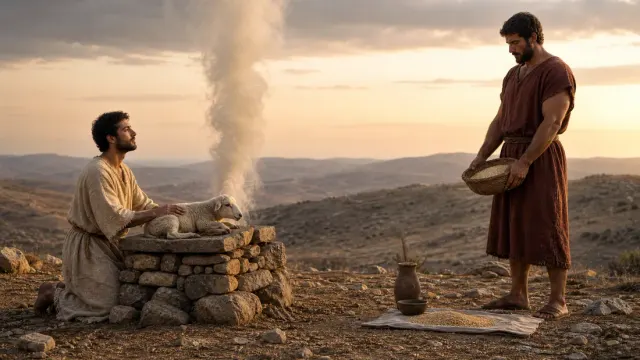
    She bears Cain and says she has gotten a man from the LORD, the first time a human being speaks the covenant name in the account. Then she bears Abel. One will farm the cursed ground and one will keep sheep.

    The promise of seed is kept in the first verse after the exile. Eve bears a son and speaks the first words at a birth in Scripture: I have gotten a man from the LORD. The Hebrew can be read as I have gotten a man, the LORD, and some have heard in it a hope that the child was already the promised seed; more likely she means with the LORD's help. Either way she credits God for the child and names him Cain, gotten. Abel's name, breath, is given without explanation, and his life will be as brief as the word. The two brothers take up the two oldest callings, shepherd and farmer, and the difference between them will be the setting of the first murder.

    Verse by verse

    1. 4:1

      Knew: the Bible's word for the union of husband and wife. From the LORD: the first thanksgiving of a mother.

    2. 4:2

      Abel, Hebel, is the word Ecclesiastes uses for vanity, a breath that passes.

    Genesis 4:1-2

    King James Version · 2 verses

    4:1And Adam knew Eve his wife; and she conceived, and bare Cain, and said, I have gotten a man from the LORD.

    4:2And she again bare his brother Abel. And Abel was a keeper of sheep, but Cain was a tiller of the ground.

    Genesis 4:1-2: The first birth
  7. 07

    Genesis 4:25

    Another seed

    After Abel is killed and Cain is sent away, she bears a third son and names him Seth, because God has appointed her another seed instead of Abel. The word she uses for seed is the word from the promise in the garden.


    Eve speaks once more, after the murder, and her last recorded words look back over the whole loss and forward to the promise. God has appointed another seed instead of Abel, whom Cain slew. She names the loss and the killer in the same sentence and still calls the new child a gift. Seth means appointed or set in place. Through him the line of chapter 5 runs to Noah, and through Noah to Abraham, and Luke's genealogy of Jesus ends with Seth, which was the son of Adam, which was the son of God. The mother of all living has her seed after all.

    Verse by verse

    1. 4:25

      Another seed: the word of 3:15. Eve has not forgotten the promise, and God has not.

    Genesis 4:25

    King James Version · 1 verse

    4:25And Adam knew his wife again; and she bare a son, and called his name Seth: For God, said she, hath appointed me another seed instead of Abel, whom Cain slew.

    Genesis 4:25: Another seed

The people, the places and the rest of Scripture.

Reading Eve closely

The people she dealt with

Eve has three relationships in the text and each one defines something. With Adam she is the counterpart, the one he names twice, first as woman because she was taken out of man and then as Eve because life will come through her. When the fruit is eaten she hands it to him and he eats without a word, and when God questions them he blames her. The account gives no sign that she answers the accusation. The fracture between them is recorded as the first consequence of the fall in a human relationship.

With the serpent she is the one who talks. The serpent never addresses the man. It questions what God said, she corrects it, it contradicts God outright, and she weighs the tree with her own eyes. Later writers noticed that she adds a rule God did not give, that the tree could not even be touched, and read it as the first sign that the command was already slipping in her mind before she broke it.

With her sons she is the mother who names and who speaks. Cain's name is her exclamation at getting a man from the LORD. Seth's name is her statement that God has replaced what was lost. Between those two births she loses both her first sons in a single chapter, one to the grave and one to the land of Nod, and the text lets her grief be heard only in the naming.

Genesis 2
Genesis 2

What came before and what followed

Before Eve there is a man alone in a garden, and the first negative judgment God makes about his own creation is about that. Her making is the answer to a need that God himself names. The order of events in Genesis 2, with the animals paraded first, is there so that the reader feels the lack before it is filled.

What follows her is every mother in the Bible. The promise that the serpent's head would be bruised by the woman's seed is the reason the genealogies in Genesis exist at all, and it is why the account keeps pausing over barren women and unexpected births: Sarah at ninety, Rebekah after twenty years, Rachel, Hannah, Elizabeth. The last of the line is a young woman in Nazareth, and when Paul writes that God sent his Son made of a woman, he is finishing a sentence begun in Genesis 3.

Genesis 2

Where the rest of Scripture reaches back

Her name appears only twice more after Genesis 4. In 2 Corinthians 11 Paul tells a church that he fears for them as the serpent beguiled Eve through its subtlety, so that their minds might be corrupted from the simplicity that is in Christ; she is the picture of a mind talked out of a plain word. In 1 Timothy 2 he notes that Adam was formed first and that Eve was the one deceived, and adds that she shall be saved in childbearing if they continue in faith. Readers have argued for centuries over what that last clause means, and the argument is a sign of how much weight her account carries.

Without naming her, the rest of the Bible keeps returning to the garden. The prophets describe Israel as a wife who listened to other voices. Revelation ends with a tree of life whose leaves heal the nations, in a garden city with no serpent in it, which is the world Eve lost given back.

Genesis 3

Why it matters

Eve carries the beginning of two things the Bible never lets go of. The first is the promise. The sentence on the serpent says that the woman's seed will bruise its head, and from that moment the line of descent through mothers as much as fathers becomes the thread the account follows: Sarah, Rebekah, Tamar, Ruth, Bathsheba, Mary. The second is the pattern of deception. She is the first person to be lied to about God, and Paul tells the Corinthians that he fears they will be led astray the way the serpent beguiled Eve.

Her account is also the first account of a marriage, of blame between husband and wife, and of grief over a child. She loses Abel to murder and Cain to exile in one day, and her words at Seth's birth are the first recorded words of a bereaved parent. That she names God as the one who appointed the new son, and that she still calls on the LORD after everything, is the quiet centre of her sheet.

6 songs

The music

Every song in the catalogue whose passage falls inside these chapters.

  1. Genesis 1:1-2:3

    And There Was Light

  2. Genesis 1:1-2:25

    Before the First Dawn

  3. Genesis 2:4-25

    Bone of My Bone

  4. Genesis 3:1-5:32

    Blood in the Ground

  5. Genesis 3

    East of Eden

  6. Genesis 4:1-16

    The Blood Cries

Nearby

All the people

Report an error on this page