
New · FreePlay The Witnesses The in-depth puzzle battle quest through Bible history

Places of the Bible

Eden

A garden with a river, two named trees, and one instruction.

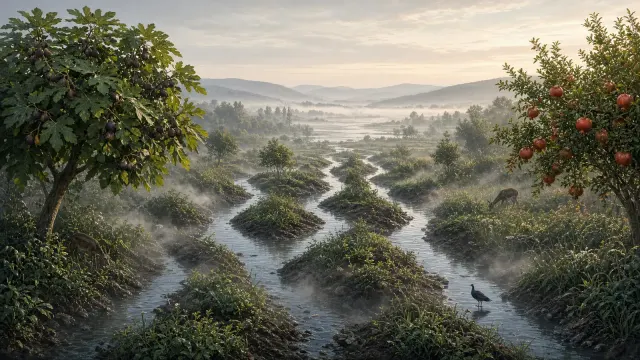
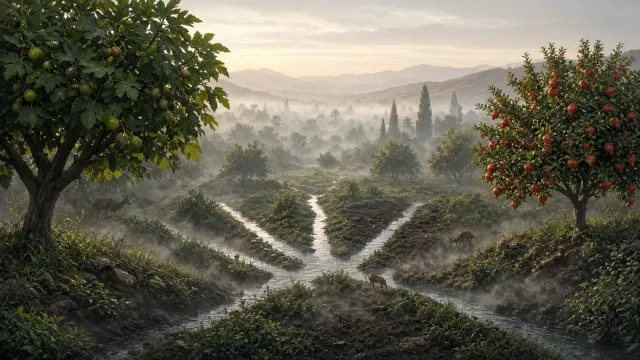
Eden is planted eastward and a river runs out of it, dividing into four heads whose names the account gives as carefully as a surveyor would. The man is put there to work it and keep it, which makes it a place with a job attached rather than a place to rest. Two trees are named out of everything growing there. Only one of them is closed, and it is the closing that the rest of the chapter turns on.

Where it appearsGenesis 2 to 4

Scroll down to the account

The movements, in the order the text gives them.

The Account of Eden

  1. 01

    Genesis 2:8-14

    The river and the four heads

    The account maps the place before anything happens in it, which is what makes it read as a location rather than a symbol.

    The trees are beautiful before they are useful. Pleasant to the sight comes before good for food, a small ordering that prevents Eden from becoming merely an efficient arrangement for keeping a man alive. God plants; the man receives. Nothing here suggests that Adam has earned the garden, produced its trees, or negotiated the river. His first address is a gift.

    The description then travels beyond the garden. One river becomes four heads, and the Book of Genesis pauses over countries, gold, and stones before returning to the man. Even the gold gets a quality assessment. That little observation gives the passage the texture of a world with particular things in particular places, not an indistinct patch of perfection. Eden is the setting, but the horizon is already wider than Eden.

    The two named trees stand within this abundance, not in a wasteland where one forbidden meal is the only food available. That proportion matters. The prohibition in verse 17 does not define the whole garden; it draws one boundary inside an extraordinary provision. Before anything is withheld, much has been given.

    Verse by verse

    1. 2:8

      The garden is planted in Eden; the wording distinguishes the garden from the wider location bearing that name.

    2. 2:10

      The four heads are divisions of the river. The passage describes their relationship without supplying a map that securely identifies every river today.

    3. 2:14

      Hiddekel also appears in Daniel 10:4. The Euphrates receives no additional description here, unlike the preceding rivers.
    Genesis 2:8-14

    King James Version · 7 verses

    2:8And the LORD God planted a garden eastward in Eden; and there he put the man whom he had formed.

    2:9And out of the ground made the LORD God to grow every tree that is pleasant to the sight, and good for food; the tree of life also in the midst of the garden, and the tree of knowledge of good and evil.

    2:10And a river went out of Eden to water the garden; and from thence it was parted, and became into four heads.

    2:11The name of the first is Pison: that is it which compasseth the whole land of Havilah, where there is gold;

    2:12And the gold of that land is good: there is bdellium and the onyx stone.

    2:13And the name of the second river is Gihon: the same is it that compasseth the whole land of Ethiopia.

    2:14And the name of the third river is Hiddekel: that is it which goeth toward the east of Assyria. And the fourth river is Euphrates.

    Genesis 2:8-14: The river and the four heads
  2. 02

    Genesis 2:15-17

    To work it and keep it

    The garden comes with responsibility and one boundary. Everything else in it is open.

    Work is already present while everything is still good. Adam is put in the garden to dress it and to keep it, not to wander through it as a permanent visitor. The curse in Genesis 3 adds painful toil, resistant ground, and thorns. It does not invent the human task. Eden has responsibility before it has trouble.

    The command begins with permission. Of every tree, followed by freely eat, gives generosity the first and strongest position. Hebrew intensifies the eating in verse 16 and the dying in verse 17 with matching verbal constructions. The permission is emphatic; so is the boundary. Reading only the prohibition loses half the sound of the command.

    The man receives an assignment, a provision, and a limit in three verses. The limit is not explained as a shortage in the garden or a defect in its fruit. It rests on the word of the one who planted it. That makes the coming dispute over what God actually said more than a disagreement about diet. The garden has been entrusted to a keeper who is not its owner.

    Verse by verse

    1. 2:15

      Dress means cultivate or tend, not decorate. Keep includes the sense of guarding what has been entrusted.

    2. 2:16

      The doubled Hebrew verb gives emphasis to the permission to eat; the King James expresses this with freely.

    3. 2:17

      Surely die expresses certainty. Interpreters differ on how in the day relates to the later account of Adam's death; the verse does not give his remaining lifespan.

    Genesis 2:15-17

    King James Version · 3 verses

    2:15And the LORD God took the man, and put him into the garden of Eden to dress it and to keep it.

    2:16And the LORD God commanded the man, saying, Of every tree of the garden thou mayest freely eat:

    2:17But of the tree of the knowledge of good and evil, thou shalt not eat of it: for in the day that thou eatest thereof thou shalt surely die.

    Genesis 2:15-17: To work it and keep it
  3. 03

    Genesis 3:1-7

    The conversation

    The one closed thing becomes the only thing in view. The garden does not change, the people in it do.

    The serpent begins by making a garden full of permission sound like a garden full of prohibition. God had opened with freely eat; the conversation opens with not eat. The woman corrects the sweeping restriction, but her reply includes neither shall ye touch it, words not present in the command recorded in Genesis 2. The text does not explain where that addition came from. Assigning it to a private conversation with Adam would fill a silence the chapter leaves open.

    The next move is no longer a question about wording. It is a contradiction of the death warning, followed by a claim about God's motive: the withheld fruit is presented as withheld advancement. Then the woman's assessment repeats the garden's earlier attractions, good for food and pleasant to the eyes, while adding the desire for wisdom. A good-looking thing has not become safe merely by looking good.

    The promised opening of the eyes actually happens. That is the sting. Their first recorded discovery is not a throne, a new dominion, or a grander understanding of the world. It is nakedness. The impressive offer ends with two people sewing leaves.

    Verse by verse

    1. 3:1

      Genesis presents the serpent as a creature God made. Revelation 12:9 later identifies the old serpent with the Devil and Satan.

    2. 3:3

      The recorded command in Genesis 2:17 forbids eating; it does not mention touching. The source of the added wording is not given.

    3. 3:6

      The fruit is not named. With her places Adam alongside the woman at the giving and eating, but does not independently describe his location throughout every earlier exchange.

    Genesis 3:1-7

    King James Version · 7 verses

    3:1Now the serpent was more subtil than any beast of the field which the LORD God had made. And he said unto the woman, Yea, hath God said, Ye shall not eat of every tree of the garden?

    3:2And the woman said unto the serpent, We may eat of the fruit of the trees of the garden:

    3:3But of the fruit of the tree which is in the midst of the garden, God hath said, Ye shall not eat of it, neither shall ye touch it, lest ye die.

    3:4And the serpent said unto the woman, Ye shall not surely die:

    3:5For God doth know that in the day ye eat thereof, then your eyes shall be opened, and ye shall be as gods, knowing good and evil.

    3:6And when the woman saw that the tree was good for food, and that it was pleasant to the eyes, and a tree to be desired to make one wise, she took of the fruit thereof, and did eat, and gave also unto her husband with her; and he did eat.

    3:7And the eyes of them both were opened, and they knew that they were naked; and they sewed fig leaves together, and made themselves aprons.

    Genesis 3:1-7: The conversation
  4. 04

    Genesis 3:22-24

    The gate

    The way back to the tree of life is barred. It is the first time in Scripture a place is closed to people.

    The last danger in Eden is not that the man might die, but that he might reach for life forever in his altered condition. The reason for exclusion is stated before the expulsion: lest he put forth his hand. The same reaching and taking that marked the first transgression must not extend to the other tree. Judgment now has a guarded boundary.

    There is a sharp change of personnel in the word keep. In Genesis 2:15 the man was placed in the garden to keep it. Here the cherubim keep the way of the tree of life. The Hebrew verb is the same. The former keeper is now outside the place being guarded, sent to work the ground from which he was formed. His task survives, but its setting has changed completely.

    The Book of Genesis does not say the tree has died or the garden has vanished. It describes access being denied. Nor does it erase the clothing God provided in verse 21. Provision and expulsion stand side by side without canceling one another. Revelation 22:14 eventually speaks of access to the tree of life and entry through the city gates. Here, the way is closed.

    Verse by verse

    1. 3:22

      The plural one of us has been read in several ways, including divine counsel and Christian Trinitarian readings. This verse does not identify the plural participants.

    2. 3:24

      Cherubim is already plural in Hebrew. The verse does not state how many there were or say that one held the sword.

    3. 3:24

      To keep translates the same Hebrew root, shamar, used of the man's responsibility in Genesis 2:15.

    Genesis 3:22-24

    King James Version · 3 verses

    3:22And the LORD God said, Behold, the man is become as one of us, to know good and evil: and now, lest he put forth his hand, and take also of the tree of life, and eat, and live for ever:

    3:23Therefore the LORD God sent him forth from the garden of Eden, to till the ground from whence he was taken.

    3:24So he drove out the man; and he placed at the east of the garden of Eden Cherubims, and a flaming sword which turned every way, to keep the way of the tree of life.

    Genesis 3:22-24: The gate

Why it matters

Eden is the picture the whole Bible keeps measuring distance from. Exile begins here, the way back is barred here, and the last pages of Scripture answer it directly with a city that has a river running through it and the tree of life growing on both banks. It is less a lost paradise than an unfinished one.

6 songs

The music

Every song in the catalogue whose passage falls inside these chapters.

  1. Genesis 1:1-2:3

    And There Was Light

  2. Genesis 1:1-2:25

    Before the First Dawn

  3. Genesis 2:4-25

    Bone of My Bone

  4. Genesis 3:1-5:32

    Blood in the Ground

  5. Genesis 3

    East of Eden

  6. Genesis 4:1-16

    The Blood Cries

Nearby

All the places

Report an error on this page