New · FreePlay The Witnesses The in-depth puzzle battle quest through Bible history

People of the Bible

Cain

The first child born, the first to bring an offering, and the first to kill.

Also called In Hebrew, Qayin, which Eve ties to getting or acquiring

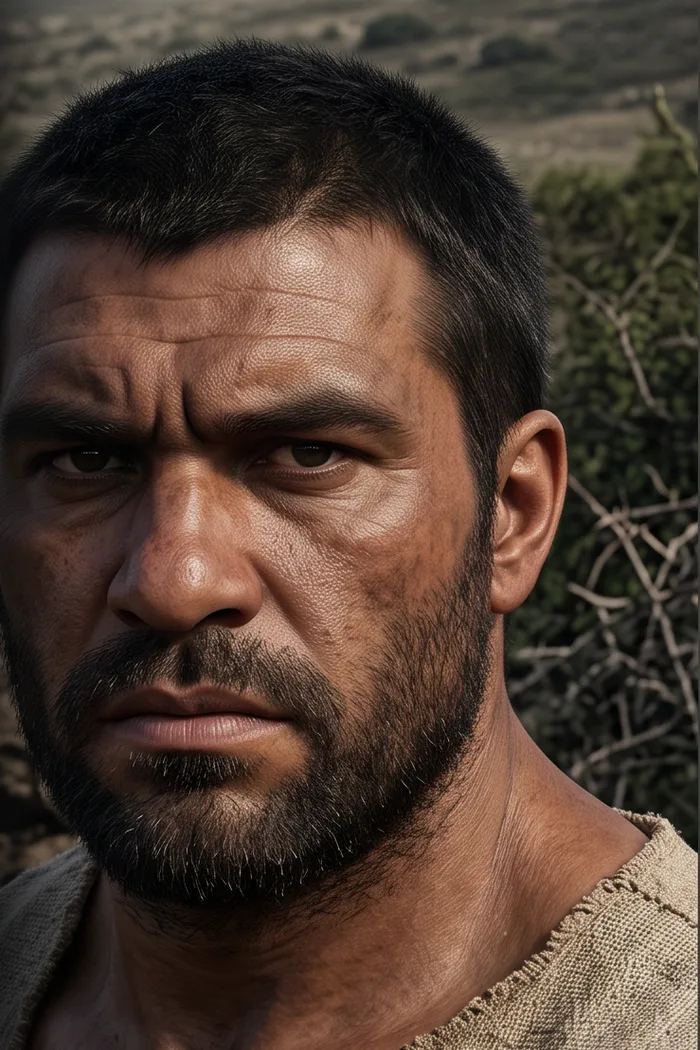
Cain is the firstborn of Adam and Eve and the first human being to be born rather than made. Eve names him with a cry of possession, saying she has gotten a man from the LORD. He becomes a tiller of the ground, the same cursed ground his father was sentenced to work, while his younger brother Abel keeps sheep. In time both brothers bring an offering, and God has regard for Abel's and not for Cain's. Genesis does not say why in so many words. It says what happened next.

Cain's face falls, God warns him that sin is crouching at the door and that he must master it, and Cain answers by taking Abel into the field and killing him. Asked where his brother is, he gives the answer the world has never forgotten: am I my brother's keeper. He is cursed from the ground that drank the blood, sentenced to wander, and given a mark so that no one will kill him. He goes east to the land of Nod, has a son, and builds the first city, naming it after the boy. His line runs six generations and ends in Lamech, who boasts of killing and doubles the vengeance promised to Cain.

Where he appearsGenesis 4

Scroll down to the account
Cain

The movements, in the order the text gives them.

The Account of Cain

  1. 01

    Genesis 4:1-2

    Gotten from the LORD

    Eve bears her first son and names him for what she has acquired, with the LORD's help. A second son, Abel, follows. The text gives their trades in one line each: Abel a keeper of sheep, Cain a tiller of the ground.

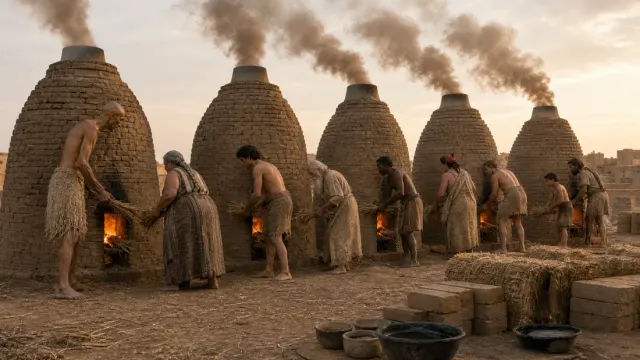
    Cain is the first human being born, and his mother greets him as a gift from the LORD. The name sounds like the Hebrew for gotten or acquired, and Eve's words carry the hope that the promised seed of chapter 3 has arrived. Abel comes second and is named without comment. The text then tells us their work before it tells us anything else about them: Abel keeps sheep, Cain tills the ground. Cain's trade is his father's, the work Adam was sent out of the garden to do, on the ground that was cursed for his sake. That ground will be the scene of the crime and the witness against him.

    Verse by verse

    1. 4:1

      Gotten, qanah, and Cain, Qayin, are a play on words. Eve credits the LORD; the child will not.

    2. 4:2

      Tiller of the ground repeats 3:23. Cain inherits his father's sentence as his occupation.

    Genesis 4:1-2

    King James Version · 2 verses

    4:1And Adam knew Eve his wife; and she conceived, and bare Cain, and said, I have gotten a man from the LORD.

    4:2And she again bare his brother Abel. And Abel was a keeper of sheep, but Cain was a tiller of the ground.

    Genesis 4:1-2: Gotten from the LORD
  2. 02

    Genesis 4:3-5

    Two offerings

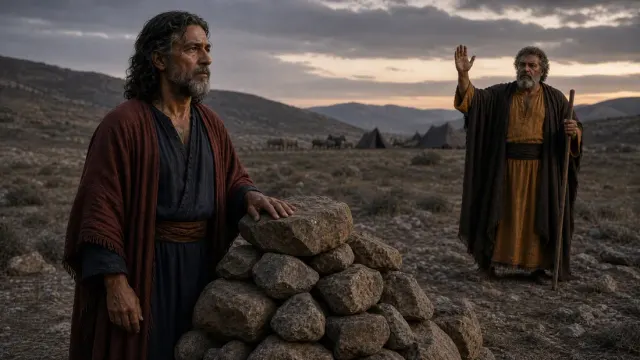
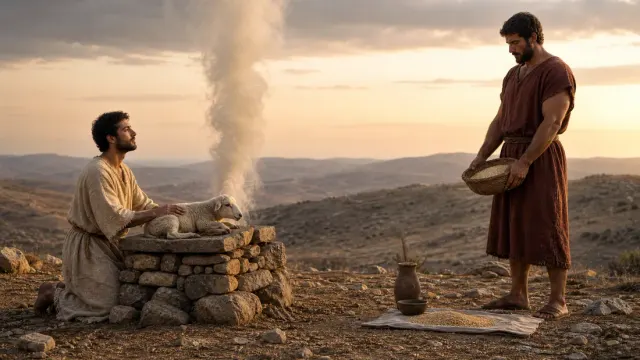
    In the course of time Cain brings some of the fruit of the ground and Abel brings the firstlings of his flock and their fat. God has regard for Abel and his offering and none for Cain and his. Cain is very angry and his face falls.

    The first worship in the Bible is two brothers bringing offerings, and the first rejection. Cain brings of the fruit of the ground; Abel brings of the firstlings of his flock and of the fat thereof. The Book of Genesis's wording is the only clue to the difference. Abel's gift is described with care, the firstborn and the best part; Cain's is simply some of what he grew. Hebrews says Abel offered by faith and so obtained witness that he was righteous, which puts the difference in the man before the gift. The LORD had respect unto Abel and to his offering, the man first, then the gift; and unto Cain and to his offering he had not respect, in the same order.

    Cain's response is the first anger in Scripture. He is very wroth, and his countenance falls. The text does not say he asked why. The rejection of an offering is answered not with a better offering but with rage at the one whose offering was received, and the account turns on that reaction rather than on the offering itself.

    Verse by verse

    1. 4:3

      In process of time: at the end of days, a set season. Offering here is minchah, a gift, not yet a blood sacrifice by definition.

    2. 4:4

      Firstlings and fat: the firstborn and the choicest part, the same portions later required in the law. The LORD looks on the giver before the gift.

    3. 4:5

      His countenance fell: the face that should be lifted to God turns to the ground.

    Genesis 4:3-5

    King James Version · 3 verses

    4:3And in process of time it came to pass, that Cain brought of the fruit of the ground an offering unto the LORD.

    4:4And Abel, he also brought of the firstlings of his flock and of the fat thereof. And the LORD had respect unto Abel and to his offering:

    4:5But unto Cain and to his offering he had not respect. And Cain was very wroth, and his countenance fell.

    Genesis 4:3-5: Two offerings
  3. 03

    Genesis 4:6-7

    Sin at the door

    God speaks to Cain before he acts, not after. Why are you angry? If you do well, will you not be accepted? Sin lies at the door and desires you, and you must rule over it. It is the first warning in Scripture, and it is refused.

    God speaks to Cain before he acts, which is the mercy in the account. Two questions, why art thou wroth and why is thy countenance fallen, invite him to look at himself. Then a promise and a warning in one sentence. If thou doest well, shalt thou not be accepted: the way back is open. If not, sin lieth at the door, crouching like an animal, and its desire is toward thee, but thou shalt rule over it. Sin is pictured here for the first time as a thing with a will of its own, waiting at the threshold, and Cain is told it can be mastered. The words desire and rule are the same pair used of the woman and her husband in 3:16. Cain is offered exactly what he needs and says nothing in reply.

    Verse by verse

    1. 4:6

      God's questions to Cain match his question to Adam in 3:9: not information, but an invitation to answer honestly.

    2. 4:7

      Lieth at the door: the verb is used of a beast crouching. Sin is personified for the first time, and mastery over it is commanded, not assumed impossible.

    Genesis 4:6-7

    King James Version · 2 verses

    4:6And the LORD said unto Cain, Why art thou wroth? and why is thy countenance fallen?

    4:7If thou doest well, shalt thou not be accepted? and if thou doest not well, sin lieth at the door. And unto thee shall be his desire, and thou shalt rule over him.

    Genesis 4:6-7: Sin at the door
  4. 04

    Genesis 4:8

    The field

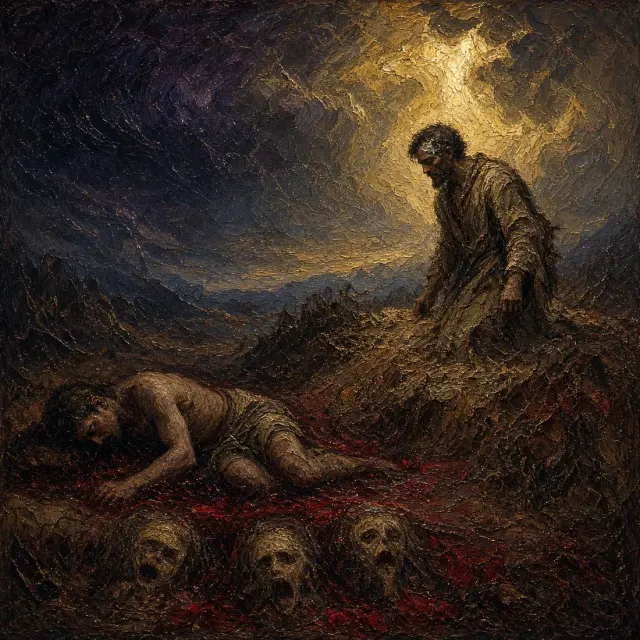
    Cain talks with his brother, and when they are in the field he rises against Abel and kills him. The oldest versions of the text preserve his invitation, let us go out to the field, which makes the killing planned rather than sudden.

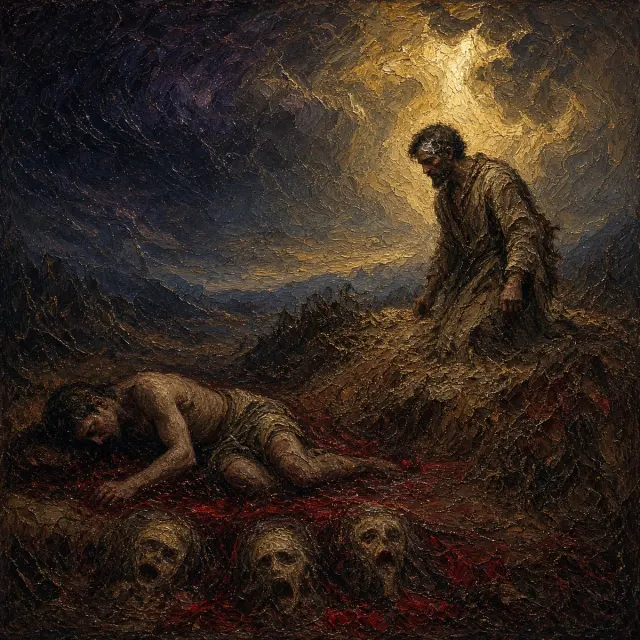
    One verse holds the first murder. Cain talked with Abel his brother; the Hebrew leaves the words unsaid, and the old versions supply let us go out into the field. Whatever he said, it got Abel away from the house. In the field, the place of Cain's work, he rose up against his brother and slew him. The word brother is used seven times in this chapter, twice in this verse, so that the reader cannot forget what Cain has done. He has killed not a stranger but the only other person born into the world. John says Cain slew his brother because his own works were evil and his brother's righteous, and calls that the pattern of the world's hatred of the church.

    Verse by verse

    1. 4:8

      In the field: out of sight, as he thought. The first death of a human being is a killing, and the victim is the one whose offering God accepted. See 1 John 3:12.

    Genesis 4:8

    King James Version · 1 verse

    4:8And Cain talked with Abel his brother: and it came to pass, when they were in the field, that Cain rose up against Abel his brother, and slew him.

    Genesis 4:8: The field
  5. 05

    Genesis 4:9-12

    Am I my brother's keeper

    Asked where Abel is, Cain lies and then asks the question. God answers that the blood cries from the ground. Cain is cursed from the ground that received it; it will no longer yield to him, and he will be a fugitive and a wanderer.

    Where is Abel thy brother is the second where in Genesis, and like the first it is asked by one who knows. Adam hid and admitted fear; Cain lies and adds insolence. I know not: am I my brother's keeper? The word keeper is Abel's trade, the keeper of sheep, so Cain's sneer is that he is not his brother's shepherd. God's answer does not argue. What hast thou done? The voice of thy brother's blood crieth unto me from the ground. The blood has a voice, and the ground that received it becomes the accuser.

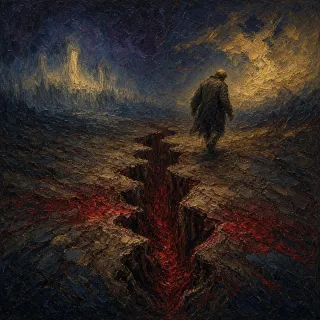
    The sentence is built on the ground, Cain's element. Adam heard that the ground was cursed for his sake; Cain hears that he is cursed from the ground. The soil that drank his brother's blood will no longer yield to him, and the tiller of the ground becomes a fugitive and a vagabond, a man who cannot stay anywhere. The punishment matches the crime at every point.

    Verse by verse

    1. 4:9

      My brother's keeper: the only question a human asks God in the chapter, and it is a lie dressed as a question.

    2. 4:10

      Crieth unto me: Hebrews 12:24 says the blood of Jesus speaks better things than that of Abel, which cried for justice.

    3. 4:11-12

      Cursed from the earth: Cain is the first human being called cursed. Fugitive and vagabond, nad and nod, give the land of Nod its name.

    Genesis 4:9-12

    King James Version · 4 verses

    4:9And the LORD said unto Cain, Where is Abel thy brother? And he said, I know not: Am I my brother’s keeper?

    4:10And he said, What hast thou done? the voice of thy brother’s blood crieth unto me from the ground.

    4:11And now art thou cursed from the earth, which hath opened her mouth to receive thy brother’s blood from thy hand;

    4:12When thou tillest the ground, it shall not henceforth yield unto thee her strength; a fugitive and a vagabond shalt thou be in the earth.

    Genesis 4:9-12: Am I my brother's keeper
  6. 06

    Genesis 4:13-16

    The mark

    Cain says his punishment is greater than he can bear and that whoever finds him will kill him. God promises sevenfold vengeance on anyone who does and sets a mark on him. Cain goes out from the presence of the LORD and settles in Nod, the land of wandering, east of Eden.

    Cain's reply is the first prayer of a sinner in the Bible, and it is about himself. My punishment is greater than I can bear, or, as some read it, my iniquity is too great to be forgiven. He names four losses: the face of the earth, the face of God, a settled life, and safety, for every one that findeth me shall slay me. He fears from others what he did to his brother. He does not mention Abel.

    God's answer is protection. Whoever kills Cain will suffer sevenfold, and a mark is set on him, not as a brand of shame but as a guard. The text never says what the mark was. It is the same pattern as the coats of skins: judgement, and then a covering. Cain goes out from the presence of the LORD, the last thing he had left, and settles in Nod, the land of wandering, east of Eden, the direction his parents went.

    Verse by verse

    1. 4:13

      Greater than I can bear: the word for punishment is also the word for iniquity. He complains of the weight, not the wrong.

    2. 4:14

      Every one that findeth me: Cain assumes a world already full of people who will act as he did.

    3. 4:15

      The mark is a sign for Cain, to protect him. What it was is not said, and the guesses are all later.

    4. 4:16

      From the presence of the LORD: the exile is completed. Nod means wandering.

    Genesis 4:13-16

    King James Version · 4 verses

    4:13And Cain said unto the LORD, My punishment is greater than I can bear.

    4:14Behold, thou hast driven me out this day from the face of the earth; and from thy face shall I be hid; and I shall be a fugitive and a vagabond in the earth; and it shall come to pass, that every one that findeth me shall slay me.

    4:15And the LORD said unto him, Therefore whosoever slayeth Cain, vengeance shall be taken on him sevenfold. And the LORD set a mark upon Cain, lest any finding him should kill him.

    4:16And Cain went out from the presence of the LORD, and dwelt in the land of Nod, on the east of Eden.

  7. 07

    Genesis 4:17-24

    The city and the line

    Cain's wife bears Enoch, and Cain builds a city and names it after his son. Six generations down, Lamech takes two wives, fathers the first herdsmen, musicians and metalworkers, and sings of killing a man for wounding him. Cain's sevenfold becomes Lamech's seventy-sevenfold.


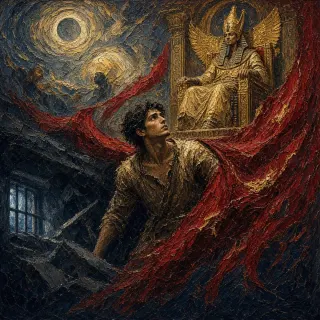
    The fugitive builds a city. Cain, sentenced to wander, founds the first settlement and names it for his son, so that his name and not God's is on the first human institution. His line runs seven generations to Lamech, and in it are the first tents and herds, the first music, and the first metalwork. Civilisation begins east of Eden among the descendants of a murderer, which is the Bible's steady view of human achievement: real, useful, and cut off from God.

    Lamech is the end of the line and its summary. He takes two wives, the first polygamy, and sings the first human poem after Adam's, a boast to his wives about a killing. He has slain a man for wounding him, and turns God's sevenfold protection of Cain into a seventy-sevenfold vengeance of his own. The chapter that began with a brother killing a brother ends with a man proud of it. The next verse is Seth's birth, and the line that calls on the name of the LORD begins.

    Verse by verse

    1. 4:17

      Builded a city: the wanderer settles. Enoch here is not the Enoch of chapter 5 who walked with God.

    2. 4:19

      Two wives: the first departure from 2:24.

    3. 4:20-22

      Jabal, Jubal, Tubal-cain: herding, music, metal. The arts come from Cain's line and are not condemned in themselves.

    4. 4:23-24

      Lamech's song: the first poetry of violence. Jesus answers seventy times seven with forgiveness in Matthew 18:22.

    Genesis 4:17-24

    King James Version · 8 verses

    4:17And Cain knew his wife; and she conceived, and bare Enoch: and he builded a city, and called the name of the city, after the name of his son, Enoch.

    4:18And unto Enoch was born Irad: and Irad begat Mehujael: and Mehujael begat Methusael: and Methusael begat Lamech.

    4:19And Lamech took unto him two wives: the name of the one was Adah, and the name of the other Zillah.

    4:20And Adah bare Jabal: he was the father of such as dwell in tents, and of such as have cattle.

    4:21And his brother’s name was Jubal: he was the father of all such as handle the harp and organ.

    4:22And Zillah, she also bare Tubal-cain, an instructer of every artificer in brass and iron: and the sister of Tubal-cain was Naamah.

    4:23And Lamech said unto his wives, Adah and Zillah, Hear my voice; ye wives of Lamech, hearken unto my speech: for I have slain a man to my wounding, and a young man to my hurt.

    4:24If Cain shall be avenged sevenfold, truly Lamech seventy and sevenfold.

The people, the places and the rest of Scripture.

Reading Cain closely

The people he dealt with

Cain's account has four people in it and he fails each of them. His mother speaks over him at his birth with more hope than any child in Genesis before Isaac. His father is never mentioned in the chapter after the first verse, and Cain inherits his work, the ground and its curse. His brother Abel never says a word in the whole account; he brings his offering, he is accepted, and he is killed. Everything the reader knows of Abel's character comes from later writers, who call him righteous and say he offered by faith.

The fourth is God, and this is where the account is most careful. God speaks to Cain twice, once before the murder and once after, and both times he asks a question first. The warning about sin crouching at the door is given to a man whose offering has just been refused, which means the refusal was not the end of the matter. The door was still open. After the murder God does not strike Cain down. He curses, sentences, listens to the complaint, and then protects. The mark is not explained and readers have guessed at it for three thousand years, but its purpose is stated: so that no one finding him would kill him.

His descendants are the last people in his account. Cain's line produces the first city, the first tent-dwelling herdsmen, the first musicians and the first workers in bronze and iron, and its last named man is a killer who boasts in verse. The chapter then turns to Seth, and the book of the generations of Adam in Genesis 5 does not mention Cain at all.

Why the offering was refused

Genesis does not say. It records that Abel brought the firstlings and their fat, the best of what he had, and that Cain brought of the fruit of the ground, with no such word attached. Readers have drawn the difference from that. Others have pointed to the warning that follows, if you do well, and argued that the problem was the man and not the gift.

The New Testament settles the question from the side of Abel rather than Cain. Hebrews says Abel offered a more excellent sacrifice by faith and so obtained witness that he was righteous. John says Cain's works were evil and his brother's righteous. The offering was the same act performed by two different hearts, and God saw the hearts. Cain's response proves the reading: a man wronged by an unfair judgment does not murder the man who was preferred.

What came before and what followed

Before Cain there is a promise and a curse. The woman has been told that her seed will bruise the serpent's head, and her first son is greeted as if he might be that seed. The ground has been cursed for Adam's sake, and that is the ground Cain works. Both threads run straight into the account: the hoped-for son becomes the first murderer, and the cursed ground drinks the first blood.

After him the world goes two ways. His own line builds and invents and grows violent, until the flood ends it. Seth's line calls on the name of the LORD, and it is through Seth that the promise travels to Noah. The pattern of an older brother set aside and a younger one chosen, which begins here with Cain and Abel, repeats through Genesis with Ishmael and Isaac, Esau and Jacob, Reuben and Judah, and Manasseh and Ephraim, and each time the text refuses to let the elder be simply a villain.

Where the rest of Scripture reaches back

Cain is named three times in the New Testament, each time as a warning. Hebrews 11:4 sets him against Abel's faith without naming his sin. 1 John 3:12 tells believers not to be as Cain, who was of that wicked one and slew his brother, and gives the reason: his works were evil and his brother's righteous, so that Cain becomes the picture of hatred within a family. Jude 1:11 pronounces woe on those who have gone in the way of Cain, alongside Balaam and Korah, which puts him first in a list of men who knew God and turned.

Jesus does not name Cain but names his victim. The blood of righteous Abel is the first blood in the reckoning of Matthew 23 and Luke 11, and Hebrews 12 says the blood of Jesus speaks better things than that of Abel. Abel's blood cried out from the ground for justice. Cain is the reason it had to.

Why it matters

Cain is the Bible's first study of what happens after the garden. Sin is no longer a single act at a tree; it is something with a will of its own, crouching, desiring, needing to be mastered, and Cain is the first person told that plainly and the first to fail at it. His question to God is the question the law and the prophets answer: yes, you are your brother's keeper.

He is also the first sinner shown mercy after judgment. He complains that his punishment is more than he can bear, and God, without lifting the sentence, marks him for protection. The New Testament treats him as a type. Hebrews sets his offering against Abel's faith, John names him as the one who belonged to the wicked one and killed his brother because his brother's works were righteous, and Jude speaks of false teachers who have gone the way of Cain. Jesus counts the blood of righteous Abel as the first of all the blood that would be required of a generation that killed the prophets, which makes Cain the first of the killers.

2 songs

The music

Every song in the catalogue whose passage falls inside these chapters.

  1. Genesis 3:1-5:32

    Blood in the Ground

  2. Genesis 4:1-16

    The Blood Cries

Nearby

All the people

Report an error on this page