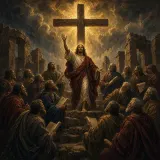
The big picture
The Book of 1 Corinthians reaches its longest sustained argument by asking what is left if resurrection is removed from the gospel. Paul begins with the proclamation Corinth already received, then follows denial until preaching, faith, forgiveness, apostolic testimony, and hope for the dead all collapse with it. His answer is not that death has become unimportant, but that Christ is risen as firstfruits and death itself is the last enemy to be destroyed. The question of the resurrection body then receives images of seed, created variety, corruption giving way to incorruption, and the earthly image giving way to the heavenly. Both the dead and the living require transformation. The chapter ends by turning that future victory back toward present labor: because death will not keep what it takes, work in the Lord is not empty.
In this chapter
- The Gospel Received, the Witnesses Named 1 Corinthians 15:1-11
Paul begins by taking Corinth backward, not forward.
- A Denial That Removes Its Own Foundation 1 Corinthians 15:12-19
The denial Paul examines cannot stay small.
- Firstfruits Are the Beginning of a Harvest 1 Corinthians 15:20-23
Two words change the direction of the whole argument: "But now." Paul stops tracing the consequences of a false premise and states the reality on which the rest of the chapter depends.
- The Last Enemy Is Actually Destroyed 1 Corinthians 15:24-28
Paul enlarges the resurrection question until it becomes a kingdom question.
- Practices and Dangers That Denial Cannot Explain 1 Corinthians 15:29-34
The strangest phrase in the chapter is useful precisely because Paul does not explain it.
- A Seed Is Not the Finished Plant 1 Corinthians 15:35-41
The objection asks for a body as though resurrection must first pass a test of familiarity.
- A Spiritual Body Is Still a Body 1 Corinthians 15:42-49
Paul finally names the transformation the seed image was carrying.
- The Living Need Transformation Too 1 Corinthians 15:50-53
The living do not get an exemption from resurrection's logic.
- The Argument Ends Where Labor Begins 1 Corinthians 15:54-58
Paul has called death an enemy, and now he lets Scripture taunt it.

Scripture beside the summary
1 Corinthians · King James Version · 581 Corinthians 15:1-11
The Gospel Received, the Witnesses Named
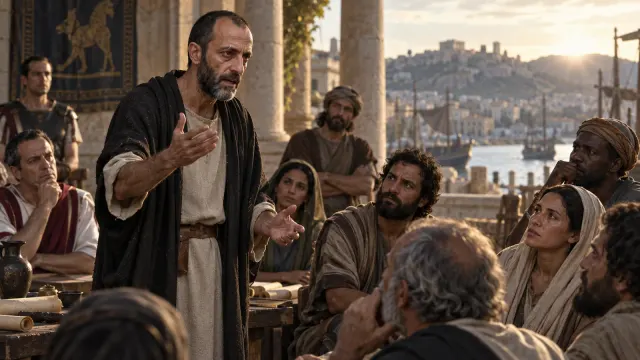
Paul begins by taking Corinth backward, not forward. Resurrection is not a new doctrine added to settle a local argument; it belongs to the gospel they already "received" and in which they already stand. The witness list matters because the claim is public enough to have names attached to it: Cephas, the twelve, more than five hundred, James, the apostles, and finally Paul. Yet the most revealing name in the list is Paul's own. He does not use his encounter with the risen Christ to raise himself above the others. He remembers that he persecuted the church, calls himself least, and then refuses even to keep the credit for his later labor. "By the grace of God I am what I am" becomes the measure of both his past and his work. In a church prone to comparing messengers, the paragraph ends by flattening the rivalry: whether Paul or they preached, the message was the same, and Corinth believed it.
Deep dive
The sequence of receiving, standing, being saved, and holding fast makes this a recall of the gospel already preached, not the presentation of a new specialty. The repeated "according to the scriptures" locates Christ's death and resurrection within the scriptural purpose Paul proclaims. Burial belongs to the account of a real death; appearances belong to the claim that the dead Christ has been raised. Paul does not identify one proof text here, and supplying a single hidden citation as though he had named it would narrow his language without warrant.
The witnesses are named or grouped: Cephas, the twelve, more than five hundred together, James, and all the apostles. Paul's distinction between those still living and those who have fallen asleep anchors the testimony in the circumstances of his writing. The list is not presented as a full chronology of every appearance found elsewhere. Its purpose is to identify the testimony undergirding the common proclamation.
Paul's own appearance comes last and is described with the unsettling image of an untimely birth. His reason for calling himself least is explicit: he persecuted God's church. Grace neither pretends that past never happened nor leaves him defined only by it. His abundant labor is acknowledged and immediately credited to grace. The final return to the shared preaching is crucial in a divided church: whether the messenger was Paul or another apostle, this was the gospel the Corinthians believed.
Words to trace: seen, grace, apostles, believed, brethren, preached
Verse-by-verse path
- 1 Corinthians 15:1
“Declare” is gnorizo, to make known, as though reminding people of something they have let slip. Across this verse and the next Paul traces the gospel through their lives in four verbs: he preached it, they received it, they stand in it, and by it they are being saved.
- 1 Corinthians 15:2
“Keep in memory” is katecho, to hold fast, the verb of 11:2, “keep the ordinances, as I delivered them”. “Are saved” is present in Greek, are being saved. “In vain” is eike, without cause: faith in a gospel that was never true would have been faith in nothing.
- 1 Corinthians 15:3
“Delivered” and “received” are the technical pair for handing on tradition, the same pair Paul used for the Lord’s Supper in 11:23. The balanced lines that follow read like a formula, and most scholars take verses 3 to 5 as a creed Paul was himself taught within a few years of the crucifixion. “First of all” means of first importance.
- 1 Corinthians 15:4
“Was buried” stands as its own line in the formula, sealing the reality of the death and implying a tomb. “Died” and “was buried” are simple past, but “rose” is a Greek perfect, egegertai, has been raised and stays raised. “The third day” may look to Hosea 6:2, though Paul names no text.
- 1 Corinthians 15:5
Cephas is the Aramaic form of Peter’s name, the one Paul regularly uses (1:12, 3:22, 9:5). Luke 24:34 records this same private appearance, “hath appeared to Simon”. “The twelve” is the group’s title, kept even though Judas was gone.
- 1 Corinthians 15:6
The appearance to more than five hundred at once is found nowhere else in the New Testament. Paul adds that most are still alive, which amounts to an invitation to go and ask them. “Fallen asleep” is koimao, the Christian word for death, from which “cemetery”, a sleeping place, comes.
- 1 Corinthians 15:7
This James is the Lord’s brother, who did not believe during the ministry (John 7:5) and later led the church in Jerusalem, where Paul met him (Galatians 1:19). No Gospel records an appearance to him; this line is its only mention, and it goes a long way to explaining his change.
- 1 Corinthians 15:8
“One born out of due time” is ektroma, a miscarriage, a child born dead or deformed. It is a savage word to use of oneself, and the Greek gives it the article, “the ektroma”, which has led some to suspect it was an insult his opponents threw at him first.
- 1 Corinthians 15:9
Paul’s Roman name, Paulus, means “small”, and some hear a play on it in “least”, elachistos, though he never makes it explicit. He recalls his persecution in almost the same words in Galatians 1:13, where he “persecuted the church of God”, and in 1 Timothy 1:13.
- 1 Corinthians 15:10
The claim to have laboured more than all of them is not idle: 2 Corinthians 11:23–28 lists the beatings, shipwrecks and sleepless nights behind it. “Bestowed upon me” is literally “toward me”, grace aimed at him. “In vain” here is kenos, empty, a word the chapter will come back to.
- 1 Corinthians 15:11
“Therefore” resumes the thread broken off by Paul’s digression about himself. “So we preach” is present tense and “so ye believed” is past: the message has not changed from one apostle to the next, and the only open question is whether Corinth will keep what it believed.
1 Corinthians 15:1-11
King James Version1Moreover, brethren, I declare unto you the gospel which I preached unto you, which also ye have received, and wherein ye stand;
2By which also ye are saved, if ye keep in memory what I preached unto you, unless ye have believed in vain.
3For I delivered unto you first of all that which I also received, how that Christ died for our sins according to the scriptures;
4And that he was buried, and that he rose again the third day according to the scriptures:
5And that he was seen of Cephas, then of the twelve:
6After that, he was seen of above five hundred brethren at once; of whom the greater part remain unto this present, but some are fallen asleep.
7After that, he was seen of James; then of all the apostles.
8And last of all he was seen of me also, as of one born out of due time.
9For I am the least of the apostles, that am not meet to be called an apostle, because I persecuted the church of God.
10But by the grace of God I am what I am: and his grace which was bestowed upon me was not in vain; but I laboured more abundantly than they all: yet not I, but the grace of God which was with me.
11Therefore whether it were I or they, so we preach, and so ye believed.
1 Corinthians 15:12-19
A Denial That Removes Its Own Foundation
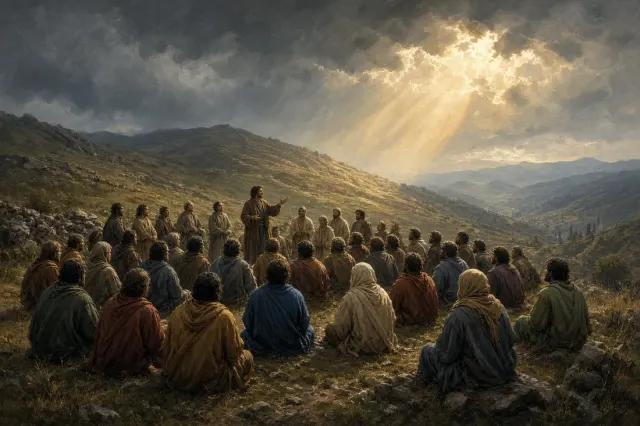
The denial Paul examines cannot stay small. Saying that the dead do not rise might sound like a single correction to Christian hope, but Paul follows it until it pulls the floor out from under everything else. If resurrection is impossible as a category, Christ cannot be the protected exception. Then preaching becomes empty, faith becomes empty, the witnesses have spoken falsely about God, believers remain in their sins, and the dead in Christ have not merely fallen asleep but perished. The argument grows more severe because each consequence exposes something the denial was trying to keep while discarding its foundation. Even present hope changes character if death finally proves victorious. Paul is not claiming that Christian life has no value before death. He is showing that a hope built on a risen Christ cannot survive by keeping the language of salvation while surrendering the resurrection that gives that language its future.
Deep dive
The issue is introduced as something said by some among the Corinthians, not as a denial necessarily shared by the entire church. Their precise explanation is not preserved. Paul nevertheless identifies an inconsistency between confessing Christ's resurrection and denying resurrection of the dead. Christ's rising is not insulated from the category being rejected. If the dead cannot be raised, the gospel's central resurrection claim falls with them.
The consequences become progressively more personal. Preaching and faith are empty, the witnesses have misrepresented God, and the Corinthians remain in their sins. Paul will not preserve the saving significance of the cross by detaching it from the resurrection. Nor does he leave the dead believers safely outside the argument. Those who fell asleep in Christ have perished under the denied-resurrection premise. The reassuring expression fallen asleep therefore rests on a hope the opponents' position cannot sustain.
The final description of present-life-only hope is not a claim that Christian life contains no present good. Paul is considering a hope whose promised victory over death has proved false while the costly commitment remains. His reasoning refuses a reduced gospel in which resurrection can be discarded without changing anything important. The hypothetical denial would undo the message, the messenger's truthfulness, the believers' standing, and the future of their dead.
Words to trace: Christ, dead, raised, vain, faith, resurrection
Verse-by-verse path
- 1 Corinthians 15:12
“Some among you” were denying the resurrection of the dead in general, not Christ’s by name. Many Greeks held that the soul is freed from the body at death, so a raised body sounded like a step backward; the Athenians laughed at Paul at exactly this point (Acts 17:32).
- 1 Corinthians 15:13
The logic is strict: a general denial covers every particular case. If no dead person rises, there is no room left for an exception, and the Greek puts it emphatically, oude Christos, not even Christ.
- 1 Corinthians 15:14
“Vain” is kenos, empty, containing nothing. The “vain” of verse 17 is a different word, mataios, futile, pointless; English uses one word for both, and Paul uses two, first for the hollowness of the message and then for the uselessness of the faith that rests on it.
- 1 Corinthians 15:15
“False witnesses of God” can mean witnesses who misrepresent God or, reading the Greek kata more sharply, witnesses against God, claiming he did what he did not. The ninth commandment forbade false witness (Exodus 20:16), and Paul reckons the apostles guilty of it toward God himself.
- 1 Corinthians 15:16
The King James varies “risen” and “raised”, but the Greek verb is the same passive in verses 13 and 16, egegertai. Paul repeats his premise almost word for word, clearing the ground before he draws the harder consequences in the next three verses.
- 1 Corinthians 15:17
“Vain” this time is mataios, the word Greek writers used of idols and empty rites. “Ye are yet in your sins” ties forgiveness to the resurrection and not to the cross alone; Romans 4:25 says Christ “was raised again for our justification”.
- 1 Corinthians 15:18
“Perished” is apollymi, the verb Paul used in 1:18 for “them that perish” and in 10:10 for the Israelites “destroyed of the destroyer”. The believing dead would join those whose end the letter has already described as ruin.
- 1 Corinthians 15:19
“Most miserable” is eleeinoteroi, most to be pitied. The Greek places “only” awkwardly, and many read it as “if we have merely hoped in Christ in this life”, with nothing beyond. Paul’s own life, as he described it in 4:9–13, was the kind others pitied.
1 Corinthians 15:12-19
King James Version12Now if Christ be preached that he rose from the dead, how say some among you that there is no resurrection of the dead?
13But if there be no resurrection of the dead, then is Christ not risen:
14And if Christ be not risen, then is our preaching vain, and your faith is also vain.
15Yea, and we are found false witnesses of God; because we have testified of God that he raised up Christ: whom he raised not up, if so be that the dead rise not.
16For if the dead rise not, then is not Christ raised:
17And if Christ be not raised, your faith is vain; ye are yet in your sins.
18Then they also which are fallen asleep in Christ are perished.
19If in this life only we have hope in Christ, we are of all men most miserable.
1 Corinthians 15:20-23
Firstfruits Are the Beginning of a Harvest
Two words change the direction of the whole argument: "But now." Paul stops tracing the consequences of a false premise and states the reality on which the rest of the chapter depends. Christ is risen, and "firstfruits" refuses to let that resurrection remain a magnificent one-time exception. The image points beyond the first portion to the harvest that follows. That is why Adam and Christ appear together. Death enters the argument through one representative relation, and resurrection life through another. Yet Paul is equally careful about sequence. Christ is firstfruits; those who belong to him are raised afterward, at his coming. Present mortality therefore does not count as evidence that Christ's victory failed. The interval is already built into the image. The firstfruits and the harvest belong together precisely because they are connected without occurring at the same moment.

Deep dive
The decisive turn is "But now." Paul is no longer following the denied-resurrection premise but stating what he proclaims to be the case. Firstfruits is an agricultural image: the first portion belongs to a harvest still to follow. Christ's resurrection is therefore more than an isolated exception allowed in a universe where death otherwise remains final. It establishes the beginning and character of what follows for those who are his.
The parallel with Adam relates death and resurrection to humanity through a man in each case. Paul's two uses of all have generated debate about the extent of the life described. The immediate qualification in verse 23 identifies those who belong to Christ at his coming. The passage should not be made to settle every question about universal salvation without attending to that specification and to the chapter's audience.
Order also matters. Christ has been raised, while the resurrection of his people is still associated with his coming. Their present mortality does not disprove his victory, because Paul has not claimed that every stage occurs simultaneously. The interval gives the firstfruits image its force. The first risen one and the coming harvest are connected without being collapsed into the same moment.
Words to trace: Christ, dead, firstfruits, Adam, alive, become
Verse-by-verse path
- 1 Corinthians 15:20
“Firstfruits” is aparche, recalling the first sheaf of the barley harvest waved before the LORD on the day after the sabbath of Passover week (Leviticus 23:10–11). That day fell on the first day of the week, the day of the resurrection, and many have seen the date as part of Paul’s image.
- 1 Corinthians 15:21
Two lines, each hinging on “by man”, di’ anthropou. Death and resurrection both arrive through a human being, which makes Christ’s humanity essential to the rising, not incidental. Paul holds back the name Adam until the next verse.
- 1 Corinthians 15:22
“In Adam” and “in Christ” are parallel phrases of belonging. Whether the second “all” means every human being or all who are in Christ is debated; verse 23 narrows it at once to “they that are Christ’s”. Romans 5:12–21 develops the same comparison at length.
- 1 Corinthians 15:23
“Order” is tagma, a military unit, a company of troops marching in its turn. “Coming” is parousia, the word for a king’s or emperor’s arrival on a state visit, which Paul also uses of Christ in 1 Thessalonians 4:15.
1 Corinthians 15:20-23
King James Version20But now is Christ risen from the dead, and become the firstfruits of them that slept.
21For since by man came death, by man came also the resurrection of the dead.
22For as in Adam all die, even so in Christ shall all be made alive.
23But every man in his own order: Christ the firstfruits; afterward they that are Christ’s at his coming.
1 Corinthians 15:24-28
The Last Enemy Is Actually Destroyed
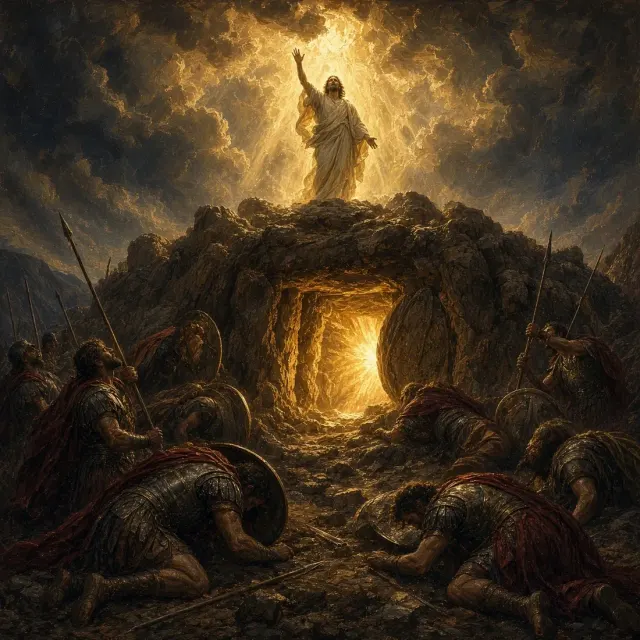
Paul enlarges the resurrection question until it becomes a kingdom question. The end is not simply the point when enough time has passed. It is the completion of a reign in which every opposing rule, authority, and power is brought down, and death is named without euphemism as "the last enemy." That phrase matters. Paul will not make resurrection hope depend on pretending death is harmless, natural in the comforting sense, or already defeated merely because believers speak differently about it. The bodies that die still require raising, and the enemy that holds them still requires destruction. Scriptural language about all things beneath the ruler's feet frames Christ's reign, while Paul carefully excludes God from the "all things" being subjected. The Son's reign, the subjection of enemies, and the delivery of the kingdom all move toward one ordered conclusion: "that God may be all in all."
Deep dive
The end is defined by the removal of opposing rule, authority, and power, not merely by the passage of enough time. Paul draws on the language of enemies beneath the ruler's feet associated with Psalm 110:1, then on the subjection of all things in Psalm 8:6. These scriptural lines converge in the reign of Christ. The chapter's bodily hope belongs within a kingdom in which hostile powers do not remain permanently enthroned.
Death is the last enemy. That identification keeps the resurrection claim from becoming a polite renaming of death as something already harmless. The bodies that die require raising, and the dominion that holds them requires destruction. Paul's argument would not be satisfied by a consolation that leaves death's final possession of its victims untouched.
The reference to all things being subjected receives an explicit exception: God, who subjects them, is not included among the subjected things. Paul is careful about the relation his language creates. The Son's own subjection and the delivery of the kingdom are directed toward God being all in all. The passage describes the ordered completion of the Son's reign within the Father's purpose. It should not be forced to answer every later question about divine being as though Paul had stopped his resurrection argument to supply an exhaustive metaphysical definition.
Words to trace: feet, authority, cometh, death, delivered, destroyed
Verse-by-verse path
- 1 Corinthians 15:24
“Put down” is katargeo, to render inactive, the verb 13:8 used of prophecies. Rule, authority and power are Paul’s names for the forces ranged against God, the same trio as Ephesians 1:21. “Delivered up” uses the verb of handing on tradition from verse 3.
- 1 Corinthians 15:25
The line reworks Psalm 110:1, “until I make thine enemies thy footstool”, the Old Testament verse the New Testament quotes more than any other. “Must” is dei, the word of divine necessity; the reign has a fixed end point, and it is set by the enemies’ defeat.
- 1 Corinthians 15:26
The Greek sentence is short and ends on its subject: last enemy abolished, death. The verb is present tense, katargeitai, “is being abolished”, which speaks of the destruction as though it were already under way.
- 1 Corinthians 15:27
The quotation is Psalm 8:6, “thou hast put all things under his feet”, a psalm about humankind that Paul reads as fulfilled in the one true man. Hebrews 2:6–9 reads it the same way, and Ephesians 1:20–22 sets Psalm 8 and Psalm 110 side by side.
- 1 Corinthians 15:28
“Subject” is hypotasso, the verb of 14:32 and 14:34. Arians in the fourth century cited this verse against the Son’s full deity; Nicene writers answered that it describes his mission as mediator, not his nature. “All in all” recalls 12:6, God “which worketh all in all”.
1 Corinthians 15:24-28
King James Version24Then cometh the end, when he shall have delivered up the kingdom to God, even the Father; when he shall have put down all rule and all authority and power.
25For he must reign, till he hath put all enemies under his feet.
26The last enemy that shall be destroyed is death.
27For he hath put all things under his feet. But when he saith all things are put under him, it is manifest that he is excepted, which did put all things under him.
28And when all things shall be subdued unto him, then shall the Son also himself be subject unto him that put all things under him, that God may be all in all.
1 Corinthians 15:29-34
Practices and Dangers That Denial Cannot Explain
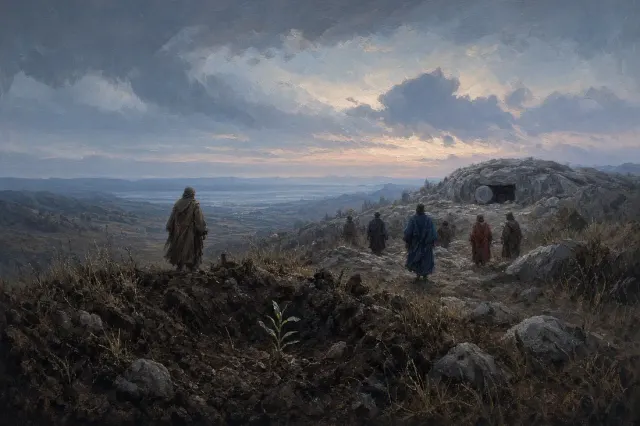
The strangest phrase in the chapter is useful precisely because Paul does not explain it. "Baptized for the dead" was clear enough to Corinth to serve his argument, but not clear enough here to reconstruct a ceremony with confidence. Paul does not institute the practice, describe its mechanics, or stop to approve it. He asks a narrower question: what sense does it make if the dead do not rise? Then he places his own danger beside it. Continual jeopardy and his claim to "die daily" also lose their horizon if death ends everything. Even the difficult line about fighting beasts at Ephesus is left without the detail needed to turn it into a scene. What becomes clear is the moral pressure of the doctrine. "Let us eat and drink; for to morrow we die" is not merely a slogan Paul dislikes. It is the horizon that remains when resurrection is removed, and conduct changes with it.

Deep dive
Baptism for the dead remains one of the chapter's genuinely obscure phrases. Proposed readings include a baptism performed on behalf of dead people, baptism undertaken in hope of resurrection, and a figurative baptism in suffering. The sentence presumes something the Corinthians could recognize but does not describe its procedure. Paul refers to those who perform it in the third person. He neither institutes a rite here nor pauses to issue an explicit verdict on its legitimacy.
The argumentative function is clearer than the practice: denying resurrection removes the rationale being invoked. Paul then places his own danger beside it. Dying daily describes continual exposure rather than repeated literal death. Fighting beasts at Ephesus may refer to a literal ordeal or to violent human opposition; the line does not provide enough detail to narrate an arena scene. Without resurrection, the cost he bears loses the future to which he has related it.
The quotation about eating and drinking before death echoes Isaiah 22:13 and exposes the alternative horizon. The proverb concerning corrupting company or conversation then connects belief with conduct. Paul does not treat denial as a harmless intellectual adjustment. His closing rebuke concerns ignorance of God and the need for righteous conduct. The people proud of their knowledge are being told that a decisive part of their understanding has failed.
Words to trace: dead, baptized, rise, advantageth, Awake, beasts
Verse-by-verse path
- 1 Corinthians 15:29
Scholars have counted some forty readings of this clause, and Latter-day Saint proxy baptism appeals to it. Paul says “they”, not “we” or “ye”, which keeps the practice at arm’s length, and switches to “we” in the next verse for dangers he does own.
- 1 Corinthians 15:30
“Jeopardy” is kindyneuo, to run a risk; 2 Corinthians 11:26 spells out its forms, perils of waters, of robbers, of his own countrymen, in the city and the wilderness. “Every hour” is no exaggeration in a life like that.
- 1 Corinthians 15:31
“I protest by” renders ne, a Greek particle of oath found only here in the New Testament: I swear by. What Paul swears by is his pride in the Corinthians, a surprising oath. “I die daily” means daily exposure to death, not a spiritual exercise.
- 1 Corinthians 15:32
“After the manner of men” means humanly speaking, with merely human hopes. A Roman citizen was not normally sent to the arena, so many read the beasts as a figure for violent opponents, like the Ephesian riot of Acts 19. “Let us eat and drink” quotes Isaiah 22:13, where Jerusalem feasts as the siege closes in.
- 1 Corinthians 15:33
“Evil communications corrupt good manners” is a line of verse from Menander, the Athenian comic playwright, by then a common proverb. “Communications” means company, homiliai, the people one keeps; “manners” means character. Paul quotes the theatre to people who prized Greek learning.
- 1 Corinthians 15:34
“Awake” is eknepho, to sober up, to come out of a drunken stupor, the right word after “let us eat and drink”. The Greek reads literally “ignorance of God some have”, a hard word for a church that boasted of knowledge (8:1).
1 Corinthians 15:29-34
King James Version29Else what shall they do which are baptized for the dead, if the dead rise not at all? why are they then baptized for the dead?
30And why stand we in jeopardy every hour?
31I protest by your rejoicing which I have in Christ Jesus our Lord, I die daily.
32If after the manner of men I have fought with beasts at Ephesus, what advantageth it me, if the dead rise not? let us eat and drink; for to morrow we die.
33Be not deceived: evil communications corrupt good manners.
34Awake to righteousness, and sin not; for some have not the knowledge of God: I speak this to your shame.
1 Corinthians 15:35-41
A Seed Is Not the Finished Plant
The objection asks for a body as though resurrection must first pass a test of familiarity. Paul answers with a seed, one of the most ordinary things in the world, because ordinary creation already refuses the assumption behind the question. What is sown is genuinely connected to what appears, yet the bare grain is not the finished form of the plant. Continuity does not require sameness of present appearance. Paul then widens the field from seed to flesh, from earthly bodies to heavenly bodies, and from sun to moon to stars. The point is not to build a catalog of resurrection classes. It is to show that created existence already contains more variety than the objection allows. "God giveth it a body as it hath pleased him" places the future body within divine giving rather than present human limitation. The question is not whether the future must look like the familiar, but whether the God who gives bodies is confined to what is familiar now.

Deep dive
The imagined objector presses both the possibility of resurrection and the kind of body involved. Paul's sharp answer exposes an inconsistency in the objection rather than offering a detailed account of decomposition. Ordinary sowing already involves continuity through a profound change of appearance. The bare grain is related to the plant that comes, but it is not the complete visible form of that plant.
The seed illustration is an analogy of transformation, not a modern botanical claim that a seed must become biologically lifeless before it germinates. Paul's stated emphasis is that God gives the body and gives each seed its own. This preserves both continuity and divine freedom: resurrection is neither the disappearance of the person nor the requirement that the future body be confined to its present condition.
Different kinds of flesh, earthly and heavenly bodies, and the varied glory of sun, moon, and stars extend the answer. Creation already displays a range of bodily forms and splendors. The objection has assumed that the body presently known exhausts the possibilities. Paul does not map each kind of star onto a precise class of resurrected person. He uses the variety to loosen an assumption that would make God's future act impossible simply because it exceeds the familiar.
Words to trace: glory, body, flesh, sowest, bodies, celestial
Verse-by-verse path
- 1 Corinthians 15:35
Paul voices an objector with two questions, how and with what body. The second is the real challenge: a corpse decays, so what could come back? For many Greeks the body was a prison the soul was glad to leave, which made the question a sneer as much as a query.
- 1 Corinthians 15:36
“Thou fool” is aphron, senseless, singular, aimed at the imaginary questioner. The Greek stresses “thou”: what you yourself sow every season. Jesus used the grain that must die to bear fruit in John 12:24.
- 1 Corinthians 15:37
“Bare grain” is gymnos kokkos, a naked kernel. “It may chance” is ei tychoi, the “it may be” of 14:10. Every farmer knows that what goes into the ground looks nothing like the stalk that comes up, and plants it anyway.
- 1 Corinthians 15:38
“As it hath pleased him” is past tense in Greek, “as he willed”, which points back to the creation week, when each plant was made to yield seed “after his kind” (Genesis 1:11–12). Each seed receiving “his own body” keeps continuity: what is sown as wheat comes up wheat.
- 1 Corinthians 15:39
The four kinds of flesh, men, beasts, fishes, birds, run roughly backward through the days of creation in Genesis 1. “Flesh” is sarx used plainly, bodily substance, without the moral sense the word carries in Romans 8.
- 1 Corinthians 15:40
“Celestial” and “terrestrial” are the Latinate English for epouranios and epigeios, heavenly and earthly. Whether “celestial bodies” means sun and stars or angelic beings is debated; the next verse, with its sun, moon and stars, tilts it toward the sky.
- 1 Corinthians 15:41
“One star differeth from another star in glory” was sound astronomy to ancient eyes: Greek astronomers already ranked stars by brightness, a scale traditionally traced to Hipparchus. “Glory” here is doxa in its plain sense, visible splendour.
1 Corinthians 15:35-41
King James Version35But some man will say, How are the dead raised up? and with what body do they come?
36Thou fool, that which thou sowest is not quickened, except it die:
37And that which thou sowest, thou sowest not that body that shall be, but bare grain, it may chance of wheat, or of some other grain:
38But God giveth it a body as it hath pleased him, and to every seed his own body.
39All flesh is not the same flesh: but there is one kind of flesh of men, another flesh of beasts, another of fishes, and another of birds.
40There are also celestial bodies, and bodies terrestrial: but the glory of the celestial is one, and the glory of the terrestrial is another.
41There is one glory of the sun, and another glory of the moon, and another glory of the stars: for one star differeth from another star in glory.
1 Corinthians 15:42-49
A Spiritual Body Is Still a Body
Paul finally names the transformation the seed image was carrying. What is sown in corruption is raised in incorruption; dishonor gives way to glory, weakness to power, and the natural body to a spiritual body. The last phrase is easy to flatten into a contradiction, but Paul does not. Both are bodies. "Spiritual" therefore cannot mean that embodiment has been abandoned. The contrast concerns the condition and source of life, not the disappearance of bodily existence. Adam and Christ then explain why the change is more than an upgrade to the same mortal arrangement. The first man is earthly and living; the last Adam is life-giving. One order comes first, the other afterward. Those who have borne the image of the earthly will bear the image of the heavenly. The chapter's hope is therefore neither escape from humanity nor indefinite preservation of present weakness. It is embodied life conformed to the risen Christ.
Deep dive
The repeated contrast between what is sown and what is raised applies the illustration directly. The present body's vulnerability is neither denied nor treated as the final definition of bodily existence. The KJV's natural and spiritual bodies are both called bodies. Spiritual therefore cannot simply mean nonbodily. The contrast concerns the condition and source of life rather than an escape from embodiment as such.
Genesis 2:7 supplies the description of the first Adam as a living soul. The last Adam is described as life-giving, which moves beyond merely possessing the same life under better circumstances. Paul distinguishes the first, earthly mode and the subsequent, heavenly one. Natural comes first and spiritual afterward; the Corinthians cannot dismiss the coming transformation by pretending the present stage already exhausts it.
The image borne by those who belong to the earthly man will give way to the image of the heavenly man. This develops the representative parallel introduced in verses 21–22 and explains why Christ's own resurrection matters for others. Paul promises a changed mode of embodied life without supplying specifications about its every faculty. The emphasis falls on conformity to the risen Lord rather than on satisfying every curiosity about the future body's operation.
Words to trace: body, earthy, raised, sown, spiritual, first
Verse-by-verse path
- 1 Corinthians 15:42
“So also” applies all the illustrations at once. The verbs are “sown” and “raised”, and the subject is left as a bare “it”: burial is described in a farmer’s language, not a gravedigger’s. “Corruption” is phthora, decay.
- 1 Corinthians 15:43
Two more pairs follow, dishonour and glory, weakness and power. A corpse was unclean and shameful in the ancient world and was carried outside the city to be buried. “Dishonour” is atimia, the word 11:14 used of long hair on a man.
- 1 Corinthians 15:44
“Natural” is psychikos, from psyche, soul: the body animated by ordinary life. The same word in 2:14 describes “the natural man” who does not receive the things of the Spirit. The second sentence insists the spiritual body exists, not merely that it could.
- 1 Corinthians 15:45
The quotation is Genesis 2:7, “man became a living soul”, with “first” and “Adam” added by Paul. The second half is not from Genesis at all but Paul’s completion of it: the last Adam became a spirit that gives life.
- 1 Corinthians 15:46
Philo of Alexandria read Genesis 1 and 2 as describing two men, a heavenly ideal man first and an earthly one after. Paul insists on the opposite order: the earthy comes first, the spiritual afterward. Whether he is answering that kind of reading directly is an inference, but the fit is close.
- 1 Corinthians 15:47
“Of the earth, earthy” is choikos, made of dust, choos, the word of Genesis 2:7, “the dust of the ground”. The oldest manuscripts read “the second man is from heaven”, without “the Lord”; the King James follows later copies that added it.
- 1 Corinthians 15:48
The Greek has no verbs, only paired adjectives, dusty and heavenly, and reads almost like an equation. Belonging decides nature: those who belong to the dust share its fate, and those who belong to the heavenly man share his.
- 1 Corinthians 15:49
“Image” is eikon, the word of Genesis 1:27 and 5:3, where Adam begets a son “in his own likeness, after his image”. Many of the oldest manuscripts read “let us also bear”, an exhortation, for “we shall bear”; in Greek the difference is one vowel.
1 Corinthians 15:42-49
King James Version42So also is the resurrection of the dead. It is sown in corruption; it is raised in incorruption:
43It is sown in dishonour; it is raised in glory: it is sown in weakness; it is raised in power:
44It is sown a natural body; it is raised a spiritual body. There is a natural body, and there is a spiritual body.
45And so it is written, The first man Adam was made a living soul; the last Adam was made a quickening spirit.
46Howbeit that was not first which is spiritual, but that which is natural; and afterward that which is spiritual.
47The first man is of the earth, earthy: the second man is the Lord from heaven.
48As is the earthy, such are they also that are earthy: and as is the heavenly, such are they also that are heavenly.
49And as we have borne the image of the earthy, we shall also bear the image of the heavenly.
1 Corinthians 15:50-53
The Living Need Transformation Too
The living do not get an exemption from resurrection's logic. "Flesh and blood cannot inherit the kingdom of God" is immediately explained by the parallel between corruption and incorruption, so the problem is not that bodies exist. The problem is mortality in its present perishable condition. Paul then discloses the mystery: not everyone will die before the final change, but everyone in view must be changed. The dead are raised incorruptible, and those still living are transformed with them. That removes any imagined advantage from avoiding the grave. Burial is not what makes transformation necessary; corruption is. The suddenness of "the twinkling of an eye" emphasizes how decisively the change occurs without turning the verse into a stopwatch or a complete prophetic timetable. The essential claim is simpler and larger: neither death nor continued mortal life can carry a person into incorruption unchanged, but neither can prevent the change God provides.
Deep dive
The statement about flesh and blood is immediately paralleled with corruption and incorruption. In this argument, the problem is the present mortal condition, not the bare fact of having a body. Reading the line as a rejection of embodiment would contradict the spiritual body Paul has just described. The future kingdom requires a form of life that does not remain subject to decay.
The mystery is something now disclosed: death will not be the experience of every believer before the change, but transformation is necessary for all within the group Paul describes. Sleeping refers to death as it has elsewhere in the chapter. At the trumpet, the dead are raised incorruptible and the living are changed. The passage joins these events rather than setting the living at an advantage because they have avoided burial.
The language of putting on incorruption and immortality treats the change as God's provision for what presently lacks them. The twinkling of an eye emphasizes suddenness; it does not provide a scientific duration or a detailed timetable coordinating every prophetic passage. Paul's answer to the bodily objection is now complete in its essential form. Neither death nor continued mortal life can carry someone into the kingdom unchanged, but neither prevents the transformation God supplies.
Words to trace: changed, incorruption, inherit, blood, brethren, corruptible
Verse-by-verse path
- 1 Corinthians 15:50
“Now this I say” signals a summary. “Flesh and blood” is a Hebrew idiom for humanity in its mortal frailty, as in Matthew 16:17, “flesh and blood hath not revealed it”. “Inherit” is the covenant word for receiving the promised land, now used of the kingdom.
- 1 Corinthians 15:51
“Mystery” in Paul is a secret God has now disclosed, not a puzzle. His “we” counts himself possibly among the living at the end, as in 1 Thessalonians 4:17. Some manuscripts garble the line into “we shall all sleep, but we shall not all be changed”.
- 1 Corinthians 15:52
“Moment” is atomos, uncuttable, an instant too short to divide, from which “atom” comes. “Twinkling” is rhipe, a flick or a blink. The trumpet summoned Israel to assemble (Numbers 10:2) and sounds as the Lord descends in 1 Thessalonians 4:16.
- 1 Corinthians 15:53
“Put on” is enduo, the ordinary verb for getting dressed. Immortality is put on over mortality, not swapped for it, which fits a body changed rather than replaced. The repeated “this” points, as it were, to the speaker’s own body.
1 Corinthians 15:50-53
King James Version50Now this I say, brethren, that flesh and blood cannot inherit the kingdom of God; neither doth corruption inherit incorruption.
51Behold, I shew you a mystery; We shall not all sleep, but we shall all be changed,
52In a moment, in the twinkling of an eye, at the last trump: for the trumpet shall sound, and the dead shall be raised incorruptible, and we shall be changed.
53For this corruptible must put on incorruption, and this mortal must put on immortality.
1 Corinthians 15:54-58
The Argument Ends Where Labor Begins
Paul has called death an enemy, and now he lets Scripture taunt it. The victory comes when the mortal has put on immortality, not when death is merely renamed or emotionally minimized. "Death is swallowed up in victory" answers the enemy on its own ground. Its sting is tied to sin, and sin's strength to the law, so the triumph reaches deeper than biological survival. Paul does not develop those relations here as fully as he does elsewhere; he moves quickly to thanksgiving, because the victory is God's gift through Jesus Christ. Then the chapter makes its last turn. The great resurrection argument ends not with a diagram of the future but with labor in the present. "Not in vain" deliberately answers the emptiness that threatened preaching and faith earlier in the chapter. Resurrection means death does not get the final right to declare faithful work wasted. The chapter closes with a future victory that gives present work weight.
Deep dive
The timing of the triumph is explicit: when the mortal has put on immortality, the saying about death being swallowed up reaches its fulfillment. Isaiah 25:8 and Hosea 13:14 supply the language Paul brings together. He does not merely announce that death seems less frightening. The enemy identified earlier is deprived of the victory and sting by which it holds its claim.
Sin is named as death's sting and the law as sin's strength. Paul states those relations briefly rather than developing here the fuller argument found in Romans. Their presence makes the victory more than a biological repair. The resurrection hope answers a predicament in which death, sin, and the law's condemning force are connected. Thanksgiving assigns the victory to God through the Lord Jesus Christ, not to human resolve in facing the grave.
The final therefore is the chapter's bridge into ordinary labor. Steadfastness and abundant work are possible because labor in the Lord is not empty. That closing phrase answers the threatened emptiness of preaching and faith in verses 14–17 and the grace that was not empty in verse 10. Resurrection has not made present action irrelevant. It has removed the conclusion that death will finally render that action fruitless. The long argument lands not in curiosity satisfied, but in work that has a future.
Words to trace: death, Lord, victory, sting, abounding, always
Verse-by-verse path
- 1 Corinthians 15:54
The saying is Isaiah 25:8, from the feast God spreads for all peoples on Mount Zion, where he also wipes away tears. The Hebrew reads “for ever”; Paul’s wording, “in victory”, matches a Greek version other than the Septuagint, which read the same Hebrew word that way.
- 1 Corinthians 15:55
Paul adapts Hosea 13:14, “O death, I will be thy plagues; O grave, I will be thy destruction”, turning a threat into a taunt. The oldest manuscripts read “O death” in both lines. “Sting” is kentron, a scorpion’s sting or an ox goad.
- 1 Corinthians 15:56
A compressed line that anticipates Romans 5 to 7: death stings through sin, and sin draws its force from the law that names and provokes it (Romans 7:8–11). First Corinthians was written a few years before Romans, so the idea was already formed.
- 1 Corinthians 15:57
“Giveth” is present tense: the victory is being handed over now, not only promised. The thanks lands where Romans 7:25 lands after its own wrestling with sin and law, “I thank God through Jesus Christ our Lord”.
- 1 Corinthians 15:58
“Stedfast” is hedraios, firmly seated, and “unmoveable” is ametakinetos, found only here in the New Testament. “Labour” is kopos, toil to the point of weariness, Paul’s usual word for his own work. After fifty-seven verses of doctrine, the chapter ends on a work order.
1 Corinthians 15:54-58
King James Version54So when this corruptible shall have put on incorruption, and this mortal shall have put on immortality, then shall be brought to pass the saying that is written, Death is swallowed up in victory.
55O death, where is thy sting? O grave, where is thy victory?
56The sting of death is sin; and the strength of sin is the law.
57But thanks be to God, which giveth us the victory through our Lord Jesus Christ.
58Therefore, my beloved brethren, be ye stedfast, unmoveable, always abounding in the work of the Lord, forasmuch as ye know that your labour is not in vain in the Lord.
Questions to keep in mind while reading
- Identify the audience, problem, argument, command, and pastoral purpose.
- Follow connecting words so that one sentence remains inside the author’s reasoning.
- Distinguish a universal theological claim from an instruction shaped by a particular situation.
Text first
Where readers differ
The chapter summary begins with what the passage says and how its parts fit together. It does not assume one denomination has already settled every question. Where a conclusion depends on a tradition, literary theory, or historical reconstruction, that dependence is named openly.
The KJV text is presented first. Interpretive conclusions are labeled, and differences are introduced only when they help a reader understand why serious communities do not always reach the same answer.
Comparative interpretive notes for this chapter are in preparation. Until reviewed notes are ready, this page separates the KJV text from summary and application without claiming that serious readers agree on every question.
Questions beneath the surface
- What account of God, human freedom, responsibility, and the good life emerges from 1 Corinthians 15?
- Which tension does the chapter refuse to resolve quickly?
- What changes when the chapter is read as part of the whole canon rather than as an isolated moral lesson?
- Where might a sincere reader confuse a familiar tradition with something the text states directly?
Questions for serious personal contemplation
These open-ended questions make room for tension, honest response, prayer, and conclusions that remain accountable to the chapter.
Observe without rushing
What part of 1 Corinthians 15 makes you stop, feel unsettled, or feel surprised, and why?
Which detail in the passage would be easiest to overlook? How does that detail change your understanding?
Where do you see tension between what happens and this focus: Witnesses to the risen Christ, seed buried and raised transformed, and death’s apparent victory giving way to resurrection hope?
What important question does the passage leave open instead of resolving quickly?
Examine your inner life honestly
Which person, response, fear, or desire in the passage feels most like your own life right now?
What assumption about God, other people, or yourself does this text challenge?
Which part would you rather soften, avoid, or explain away too quickly? What might that reaction reveal?
If this Scripture could ask you one direct question, what do you think it would ask?
Respond with wisdom and courage
What do you need to remember, confess, grieve, thank God for, or trust after reading this passage?
How might another faithful person read this situation differently without ignoring the text?
What obedient response would be costly, uncomfortable, or slow, yet still faithful to Scripture?
What question will you carry into prayer this week, and which verses will you keep in front of you?
Music and video connected to the passage
Related media appears when its Scripture reference overlaps this study. Music and video can illuminate a theme while the biblical text remains the foundation.