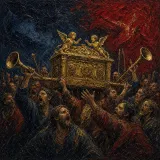
The big picture
A messenger reaches Ziklag carrying Saul's crown, bracelet, and a claim that he personally ended the wounded king's life. The royal objects establish that Saul is dead, but they do not settle every detail of the man's account, which differs from the closing report of 1 Samuel. David does not seize on the news as the moment his long struggle has finally paid. He and his men tear their clothes, mourn, weep, and fast for Saul, Jonathan, and Israel. Only after grief comes judgment, and the messenger is condemned by the testimony of his own mouth that he killed the LORD's anointed. The chapter then refuses to end on punishment or accession. David composes a lament to be taught in Judah, praises Saul's strength and gifts, names Jonathan as "my brother," and closes with the repeated cry, "How are the mighty fallen!" A crown has arrived, but David's last possession in the chapter is a song of grief.
Central truth
David receives Saul and Jonathan's deaths as Israel's calamity, condemns the claimed killing of the Lord's anointed, and gives public grief the words of a lament.
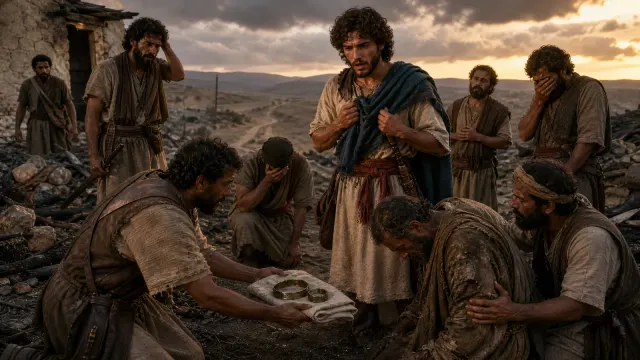

The study notes have a page of their own
The movement by movement analysis, the words to trace, the verse by verse notes and where readers differ are written for someone studying alone. They are on the Deep Personal Reflections page for this chapter. This page is the lesson.
A chapter-specific teaching brief
These anchors come from this chapter itself. They help a teacher use the Level 1 overview, the Level 2 study, and the Scripture text as one lesson.
Open with the chapter’s first image
2 Samuel 1:1: “Now it came to pass after the death of Saul, when David was returned from the slaughter of the Amalekites, and David had abode two days in Ziklag;”
Slow down at the turning point
2 Samuel 1:14: “And David said unto him, How wast thou not afraid to stretch forth thine hand to destroy the LORD’s anointed?”
Keep this word trail visible
David, Saul, Jonathan, fallen, mighty, Israel
What to explain, in order
Teach the passage in this order. Each step names the verses it rests on, so every point can be shown in the text before it is applied.
2 Samuel 1:1-4
Two battles and a man in mourning
Begin by placing David. He has come back from “the slaughter of the Amalekites” (1:1), the rescue of 1 Samuel 30, and has been in Ziklag two days. He was nowhere near Gilboa. Then the messenger arrives “with his clothes rent, and earth upon his head”, the marks of mourning, and does “obeisance”, bowing to the ground. Explain both terms before you read on. Teach this first because the whole chapter depends on it: the crown is about to come to David, and he has done nothing to reach for it.
2 Samuel 1:5-10
A report that does not match the record
Read the man's account slowly: he happened upon Mount Gilboa, Saul leaned upon his spear, Saul asked to be slain, and “I stood upon him, and slew him” (1:10). Then read 1 Samuel 31:4, where “Saul took a sword, and fell upon it.” Do not rush to harmonize. Tell the class the Book of 2 Samuel is reporting what this man said, and that David later describes him as one “thinking to have brought good tidings” and hoping for “a reward” (4:10). The crown and bracelet in his hand are real; his account of how he got them is his own.
2 Samuel 1:11-16
Grief first, then a verdict
Notice the order. Before David says a word to the messenger, he tears his clothes and the whole company mourns and fasts until evening (1:11-12). Only then comes the second question, “Whence art thou?”, and the answer, “the son of a stranger, an Amalekite”: a resident foreigner living under Israel's law. Explain that “the LORD's anointed” is the reason David gives, not personal anger. Read 1:15-16 plainly and without dramatizing; the execution is told in one verse. Place it here so the class sees that David's grief and his judgment rest on the same conviction about Saul.
2 Samuel 1:17-18
A lament taught on purpose
Point out that David does not only weep; he composes a lament and has it taught to Judah. Explain that “the use of the bow” has words in italics in many printings, so the phrase is filled out by the translators; many read it as the song's title, taken from Jonathan's bow in 1:22. The book of Jasher is mentioned also in Joshua 10:13 and has not survived. Say so and move on. This step belongs before the poem because it tells the class the lament was meant for a whole people to learn, not as a private diary.
2 Samuel 1:19-24
How are the mighty fallen
Read the first half aloud as poetry. Mark the refrain in 1:19, then the two cities of the Philistines in 1:20, the mountains of Gilboa cursed with no dew in 1:21, and the shield “vilely cast away”, meaning thrown down in disgrace. Show how 1:22-23 praises the two men's courage together: “in their death they were not divided”. Then 1:24 turns to Israel's women and Saul's gifts to them. Explain that David praises what Saul truly gave without commenting on his failures; the lament chooses what can be honestly honoured.
2 Samuel 1:25-27
My brother Jonathan
The refrain returns in 1:25 and the poem turns to direct speech: “I am distressed for thee, my brother Jonathan.” Explain “passing the love of women” by reading the covenant of 1 Samuel 18:1-3 and 20:17, where Jonathan “loved him as he loved his own soul”, a love that cost Jonathan his claim to the throne. Keep to what the text says and do not speculate beyond it. End on 1:27, where the refrain closes with “the weapons of war perished”, so the class leaves with the loss of a nation's strength and of one faithful friend held together.
Where learners get stuck
The misreadings this passage tends to produce, and how to answer each from the text.
“David was secretly glad, because Saul's death cleared his way to the throne.”
The text gives no hint of hidden joy and much evidence of real grief. David tears his clothes and fasts until evening for Saul by name (1:11-12), executes the man who claims to have killed him (1:15-16), and calls Israel's daughters to weep over Saul (1:24). This matches 1 Samuel 24:6 and 26:9, where David twice refused to harm Saul. Teach the consistency, and do not read later political caution back into this chapter.
“The Amalekite killed Saul, so 1 Samuel 31 got it wrong.”
The Book of 2 Samuel tells us what this man said, not that it is true. 1 Samuel 31:4-5 reports Saul falling on his own sword in the book's own account, while 2 Samuel 1:6-10 is one man's speech to a king, with a crown in his hand and, as 4:10 says, hope of a reward. Readers have explained the two in more than one way. The plain teaching point is that a reported speech can carry a self-serving account.
“David had no right to put the man to death without a trial.”
Let the text speak before the class judges. David gives his reason in 1:16: the man's own testimony that he had slain the LORD's anointed. The chapter records the act without praise or blame, and modern standards of evidence cannot be read into it. What the class can see is that David holds the man to the same conviction he held himself in 1 Samuel 26:9, “who can stretch forth his hand against the LORD's anointed, and be guiltless?”
“Passing the love of women means David and Jonathan were lovers.”
The text does not say this, and the Books of Samuel describe the bond as covenant friendship. 1 Samuel 18:3 says “Jonathan and David made a covenant, because he loved him as his own soul”, and 20:17 repeats it. Jonathan gave up his own claim to the throne for David. In 1:26 David calls him “my brother” and measures that loyalty against the deepest love he knows. Teach what is written and decline to build a reading on what is not.
“If David praises Saul, he must be pretending Saul was a good king.”
Honest lament selects; it does not lie. David names real gifts: Saul's courage with the sword in 1:22 and the prosperity he brought Israel's women in 1:24. He says nothing of the spear thrown at him or the years in the wilderness. That silence is not denial; the earlier chapters stand. Teach that grief can honour what was good in a flawed person without rewriting what that person did.
Learning objectives
- Distinguish the Amalekite's claim from independently reported events.
- Identify everyone mourned in 2 Samuel 1:12.
- Explain David's stated reason for the execution.
- Trace the lament's repeated announcement of fallen greatness.
- Compare the lament's treatment of Saul and Jonathan.
- Explain why remembrance need not erase wrongdoing.
Teacher preparation
- Read 1 Samuel 31:1-6 beside 2 Samuel 1:6-10; keep the two accounts' speakers distinct.
- Locate Ziklag, Gilboa, Gath, and Askelon before teaching the movement from report to lament.
- Explain 'rent' as torn and 'obeisance' as a gesture of reverence in 1:2,11.
- Read Jonathan's covenant with David in 1 Samuel 20:14-17 before discussing 1:26.
- Prepare a quiet reading of 1:19-27; do not turn the execution into a classroom reenactment.
Evidence and interpretation checks
Explicit
State that David and his men mourn Saul, Jonathan, the Lord's people, and Israel in 1:11-12, not Jonathan alone.
Scripture-supported
Read 1:14-16 with 1 Samuel 31:4-6; distinguish the messenger's confession from confirmation that he actually killed Saul.
Strong inference
Infer anticipated reward from the crown delivery in 1:10; strengthen that reading with David's later explanation in 4:10.
Possible or traditional reading
Present a lying messenger and an attempted harmonization with Saul's fall as proposed readings of 1:6-10, not equally explicit facts.
Limit
Do not invent the contents of Jasher from its mention in 1:18 or claim that 1:26 describes a sexual relationship.
Discussion with answer guidance
1. Why does David ask how the messenger knows Saul and Jonathan are dead?
What a good answer contains
Because the man's account is the only evidence he has. David has just heard that “Saul and Jonathan his son are dead also” (1:4), and his next question asks for the basis: “How knowest thou” (1:5). The answer that follows is long and detailed (1:6-10), and the crown and bracelet show the man was near Saul's body. A good answer sees David testing a report before acting on it. A weak answer treats the question as suspicion of everything, or assumes the crown proves the whole account.
Show teacher guidance
Use 1:4-10: David seeks the basis of the report. The crown supports contact with Saul, not every detail of the speaker's claim.
2. Whose deaths produce fasting in David's camp?
What a good answer contains
Four are named in 1:12: “for Saul, and for Jonathan his son, and for the people of the LORD, and for the house of Israel; because they were fallen by the sword.” David's whole company tears clothes, weeps and fasts “until even”. A strong answer includes Saul first, the man who hunted David for years, and the defeated nation as well as the friend. A weak answer reduces the mourning to Jonathan alone, or reads the tearing of clothes as a show staged for political effect, which the text does not suggest.
Show teacher guidance
Name all four objects of grief in 1:12. Correct the answer that David mourns only his friend or celebrates Saul's removal.
3. What evidence does David name when condemning the Amalekite?
What a good answer contains
The man's own words. David says, “Thy blood be upon thy head; for thy mouth hath testified against thee, saying, I have slain the LORD's anointed” (1:16). The charge is stated in 1:14: he was not afraid “to stretch forth thine hand to destroy the LORD's anointed.” A good answer notes that David judges on the confession, and that the same phrase about stretching forth the hand is what David himself refused to do in 1 Samuel 24:6. A weak answer invents witnesses or a trial the chapter does not report.
Show teacher guidance
Point to 'thy mouth' in 1:16 and the claimed attack on the Lord's anointed. Do not invent a separate investigation.
4. What does the repeated language about the mighty falling do to the lament?
What a good answer contains
It turns the lament into a single cry that keeps returning. “How are the mighty fallen” comes at the opening (1:19), again “in the midst of the battle” over Jonathan (1:25), and at the close with “the weapons of war perished” (1:27). A good answer sees that each return widens or narrows the grief: the nation, the friend, then the end of strength itself. A weak answer calls it mere repetition for poetry's sake and misses that the refrain holds the public and the personal loss together.
Show teacher guidance
Compare 1:19,25,27. Let the repetition gather national loss, Jonathan's death, and broken military strength into the same grief.
5. Why name Gath and Askelon before addressing Israel's daughters?
What a good answer contains
Because the enemy's joy would add shame to the loss. David says, “Tell it not in Gath, publish it not in the streets of Askelon; lest the daughters of the Philistines rejoice” (1:20), and later calls on the other women: “Ye daughters of Israel, weep over Saul” (1:24). A good answer sees the contrast of rejoicing daughters and weeping daughters. A weak answer takes 1:20 as an order to hide the news, when the news is already known; it is the language of grief, not a press instruction.
Show teacher guidance
Contrast enemy triumph in 1:20 with Israel's mourning in 1:24. Avoid treating the lament as a literal news blackout.
6. How can David praise Saul while grieving Jonathan more personally?
What a good answer contains
Because the lament speaks of each truthfully and at a different distance. Saul is honoured for what he gave the nation: he “clothed you in scarlet” and “put on ornaments of gold upon your apparel” (1:24), and the two men together were “lovely and pleasant in their lives” (1:23). Jonathan alone is addressed directly, “my brother Jonathan” (1:26). A good answer notices that David chooses what is genuinely praiseworthy in Saul without pretending the earlier chapters did not happen. A weak answer says David excuses Saul or that he quietly despises him.
Show teacher guidance
Use the public benefits in 1:23-24 and direct address in 1:26. Praise here selects genuine loss without canceling Saul's earlier violence.
Responsible application
Heart and habits
Ask learners to revise a hypothetical obituary that confuses honest remembrance with declaring a flawed person faultless.
Relationships and community
Design a response to a rival group's bereavement using the breadth of grief in 1:12.
Words for public sorrow
Invite an optional written line of communal lament based on 1:19-27, without requesting anyone's bereavement details.
Session plans
Two timings of the same lesson. The shorter keeps the reading, the central discussion and one response; the longer gives the confusions and the application their own time.
45 minutes
Where David was
Read 1:1-4. Ask where David has just been and what the messenger's torn clothes and earth mean. Draw two places on the board, Ziklag and Gilboa, far apart.
Two accounts side by side
Read 1:5-10 and then 1 Samuel 31:4-5. Ask question one. Use confusion two to keep the man's speech and the book's account distinct.
Mourning and the verdict
Read 1:11-16. Take questions two and three. Deal with confusions one and three briefly, from 1:12 and 1:16.
Hear the lament
Read 1:17-27 aloud slowly, with the class saying the refrain each time it comes. Take questions four and six, then confusion four if it is raised.
Handout and prayer
Read the key verse together, give out the handout, and close by praying for any who grieve in the room without naming them.
90 minutes
News that changes everything
Ask how people usually behave when a long-time rival falls. Keep the answers on the board for later. Then read 1:1-4.
The man's account
Read 1:5-10. Take question one, then read 1 Samuel 31:1-6 and 2 Samuel 4:10. Work through confusion two.
Four objects of grief
Read 1:11-12 and list on the board everyone mourned. Take question two and confusion one, and compare the class's opening answers.
The LORD's anointed
Read 1:13-16 with 1 Samuel 24:6 and 26:9. Take question three and confusion three. Keep the description of the execution brief.
A lament for a nation
Read 1:17-24. Explain the book of Jasher and the bow. Take questions four and five, marking the refrain and the two sets of daughters.
My brother Jonathan
Read 1:25-27 with 1 Samuel 18:1-3 and 20:17. Take question six and confusions four and five, staying close to the covenant language.
Truthful remembrance
Use the obituary application in pairs. Each pair names one true thing worth honouring and one thing they would not pretend away.
Handout and prayer
Read the key verse aloud together, point to the take-home line, and pray for those carrying grief or old conflicts.
Adapting the lesson
Children
Tell children that King Saul and his son Jonathan died in a battle, and that David was very sad, even though Saul had been unkind to him. Leave out the execution of the messenger. Show a toy bow and say Jonathan was David's best friend who kept a promise. Teach them the line “How are the mighty fallen” and let them say it with you. Ask who they could be kind to when someone is sad.
Youth
Young people know how quickly a rival's fall becomes a joke online. Ask what David's camp could have posted the day the news came, then read 1:11-12 and 1:24. Spend time on the two accounts of Saul's death and let them weigh a speaker who has something to gain. On 1:26, keep to the covenant friendship the text describes and do not open a debate the passage does not raise.
Adults
Give time to the relation between 1 Samuel 31 and 2 Samuel 1, and to the ethics of David's verdict, letting the group state differing views fairly. Discuss how to grieve a leader or relative who did real harm, using what the lament includes and leaves out. Some adults carry unresolved grief for a difficult parent; acknowledge that without inviting disclosure, and let the lament model honest mixed sorrow.
One to one
Read the lament aloud together, alternating verses, and ask which line the person would keep. If they are grieving, let 1:12 show that the whole camp fasted and wept, so grief is not weakness. If they are carrying anger toward someone who has died, let them notice that David speaks truthfully and kindly without denying the past. Do not press for the details of their own loss.
Song and video learning lab
A song or video may interpret, compress, or dramatize the text. Its value becomes clearer when its choices are compared with Scripture.
- Before the media: the exact passage and its central movement.
- During the media: the words, people, events, and emotions the artist emphasizes.
- After the media: what it clarifies, what it leaves out, and what belongs back in the biblical text.
Handout
One page for learners to take home. The print button prints this section alone.
2 Samuel 1:1–27
The passage in brief
After Saul and Jonathan die in battle, a man arrives at David's camp with Saul's crown and claims he killed the king. David and his men tear their clothes, weep and fast for Saul, Jonathan and the whole nation. David puts the man to death on his own confession that he struck the LORD's anointed. Then David writes a lament for Saul and Jonathan, “How are the mighty fallen”, honouring what was good in both and grieving most for Jonathan, his covenant friend.
A verse to keep
Saul and Jonathan were lovely and pleasant in their lives, and in their death they were not divided: they were swifter than eagles, they were stronger than lions.
2 Samuel 1:23 · King James Version
Questions to take home
Whom did David and his men mourn in 1:12, and which of those surprises you most?
What reason did David give in 1:16 for his verdict on the messenger?
What does David choose to honour about Saul in 1:22-24?
This week
When someone you have struggled with suffers loss this week, speak of them with honesty and kindness, not satisfaction.
Music and video connected to the passage
Related media appears when its Scripture reference overlaps this study. Music and video can illuminate a theme while the biblical text remains the foundation.