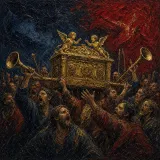
The big picture
The announced sword enters David's own household through Amnon's desire for Tamar. Jonadab turns that desire into a plan using feigned sickness, and David unknowingly sends Tamar into the situation. The account gives unusual space to her work, her reasoned refusal, and her attempt to stop what Amnon intends. He refuses to listen, rapes her, then refuses to listen again when she protests being cast out. Her torn royal garment, ashes, and crying keep her suffering visible after he bolts the door. Absalom houses her and hates Amnon; David becomes very angry, but the chapter records no royal judgment against his firstborn. Two years later Absalom engineers Amnon's presence at a sheep-shearing feast and orders his servants to kill him. The first report falsely tells David all his sons are dead, multiplying the grief before the surviving princes return. Absalom flees to Geshur for three years. The chapter ends with David longing toward him while Tamar's last stated condition remains desolation.
Central truth
Tamar's violated plea and continuing desolation expose a royal household in which anger, revenge, and a managed reunion take the place of recorded justice and repentance.
The study notes have a page of their own
The movement by movement analysis, the words to trace, the verse by verse notes and where readers differ are written for someone studying alone. They are on the Deep Personal Reflections page for this chapter. This page is the lesson.
A chapter-specific teaching brief
These anchors come from this chapter itself. They help a teacher use the Level 1 overview, the Level 2 study, and the Scripture text as one lesson.
Open with the chapter’s first image
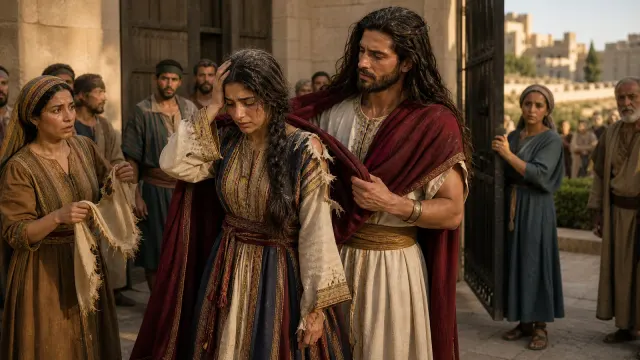
2 Samuel 13:1: “And it came to pass after this, that Absalom the son of David had a fair sister, whose name was Tamar; and Amnon the son of David loved her.”
Slow down at the turning point
2 Samuel 13:20: “And Absalom her brother said unto her, Hath Amnon thy brother been with thee? but hold now thy peace, my sister: he is thy brother; regard not this thing…”
Keep this word trail visible
Amnon, Absalom, king, brother, Tamar, king’s
What to explain, in order
Teach the passage in this order. Each step names the verses it rests on, so every point can be shown in the text before it is applied.
2 Samuel 13:1-10
A plan to trap a sister
Before reading, tell the group what this chapter contains and that anyone may step out. Then read 13:1-2: Amnon's desire is called love, but it makes him sick and it fixes on doing “any thing to her”. Introduce Jonadab as the cunning cousin who designs the trap, and show how each step isolates Tamar: the pretended illness, the king's order, cooking in his sight, the room emptied. Explain that Tamar does what she is asked by her father and king. Teach this first so the class sees that the harm was planned, not sudden.
2 Samuel 13:11-14
She said no
Read 13:11-14 once, plainly, without lingering. Put all the weight on Tamar's words in 13:12-13: she refuses, she names the act as folly and as something that must not be done in Israel, and she pleads for any other way, even asking him to speak to the king. Explain that 13:13 is a desperate attempt to escape, not consent. Then read 13:14: “being stronger than she, forced her”. Name it as rape. Tell the class the Book of 2 Samuel records her voice so that it will be heard.
2 Samuel 13:15-20
Thrown out and silenced
Read Amnon's hatred in 13:15 and his order, “Arise, be gone.” Tamar says sending her away is a greater evil still (13:16), because it leaves her disgraced and without remedy. He calls her “this woman” and has the door bolted. Explain the robe of divers colours as the dress of a king's virgin daughter, which she tears. Then read Absalom's words, “hold now thy peace”, and say clearly that this is a family silencing a victim to protect a brother. End on 13:20: “So Tamar remained desolate.”
2 Samuel 13:21-39
Anger without justice, and revenge
Read 13:21 by itself: “he was very wroth.” Then ask what David does, and let the silence of the text be the answer. Show the two years, Absalom's feast, and the murder at the shearing. Explain the false report that all the king's sons were dead, and Jonadab's cool correction. Then Absalom flees to Geshur, his mother's father's land (3:3), for three years. Teach this step to show that when the one with authority fails to act, harm multiplies: a crime unpunished becomes a murder and an exile.
2 Samuel 14:1-20
Joab's arranged appeal
Joab sees the king's heart is toward Absalom and arranges a parable, as Nathan did, but this time the words are Joab's, put into the woman's mouth (14:3). Read her case: two sons, one killed, the family demanding the other's death. David rules for her son, and she turns the ruling on him: why not bring back your own banished son? Read 14:14 and explain that it is a true and beautiful saying used in a staged scene. Teach the contrast with chapter 12: Nathan was sent by the LORD; this woman was sent by Joab.
2 Samuel 14:21-33
Home, but not reconciled
David allows the return, but “let him not see my face” (14:24). Read the description of Absalom's beauty and hair in 14:25-26; the hair returns in 18:9. Point out 14:27 gently: Absalom names his daughter Tamar, and that is the only time the name appears again. Then two years, the burned barley field, and the kiss. Teach this last because the class needs to see that a public reunion without truth, accountability or repair is not reconciliation, and that Tamar has not been mentioned in the king's decisions at all.
Where learners get stuck
The misreadings this passage tends to produce, and how to answer each from the text.
“Tamar should not have gone into the room, so she was partly to blame.”
Tamar went because the king sent her (13:7), and she went into the chamber because a sick brother asked for food (13:10). The plan was made by Jonadab and Amnon to trap her (13:5). She refused in words (13:12-13), and Amnon overpowered her (13:14). The text places the blame entirely on Amnon, and Absalom says plainly that Amnon “had forced his sister Tamar” (13:22). Never let a lesson suggest a victim invited what was done to her.
“Absalom was right to tell her to keep quiet; he was protecting her.”
Absalom gives her a home, and that matters. But his words in 13:20, “hold now thy peace, my sister: he is thy brother; regard not this thing”, ask her to be silent for the family's sake, and the result is that she “remained desolate”. His own response was secret hatred and, two years later, murder (13:22-29). Teach that silencing a victim, however kindly meant, leaves her alone with the harm.
“David was angry, so he did what he could.”
The text records his anger in 13:21 and no action at all. Amnon is not punished, Tamar receives no justice, and nothing is said to either of them. Under the law of Leviticus 18:9 and 20:17 the act was a grave crime. David's failure to act is part of the chain that leads to Amnon's murder and Absalom's revolt. Teach that feeling anger is not the same as protecting the harmed, especially for someone with power to act.
“The woman of Tekoah spoke for God, like Nathan.”
Compare 12:1, “the LORD sent Nathan”, with 14:2-3, “Joab sent to Tekoah” and “put the words in her mouth”. She admits it when asked (14:19). Her saying in 14:14 about God's mercy toward the banished is true in itself, but here it is used to bring Absalom home without any reckoning. Teach the class to ask who sent a message and what it is meant to achieve, especially when it sounds holy.
“The king's kiss shows everything was healed.”
Read 14:32-33 closely. Absalom demands an audience, offers no confession, and gets in by burning Joab's field. The kiss restores access, not trust. Within four years, chapter 15 shows Absalom stealing the hearts of Israel. Tamar is never consulted or mentioned. Teach that reconciliation without truth, repentance and repair for the one harmed is only a ceremony, and it can leave the real wound untouched.
Learning objectives
- Identify Tamar's refusal and Amnon's responsibility.
- Explain Jonadab's part in arranging access to Tamar.
- Distinguish David's anger from recorded protective action.
- Trace Absalom's revenge, exile, and restricted return.
- Evaluate the woman of Tekoah's commissioned argument.
- Distinguish restored royal access from demonstrated reconciliation.
Teacher preparation
- Give a brief content notice for sexual violence, family abuse, and murder; allow quiet nonparticipation without explanation.
- Prepare a family chart distinguishing Tamar, Absalom's sister, from his daughter Tamar in 14:27.
- Read Leviticus 18:9 before 13:13; do not treat Tamar's desperate proposal as proof that sibling marriage was lawful.
- Explain 'subtil' in 13:3 as crafty and 'polled' in 14:26 as cut the hair.
- Select non-graphic readings; forbid assault reenactments, victim-blaming questions, and requests for personal experiences.
Evidence and interpretation checks
Explicit
Name the refusal and force in 13:12-14, and Tamar's desolation in 13:20; the passage does not describe mutual romance.
Scripture-supported
Read 13:13 beside Leviticus 18:9; a plea made under threat cannot cancel the wider prohibition on sexual relations with a sister.
Strong inference
Infer unresolved rupture from the two years without royal audience in 14:28 and Absalom's coercive field-burning in 14:30-32.
Possible or traditional reading
Present Tamar's marriage appeal in 13:13 as possibly an attempt to delay or escape the assault; the text does not explain her strategy.
Limit
Do not claim 13:21 records David punishing Amnon, or that the kiss in 14:33 records Absalom's confession or Tamar's restoration.
Discussion with answer guidance
1. What do Tamar's actual words establish before Amnon forces her?
What a good answer contains
That she refused clearly and named the act as wrong. “Nay, my brother, do not force me; for no such thing ought to be done in Israel: do not thou this folly” (13:12). She speaks of her shame and of his, and pleads for any other way (13:13). Then the text says, “he would not hearken unto her voice: but, being stronger than she, forced her” (13:14). A good answer states plainly that this was rape, and that Tamar said no. A weak answer suggests she should have resisted more, or that her words in 13:13 imply consent; they are the pleas of someone trying to escape.
Show teacher guidance
Read 13:12-14: she refuses, names the wrong, and is overpowered. Correct any answer suggesting silence, consent, or responsibility on her part.
2. How do Jonadab's advice and David's order place Tamar within Amnon's reach?
What a good answer contains
Jonadab, “a very subtil man” (13:3), designs the trap: pretend to be sick, ask the king to send Tamar, have her cook “in my sight” (13:5). Amnon follows it exactly (13:6), and David sends Tamar to his house (13:7). Then Amnon clears the room (13:9) and calls her into the chamber (13:10). A good answer distinguishes the scheme, which is Jonadab's and Amnon's, from David's order, which the text does not say he understood. A weak answer either clears everyone around Amnon or claims David knew the plan beforehand.
Show teacher guidance
Trace 13:3-10. Distinguish Jonadab's deliberate scheme from David's reported instruction; do not claim David knew the scheme beforehand.
3. What responses follow Tamar's public grief, and what response is not recorded?
What a good answer contains
Tamar grieves publicly: ashes, a torn royal garment, her hand on her head, “and went on crying” (13:19). Absalom says, “hold now thy peace, my sister: he is thy brother; regard not this thing” (13:20). David “was very wroth” (13:21). Absalom hates Amnon in silence (13:22). What is not recorded is any justice for Tamar or any punishment of Amnon. A good answer notices that the verse ends, “So Tamar remained desolate.” A weak answer treats David's anger as if it were action.
Show teacher guidance
Compare 13:19-22: Absalom urges silence and hates Amnon, David becomes angry, and Tamar remains desolate. No punishment of Amnon is described.
4. How does Absalom's treatment of Amnon differ from an open pursuit of justice?
What a good answer contains
Absalom waits “two full years” (13:23), plans a feast, presses David until Amnon is allowed to come, and orders his servants to strike “when Amnon's heart is merry with wine” (13:28). That is an ambush, planned in secret, not a judgment before the king or the elders. Jonadab confirms it was “determined from the day that he forced his sister Tamar” (13:32). A good answer takes Absalom's anger at the crime seriously and still calls his revenge murder. A weak answer makes Absalom a hero of justice.
Show teacher guidance
Use the two-year interval and planned killing in 13:23-29. His outrage does not make a wine-assisted ambush a judicial hearing.
5. Who supplies the woman of Tekoah's words, and why does that matter?
What a good answer contains
Joab does. He fetches the woman, tells her to pretend to be a mourner, and “put the words in her mouth” (14:2-3), and she admits it when David asks, “Is not the hand of Joab with thee in all this?” (14:19). Her words in 14:14 about God devising means “that his banished be not expelled from him” are part of a performance designed to move the king. A good answer notices that a wise saying can be used to steer a decision. A weak answer treats her parable as a prophet's message from God.
Show teacher guidance
Read 14:2-3,19-20. Joab arranges the appeal; distinguish its claims about God in 14:14 from a separately authenticated divine message.
6. What has changed by the king's kiss, and what remains unaddressed?
What a good answer contains
Absalom is back in the king's presence: he bows to the ground, “and the king kissed Absalom” (14:33). But he got there by forcing Joab's hand, setting his field on fire (14:30), and he says, “if there be any iniquity in me, let him kill me” (14:32), with no confession. A good answer names what is missing: no repentance from Absalom, no word from David about Amnon's death, and no mention of Tamar since 13:20. A weak answer reads the kiss as full reconciliation, which chapter 15 quickly disproves.
Show teacher guidance
Trace 14:23-33: geographic return becomes royal access after coercion. The Book of 2 Samuel records neither repentance nor repair for Tamar.
Responsible application
Heart and habits
Compare moral outrage with concrete protective action using the difference between 13:21 and what the chapter does not report.
Relationships and community
Evaluate a fictional family's demand for silence to protect its reputation; center the harmed person's dignity and safety.
Reconciliation without shortcuts
List what a public reunion cannot by itself establish: truthfulness, accountability, changed conduct, or restored trust.
Session plans
Two timings of the same lesson. The shorter keeps the reading, the central discussion and one response; the longer gives the confusions and the application their own time.
45 minutes
A safe reading frame
Say plainly that this passage describes sexual assault. Name the safe adult or safeguarding contact, and say no one will be asked to share personal experience.
Listen to her refusal
Read 13:1-14 once, plainly. Take questions one and two, and confusion one.
Tamar remains desolate
Read 13:15-22. Take question three and confusions two and three.
Revenge and exile
Summarize 13:23-39. Take question four.
The arranged return
Read 14:1-3, 14:14 and 14:19-24, then 14:28-33. Take questions five and six, and confusions four and five.
Handout and prayer
Read the key verse together, give out the handout, and pray for all who have been harmed and not heard.
90 minutes
A safe reading frame
Explain what the passage contains, name the safeguarding contact and the support available, and assure the group no one will be asked to disclose anything.
The trap
Read 13:1-10. Take question two. List on the board each step that isolated Tamar.
She said no
Read 13:11-14 once, plainly. Take question one and confusion one. Read 13:12-13 a second time and ask what Tamar's words show.
Silenced
Read 13:15-22. Take question three and confusions two and three, with Leviticus 18:9 read briefly.
Two years later
Read 13:23-39. Take question four. Ask how David's inaction in 13:21 contributed to what followed.
Joab's parable
Read 14:1-20. Take question five and confusion four, comparing 12:1 with 14:2-3.
A kiss without repair
Read 14:21-33. Take question six and confusion five. Point to 14:27 and the daughter named Tamar.
Response
Use the application on a family's demand for silence. List what a community must do to keep a harmed person safe and heard.
Handout and prayer
Read the key verse, point to the take-home line, and repeat where anyone can go for help.
Adapting the lesson
Children
For young children, do not teach chapter 13 in detail. If it must be covered, say only that a prince named Amnon hurt his sister Tamar very badly and that it was very wrong, and that Tamar told people what happened. Tell children that if anyone ever hurts them or touches them in a way that is wrong, it is never their fault, and they should tell a trusted grown-up. Have your church's safeguarding procedure ready.
Youth
Name the act as rape and Tamar's words as a clear no. Spend time on Absalom's demand for silence and on David's anger without action, and ask what Tamar needed from her family. Before the session, check your church's safeguarding policy, have a named safe adult present, and say aloud that anyone who has been hurt can talk privately. If a young person discloses abuse, do not investigate; listen, reassure them, and follow the policy that day.
Adults
Assume survivors are present. Read 13:11-14 once and do not retell it. Give the time to Tamar's voice, the family's silencing, and the failure of the one with authority to act. Discuss how churches and families protect the powerful and leave victims desolate, and what your congregation's safeguarding commitments are. Have support information ready, make clear disclosures will be handled properly, and never suggest forgiveness requires a victim to keep quiet or to reconcile with the abuser.
One to one
Ask permission before reading chapter 13 together, and let the person decide how much to read. If they have been harmed, let them hear that Tamar's no is recorded and that the Book of 2 Samuel does not blame her. Do not ask for details. If they disclose abuse, listen, believe them, and follow your safeguarding procedure. Do not push toward forgiveness or reconciliation; let 13:20 show that silence was not care.
Song and video learning lab
A song or video may interpret, compress, or dramatize the text. Its value becomes clearer when its choices are compared with Scripture.
- Before the media: the exact passage and its central movement.
- During the media: the words, people, events, and emotions the artist emphasizes.
- After the media: what it clarifies, what it leaves out, and what belongs back in the biblical text.
Handout
One page for learners to take home. The print button prints this section alone.
2 Samuel 13:1–14:33
The passage in brief
Amnon, a son of David, plots with his cousin Jonadab to get his half-sister Tamar alone. She refuses him clearly, but he overpowers and rapes her, then throws her out. Absalom tells her to keep quiet, and she lives desolate in his house. David is angry but does nothing. Two years later Absalom has Amnon killed and flees. Joab arranges for a woman to persuade David to bring Absalom home, and at last David kisses him, but there is no repentance and no justice for Tamar.
A verse to keep
And she answered him, Nay, my brother, do not force me; for no such thing ought to be done in Israel: do not thou this folly.
2 Samuel 13:12 · King James Version
Questions to take home
What did Tamar say in 13:12-13, and why does it matter that the Bible records her words?
What did David feel in 13:21, and what did he fail to do?
What was missing when David kissed Absalom in 14:33?
This week
If someone tells you they have been harmed, believe them, do not ask them to be quiet, and help them reach safety.
Music and video connected to the passage
Related media appears when its Scripture reference overlaps this study. Music and video can illuminate a theme while the biblical text remains the foundation.