The big picture
Psalm 121 turns the eyes upward and answers the question of help by naming the LORD, maker of heaven and earth. The hills may fill the traveler’s view, but they are not independent sources of protection. The Book of Psalms then changes from first-person confession to direct assurance: the keeper will not let the foot slip, will not slumber, and will not leave Israel unattended. Shade at the right hand brings the creator’s care close to the body, while sun and moon extend the promise across day and night. The repeated verbs of keeping and preserving gather movement, danger, and time into one blessing. Going out and coming in cover ordinary departures and returns, and “from this time forth, and even for evermore” pushes the horizon beyond one journey. The vulnerable traveler changes location; the keeper does not change shifts.
Central truth
Psalm 121 answers the upward look with the Lord who made heaven and earth, keeps Israel without sleeping, and guards the worshiper’s whole course of going out and coming in.
The study notes have a page of their own
The movement by movement analysis, the words to trace, the verse by verse notes and where readers differ are written for someone studying alone. They are on the Deep Personal Reflections page for this chapter. This page is the lesson.
A chapter-specific teaching brief
These anchors come from this chapter itself. They help a teacher use the Level 1 overview, the Level 2 study, and the Scripture text as one lesson.
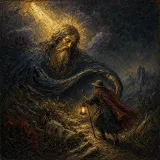
Open with the chapter’s first image
Psalms 121:1: “I will lift up mine eyes unto the hills, from whence cometh my help.”
Slow down at the turning point
Psalms 121:4: “Behold, he that keepeth Israel shall neither slumber nor sleep.”
Keep this word trail visible
LORD, preserve, cometh, help, keepeth, slumber
What to explain, in order
Teach the passage in this order. Each step names the verses it rests on, so every point can be shown in the text before it is applied.
Psalms 121:1-2
Eyes to the hills, help from the Lord
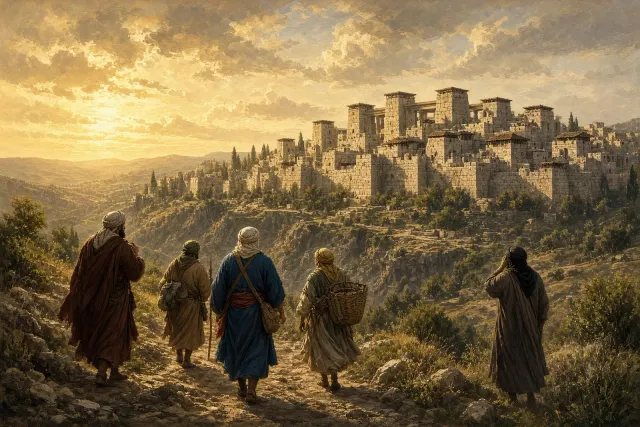
Begin with the pilgrim's view. On the way to Jerusalem the road climbs through hills that held both danger, robbers and shrines to other gods, and the sight of the destination. “I will lift up mine eyes unto the hills” leads into the matter of where help comes from, and verse 2 settles it: “My help cometh from the LORD, which made heaven and earth.” Explain that the hills are not the help; their Maker is. Teach this first because the rest of the psalm shows what that help looks like.
Psalms 121:3-4
The Keeper who does not sleep
Now a second voice seems to answer the pilgrim, speaking to him as thee. He will not let your foot slip; your keeper will not slumber. Then verse 4 widens it: the keeper of Israel neither slumbers nor sleeps. Explain the picture of a traveller sleeping beside the road, or a city watchman fighting sleep on the wall, and set it against a God who never closes his eyes. Introduce the key word keep here and ask the class to listen for it.
Psalms 121:5-6
Shade at the right hand
The Lord is “thy keeper” and “thy shade upon thy right hand”. Explain shade as protection from a sun that could kill on the road, and the right hand as the side of action and defence, where a protector stands. Then verse 6, sun by day and moon by night, as a way of saying every hour. Teach that God's protection is close, at the traveller's side, not distant. Avoid speculation about the moon; the psalm is simply covering day and night.
Psalms 121:7-8
All evil, every journey, for ever
The last verses widen as far as they can go. The Lord will preserve from all evil, will preserve the soul, will preserve going out and coming in, from now and for evermore. Explain that all evil does not mean no hardship, since the pilgrims still walked the road, but that nothing can take the traveller out of the Keeper's care. Point to Romans 8:38-39 if it helps. Close by noting that this psalm is read at departures, weddings and funerals, and ask why.
Where learners get stuck
The misreadings this passage tends to produce, and how to answer each from the text.
“I will lift up mine eyes unto the hills means the hills help us.”
Verse 2 settles it: “My help cometh from the LORD, which made heaven and earth.” The hills were the pilgrim's landscape and sometimes the site of other gods' shrines. The psalmist looks up at them and then beyond them, to their Maker. Teach the opening as a question and an answer, with the hills as the place the eyes rise from, not where they come to rest.
“God will preserve me from all evil means nothing bad will happen to me.”
The pilgrims of these psalms still walked dangerous roads, and Psalm 120 has just described living among liars and warmongers. To be kept from evil means to be held in God's care so that no evil has the last word, above all over the soul (121:7). Believers do suffer. Teach the promise as God's constant keeping, and be gentle with anyone who has recently been harmed.
“The moon can harm us at night.”
Sun by day and moon by night (121:6) is a pair that means all the time, every hour of day and night. Ancient people did fear the dangers of the night, but the psalm is not teaching a theory about the moon. It says there is no hour when the Keeper is off duty. Keep the explanation simple and move on.
“This psalm is only for travellers.”
It was sung on the road, but its last line widens to “thy going out and thy coming in from this time forth, and even for evermore” (121:8). That covers leaving home and returning, beginnings and endings, the whole of life. That is why it is read at so many moments of transition. Every life is a journey, and the Keeper keeps all of it.
Learning objectives
- State where the psalm locates the worshiper’s help.
- Trace the repeated language of keeping and preserving through all eight verses.
- Explain the force of the Lord neither slumbering nor sleeping.
- Interpret the day-and-night language as comprehensive divine care.
- Distinguish the psalm’s promise of keeping from a promise of painless circumstances.
- Connect the final going-out and coming-in phrase with the psalm’s journey setting.
Teacher preparation
- Read Psalm 121 aloud twice, once listening only for words related to keep, preserve, help, and movement.
- Prepare the punctuation issue in verse 1: the KJV can sound as if help comes from the hills, but verse 2 explicitly says help comes from the Lord.
- Explain 'shade upon thy right hand' as close protection, with the right hand representing the exposed working or fighting side in ordinary imagery.
- Treat sun by day and moon by night as paired language spanning the whole cycle, not as permission to invent a doctrine of lunar injury.
- Read Psalm 120 before class so the shift from hostile surroundings to the Keeper of Israel lands with full force.
Evidence and interpretation checks
Explicit
Verse 2 explicitly identifies the source of help as the Lord, the maker of heaven and earth.
Scripture-supported
Verses 3–5 repeat the keeping theme and move from 'he that keepeth thee' to 'he that keepeth Israel' and then 'the Lord is thy keeper.'
Strong inference
The repeated day-night, going-out-coming-in pairs strongly function as totalizing language, presenting God’s care as continuous rather than limited to one place or hour.
Possible or traditional reading
Some readers take the hills in verse 1 as the source of danger, others as the direction of Jerusalem, and others simply as the visual prompt for the question. Verse 2 settles the main theological point without settling every scenic detail.
Limit
Psalm 121 does not say the worshiper will never suffer, stumble emotionally, face enemies, or die. Its claim is that the Lord keeps the person and the journey, not that every circumstance will feel safe.
Discussion with answer guidance
1. According to verse 2, where does help come from after the eyes lift toward the hills?
What a good answer contains
“My help cometh from the LORD, which made heaven and earth” (121:2). The eyes are lifted to the hills, but the help does not come from the hills; it comes from the one who made them and everything else. A good answer sees that the Maker of heaven and earth is greater than anything on the road, the hills included, which may have held robbers or shrines to other gods. A weak answer gives the hills the credit.
Show teacher guidance
Do not let the hills receive the credit. The verse names the Lord and immediately identifies him as maker of heaven and earth.
2. What word-family dominates verses 3–8?
What a good answer contains
Keep and preserve. “he that keepeth thee will not slumber” (121:3), “he that keepeth Israel” (121:4), “The LORD is thy keeper” (121:5), and “The LORD shall preserve thee from all evil: he shall preserve thy soul” and “thy going out and thy coming in” (121:7-8). In Hebrew it is one verb, used six times. A good answer counts them and lets the repetition carry the meaning. A weak answer notices the images but misses the spine.
Show teacher guidance
Look for keepeth, keeper, and preserve. The repetition is the spine of the psalm and should control interpretation.
3. Why does verse 4 expand from 'thee' to 'Israel'?
What a good answer contains
Because the personal promise rests on God's care for his people. Verse 3 speaks to the single traveller, “thee”; verse 4 says “he that keepeth Israel shall neither slumber nor sleep”. The traveller is kept because he belongs to the people God keeps. A good answer sees the covenant behind the comfort. A weak answer treats verse 4 as a repeat of verse 3 with nothing added.
Show teacher guidance
The individual traveler’s confidence is placed inside God’s care for his people. The personal promise is not isolated from the covenant community.
4. What does the statement that the Keeper neither slumbers nor sleeps contribute?
What a good answer contains
Unbroken attention. Human watchmen have to sleep, and travellers slept in the open with no guard, but the Lord “shall neither slumber nor sleep” (121:4). A good answer may recall Elijah's taunt in 1 Kings 18:27, that Baal might be asleep, to show the contrast with false gods. It sees that the point is God's constant care, not merely his strength. A weak answer turns it into a remark about God's stamina.
Show teacher guidance
Contrast divine attention with human watchmen who must rest. The point is unbroken vigilance, not merely that God has impressive stamina.
5. How do sun and moon, day and night function together in verses 5–6?
What a good answer contains
Together they cover the whole day and night: “The sun shall not smite thee by day, nor the moon by night” (121:6). Sunstroke was a real danger on the road, and the night brought its own fears. The pair means at no hour at all. A good answer reads them as a full cycle of exposure covered by the Lord as shade at the right hand (121:5). A weak answer invents a theory about harm from the moon.
Show teacher guidance
Treat the pair as a full daily cycle of exposure. Resist speculative claims about the moon that the psalm does not explain.
6. What does verse 8 add after the earlier images of foot, shade, sun, and moon?
What a good answer contains
It widens to every journey and every time: “The LORD shall preserve thy going out and thy coming in from this time forth, and even for evermore” (121:8). Going out and coming in means the whole of life's coming and going, leaving home and returning, work and rest. A good answer sees that the psalm ends on the largest possible horizon. A weak answer limits it to one pilgrimage.
Show teacher guidance
It widens the scope to going out and coming in, from now and for evermore, giving the psalm a comprehensive closing horizon.
Responsible application
Name the actual source of help
When a group faces a difficult decision, list the visible supports available, then use verses 1–2 to distinguish useful means from the Lord who is ultimately named as help.
Keep watch without acting like God
Use verses 3–4 to shape leadership expectations: people need rest and handoffs because only the Keeper of Israel is described as never sleeping.
Bless ordinary movement
Use verse 8 when sending people into travel, work, service, or transition. Let the text dignify ordinary departures and returns without promising a trouble-free route.
Session plans
Two timings of the same lesson. The shorter keeps the reading, the central discussion and one response; the longer gives the confusions and the application their own time.
45 minutes
Up to the hills
Read the psalm aloud twice, the second time listening for keep and preserve. Take question two.
Where help comes from
Read 121:1-2 and take question one and confusion one.
The Keeper of Israel
Read 121:3-4 and take questions three and four.
Shade, sun and moon
Read 121:5-6 and take question five and confusion three.
Going out and coming in, and the handout
Read 121:7-8 and take question six and confusion two. Give out the handout and read the key verse together.
90 minutes
Journeys
Ask about a journey someone made that felt dangerous or uncertain. Then read Psalm 120 and Psalm 121 in sequence.
The hills
Read 121:1-2 and take question one and confusion one. Show a photograph of the hill country around Jerusalem.
Keep
Take question two. Have the group underline every keep and preserve and count them.
No sleep
Read 121:3-4 and 1 Kings 18:27, and take questions three and four.
Shade at the right hand
Read 121:5-6 and take question five and confusion three.
All evil
Read 121:7-8 and Romans 8:35-39. Take question six and confusions two and four, with care for anyone who has suffered harm.
Blessing one another
Have pairs read the psalm to each other as a blessing, putting the other person's name where the psalm says thee.
Handout
Give out the handout and read the key verse together.
Adapting the lesson
Children
Talk about bedtime and who watches over the house while everyone sleeps. Read 121:3-4 and say that God never falls asleep. Play a game in which one child is the keeper and stays awake while the others pretend to sleep. Teach 121:8 with actions for going out of a door and coming back in. This psalm is a good one for children to learn by heart.
Youth
Many young people are anxious about the future. Ask them to name journeys ahead of them: exams, moves, jobs. Read 121:1-2 and talk about where they look for help. Then count the keeps together. Discuss 121:7 honestly: does it mean nothing bad will happen? Use confusion two, and invite them to pray the psalm for a friend.
Adults
Adults can enjoy the pilgrim setting, the dialogue shape of the psalm and the repetition of keep. Spend time on 121:7 and the honest question of suffering under God's keeping. Ask why the psalm is read at departures, weddings and funerals, and invite people to share where they have known the Keeper on their own journeys.
One to one
If the person is facing a move, a diagnosis, a new job or a loss, read the psalm slowly and pause at each keep. Let them choose the line they most need. Then pray the psalm over them, using their name. Do not promise that nothing hard will happen; promise what the psalm promises, that the Lord keeps them.
Song and video learning lab
A song or video may interpret, compress, or dramatize the text. Its value becomes clearer when its choices are compared with Scripture.
- Before the media: the exact passage and its central movement.
- During the media: the words, people, events, and emotions the artist emphasizes.
- After the media: what it clarifies, what it leaves out, and what belongs back in the biblical text.
Handout
One page for learners to take home. The print button prints this section alone.
Psalms 121:1–8
The passage in brief
Psalm 121 is a pilgrim's song. The traveller lifts his eyes to the hills and asks where help will come from. The answer is the Lord, who made heaven and earth. He will not let your foot slip, and he never sleeps. He is like shade at your side, so that nothing can harm you by day or by night. The Lord keeps you from evil and keeps your going out and your coming in, now and for ever.
A verse to keep
I will lift up mine eyes unto the hills, from whence cometh my help. My help cometh from the LORD, which made heaven and earth.
Psalms 121:1-2 · King James Version
Questions to take home
Where does the traveller's help come from, according to 121:2?
How many times can you find keep, keeper or preserve in the psalm?
What journey are you on this week that you need the Lord to keep?
This week
Every time you leave home this week, pray 121:8 as you go out of the door.
Music and video connected to the passage
Related media appears when its Scripture reference overlaps this study. Music and video can illuminate a theme while the biblical text remains the foundation.