


Lyrics · Numbers
Around the Holy Center
Numbers 1:1-4:49
Lyrics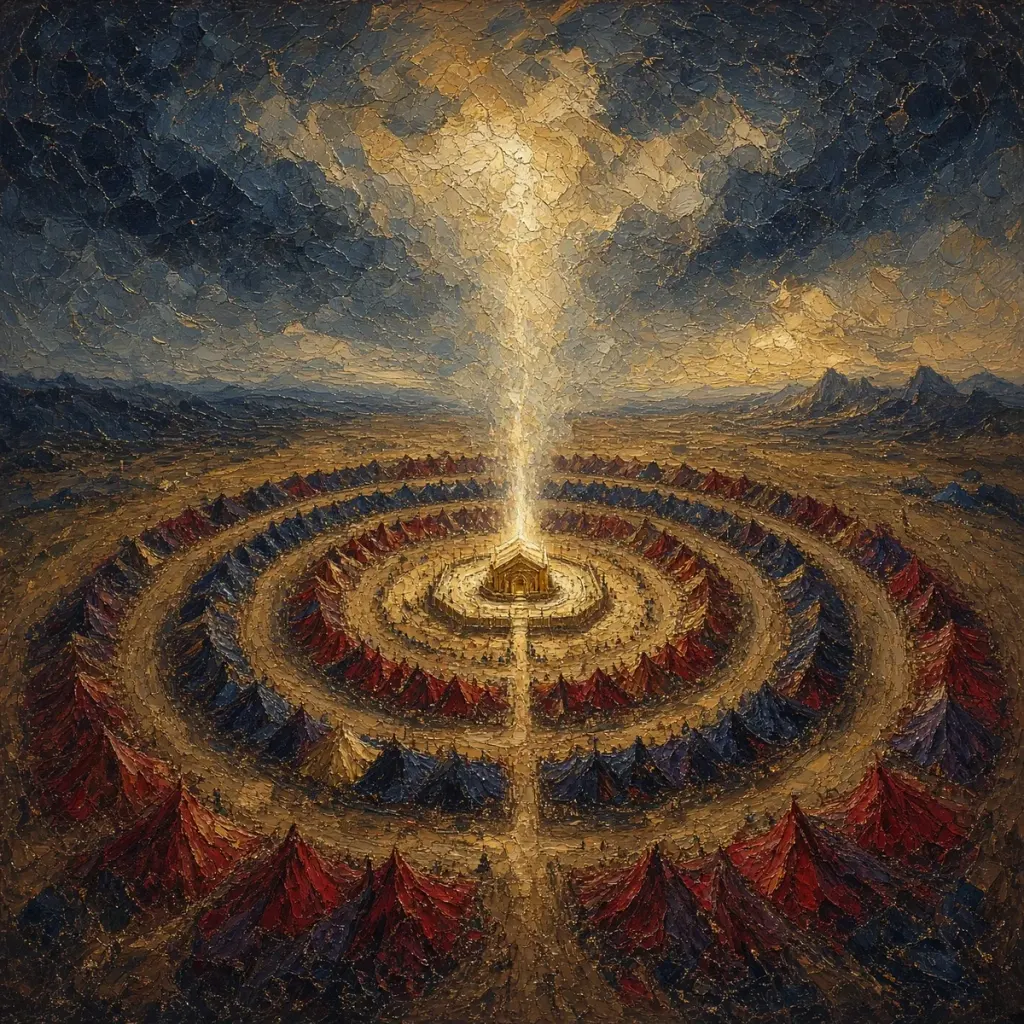
Playing next
About this song
About this song
This song belongs to the Numbers collection. One recording is available to play here, with the complete lyrics below.
- Bible book
- Numbers
- Collection
- Numbers
- Musical styles
- Cinematic Soundtrack
Named in this songTabernacle
About the passage
Numbers 1: Names counted before the wilderness journey
Numbers opens with a census that sounds administrative until its limits become clear. Moses and Aaron count by name, household, tribe, age, and military fitness, producing 603,550 men able to go to war. The repeated tribal formula makes everyone comparable without pretending that every tribe is the same size, and Joseph appears through Ephraim and Manasseh while Levi stands outside the military total. That exception is not leisure. The Levites receive the tabernacle, its equipment, its transport, and its protective perimeter. The opening register therefore does two jobs at once: it prepares an army and marks the sanctuary as the center that army does not control. Before anyone marches, Numbers has already distinguished belonging to Israel from being counted for one particular purpose.
Study Numbers 1 in depthNumbers 2: A camp arranged around the tabernacle
The census becomes geography. Israel is placed around the tabernacle in four three-tribe camps: Judah in the east, Reuben in the south, Ephraim in the west, and Dan in the north. Each division keeps its named leaders and tribal counts, but those figures now determine where people pitch and when they move. Judah leads, Reuben follows, the tabernacle and Levites occupy the middle, Ephraim comes third, and Dan serves as the assigned rear. The arrangement refuses to make the camp a featureless mass. Families keep their identities and standards while taking their bearings from one shared center. The chapter closes by repeating both the 603,550 military total and Levi's exclusion from it, then records that Israel camped and marched as commanded. Order around the sanctuary is now ready to become motion.
Study Numbers 2 in depthNumbers 3: Levites stand in place of the firstborn
Numbers narrows from Israel's camps to Levi's internal structure. Aaron's surviving sons hold the priestly office, while Gershon, Kohath, and Merari receive distinct service around the tabernacle. The Levitical census begins at one month old because this count is not selecting laborers; it is preparing for substitution in place of Israel's firstborn. That purpose explains why infants belong in the register even though chapter 4 will count working-age men separately. The chapter also refuses to hide a numerical problem: its family subtotals add to 22,300 while the stated total is 22,000, and the later redemption uses the stated figure. Israel has 22,273 firstborn males, leaving 273 to be redeemed at five sanctuary shekels each. The final arithmetic is exact even where the earlier discrepancy remains visible.
Study Numbers 3 in depth