
The big picture
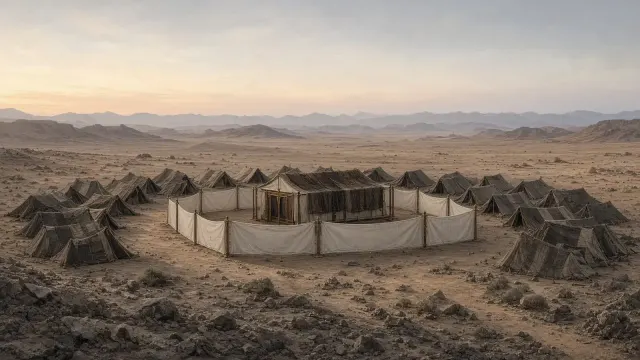
Numbers narrows from Israel's camps to Levi's internal structure. Aaron's surviving sons hold the priestly office, while Gershon, Kohath, and Merari receive distinct service around the tabernacle. The Levitical census begins at one month old because this count is not selecting laborers; it is preparing for substitution in place of Israel's firstborn. That purpose explains why infants belong in the register even though chapter 4 will count working-age men separately. The chapter also refuses to hide a numerical problem: its family subtotals add to 22,300 while the stated total is 22,000, and the later redemption uses the stated figure. Israel has 22,273 firstborn males, leaving 273 to be redeemed at five sanctuary shekels each. The final arithmetic is exact even where the earlier discrepancy remains visible.
In this chapter
- Priests, Assistants, and a Claim from Egypt Numbers 3:1-13
Aaron's household is introduced through names marked by both office and loss.
- Counted at One Month, Assigned by Family Numbers 3:14-26
This census starts at one month old, which immediately signals that it is not a workforce count.
- Four Sides and an Unresolved Total Numbers 3:27-39
Kohath camps south with responsibility for the sanctuary furnishings, while Merari camps north with responsibility for boards, bars, pillars, sockets, pins, and other structural parts.
- The Remaining 273 Are Not Rounded Away Numbers 3:40-51
The firstborn are counted under the same one-month threshold used for Levi, and the exchange is worked out all the way to the remainder.
Scripture beside the summary
Numbers · King James Version · 51Numbers 3:1-13
Priests, Assistants, and a Claim from Egypt
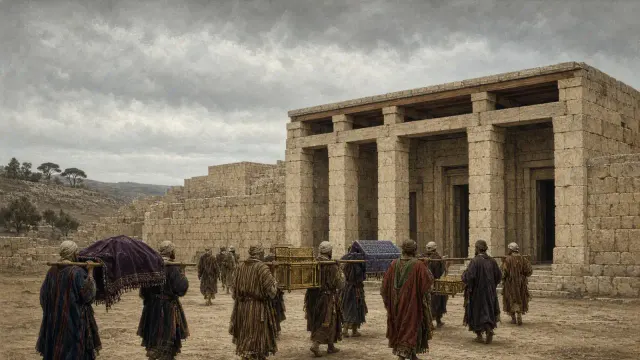
Aaron's household is introduced through names marked by both office and loss. Nadab and Abihu are still listed, then their deaths and lack of children explain why the active priestly line continues through Eleazar and Ithamar. The Levites are brought near to assist that priestly household and to serve the congregation, but Numbers does not blur assistance into priesthood. Aaron and his sons keep the priest's office, while Levi receives the tabernacle's service. The reason for taking the Levites reaches back to Egypt. Israel's firstborn belong to the LORD because they were set apart when Egypt's firstborn were struck, and Levi is now taken in their place. The appointment is therefore not a prize handed to one tribe for superior pedigree. It answers an existing claim. The LORD already claims the firstborn, and the Levites become the designated substitute through which that claim is carried within Israel's ordered worship.
Deep dive
The heading names Aaron and Moses, but the sons actually listed are Aaron’s. The subject is the priestly household, not a general account of both men’s descendants. Nadab and Abihu are named before their deaths are recalled, and their lack of children explains why their lines do not continue in the priestly service described here. Eleazar and Ithamar minister in their father’s presence. The names carry both continuity and loss.
The Levites are then brought near as a gift to Aaron and his sons. Their service benefits the whole congregation, but it does not turn the whole tribe into priests. Verse 10 reserves the priestly office for Aaron’s household. The reason for taking Levi is subsequently rooted in the night of Egypt’s firstborn: Israel’s firstborn belong to the LORD because he set them apart then. The tribe’s appointment is therefore not explained here as an award for superior ancestry. It is a substitution within an existing divine claim.
Words to trace: Aaron, LORD, children, firstborn, Israel, Moses
Verse-by-verse path
- Numbers 3:1
“These also are the generations” is the toledot heading that structured Genesis. Aaron is named before Moses, as in Exodus 6:26, and then only Aaron’s sons are listed. Moses’ own sons, Gershom and Eliezer, were reckoned among the ordinary Levites (1 Chronicles 23:14), with no priestly rank.
- Numbers 3:2
Nadab and Abihu had gone up Sinai with Moses and the seventy elders and seen the God of Israel (Exodus 24:1, 9–10). Nadab means “willing” or “generous”; Eleazar, “God has helped”. The four are listed by birth, the dead first.
- Numbers 3:3
“Consecrated” is literally “whose hand he filled”, mille yad, the Hebrew idiom for ordaining a priest (Exodus 28:41). The ritual placed portions of the ordination offering in their hands (Leviticus 8:27).
- Numbers 3:4
The strange fire is the event of Leviticus 10:1–2. “In the sight of Aaron” is literally “on Aaron’s face”, during his lifetime and under his eye. Because the two died childless, the later high priests all came from Eleazar and Ithamar: Zadok from the first, Eli and Abiathar from the second.
- Numbers 3:5
The speech formula marks a turn from the priestly family to the tribe that will serve it. The next instruction is addressed to Moses alone, though it concerns Aaron.
- Numbers 3:6
“Bring near” is qarav in the causative, the verb of bringing an offering, from which korban comes. The tribe is presented to Aaron almost as a gift is presented at the altar, which chapter 8 will make explicit with the Levites waved as an offering.
- Numbers 3:7
“Service” is avodah, the word used for Israel’s forced labour in Egypt (Exodus 1:14) and also for worship. The same noun that described brick making under taskmasters now describes carrying the tent of the LORD.
- Numbers 3:8
“Instruments” is kelim, a broad word for vessels, tools and furnishings. The Levites keep “the charge of the children of Israel”, the duty that would otherwise fall to every tribe, doing it on behalf of the rest.
- Numbers 3:9
“Wholly given” is the Hebrew netunim netunim, “given, given”, the word doubled. 8:16 repeats the doubling. The same root later names the Nethinim, the temple servants listed on the return from exile in Ezra 2:43.
- Numbers 3:10
“Wait on” is the verb shamar, to guard or keep. The warning against the unauthorised outsider is repeated at 1:51, here, at 3:38 and at 18:7. King Uzziah’s leprosy in 2 Chronicles 26:16–21 shows what it cost a man of royal rank to take up a priest’s censer.
- Numbers 3:11
Another speech formula, beginning a new instruction within the same day at Sinai. The chapter is built out of short divine speeches, each followed by Moses carrying it out.
- Numbers 3:12
“I, behold, I have taken” doubles the pronoun for emphasis. “Openeth the matrix” translates peter rechem, “the opening of the womb”, the phrase of Exodus 13:2. A firstborn is reckoned from the mother, the first child she bore, not from the father.
- Numbers 3:13
The claim goes back to the tenth plague (Exodus 12:29, 13:15). “Hallowed” is the verb for making holy: Israel’s firstborn were spared that night and in the same act set apart as the LORD’s possession, animal and human alike.
Numbers 3:1-13
King James Version1These also are the generations of Aaron and Moses in the day that the LORD spake with Moses in mount Sinai.
2And these are the names of the sons of Aaron; Nadab the firstborn, and Abihu, Eleazar, and Ithamar.
3These are the names of the sons of Aaron, the priests which were anointed, whom he consecrated to minister in the priest’s office.
4And Nadab and Abihu died before the LORD, when they offered strange fire before the LORD, in the wilderness of Sinai, and they had no children: and Eleazar and Ithamar ministered in the priest’s office in the sight of Aaron their father.
5And the LORD spake unto Moses, saying,
6Bring the tribe of Levi near, and present them before Aaron the priest, that they may minister unto him.
7And they shall keep his charge, and the charge of the whole congregation before the tabernacle of the congregation, to do the service of the tabernacle.
8And they shall keep all the instruments of the tabernacle of the congregation, and the charge of the children of Israel, to do the service of the tabernacle.
9And thou shalt give the Levites unto Aaron and to his sons: they are wholly given unto him out of the children of Israel.
10And thou shalt appoint Aaron and his sons, and they shall wait on their priest’s office: and the stranger that cometh nigh shall be put to death.
11And the LORD spake unto Moses, saying,
12And I, behold, I have taken the Levites from among the children of Israel instead of all the firstborn that openeth the matrix among the children of Israel: therefore the Levites shall be mine;
13Because all the firstborn are mine; for on the day that I smote all the firstborn in the land of Egypt I hallowed unto me all the firstborn in Israel, both man and beast: mine shall they be: I am the LORD.
Numbers 3:14-26
Counted at One Month, Assigned by Family
This census starts at one month old, which immediately signals that it is not a workforce count. Babies are being enrolled as members of the tribe that stands in place of Israel's firstborn, not assigned to carry curtains. Gershon is the first family described, with 7,500 males counted, a western camping position, and responsibility for the tabernacle's fabric: tent coverings, entrance hanging, courtyard hangings, and cords. Numbers gives those materials their own custodians instead of treating them as decorative leftovers beside the ark and altar. The distinction matters because the sanctuary depends on boundaries as much as on famous furnishings. A curtain controls access; a cord keeps the structure functioning; a named family is responsible for both. The chapter therefore joins a broad substitution census with very concrete service. Membership is counted from infancy, while actual labor will be assigned under another age rule, and the two purposes should not be confused.

Deep dive
A count beginning at one month old cannot have the same purpose as the military register. These infants are being counted, not handed tent poles. Chapter 4 will separately identify the adults assigned to carry and serve. Here the issue is the tribe’s membership for substitution in place of Israel’s firstborn. Keeping those purposes distinct prevents an apparent mismatch in age requirements from becoming a confusion about the work itself.
Gershon, Kohath, and Merari supply the three family divisions. The Gershonites, counted at 7,500, camp west of the tabernacle and care for its fabric coverings, entrance hanging, courtyard hangings, and associated cords. Their assignment makes a useful distinction visible: the tabernacle is not only its most famous objects. The curtains and boundaries that enclose those objects have their own custodians. A named family and a named leader stand behind work that might otherwise vanish into the background.
Words to trace: families, sons, tabernacle, Gershon, Gershonites, house
Verse-by-verse path
- Numbers 3:14
The place is named again, the wilderness of Sinai. The census of Levi is taken at the mountain like the census of the other tribes, not on the road.
- Numbers 3:15
“By their families” (lemishpechotam) names the clan, the level below the father’s house that verses 17–20 will list. Only males are counted: the substitution is for firstborn sons.
- Numbers 3:16
“According to the word of the LORD” is literally “according to the mouth of the LORD”. A rabbinic tradition held that Moses stood at each tent door and a voice from heaven told him how many infants were inside, an answer to how babies could be counted by name.
- Numbers 3:17
The same three sons of Levi appear in Genesis 46:11 among those who went down to Egypt, and in Exodus 6:16, which gives Levi a life of 137 years. The order is by birth and holds throughout the chapter.
- Numbers 3:18
Libni means “white”; Shimei, from shama, “heard”. The same pair of names appears in Exodus 6:17 and 1 Chronicles 6:17.
- Numbers 3:19
Amram was the father of Moses and Aaron (Exodus 6:20). Izehar was the father of Korah (16:1). Uzziel’s son Mishael and grandson Elzaphan carried Nadab and Abihu out of the camp in Leviticus 10:4. Hebron shares its name with the city Abraham knew.
- Numbers 3:20
Mahli and Mushi close the list of Levi’s grandsons. A later Eleazar of the Mahlite line died with only daughters, who married their cousins so the family remained within the clan (1 Chronicles 23:22).
- Numbers 3:21
Clan names are formed from ancestors’ names, Libni to Libnites, Shimei to Shimites. This Shimei is not the Benjamite who cursed David in 2 Samuel 16.
- Numbers 3:22
The Gershonites number 7,500. The Hebrew uses “those that were numbered of them” twice in the one verse, as the King James keeps, which lays heavy stress on the act of counting.
- Numbers 3:23
“Behind” is the word for the back, because the tabernacle faced east. The Gershonites camp on the west, behind the most holy place, and next to the camp of Ephraim.
- Numbers 3:24
Eliasaph son of Lael shares his name with Gad’s prince, Eliasaph son of Deuel, but is a different man. Lael means “belonging to God”, a name found nowhere else.
- Numbers 3:25
Three layers are listed. “The tabernacle” here means the inner linen curtains (Exodus 26:1–6), “the tent” the goats’ hair curtains stretched over them (26:7), and “the covering” the rams’ skins and badgers’ skins on top (26:14). The Gershonites also carry the screen at the tent door.
- Numbers 3:26
The court’s hangings were of fine twined linen, a hundred cubits along each long side (Exodus 27:9). The cords belong to the hangings; chapter 4 and verse 37 give the cords of the pillars to Merari instead.
Numbers 3:14-26
King James Version14And the LORD spake unto Moses in the wilderness of Sinai, saying,
15Number the children of Levi after the house of their fathers, by their families: every male from a month old and upward shalt thou number them.
16And Moses numbered them according to the word of the LORD, as he was commanded.
17And these were the sons of Levi by their names; Gershon, and Kohath, and Merari.
18And these are the names of the sons of Gershon by their families; Libni, and Shimei.
19And the sons of Kohath by their families; Amram, and Izehar, Hebron, and Uzziel.
20And the sons of Merari by their families; Mahli, and Mushi. These are the families of the Levites according to the house of their fathers.
21Of Gershon was the family of the Libnites, and the family of the Shimites: these are the families of the Gershonites.
22Those that were numbered of them, according to the number of all the males, from a month old and upward, even those that were numbered of them were seven thousand and five hundred.
23The families of the Gershonites shall pitch behind the tabernacle westward.
24And the chief of the house of the father of the Gershonites shall be Eliasaph the son of Lael.
25And the charge of the sons of Gershon in the tabernacle of the congregation shall be the tabernacle, and the tent, the covering thereof, and the hanging for the door of the tabernacle of the congregation,
26And the hangings of the court, and the curtain for the door of the court, which is by the tabernacle, and by the altar round about, and the cords of it for all the service thereof.
Numbers 3:27-39
Four Sides and an Unresolved Total
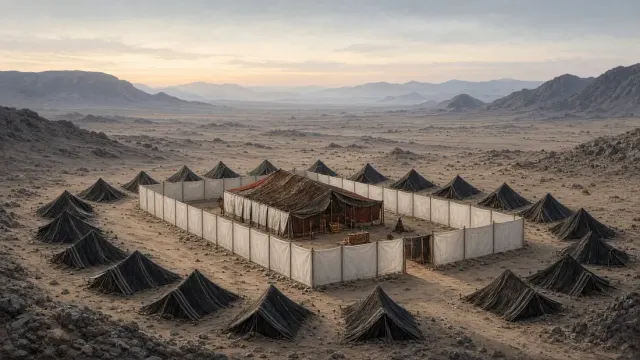
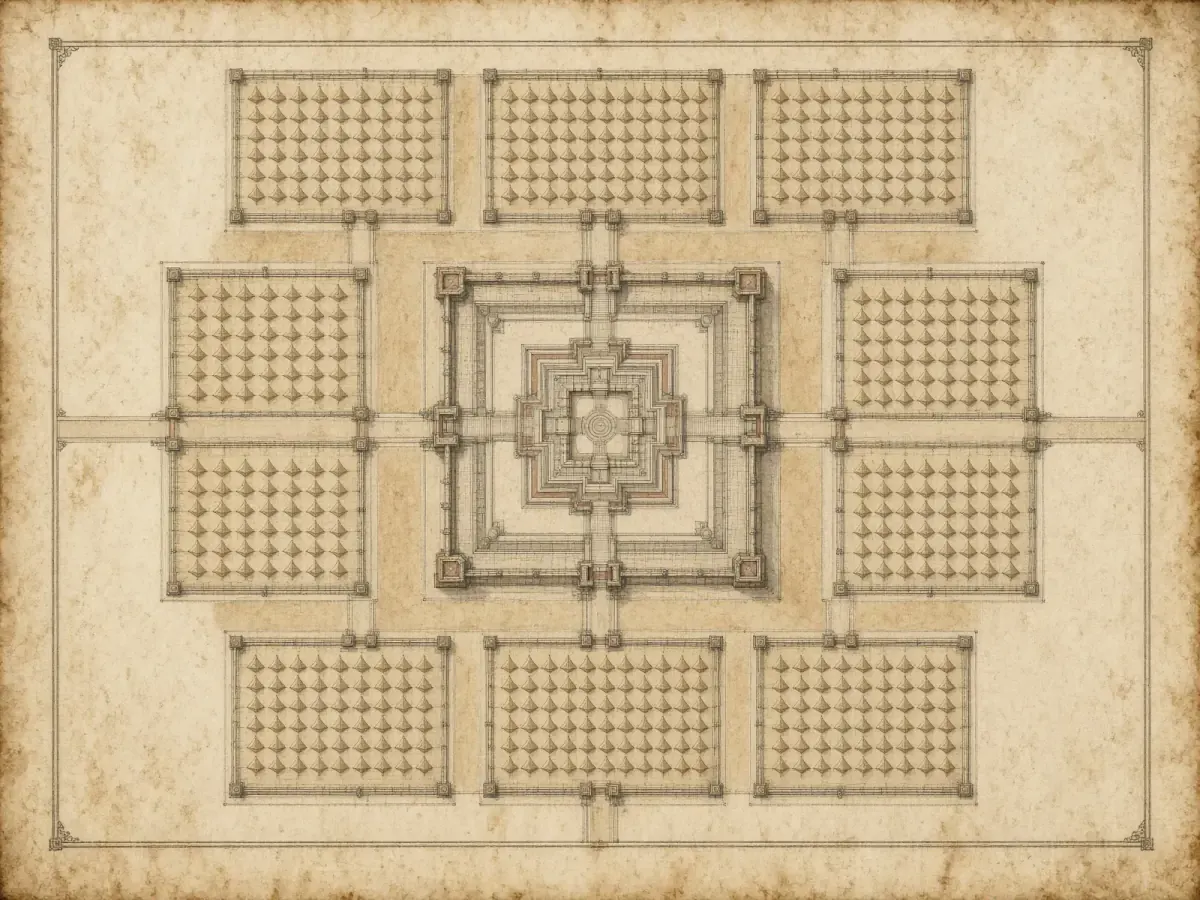
Kohath camps south with responsibility for the sanctuary furnishings, while Merari camps north with responsibility for boards, bars, pillars, sockets, pins, and other structural parts. Moses, Aaron, and Aaron's sons occupy the eastern approach. The four sides around the tabernacle are therefore not four copies of the same duty. Access, furnishings, fabric, and framework remain under distinct charges, even inside one tribe. Then the arithmetic refuses to behave neatly. Gershon's 7,500, Kohath's 8,600, and Merari's 6,200 total 22,300, but verse 39 states 22,000. Later interpretation has offered explanations, including excluding three hundred firstborn Levites or reading a different Kohathite subtotal, but the KJV itself gives neither explanation. Numbers leaves the received figures visible. The honest reading is not to pretend the discrepancy vanished, but to note that the chapter's later redemption calculation proceeds from the stated total of 22,000.
Deep dive
Kohath’s families camp south and guard the sanctuary’s furnishings, including the ark, table, lampstand, and altars. Merari camps north and cares for the framework and its fittings. Moses, Aaron, and Aaron’s sons occupy the eastern approach, with responsibility for the sanctuary on behalf of Israel. The arrangement brings the distinctions of chapter 1 into sharper focus: proximity is ordered, and different kinds of service remain different even within Levi.
The figures require an honest pause. Gershon’s 7,500, Kohath’s 8,600, and Merari’s 6,200 add to 22,300, but verse 39 gives 22,000. The later redemption calculation uses the latter figure. One traditional explanation, defended in Gill’s commentary on this verse, excludes 300 Levites who were themselves firstborn and therefore unavailable as substitutes. Keil and Delitzsch instead propose a copying difference in a family subtotal, possibly 8,300 rather than 8,600 for Kohath. These are explanations offered by interpreters. The KJV gives neither the exclusion nor the altered subtotal. Both proposals address a discrepancy that the received figures leave visible.
Words to trace: charge, families, family, tabernacle, chief, Merari
Verse-by-verse path
- Numbers 3:27
Kohath has four clans where Gershon and Merari have two each. The Amramites include the households of Moses and Aaron themselves.
- Numbers 3:28
The Kohathite total alone is followed by a job description: “keeping the charge of the sanctuary”. They were the family closest to the holy things.
- Numbers 3:29
On the south side, inside the holy place, stood the lampstand (Exodus 26:35), with the table on the north. The Kohathites camp on the lampstand’s side, the Merarites on the table’s.
- Numbers 3:30
Elizaphan comes from Uzziel, Kohath’s youngest son, rather than from Izhar, the next in line. Rashi connected Korah’s revolt in chapter 16 with this appointment: Korah, Izhar’s son, had been passed over.
- Numbers 3:31
Four pieces are named: the ark, the table, the lampstand and the altars, both the golden altar of incense and the bronze altar of the court. “The hanging” here is the veil in front of the most holy place, which chapter 4 will have the priests use to cover the ark.
- Numbers 3:32
“Chief over the chief” is literally “prince of the princes of the Levites”. Eleazar supervises the Kohathites and the holy things directly; his brother Ithamar is given oversight of the other two families (4:28, 33).
- Numbers 3:33
Mahlites and Mushites form Merari’s two clans. The census of chapter 26 lists the Levite families differently, naming five and including the Korathites (26:58).
- Numbers 3:34
At 6,200 the Merarites are the smallest family of Levi, and they carried the heaviest loads. In chapter 7 they receive four of the six wagons for that reason (7:8).
- Numbers 3:35
Zuriel means “my rock is God”, a name built like Zurishaddai of 1:6. Abihail, “my father is strength”, is elsewhere a woman’s name (1 Chronicles 2:29) and the name of Esther’s father.
- Numbers 3:36
The “boards” were forty-eight gilded acacia frames, ten cubits tall (Exodus 26:15–25), and the sockets were silver bases weighing a talent each, a hundred talents in all (Exodus 38:27). This was the frame of the building, and its weight.
- Numbers 3:37
The “pins” are tent pegs, yetedot, made of brass (Exodus 27:19), driven in around the court to hold the pillars upright with their cords. No piece is too small to be assigned a keeper.
- Numbers 3:38
The east, the one side where anyone could approach, is held by Moses, Aaron and the priests in person. The leaders of Israel camp at the most exposed point, at the door.
- Numbers 3:39
In the Hebrew text the name Aaron in this verse carries dots over its letters, one of ten such dotted places in the Torah. The rabbis read the dots as marking a doubt, and said Aaron did not take part in counting the Levites.
Numbers 3:27-39
King James Version27And of Kohath was the family of the Amramites, and the family of the Izeharites, and the family of the Hebronites, and the family of the Uzzielites: these are the families of the Kohathites.
28In the number of all the males, from a month old and upward, were eight thousand and six hundred, keeping the charge of the sanctuary.
29The families of the sons of Kohath shall pitch on the side of the tabernacle southward.
30And the chief of the house of the father of the families of the Kohathites shall be Elizaphan the son of Uzziel.
31And their charge shall be the ark, and the table, and the candlestick, and the altars, and the vessels of the sanctuary wherewith they minister, and the hanging, and all the service thereof.
32And Eleazar the son of Aaron the priest shall be chief over the chief of the Levites, and have the oversight of them that keep the charge of the sanctuary.
33Of Merari was the family of the Mahlites, and the family of the Mushites: these are the families of Merari.
34And those that were numbered of them, according to the number of all the males, from a month old and upward, were six thousand and two hundred.
35And the chief of the house of the father of the families of Merari was Zuriel the son of Abihail: these shall pitch on the side of the tabernacle northward.
36And under the custody and charge of the sons of Merari shall be the boards of the tabernacle, and the bars thereof, and the pillars thereof, and the sockets thereof, and all the vessels thereof, and all that serveth thereto,
37And the pillars of the court round about, and their sockets, and their pins, and their cords.
38But those that encamp before the tabernacle toward the east, even before the tabernacle of the congregation eastward, shall be Moses, and Aaron and his sons, keeping the charge of the sanctuary for the charge of the children of Israel; and the stranger that cometh nigh shall be put to death.
39All that were numbered of the Levites, which Moses and Aaron numbered at the commandment of the LORD, throughout their families, all the males from a month old and upward, were twenty and two thousand.
Numbers 3:40-51
The Remaining 273 Are Not Rounded Away
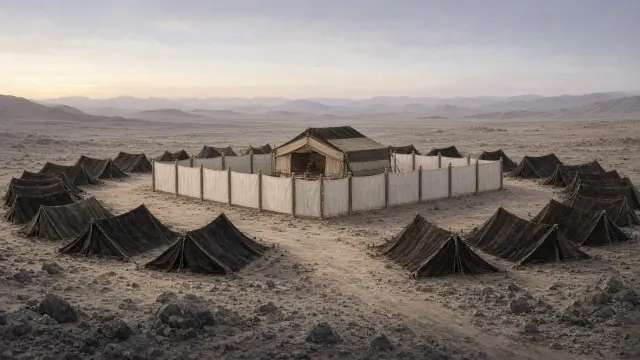
The firstborn are counted under the same one-month threshold used for Levi, and the exchange is worked out all the way to the remainder. Israel has 22,273 firstborn males. Using the chapter's stated 22,000 Levites leaves 273 without a Levitical substitute, and Numbers does not round them away. Each is redeemed at five sanctuary shekels, producing exactly 1,365 shekels for Aaron and his sons. That precision is important because it shows how seriously the chapter treats the individuals left over after the large exchange has been made. The transaction does not mean the LORD's claim on the firstborn has disappeared. Substitution accounts for most of them, and redemption accounts for the rest. The arithmetic closes cleanly once the stated total of 22,000 is accepted, even though that clean conclusion still does not explain why the earlier family figures appear to add three hundred more.
Deep dive
The substitution is worked out person by person. The firstborn are counted by name from one month old, matching the membership threshold used for Levi. Using the chapter’s stated total of 22,000 Levites leaves 273 firstborn without a corresponding substitute. The payment of five sanctuary shekels for each produces 1,365 shekels, exactly the amount delivered to Aaron and his sons.
This precision makes a casual rounding explanation for the earlier 300-person difference difficult: the conclusion is attentive even to the remainder of 273. The calculation is exact once its stated starting total is accepted, but it does not itself explain the earlier discrepancy. The larger point of the transaction is equally concrete. The firstborn are not simply released from the LORD’s claim because a tribal arrangement is more convenient. Substitution and redemption provide the specified means of accounting for that claim, including the people left over after the main exchange.
Words to trace: children, firstborn, Israel, Levites, LORD, Moses
Verse-by-verse path
- Numbers 3:40
“Of the males” limits the count to firstborn sons, and the age matches the Levites’ count, a month and up. “Take the number of their names” means a register by name, not a head count.
- Numbers 3:41
The parenthesis “(I am the LORD)” breaks into the sentence as a signature. Levite livestock replace Israel’s firstborn animals in a one-time exchange; from then on, firstlings were still given or redeemed (18:15–17).
- Numbers 3:42
The verse records only the act of counting. The result is given in the next verse.
- Numbers 3:43
The figure is 22,273. Set against 603,550 men, it gives about one firstborn son to every twenty-seven men, which has long been a puzzle. One proposal, made by Keil among others, is that only those born since the exodus were counted; the text does not say so.
- Numbers 3:44
The formula introduces the ruling on the surplus. The command of verse 41 is now put as an order to carry out.
- Numbers 3:45
Two exchanges are named together, persons and cattle, and both end with the same claim: “the Levites shall be mine”. The signature “I am the LORD” closes the command.
- Numbers 3:46
“Which are more than” renders a Hebrew participle, ha’odefim, “those in excess”. The same verb is used of manna that was left over in Exodus 16:18 and 16:23.
- Numbers 3:47
Five shekels a head became the standing price for redeeming a firstborn son (18:16). Luke 2:22–23 describes Mary and Joseph bringing Jesus to the temple under this law. Jewish families still keep the redemption ceremony, pidyon haben.
- Numbers 3:48
“Odd number” means the leftover, the ones beyond the even exchange. The money goes to Aaron’s household, not into a general treasury, and is the first income assigned to the priests in the Book of Numbers.
- Numbers 3:49
The phrasing is careful: “them that were over and above them that were redeemed by the Levites”. The Levites themselves are counted as redemption, a price paid in persons.
- Numbers 3:50
1,365 shekels. How to decide which 273 firstborn paid, and which were covered by a Levite, is not said. The Talmud (Sanhedrin 17a) imagines lots drawn from an urn, marked “Levite” or “five shekels”.
- Numbers 3:51
The chapter ends by repeating that everything was done “according to the word of the LORD”, and closes, like chapter 1, with a line of obedience. The last thing in the account is silver placed in the priests’ hands.
Numbers 3:40-51
King James Version40And the LORD said unto Moses, Number all the firstborn of the males of the children of Israel from a month old and upward, and take the number of their names.
41And thou shalt take the Levites for me (I am the LORD) instead of all the firstborn among the children of Israel; and the cattle of the Levites instead of all the firstlings among the cattle of the children of Israel.
42And Moses numbered, as the LORD commanded him, all the firstborn among the children of Israel.
43And all the firstborn males by the number of names, from a month old and upward, of those that were numbered of them, were twenty and two thousand two hundred and threescore and thirteen.
44And the LORD spake unto Moses, saying,
45Take the Levites instead of all the firstborn among the children of Israel, and the cattle of the Levites instead of their cattle; and the Levites shall be mine: I am the LORD.
46And for those that are to be redeemed of the two hundred and threescore and thirteen of the firstborn of the children of Israel, which are more than the Levites;
47Thou shalt even take five shekels apiece by the poll, after the shekel of the sanctuary shalt thou take them: (the shekel is twenty gerahs:)
48And thou shalt give the money, wherewith the odd number of them is to be redeemed, unto Aaron and to his sons.
49And Moses took the redemption money of them that were over and above them that were redeemed by the Levites:
50Of the firstborn of the children of Israel took he the money; a thousand three hundred and threescore and five shekels, after the shekel of the sanctuary:
51And Moses gave the money of them that were redeemed unto Aaron and to his sons, according to the word of the LORD, as the LORD commanded Moses.
Questions to keep in mind while reading
- Identify the people addressed and the covenant setting.
- Distinguish rescue, worship, holiness, justice, and community responsibility.
- Read commands in their literary and covenant context before making a modern application.
Text first
Where readers differ
The chapter summary begins with what the passage says and how its parts fit together. It does not assume one denomination has already settled every question. Where a conclusion depends on a tradition, literary theory, or historical reconstruction, that dependence is named openly.
The KJV text is presented first. Interpretive conclusions are labeled, and differences are introduced only when they help a reader understand why serious communities do not always reach the same answer.
Comparative interpretive notes for this chapter are in preparation. Until reviewed notes are ready, this page separates the KJV text from summary and application without claiming that serious readers agree on every question.
Questions beneath the surface
- What account of God, human freedom, responsibility, and the good life emerges from Numbers 3?
- Which tension does the chapter refuse to resolve quickly?
- What changes when the chapter is read as part of the whole canon rather than as an isolated moral lesson?
- Where might a sincere reader confuse a familiar tradition with something the text states directly?
Questions for serious personal contemplation
These open-ended questions make room for tension, honest response, prayer, and conclusions that remain accountable to the chapter.
Observe without rushing
What part of Numbers 3 makes you stop, feel unsettled, or feel surprised, and why?
Which detail in the passage would be easiest to overlook? How does that detail change your understanding?
Where do you see tension between what happens and this focus: Numbers 3 develops its own movement around LORD, children, Moses, sons, tabernacle?
What important question does the passage leave open instead of resolving quickly?
Examine your inner life honestly
Which person, response, fear, or desire in the passage feels most like your own life right now?
What assumption about God, other people, or yourself does this text challenge?
Which part would you rather soften, avoid, or explain away too quickly? What might that reaction reveal?
If this Scripture could ask you one direct question, what do you think it would ask?
Respond with wisdom and courage
What do you need to remember, confess, grieve, thank God for, or trust after reading this passage?
How might another faithful person read this situation differently without ignoring the text?
What obedient response would be costly, uncomfortable, or slow, yet still faithful to Scripture?
What question will you carry into prayer this week, and which verses will you keep in front of you?
Music and video connected to the passage
Related media appears when its Scripture reference overlaps this study. Music and video can illuminate a theme while the biblical text remains the foundation.