New · FreePlay The Witnesses The in-depth puzzle battle quest through Bible history

Places of the Bible

Mount Sinai

A mountain nobody was allowed to touch, where a nation was given a constitution and broke it inside forty days.

Also called Horeb, the mountain of God

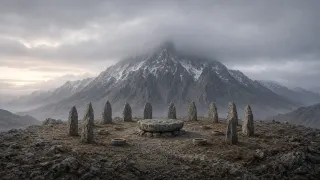
Moses had already been here once, alone, at a bush that would not burn away, and was told that the sign would be that he would bring the people back to worship on this mountain. They arrive in the third month. The preparation is three days long and mostly about distance: bounds are set around the mount, and whosoever touches it, man or beast, shall surely be put to death. The holiness is treated as a physical hazard.

Where it appearsExodus 19 to 20 · Exodus 24 · Exodus 32 to 34

Scroll down to the account
Mount Sinai

The movements, in the order the text gives them.

The Account of Mount Sinai

  1. 01

    Exodus 19:4-6

    I bare you on eagles’ wings

    The covenant is offered with its history first and its terms second. A kingdom of priests and an holy nation is the job description.

    The destination is not named as a country. Brought you unto myself. Before the mountain becomes the place of commandments, it is the meeting place of a people and the God who carried them there. The eagle image makes the direction of dependence unmistakable: Israel is borne, not congratulated for learning to fly.

    The order of the sentences matters. What God did in Egypt comes first; the call to hear his voice and keep his covenant follows. Rescue is already part of their history when these terms are spoken. Yet the if is real. The special calling is not presented as an excuse to disregard the one who gives it.

    Peculiar treasure does not mean an unusually eccentric nation. It means a possession specially valued. Then the sentence widens without warning: all the earth is mine. Israel's distinction does not depend on God having a small territory and needing a people to defend it. The whole earth already belongs to him. Within that wider ownership, a kingdom of priests and a holy nation receives a particular vocation. First Peter 2:9 later takes up this language of royal priesthood and holy nation. Its force begins here, with a people brought near before being told what that nearness requires.

    Verse by verse

    1. 19:4

      The wings describe God's carrying and protection. The verse is an image of the exodus, not a statement that the people traveled by literal flight.

    2. 19:5

      Peculiar means specially belonging to someone in this older English usage. The accompanying phrase all the earth is mine keeps the calling within God's universal ownership.

    3. 19:6

      The priestly description addresses the nation as a whole. It does not erase the distinct priestly offices specified elsewhere in Exodus.
    Exodus 19:4-6

    King James Version · 3 verses

    19:4Ye have seen what I did unto the Egyptians, and how I bare you on eagles’ wings, and brought you unto myself.

    19:5Now therefore, if ye will obey my voice indeed, and keep my covenant, then ye shall be a peculiar treasure unto me above all people: for all the earth is mine:

    19:6And ye shall be unto me a kingdom of priests, and an holy nation. These are the words which thou shalt speak unto the children of Israel.

    Exodus 19:4-6: I bare you on eagles’ wings
  2. 02

    Exodus 19:16-19

    The whole mount quaked greatly

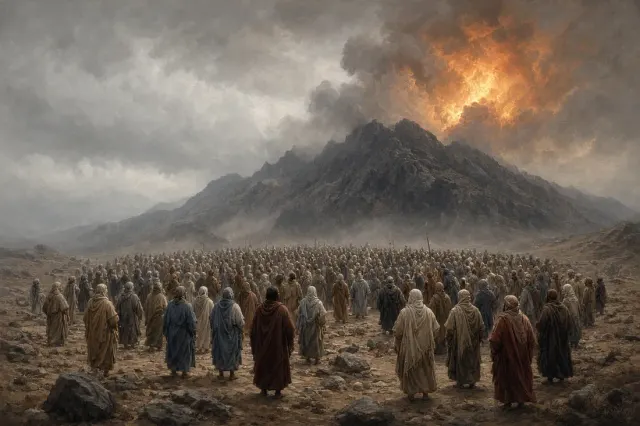
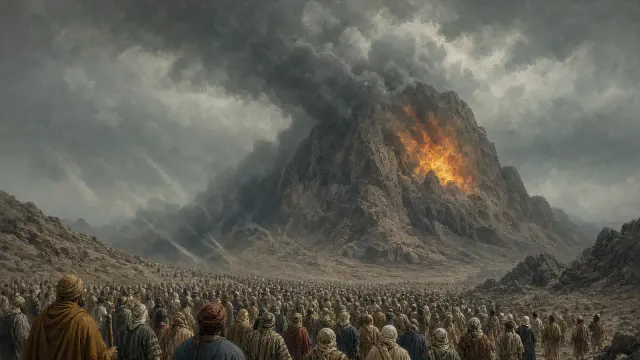
    Thunders, lightnings, a thick cloud and a trumpet exceeding loud. All the people that was in the camp trembled, which is recorded rather than corrected.

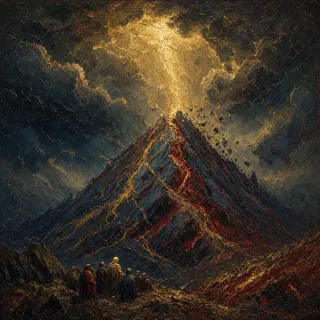
    The people tremble, and then the mountain does. The Hebrew uses the same verb for both. The ground beneath the scene is not a calm stage on which frightened people overreact; the mountain itself participates in the disturbance. Sinai is altogether on a smoke because the LORD has descended in fire. The passage supplies its own explanation of the spectacle.

    The direction is important. Moses brings the people out to meet God, but God has first promised to come down. This is not an account of human beings climbing high enough to discover divinity. The meeting happens because the LORD makes himself present, with boundaries already established around the mount. Nearness is offered without making the approach casual.

    The sound does not fade. The trumpet grows louder and louder until Moses speaks and God answers. What might otherwise be remembered only as fire and shaking becomes an exchange of speech. The mountain is not simply impressive; it is the place where a voice establishes Moses before the people, as verse 9 has already explained. Hebrews 12:18-24 later recalls the fire, darkness, trumpet, and voice when contrasting Sinai with the heavenly Zion. The later contrast depends on taking this first encounter seriously. Sinai is not scenery.

    Verse by verse

    1. 19:16

      The third day is the appointed day after the preparations in Exodus 19:10-11, not the third day after leaving Egypt.

    2. 19:17

      Nether part means the lower part or foot of the mountain. It does not place the people inside a cavern beneath it.

    3. 19:18

      The people trembled in verse 16 and the mountain quaked here use the same Hebrew verb, charad.

    4. 19:19

      Waxed louder means grew louder. No human trumpet player is identified in these verses.

    Exodus 19:16-19

    King James Version · 4 verses

    19:16And it came to pass on the third day in the morning, that there were thunders and lightnings, and a thick cloud upon the mount, and the voice of the trumpet exceeding loud; so that all the people that was in the camp trembled.

    19:17And Moses brought forth the people out of the camp to meet with God; and they stood at the nether part of the mount.

    19:18And mount Sinai was altogether on a smoke, because the LORD descended upon it in fire: and the smoke thereof ascended as the smoke of a furnace, and the whole mount quaked greatly.

    19:19And when the voice of the trumpet sounded long, and waxed louder and louder, Moses spake, and God answered him by a voice.

    Exodus 19:16-19: The whole mount quaked greatly
  3. 03

    Exodus 20:18-21

    Speak thou with us, and we will hear

    They ask for a mediator because the direct voice is unbearable, and the request is granted. Moses drew near unto the thick darkness where God was.

    Moses tells the people not to fear, then explains that God's fear is meant to remain before them. Both statements belong to the same verse. He is not asking for an impossible emotional switch. The terror that drives the people away is being distinguished from the reverence that is to restrain sin. Fear can scatter a congregation or govern its conduct; the passage is concerned with the difference.

    Their request is equally specific. They ask Moses to speak and promise to hear. They do not ask for the commandments to be canceled, only for the voice to reach them through a mediator rather than in the form they have just experienced. Deuteronomy 5:28 records God's approval of what they said. Calling this request simple rejection of God would miss that later judgment.

    The closing line gives the arrangement a physical shape. The people remain far off while Moses draws near to the thick darkness where God was. Darkness here is not proof of divine absence or evil. It marks the place of presence into which Moses approaches on their behalf. The man moves toward the very place the people have left. Mediation has become a position on the mountain.

    Verse by verse

    1. 20:18

      Removed means drew back or moved away. It does not mean that the people were deported or taken away by someone else.

    2. 20:20

      Fear not and his fear distinguish panic from reverent restraint within the same sentence. Neither half should be made to cancel the other.

    3. 20:21

      Thick darkness is the setting of God's presence here. The phrase cannot automatically be treated as a symbol of evil in every biblical context.

    Exodus 20:18-21

    King James Version · 4 verses

    20:18And all the people saw the thunderings, and the lightnings, and the noise of the trumpet, and the mountain smoking: and when the people saw it, they removed, and stood afar off.

    20:19And they said unto Moses, Speak thou with us, and we will hear: but let not God speak with us, lest we die.

    20:20And Moses said unto the people, Fear not: for God is come to prove you, and that his fear may be before your faces, that ye sin not.

    20:21And the people stood afar off, and Moses drew near unto the thick darkness where God was.

    Exodus 20:18-21: Speak thou with us, and we will hear
  4. 04

    Exodus 24:9-11

    They saw God, and did eat and drink

    Seventy-four men go up and the covenant is confirmed with a meal. The description stops at his feet and the pavement under them.

    The most astonishing part of this meal may be that the guests remain alive to eat it. He laid not his hand makes their survival explicit. The Book of Exodus does not treat a meeting with God as a harmless royal reception. The same mountain has been fenced against unauthorized approach. These men ascend because they have been summoned.

    The description is both direct and remarkably restrained. They saw the God of Israel, and then the words turn downward, to what is beneath his feet. Twice the comparison is qualified: as it were. The sapphire-like pavement and the clarity of heaven are described, but no portrait of God's face is supplied. The text affirms the encounter without pretending to exhaust what was seen. Exodus 33:20 later forbids the sight of God's face; that distinction should not be erased by either denying this encounter or inventing details for it.

    Eating and drinking follow the blood of the covenant in verses 6-8. The meal belongs to the covenant's ratification, not to a casual picnic on a convenient summit. Moses is not alone here: Aaron, Nadab, Abihu, and seventy elders are included. Representatives of the people share a meal in the presence they had feared to approach. The boundary is real. So is the welcome.

    Verse by verse

    1. 24:9

      Seventy elders accompany the four named men. The number seventy does not include Moses, Aaron, Nadab, and Abihu in this list.

    2. 24:10

      As it were marks comparison. The description concerns what is beneath God's feet and does not supply a description of his face.

    3. 24:11

      Laid not his hand means that God did not strike them. Their survival is expressly distinguished from the danger of unauthorized approach.

    4. 24:11

      The eating and drinking follow the covenant's blood ceremony in Exodus 24:6-8, giving the meal its immediate covenantal setting.

    Exodus 24:9-11

    King James Version · 3 verses

    24:9Then went up Moses, and Aaron, Nadab, and Abihu, and seventy of the elders of Israel:

    24:10And they saw the God of Israel: and there was under his feet as it were a paved work of a sapphire stone, and as it were the body of heaven in his clearness.

    24:11And upon the nobles of the children of Israel he laid not his hand: also they saw God, and did eat and drink.

    Exodus 24:9-11: They saw God, and did eat and drink
  5. 05

    Exodus 32:15-19

    He cast the tables out of his hands

    He comes down carrying writing described as the work of God, graven on both sides, and breaks it in sight of the thing that made it necessary.

    The Book of Exodus pauses to describe the tablets just before they are shattered. Written on both sides. The work of God. The writing of God. Those details are not decorative specifications. They establish what Moses is carrying and therefore what the breaking will mean. Something made by God is descending toward something the people have made and called divine.

    Joshua hears the camp before Moses sees it. He identifies the sound as war; Moses distinguishes neither victory nor defeat, but singing. The problem is not that Israel has become musical. Singing and dancing followed the LORD's victory at the sea in Exodus 15. Here the same public forms of celebration surround the calf. The difference is the object of their honor, not the mere presence of rhythm.

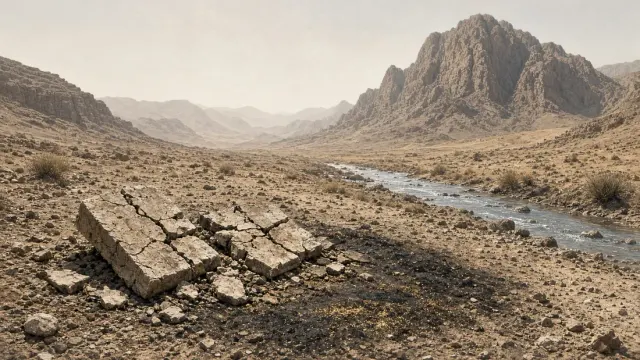
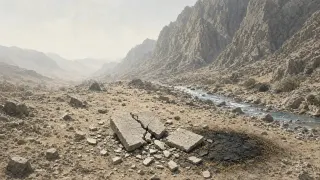
    Moses' anger is stated plainly when he sees the calf and the dancing. The tablets do not slip. He throws them and breaks them beneath the mountain. The action gives visible form to the covenantal rupture already exposed in the worship below. It is not necessary to invent a speech explaining his gesture. The juxtaposition does the work: God's writing in his hands, an image in the camp, broken stone at the foot of the place where the covenant had been made.

    Verse by verse

    1. 32:15

      The tablets were inscribed on both sides. Their shape and the distribution of individual commandments between them are not specified.

    2. 32:16

      Both the making of the tablets and their writing are attributed to God, distinguishing this first pair from the stones Moses hews in Exodus 34:4.

    3. 32:18

      Mastery means victory or prevailing in combat. Moses says that the sound is neither a victor's shout nor a defeated force's cry.

    4. 32:19

      Moses' anger and deliberate throwing are explicit. The passage does not describe an accidental drop.

    Exodus 32:15-19

    King James Version · 5 verses

    32:15And Moses turned, and went down from the mount, and the two tables of the testimony were in his hand: the tables were written on both their sides; on the one side and on the other were they written.

    32:16And the tables were the work of God, and the writing was the writing of God, graven upon the tables.

    32:17And when Joshua heard the noise of the people as they shouted, he said unto Moses, There is a noise of war in the camp.

    32:18And he said, It is not the voice of them that shout for mastery, neither is it the voice of them that cry for being overcome: but the noise of them that sing do I hear.

    32:19And it came to pass, as soon as he came nigh unto the camp, that he saw the calf, and the dancing: and Moses’ anger waxed hot, and he cast the tables out of his hands, and brake them beneath the mount.

    Exodus 32:15-19: He cast the tables out of his hands
  6. 06

    Exodus 34:1-7

    Hew thee two tables of stone like unto the first

    The second set is cut by Moses rather than given whole, and what is proclaimed over them is a description of character rather than a rule.

    The second set of stones is new. The words are not. God promises to write what was on the first tablets, and the phrase which thou brakest leaves the earlier rupture in view. Renewal does not pretend that nothing happened, but neither does it replace the covenant with terms more convenient for the calf's worshipers. Moses must hew the stones and carry them up.

    The mountain's restrictions also return. No companion, no onlookers, not even grazing flocks are to be present. Forgiveness has not turned Sinai into common ground. Against that guarded setting, the proclamation of the name becomes extraordinary: merciful and gracious, longsuffering, abundant in goodness and truth. Moses had asked to see God's glory in Exodus 33:18. The answer includes a declaration of character, not merely an overwhelming sight.

    The proclamation holds forgiveness and judgment together without smoothing either away. Iniquity, transgression, and sin are named as things God forgives; guilt is not simply declared nonexistent. The reference to children and grandchildren gives the judgment an intergenerational reach, while mercy is kept for thousands. The passage does not offer an easy arithmetic for every later case. It announces who the covenant Lord is in the very act of renewing a covenant that has been violated. The stones are replaced. The breach is remembered. Mercy speaks into it.

    Verse by verse

    1. 34:1

      God promises the words from the first tablets, not a revised set of terms. Moses is responsible for hewing the replacement stones.

    2. 34:5-6

      The proclamation answers the promise in Exodus 33:19 that the LORD would proclaim his name before Moses.

    3. 34:6

      Longsuffering renders the Hebrew idiom slow to anger. It describes restraint in anger, not an inability to judge.

    4. 34:7

      The verse speaks of intergenerational divine judgment. Deuteronomy 24:16 separately forbids human courts to execute children for their fathers' crimes.

    5. 34:7

      The KJV says thousands without adding generations at that point. The contrasting third and fourth generation are expressly named.

    Exodus 34:1-7

    King James Version · 7 verses

    34:1And the LORD said unto Moses, Hew thee two tables of stone like unto the first: and I will write upon these tables the words that were in the first tables, which thou brakest.

    34:2And be ready in the morning, and come up in the morning unto mount Sinai, and present thyself there to me in the top of the mount.

    34:3And no man shall come up with thee, neither let any man be seen throughout all the mount; neither let the flocks nor herds feed before that mount.

    34:4And he hewed two tables of stone like unto the first; and Moses rose up early in the morning, and went up unto mount Sinai, as the LORD had commanded him, and took in his hand the two tables of stone.

    34:5And the LORD descended in the cloud, and stood with him there, and proclaimed the name of the LORD.

    34:6And the LORD passed by before him, and proclaimed, The LORD, The LORD God, merciful and gracious, longsuffering, and abundant in goodness and truth,

    34:7Keeping mercy for thousands, forgiving iniquity and transgression and sin, and that will by no means clear the guilty; visiting the iniquity of the fathers upon the children, and upon the children’s children, unto the third and to the fourth generation.

    Exodus 34:1-7: Hew thee two tables of stone like unto the first

Why it matters

What is given here is the framework the rest of the Old Testament runs on. Ten commandments spoken aloud to everyone, then the ordinances, then a covenant sealed with blood and a meal, and the elders see the God of Israel with a paved work of a sapphire stone under his feet. Then Moses goes up for forty days and the people at the bottom, unable to wait, build something they can see. The tablets are broken at the foot of the mountain that gave them, and the chapters that follow are about whether the arrangement survives it.

4 songs

The music

Every song in the catalogue whose passage falls inside these chapters.

  1. Exodus 18:1-20:26

    The Mountain Trembled

  2. Exodus 19-20

    The Mountain Burned with Fire

  3. Exodus 32

    The Calf of Gold

  4. Exodus 33-34

    Show Me Thy Glory

Nearby

All the places

Report an error on this page