New · FreePlay The Witnesses The in-depth puzzle battle quest through Bible history

Objects of the Bible

The altar of incense

The smallest altar, the closest to the veil, and the one thing that was never allowed to carry anything else.

A cubit square and two cubits high, shittim wood overlaid with pure gold, with horns and a crown and rings and staves. It stands before the veil that is by the ark of the testimony, which puts it as close to the most holy place as anything on the outside gets. Aaron burns sweet incense on it every morning when he dresses the lamps and every evening when he lights them, a perpetual incense before the LORD.

Where it appearsExodus 30 · Leviticus 10 · Luke 1

Scroll down to the account
The altar of incense

The movements, in the order the text gives them.

The Account of The altar of incense

  1. 01

    Exodus 30:1-6

    Before the veil that is by the ark

    Position is the whole description. Everything about this altar is stated in terms of how close to the ark it is allowed to stand.

    The smaller altar receives the more intimate address. Its position is described not simply by a wall or a compass direction, but by the veil, the ark, the mercy seat, and the place where God will meet Moses. The measurements locate a piece of furniture. The final sentence locates its service in relation to the divine presence.

    That does not put the altar inside the most holy place. Exodus 40:26 explicitly places it before the veil. The curtain still intervenes. Nearness and unrestricted access are not the same thing, and the arrangement preserves both the invitation to serve and the boundary around the inner chamber.

    Its square top measures one cubit on each side, against the five-cubit square of the bronze altar in Exodus 27:1. This is not an undersized version of the same appliance. It has its own material, location, and purpose. Gold-covered wood, horns, a surrounding molding, and carrying poles make it fully part of the traveling sanctuary. Its small footprint does not mean a minor role. The daily incense is offered at the boundary of the place of meeting.

    Verse by verse

    1. 30:2

      The altar is one cubit square and two cubits high; the passage does not authorize converting those dimensions into a uniquely certain modern measurement.

    2. 30:3

      The gold covers a wooden structure; this is not a solid block of gold.

    3. 30:6

      The wording links the altar to the meeting place above the ark while retaining the intervening veil.
    Exodus 30:1-6

    King James Version · 6 verses

    30:1And thou shalt make an altar to burn incense upon: of shittim wood shalt thou make it.

    30:2A cubit shall be the length thereof, and a cubit the breadth thereof; foursquare shall it be: and two cubits shall be the height thereof: the horns thereof shall be of the same.

    30:3And thou shalt overlay it with pure gold, the top thereof, and the sides thereof round about, and the horns thereof; and thou shalt make unto it a crown of gold round about.

    30:4And two golden rings shalt thou make to it under the crown of it, by the two corners thereof, upon the two sides of it shalt thou make it; and they shall be for places for the staves to bear it withal.

    30:5And thou shalt make the staves of shittim wood, and overlay them with gold.

    30:6And thou shalt put it before the vail that is by the ark of the testimony, before the mercy seat that is over the testimony, where I will meet with thee.

    Exodus 30:1-6: Before the veil that is by the ark
  2. 02

    Exodus 30:7-9

    A perpetual incense before the LORD

    The burning is tied to the lamps, morning and evening, and four things are named that may never be offered on it.

    The lamps and the incense share a timetable. Aaron tends one and burns the other in the morning; he lights the lamps and burns incense in the evening. Light and fragrance are not competing departments. The instructions bind their upkeep into one recurring service before the LORD.

    Perpetual describes the continuing institution through the generations, not an explicit claim that an unbroken column of smoke must rise every second. The text names two daily occasions. That repetition is substantial enough: the sanctuary's regular life is marked by a provision that is renewed rather than finished once and forgotten.

    The prohibitions in verse 9 protect a distinct purpose. No alternative incense, no burnt animal, no grain offering, and no poured drink offering belong here. An altar is not automatically available for every kind of offering simply because it is an altar. Yet the next verse requires annual atoning blood on its horns. The accurate distinction is not that nothing but incense ever touches it, but that every use is specifically assigned. Even this gold-covered altar near the veil receives atonement. Its holy position does not make that provision unnecessary.

    Verse by verse

    1. 30:7

      Dresseth the lamps means attending to or putting them in order, not decorating them.

    2. 30:8

      The recurring morning and evening service explains the temporal setting of the perpetual incense.

    3. 30:9

      Meat offering is the KJV name for a grain offering, not another reference to animal flesh.

    4. 30:9

      Verse 10 prescribes blood on the horns annually, an important qualification to any claim that the altar never receives blood.

    Exodus 30:7-9

    King James Version · 3 verses

    30:7And Aaron shall burn thereon sweet incense every morning: when he dresseth the lamps, he shall burn incense upon it.

    30:8And when Aaron lighteth the lamps at even, he shall burn incense upon it, a perpetual incense before the LORD throughout your generations.

    30:9Ye shall offer no strange incense thereon, nor burnt sacrifice, nor meat offering; neither shall ye pour drink offering thereon.

    Exodus 30:7-9: A perpetual incense before the LORD
  3. 03

    Exodus 30:34-38

    Ye shall not make to yourselves

    The recipe is specific and then fenced. Making it for personal use carries the same penalty as the worst offences in the book.

    The formula is disclosed, and then private copying is forbidden. Its holiness does not depend on a trade secret. Israel is told what belongs in the mixture and also told that knowing how to reproduce it does not create permission to turn it into a personal fragrance.

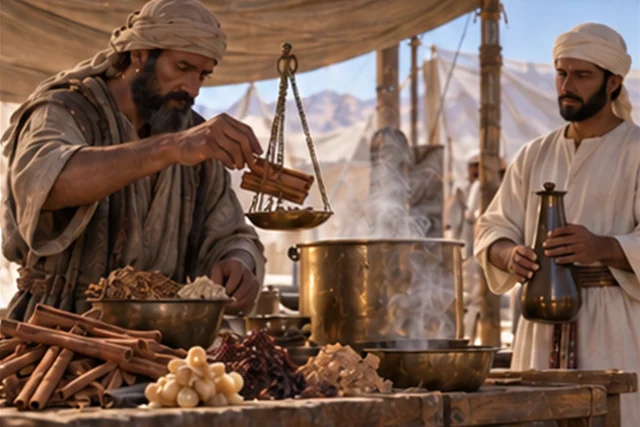
    The distinction is between a composition set apart for the LORD and the same composition made for private enjoyment. Verse 38 specifically describes making it to smell thereto. The pleasantness of the scent is not denied; it is precisely what could tempt someone to treat a sacred provision as a desirable household possession. The sanctuary's perfume does not come with a take-home edition.

    The preparation also calls for actual expertise: an apothecary's compounded work, with some of the mixture beaten very fine. This is neither a vague suggestion to burn anything fragrant nor a claim that skill replaces obedience. The craft and the restriction belong together. Modern identifications of some ingredients remain disputed, particularly stacte and onycha, so certainty about a recreated ancient scent would outrun the evidence. The passage is considerably clearer about whose incense it is than about its exact modern botanical catalogue.

    Verse by verse

    1. 30:34

      The four named ingredients are specified in equal weights; the total batch weight is not given.

    2. 30:35

      Apothecary here refers to a skilled compounder or perfumer, not a modern pharmacy.

    3. 30:37-38

      The ban concerns reproducing this sacred composition for private use; it is not a general prohibition of all pleasant fragrances.

    Exodus 30:34-38

    King James Version · 5 verses

    30:34And the LORD said unto Moses, Take unto thee sweet spices, stacte, and onycha, and galbanum; these sweet spices with pure frankincense: of each shall there be a like weight:

    30:35And thou shalt make it a perfume, a confection after the art of the apothecary, tempered together, pure and holy:

    30:36And thou shalt beat some of it very small, and put of it before the testimony in the tabernacle of the congregation, where I will meet with thee: it shall be unto you most holy.

    30:37And as for the perfume which thou shalt make, ye shall not make to yourselves according to the composition thereof: it shall be unto thee holy for the LORD.

    30:38Whosoever shall make like unto that, to smell thereto, shall even be cut off from his people.

    Exodus 30:34-38: Ye shall not make to yourselves
  4. 04

    Leviticus 10:1-2

    They offered strange fire before the LORD

    Two sons of Aaron put incense on fire that had not come from the altar, and the account gives the consequence in a single verse.

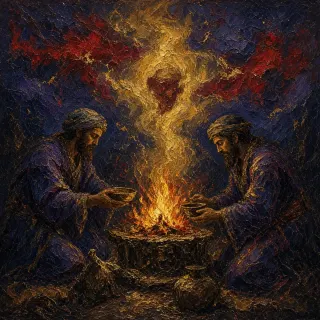
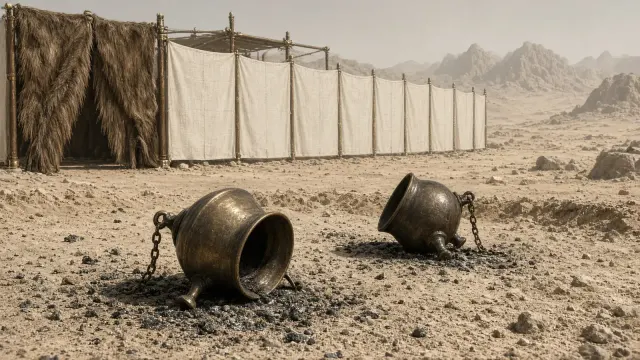
    Incense is present, censers are present, and sons of Aaron are present. The outward vocabulary of priestly service is all in place. The missing element is the decisive one: this is not what God commanded. Leviticus does not let a recognizable religious action authorize itself.

    The wording names strange fire, not simply an unpleasant smell or an inferior recipe. The precise defect has been understood in different ways, including the fire's source, timing, or unauthorized manner of approach. The text does not settle all those reconstructions. It does settle that the act was uncommanded and that both priests died before the LORD. The equipment does not stand between them and the judgment.

    Numbers 16 supplies a stark comparison without making incense itself either poison or magic. Fire consumes the unauthorized company offering incense, but later Aaron carries incense at Moses' command and makes atonement as the plague is stopped. Similar objects serve radically different actions. Nadab and Abihu's death does not cancel the appointed ministry; it makes its distinction from self-appointed action terrible to behold. The same sacred vocabulary can occur on both sides of that distinction.

    Verse by verse

    1. 10:1

      Either of them means each of them: both men bring a censer.

    2. 10:1

      The passage says that God had not commanded this act; it does not give the men an interior speech or explain every technical detail of the offense.

    3. 10:2

      The repeated before the LORD links their unauthorized offering and their death to the same sacred presence.

    Leviticus 10:1-2

    King James Version · 2 verses

    10:1And Nadab and Abihu, the sons of Aaron, took either of them his censer, and put fire therein, and put incense thereon, and offered strange fire before the LORD, which he commanded them not.

    10:2And there went out fire from the LORD, and devoured them, and they died before the LORD.

    Leviticus 10:1-2: They offered strange fire before the LORD
  5. 05

    Luke 1:8-11

    The whole multitude were praying without

    A priest is chosen by lot to burn incense, and an angel stands on the right side of the altar while the people wait outside.

    The priest goes in, but the prayer is not confined to the man inside. Luke places the whole multitude outside in prayer at the same time. The separation of spaces does not divide the event into one participant and a crowd of spectators. The incense service and the people's prayer belong to the same hour.

    Zacharias is there by the order of his priestly division and by lot. He has not arranged a private encounter or entered on the strength of an extraordinary personal claim. The circumstances are ordinary features of appointed worship, and that is where the angel appears. The precision of the right side of the altar roots the encounter in a particular place rather than a general atmosphere of religious feeling.

    The following words join a household's long lack of a child to Israel's expectation: Elisabeth will bear John, who will prepare a people for the Lord. Luke does not specify the exact words Zacharias had just prayed, so the scene should not be embellished with a reconstructed petition. What is given is enough. The altar where incense is offered stands beside the announcement of an answer, while the praying people outside do not yet know what has been said.

    Verse by verse

    1. 1:8-9

      His course is his priestly division; the lot assigns the incense duty within that setting.

    2. 1:10

      Without means outside the sanctuary building, not absent from the worship.

    3. 1:11

      Luke distinguishes the altar from the angel standing beside it; the object is the setting, not the source of the message.

    Luke 1:8-11

    King James Version · 4 verses

    1:8And it came to pass, that while he executed the priest’s office before God in the order of his course,

    1:9According to the custom of the priest’s office, his lot was to burn incense when he went into the temple of the Lord.

    1:10And the whole multitude of the people were praying without at the time of incense.

    1:11And there appeared unto him an angel of the Lord standing on the right side of the altar of incense.

    Luke 1:8-11: The whole multitude were praying without

Why it matters

The restrictions are unusually tight. Ye shall offer no strange incense thereon, nor burnt sacrifice, nor meat offering, nor drink offering. It is not a general-purpose altar. The recipe for the incense is given and then protected: whosoever shall make like unto it, to smell thereto, shall be cut off. And the object outlives the tent as a picture. Luke opens his gospel with a priest at this altar and a multitude praying outside, and Revelation puts the prayers of the saints in a golden censer at one.

3 songs

The music

Every song in the catalogue whose passage falls inside these chapters.

  1. Leviticus 9:1-10:20

    Strange Fire

  2. Luke 1:5-25

    A Son Named John

    Play here
    Open song pageRead lyrics
  3. Luke 1

    Be It Unto Me

Nearby

All the objects

Report an error on this page