New · FreePlay The Witnesses The in-depth puzzle battle quest through Bible history

People of the Bible

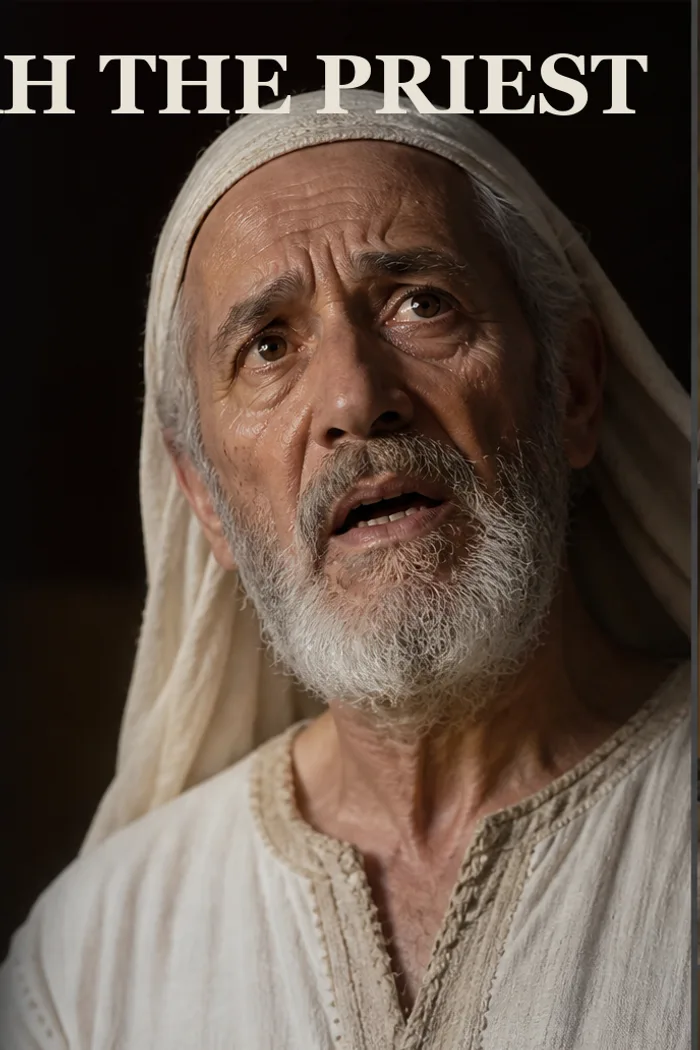
Zechariah the priest

Asked for evidence and was given nine months of silence, and used the first words he got back to sing.

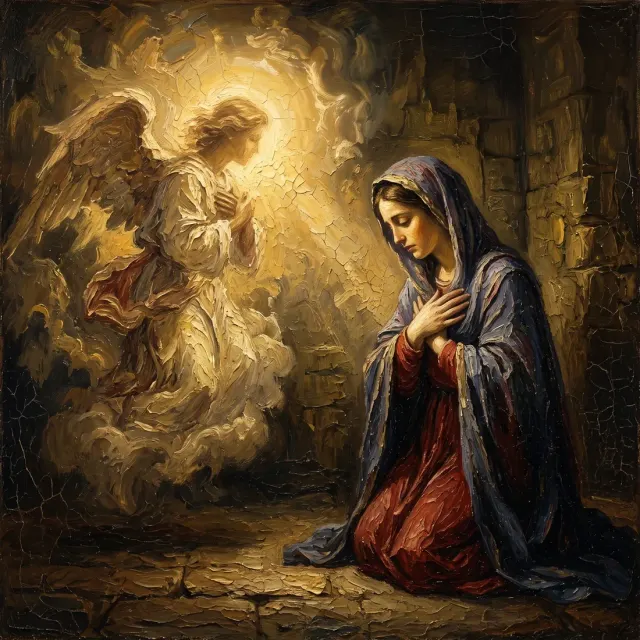
Zechariah is a priest of the course of Abia, and on the one day of his life when the lot falls to him to burn incense in the temple, a messenger is standing on the right side of the altar. He is told his prayer is heard and that his wife will bear a son. His reply is reasonable and fatal: whereby shall I know this, for I am an old man and my wife well stricken in years. He is struck dumb until the day it happens, and comes out unable to give the blessing the crowd is waiting for.

Where he appearsLuke 1

Scroll down to the account
Zechariah the priest

The movements, in the order the text gives them.

The Account of Zechariah the priest

  1. 01

    Luke 1:8-12

    The lot fell to him

    A priest served at the incense altar perhaps once in a lifetime, and the whole multitude was praying outside. He sees the messenger standing on the right side and is troubled, and fear falls on him.

    The lot assigns the incense. It does not put an angel on the schedule. Luke begins with the orderly machinery of priestly service: a division taking its turn, a priest selected for a task, and people praying at the appointed worship. Nothing in that order is mocked or dismissed. The unexpected announcement enters through the ordinary service of Israel's sanctuary.

    The physical arrangement matters. Zechariah is inside, the people are outside, and the angel stands at the right side of the incense altar. This is not a vague impression in an unspecified holy place. Luke fixes the encounter beside an identifiable object. Exodus 30 places the incense altar before the veil and prescribes incense morning and evening. The scene therefore belongs to the regular ministry of the sanctuary, not an asserted entry by Zechariah into the holy of holies as high priest.

    Fear falls on him when he sees the angel. Luke states that reaction rather than leaving it to an imaginative reconstruction, but it does not yet condemn it. The rebuke later concerns unbelief, not the simple shock of an angelic appearance. A familiar duty has become an encounter for which familiarity with the building provides no rehearsal.

    Verse by verse

    1. 1:8

      Course means a priestly division or ordered group, not a course of study.

    2. 1:9

      The Greek naos here refers to the sanctuary building. Luke identifies Zechariah as a priest, not as the high priest.

    3. 1:10

      Without means outside. The people are participating through prayer while the incense is offered inside.

    4. 1:11

      The incense altar is distinct from the altar for burnt offerings; see Exodus 30:1-9.
    Luke 1:8-12

    King James Version · 5 verses

    1:8And it came to pass, that while he executed the priest’s office before God in the order of his course,

    1:9According to the custom of the priest’s office, his lot was to burn incense when he went into the temple of the Lord.

    1:10And the whole multitude of the people were praying without at the time of incense.

    1:11And there appeared unto him an angel of the Lord standing on the right side of the altar of incense.

    1:12And when Zacharias saw him, he was troubled, and fear fell upon him.

    Luke 1:8-12: The lot fell to him
  2. 02

    Luke 1:18-22

    Whereby shall I know this

    He asks for a sign and receives one he did not want. When he comes out he cannot speak, and the people perceive he has seen a vision because he beckons to them and remains speechless.

    Zechariah offers his age as the decisive fact. Gabriel offers his commission. I am an old man is answered by I am Gabriel, that stand in the presence of God. The issue is not whether the priest has correctly described human old age. It is whether that description can overrule the word delivered by God's messenger. The answer shifts authority away from the limits Zechariah can measure.

    The sign he receives is inseparable from the failure it identifies. The man who did not believe the spoken word will temporarily lose his own speech. Gabriel states the reason plainly, but also states the limit: until the promised things occur. Judgment and assurance occupy the same sentence. The child is still coming. Zechariah's unbelief has consequences without becoming more powerful than the promise.

    Outside, the people know only that the service is taking longer than expected. When he emerges, his gestures communicate that something happened, but not the announcement in full. Luke gives the crowd a partial understanding and the passage's reader the explanation they lack. This is not a general ban on asking questions: Abraham asks for assurance in Genesis 15:8, and Mary asks about the manner of the promise in Luke 1:34. Here the messenger explicitly names unbelief. That judgment should be neither softened nor expanded into a rule the passage does not give.

    Verse by verse

    1. 1:18

      Zechariah asks for a basis of assurance and cites both his own age and his wife's. Neither age is given numerically.

    2. 1:19

      Standing in God's presence establishes Gabriel's authority as a commissioned messenger; compare Daniel 9:21-23.

    3. 1:20

      The loss of speech is both a consequence of unbelief and a sign bounded by the promised fulfillment.

    4. 1:22

      The KJV dumb means unable to speak. The Greek kophos can also concern hearing, but this sentence explicitly emphasizes the inability to speak.

    Luke 1:18-22

    King James Version · 5 verses

    1:18And Zacharias said unto the angel, Whereby shall I know this? for I am an old man, and my wife well stricken in years.

    1:19And the angel answering said unto him, I am Gabriel, that stand in the presence of God; and am sent to speak unto thee, and to shew thee these glad tidings.

    1:20And, behold, thou shalt be dumb, and not able to speak, until the day that these things shall be performed, because thou believest not my words, which shall be fulfilled in their season.

    1:21And the people waited for Zacharias, and marvelled that he tarried so long in the temple.

    1:22And when he came out, he could not speak unto them: and they perceived that he had seen a vision in the temple: for he beckoned unto them, and remained speechless.

    Luke 1:18-22: Whereby shall I know this
  3. 03

    Luke 1:59-64

    His name is John

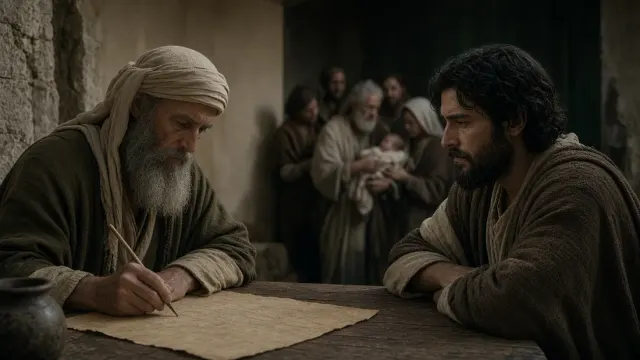
    On the eighth day they try to name the boy after him. He asks for a writing tablet and writes five words, and immediately his mouth is opened and his tongue loosed.

    The first clear public statement Zechariah makes after the temple is written, not spoken. His name is John. The sentence accepts an instruction he received before the pregnancy began, and it agrees with the answer Elizabeth has already given. It is not a newly negotiated compromise between two parental preferences. The child is being named according to the word that the father once doubted.

    The little writing tablet carries a large reversal. At the altar, Zechariah appealed to facts about himself to question the announcement. Here he records the announcement's authority over a decision that could have honored his own name. Luke does not describe the months between as a private spiritual diary. The change visible on the page is concrete: the name is written, the mouth is opened, and praise follows.

    His restored voice is not first spent explaining the inconvenience of having lost it. Luke says that he spake, and praised God. The interval ends in acknowledgment, not self-defense. Nor does his restoration push Elizabeth's earlier speech aside; her spoken answer and his written one form a matched witness. The family dispute over a name becomes the public occasion on which the sign announced in the sanctuary reaches its stated end.

    Verse by verse

    1. 1:60

      Elizabeth has already given the same name. Zechariah's statement confirms her answer.

    2. 1:62

      The relatives communicate by signs. This may suggest affected hearing as well as speech, but Luke does not provide a detailed account of the condition.

    3. 1:63

      The Greek pinakidion denotes a writing tablet, not a full-sized table. The statement gives the name as an established fact.

    4. 1:64

      The return of speech is immediate and is followed by praise. Luke does not record a medical procedure or gradual recovery.

    Luke 1:59-64

    King James Version · 6 verses

    1:59And it came to pass, that on the eighth day they came to circumcise the child; and they called him Zacharias, after the name of his father.

    1:60And his mother answered and said, Not so; but he shall be called John.

    1:61And they said unto her, There is none of thy kindred that is called by this name.

    1:62And they made signs to his father, how he would have him called.

    1:63And he asked for a writing table, and wrote, saying, His name is John. And they marvelled all.

    1:64And his mouth was opened immediately, and his tongue loosed, and he spake, and praised God.

    Luke 1:59-64: His name is John
  4. 04

    Luke 1:67-79

    The dayspring from on high

    Filled with the Holy Ghost he prophesies: a horn of salvation in the house of David, the oath sworn to Abraham, and a child who will go before to give knowledge of salvation by the remission of sins.

    Zechariah has a newborn son, but the prophecy does not begin with the child. It begins with the Lord God of Israel. Eight verses pass before the father turns directly to John. That scale is the first important fact about his restored speech: the household's happiness has been placed inside the promises to David and Abraham, not the other way round. The priest's own son is not the horn of salvation in the house of David. John belongs to Aaron's line and will prepare the way for another.

    The verbs speak of a divine intervention already under way: visited, redeemed, raised up. Zechariah is not presenting an isolated answer to a private prayer. The mercy reaches back to the fathers and the covenant oath. Deliverance from enemies is genuinely in the prophecy and should not be explained away; neither should it be allowed to swallow the purpose that follows. The people are delivered in order to serve God without fear, in holiness and righteousness. Freedom has a direction. When John finally comes into direct view, his work is to give knowledge of salvation by the remission of sins. The account has moved from the threat outside the people to the forgiveness they themselves require.

    Then the imagery changes from strength to light. The dayspring visits from on high, shining upon those who sit in darkness and the shadow of death. Isaiah 9:2 stands close behind the language, but the final line brings the great picture down to feet finding a path. This is mercy with somewhere to go: the way of peace. Nothing here requires an imagined description of what Zechariah thought during every silent month. Luke provides something better than a reconstructed diary, the prophecy itself. The man who once demanded assurance now names the faithfulness of God across generations. His voice comes back larger than his own household.

    Verse by verse

    1. 1:69

      Horn is an image of strength, not a musical instrument here. Psalm 132:17 similarly speaks of a horn springing up for David.

    2. 1:72-73

      The prophecy places the present intervention within God's covenant and oath to Abraham, not outside Israel's previous history.

    3. 1:74-75

      The stated goal of deliverance is service before God in holiness and righteousness, rather than freedom without an object.

    4. 1:76-77

      John is prophet of the Highest, while Luke 1:32 calls Jesus Son of the Highest. Preparation and forgiveness define John's announced ministry.

    5. 1:78-79

      Dayspring translates Greek anatole, rising or dawn. The following light and darkness imagery supports the dawn sense; the word also has other uses, including east.

    Luke 1:67-79

    King James Version · 13 verses

    1:67And his father Zacharias was filled with the Holy Ghost, and prophesied, saying,

    1:68Blessed be the Lord God of Israel; for he hath visited and redeemed his people,

    1:69And hath raised up an horn of salvation for us in the house of his servant David;

    1:70As he spake by the mouth of his holy prophets, which have been since the world began:

    1:71That we should be saved from our enemies, and from the hand of all that hate us;

    1:72To perform the mercy promised to our fathers, and to remember his holy covenant;

    1:73The oath which he sware to our father Abraham,

    1:74That he would grant unto us, that we being delivered out of the hand of our enemies might serve him without fear,

    1:75In holiness and righteousness before him, all the days of our life.

    1:76And thou, child, shalt be called the prophet of the Highest: for thou shalt go before the face of the Lord to prepare his ways;

    1:77To give knowledge of salvation unto his people by the remission of their sins,

    1:78Through the tender mercy of our God; whereby the dayspring from on high hath visited us,

    1:79To give light to them that sit in darkness and in the shadow of death, to guide our feet into the way of peace.

Why it matters

The contrast with Mary is deliberate and Luke builds it carefully. She asks how, he asks how shall I know, and only one of them is silenced. What makes him more than a cautionary tale is what he does with the silence: when his tongue is loosed the first thing out of it is not a complaint but the Benedictus, a song about a horn of salvation raised up in the house of David, and about his own son going before the face of the Lord to prepare his ways.

5 songs

The music

Every song in the catalogue whose passage falls inside these chapters.

  1. Luke 1:5-25

    A Son Named John

    Play here
    Open song pageRead lyrics
  2. Luke 1

    Be It Unto Me

  3. Luke 1:39-56

    Blessed Among Women

    Play here
    Open song pageRead lyrics
  4. Luke 1:57-80

    His Name Is John

    Play here
    Open song pageRead lyrics
  5. Luke 1:26-38

    The Annunciation

    Play here
    Open song pageRead lyrics

Nearby

All the people

Report an error on this page