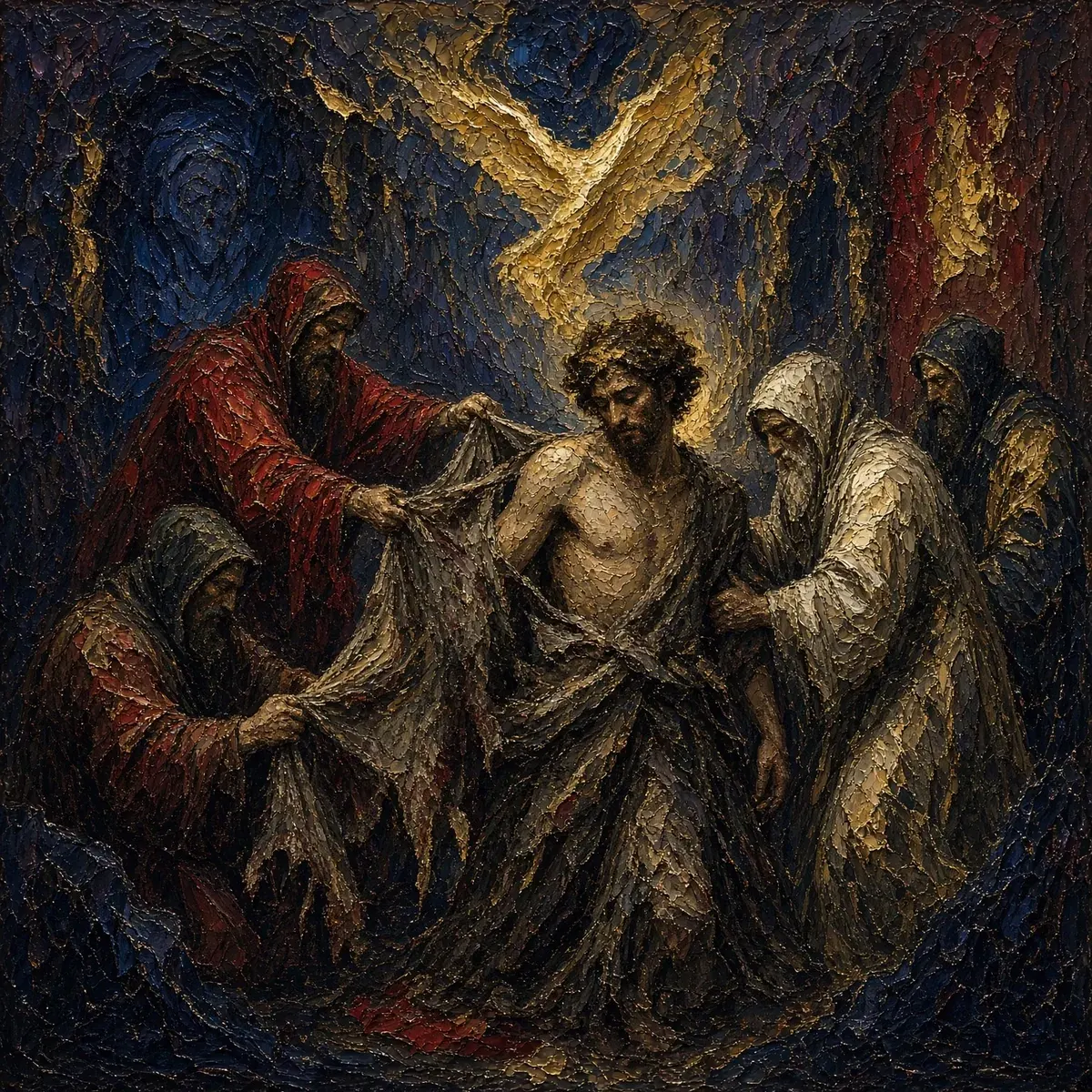
[Accusation]
Joshua stood in garments stained,
The adversary at his side.
No polished plea could hide the failure,
No office wash the inward pride.
[Divine Rebuke]
Yet mercy spoke against the accuser:
“Is this not one drawn from the flame?”
Jerusalem was still the chosen,
Though ash and exile marked her name.
[Refrain]
Take away the filthy garments;
Let the guilt no longer cling.
Clothe the priest in clean apparel,
Set the fair mitre in its ring.
[Verse II]
Joshua heard the solemn charge:
Walk in the way and guard the court.
Faithful service opens passage
Where attending angels hold report.
[Chorus]
Take away the filthy garments,
Not by silver, rank, or claim.
Mercy answers accusation,
Grace restores the priestly name.
Take away the filthy garments,
Let the living Branch appear.
In one day the land's iniquity
Will be removed and peace draw near.
[Bridge]
Before the priest a stone is resting,
Seven eyes upon its face.
God engraves the sign of cleansing,
Sets a future work of grace.
[Final Chorus]
Take away the filthy garments,
Clean the heart and dress the call.
Under vine and under fig tree,
Neighbor will invite neighbor all.
Take away the filthy garments,
Let the ember leave the fire.
The Branch will rise where ruin smoldered,
And holiness restore desire.
[Coda]
The accuser remained standing;
The sentence belonged to mercy.
Zechariah 3: The accused priest receives clean garments
Joshua the high priest stands accused in filthy garments and offers no defense speech. The LORD rebukes the accuser, the garments are removed, and the vision interprets its own symbol by declaring that Joshua’s iniquity has passed from him. A clean mitre completes the restoration of his priestly office. Only then does the charge come: Joshua must walk faithfully and keep the LORD’s charge. His cleansing is not earned by that future conduct, but restored service is not freed from responsibility. The chapter then looks beyond Joshua. He and his companions become signs pointing toward the Branch, while a mysterious stone with seven eyes accompanies the promise that the land’s iniquity will be removed in one day. The closing image is quieter than the heavenly court: neighbors sit beneath vine and fig tree, and an account that began with accusation ends in settled peace.