
Charred roof beams from Jerusalem’s fall in 586 BC turn up in the City of David

Excavators found the burnt roof of a courtyard that came down when Babylon destroyed Jerusalem, with so many tree rings that it may be dated to within a decade.
Published · Prepared by the Cinematic Bible Songs editorial team · 3 min read
Facts from named sources, each one linked. Where we add a view, we say it is ours.
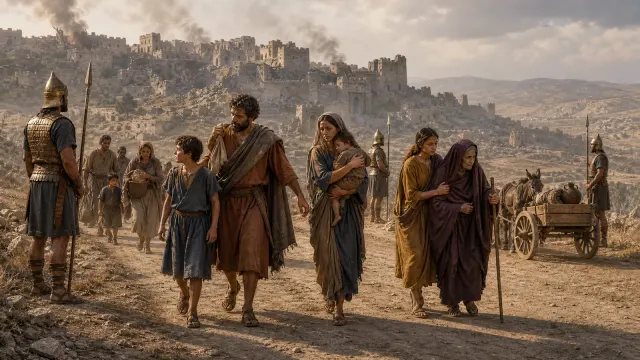
What came out of the ground
In July 2026 the Israel Antiquities Authority and Tel Aviv University announced a find from their excavation at the Givati Parking Lot, in the City of David: massive wooden beams that burned and collapsed when Jerusalem was destroyed in 586 BC.12
The excavation director, Efrat Bocher, says the beams most likely roofed an inner courtyard in a building of the First Temple period. When the building fell, the roof came down onto the floor. Plaster from the walls, melted by the fire, then ran over the charred wood and covered it, which is why it lasted some 2,600 years.12
Why the rings matter
Dr. Johanna Regev of the Israel Antiquities Authority, who is studying the wood, says it is very rare in Israel to find timber with so many growth rings. That is the useful part. Finds like this have usually been dated within a range of hundreds of years; with this many rings, she says, the range may come down to as little as ten.2
The Bible dates the fire far more tightly than that. The Book of 2 Kings gives the month, the day and the year of the king: the fifth month, the seventh day, the nineteenth year of Nebuchadnezzar (2 Kings 25:8). Tree rings will never produce a day and a month. But a decade is a different conversation from a century, and for wood this old it is unusually close.
What the text says burned
The Book of 2 Kings lists the damage from the top down, and the order is worth noticing:
And he burnt the house of the LORD, and the king’s house, and all the houses of Jerusalem, and every great man’s house burnt he with fire.
2 Kings 25:9
The temple, the palace, the houses, and then every great man’s house, as if the Book of 2 Kings went back to make sure none of the big ones had been missed. A courtyard roof in the City of David belongs somewhere in that list. Nobody can say whose house it was, and the excavators have not tried. What the find adds is what a list leaves out: timber heavy enough to carry a roof, and a fire hot enough to melt the plaster off the walls.
A ruin kept on purpose
The excavators go one step further. They believe that when Jerusalem was rebuilt, these remains were deliberately left where they lay and the new city was built over them, so that the destruction would stay in memory. Dr. Yiftah Shalev, who directs the dig for the Israel Antiquities Authority with Prof. Yuval Gadot of Tel Aviv University, calls it a landscape of memory.2
That is an interpretation, and it should be read as one. It does sit well beside the people who came back. The first thing Nehemiah says to Jerusalem’s leaders is about what they can all see:
Then said I unto them, Ye see the distress that we are in, how Jerusalem lieth waste, and the gates thereof are burned with fire: come, and let us build up the wall of Jerusalem, that we be no more a reproach.
Nehemiah 2:17
Nehemiah looked at burned gates, called them a reproach, and rebuilt. If Shalev is right, somebody else looked at a burned house and decided the ruin should stay under the new floor, where it has been waiting ever since.