New · FreePlay The Witnesses The in-depth puzzle battle quest through Bible history

Objects of the Bible

The burning bush

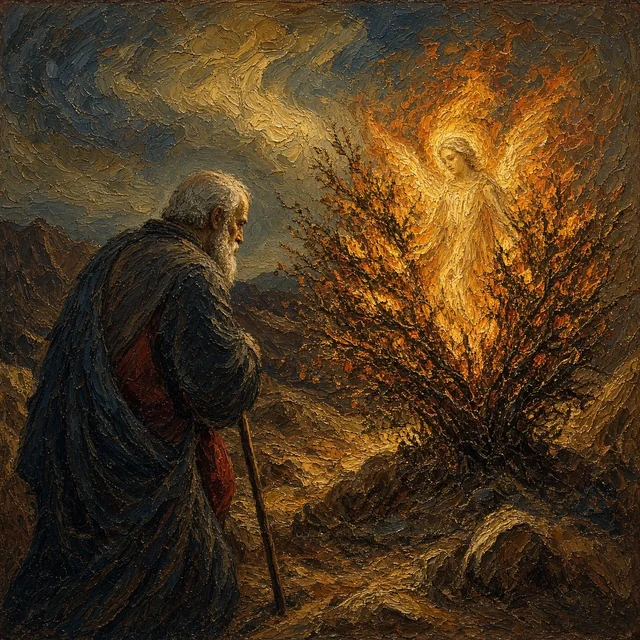
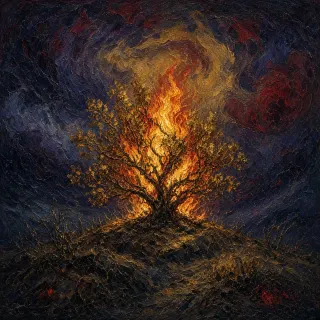
The fire was not the strange part. The bush still being there was.

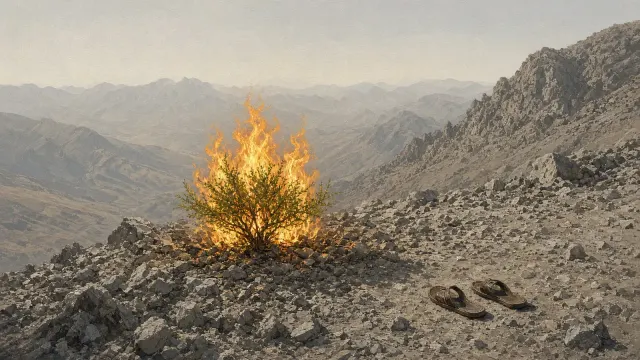
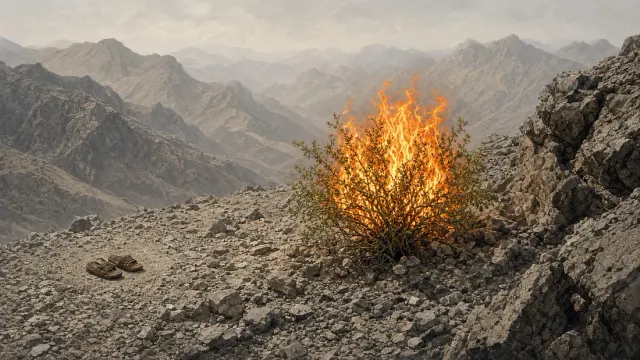
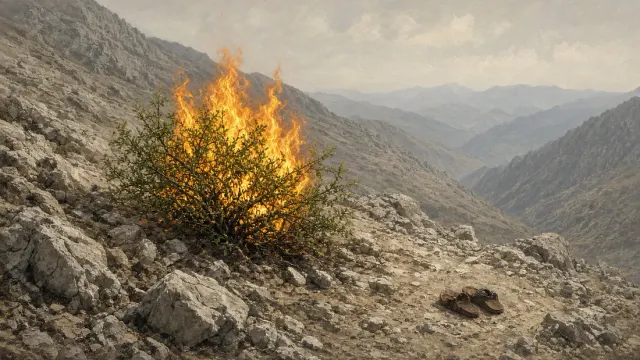
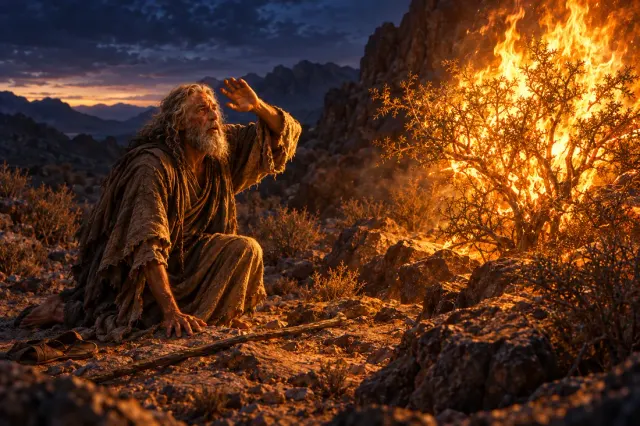
Moses is eighty, keeping another man’s sheep on the back side of the desert, and he turns aside for something odd. The text is precise about what caught him: the bush burned with fire, and the bush was not consumed. He says he will turn aside and see this great sight, why the bush is not burnt, and the voice does not come until he turns. Curiosity is the hinge of the scene, and the instruction that follows is about his feet.

Where it appearsExodus 3 to 4

Scroll down to the account
The burning bush

The movements, in the order the text gives them.

The Account of The burning bush

  1. 01

    Exodus 3:2-4

    When the LORD saw that he turned aside

    The voice waits for the turn. Nothing is said until the man has walked toward the thing he does not understand.

    A burning bush would not keep its audience for long if it simply finished burning. What arrests Moses is the contradiction: the flame is real, and the bush remains. He turns aside to investigate, and the Book of Exodus carefully places the call after that movement. The sight draws him away from his route; the voice addresses him by name. This is no longer an unusual feature of the landscape.

    The wording moves from the angel of the LORD to the LORD and then to God, all within the same encounter. The text binds the messenger's appearance to the divine speech without pausing to explain that relationship in later theological categories. Moses, Moses makes the address unmistakably personal, while Here am I answers a summons before its contents have been disclosed. The shepherd who turned aside to understand a fire is being addressed about Israel. The bush is not impressive architecture, and it has no inscription identifying its importance. Its significance is that God is speaking from it.

    Verse by verse

    1. 3:2

      The marvel is not merely fire but the bush's failure to be consumed. The text supplies no botanical species.

    2. 3:4

      God calls after Moses turns aside. The verse states the sequence without making it a universal formula for receiving revelation.

    Exodus 3:2-4

    King James Version · 3 verses

    3:2And the angel of the LORD appeared unto him in a flame of fire out of the midst of a bush: and he looked, and, behold, the bush burned with fire, and the bush was not consumed.

    3:3And Moses said, I will now turn aside, and see this great sight, why the bush is not burnt.

    3:4And when the LORD saw that he turned aside to see, God called unto him out of the midst of the bush, and said, Moses, Moses. And he said, Here am I.

    Exodus 3:2-4: When the LORD saw that he turned aside
  2. 02

    Exodus 3:5-6

    Put off thy shoes from off thy feet

    The ground is holy because of who is on it, not because of what it is. He hides his face, and the text says why: he was afraid to look.

    The ground becomes holy without receiving a building. Moses has brought a flock into this region, not entered a sanctuary he constructed or scheduled a ceremony. The command to remove his sandals identifies the ground by the presence encountered there. Nearness is real, but it does not abolish a boundary: the voice that calls him also tells him not to approach casually.

    Then the introduction reaches backward through three generations. The God speaking from this bush is the God of Abraham, Isaac, and Jacob. Israel's bondage has not made the ancestral relationship obsolete. Moses hides his face because he is afraid to look upon God; that fear is explicitly given, not supplied by imagination. Centuries later, Jesus cites this very declaration in Mark 12:26-27 when arguing for resurrection. He locates the weight in God's continuing relationship with the patriarchs. At the bush, the names of the dead do not function as an obituary. They belong to the living God's identification of himself.

    Verse by verse

    1. 3:5

      Holy ground is defined here by the divine encounter, not by a temple, altar, or human dedication mentioned in the passage.

    2. 3:6

      Mark 12:26-27 explicitly returns to the declaration at the bush in Jesus' argument concerning resurrection.

    Exodus 3:5-6

    King James Version · 2 verses

    3:5And he said, Draw not nigh hither: put off thy shoes from off thy feet, for the place whereon thou standest is holy ground.

    3:6Moreover he said, I am the God of thy father, the God of Abraham, the God of Isaac, and the God of Jacob. And Moses hid his face; for he was afraid to look upon God.

    Exodus 3:5-6: Put off thy shoes from off thy feet
  3. 03

    Exodus 3:11-12

    Who am I

    The question about his own adequacy is answered by changing the subject, and the sign offered is one he will only see afterwards.

    Moses asks about his own identity; the answer names his companion. Certainly I will be with thee does not inflate Moses' credentials or pretend Pharaoh is a small assignment. It relocates the basis of the commission. The decisive fact is not that the shepherd has finally become impressive enough, but that the one sending him promises to accompany him.

    The sign has an unusual position in time. Service on this mountain lies on the far side of the deliverance, not before the first audience with Pharaoh. The promise describes a completed return that Moses cannot yet display as evidence. It is therefore more than a private reassurance about getting through a difficult interview. A people will stand where one man now stands, and the point of their release will include worship. The mountain is not merely the place from which Moses is sent. It is also named as a destination. Egypt's laborers are being summoned into a different relationship of service.

    Verse by verse

    1. 3:11

      Moses names both parts of the commission: confronting Pharaoh and bringing Israel out. His objection concerns the whole task.

    2. 3:12

      The promised service on this mountain follows deliverance. The verse does not offer Moses an immediately completed sign before departure.

    Exodus 3:11-12

    King James Version · 2 verses

    3:11And Moses said unto God, Who am I, that I should go unto Pharaoh, and that I should bring forth the children of Israel out of Egypt?

    3:12And he said, Certainly I will be with thee; and this shall be a token unto thee, that I have sent thee: When thou hast brought forth the people out of Egypt, ye shall serve God upon this mountain.

    Exodus 3:11-12: Who am I
  4. 04

    Exodus 3:13-15

    I AM THAT I AM

    He asks for a name to quote and is given a sentence in the first person, then a second form to carry to the people.

    The answer gives Moses more than a label to repeat. I AM THAT I AM refuses to define God by ancestry, territory, or the authority of the king Moses must confront. Yet the next verse immediately names Abraham, Isaac, and Jacob. Divine freedom and remembered relationship belong together: the speaker is not dependent on the patriarchs, but he has not abandoned the people attached to their names.

    The Hebrew ehyeh can be heard with the force of I am or I will be, and the connection between this declaration and the name represented by LORD has generated substantial interpretation. The chapter itself gives a firm point of reference before any fuller discussion: in verse 12, the same verbal form belongs to the promise of presence. This naming occurs within a commission to deliver oppressed people, not in an isolated exercise in abstraction. For ever and unto all generations also push beyond Moses' immediate difficulty. The name is entrusted to a people whose memory must outlast this single conversation.

    Verse by verse

    1. 3:14

      The Hebrew expression ehyeh asher ehyeh permits discussion of present and future force; no single English tense exhausts its interpretive history.

    2. 3:15

      LORD represents the divine name YHWH here. The verse couples that name with the patriarchs and remembrance across generations.

    Exodus 3:13-15

    King James Version · 3 verses

    3:13And Moses said unto God, Behold, when I come unto the children of Israel, and shall say unto them, The God of your fathers hath sent me unto you; and they shall say to me, What is his name? what shall I say unto them?

    3:14And God said unto Moses, I AM THAT I AM: and he said, Thus shalt thou say unto the children of Israel, I AM hath sent me unto you.

    3:15And God said moreover unto Moses, Thus shalt thou say unto the children of Israel, The LORD God of your fathers, the God of Abraham, the God of Isaac, and the God of Jacob, hath sent me unto you: this is my name for ever, and this is my memorial unto all generations.

    Exodus 3:13-15: I AM THAT I AM
  5. 05

    Exodus 4:10-17

    I am slow of speech

    The fourth objection is about his mouth and is answered with a question about who made it. The reply to persistence is Aaron, and some heat.

    Even a conversation with a burning bush has not made Moses consider himself a public speaker. Neither heretofore, nor since thou hast spoken has a remarkably plain edge: the encounter has not removed the difficulty he reports. God's reply does not announce a diagnosis or promise that Moses will suddenly enjoy speaking. It promises instruction and presence with the very mouth Moses regards as inadequate.

    The exchange then moves from a stated limitation toward a request that someone else be sent. At that point the text names God's anger. Aaron is appointed, but Moses is not excused. He must receive the words, give them to Aaron, and carry the rod. The arrangement adds a spokesman without removing the commissioned man. Instead of God describes Moses' representative role toward Aaron, not a transformation of Moses into a deity. Both mouths remain dependent on divine teaching. The practical answer to the objection is therefore neither solitary heroism nor complete replacement. Two brothers will speak within one commission.

    Verse by verse

    1. 4:10

      Slow of speech and tongue states Moses' own description. It does not identify a particular speech disorder.

    2. 4:14-16

      Aaron is appointed as spokesman, but Moses still transmits the words. The role is shared without Moses being released from it.

    3. 4:17

      The rod reconnects the discussion of speech with the signs already given in the chapter.

    Exodus 4:10-17

    King James Version · 8 verses

    4:10And Moses said unto the LORD, O my Lord, I am not eloquent, neither heretofore, nor since thou hast spoken unto thy servant: but I am slow of speech, and of a slow tongue.

    4:11And the LORD said unto him, Who hath made man’s mouth? or who maketh the dumb, or deaf, or the seeing, or the blind? have not I the LORD?

    4:12Now therefore go, and I will be with thy mouth, and teach thee what thou shalt say.

    4:13And he said, O my Lord, send, I pray thee, by the hand of him whom thou wilt send.

    4:14And the anger of the LORD was kindled against Moses, and he said, Is not Aaron the Levite thy brother? I know that he can speak well. And also, behold, he cometh forth to meet thee: and when he seeth thee, he will be glad in his heart.

    4:15And thou shalt speak unto him, and put words in his mouth: and I will be with thy mouth, and with his mouth, and will teach you what ye shall do.

    4:16And he shall be thy spokesman unto the people: and he shall be, even he shall be to thee instead of a mouth, and thou shalt be to him instead of God.

    4:17And thou shalt take this rod in thine hand, wherewith thou shalt do signs.

Why it matters

What is given at the bush is a name and a job, in that order and both reluctantly received. He asks who he is to go, and the answer is not about him: certainly I will be with thee. He asks what to say when they ask the name, and gets I AM THAT I AM, which is a sentence rather than a title. Then come four objections and four answers, and at the fourth the anger of the LORD is kindled, and the concession is Aaron. The bush never appears again, and Moses is still describing it in Deuteronomy as the good will of him that dwelt in the bush.

2 songs

The music

Every song in the catalogue whose passage falls inside these chapters.

  1. Exodus 2:11-4:17

    Fire in the Bush

  2. Exodus 2:11-4:17

    Fire That Would Not Burn Away

Nearby

All the objects

Report an error on this page