
New · FreePlay The Witnesses The in-depth puzzle battle quest through Bible history

Objects of the Bible

The fleece of Gideon

He asked for a sign, got it, and then asked for the same sign backwards.

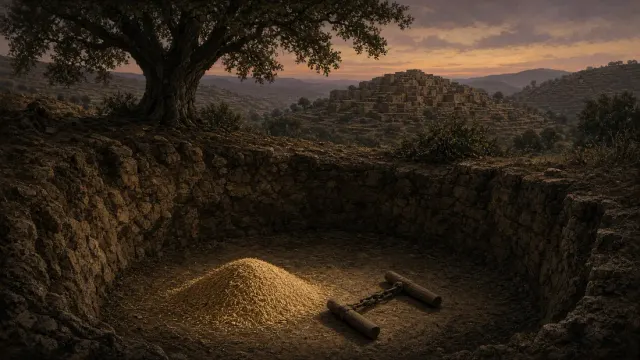
It happens after he has already been called, already torn down an altar at night, and already been told the LORD is with thee, thou mighty man of valour. He puts a fleece of wool on the threshing floor and asks that dew fall on the fleece and nowhere else. In the morning he wrings a bowl full of water out of it. The sign works exactly as requested.

Where it appearsJudges 6

Scroll down to the account
The fleece of Gideon

The movements, in the order the text gives them.

The Account of The fleece of Gideon

  1. 01

    Judges 6:36-38

    He wringed the dew out of the fleece

    The request is specific and the result is measured: a bowl full of water. Gideon is testing a promise he has already been given.

    The fleece is not how Gideon discovers his assignment. As thou hast said appears twice: he already has a word to test against the result. Earlier in the chapter he has received the commission, seen the offering consumed by fire, and summoned men after the Spirit of the LORD came upon him. The request comes inside that history, not before it.

    The test is unusually concrete. One piece of wool must be wet while the surrounding ground stays dry, and the result can be handled rather than merely interpreted. Gideon squeezes out a bowl full of water. That domestic measurement gives the sign its weight: not a slightly damp corner, not an impression about the morning air, but enough water to collect. The Book of Judges nevertheless does not say that the fleece has revealed a previously unknown course of action. Gideon asks for confirmation that God will save Israel by his hand. The mission has not changed. The man assigned to it has asked to see the promise meet the ground.

    Verse by verse

    1. 6:36

      As thou hast said points back to the commission and promise in Judges 6:14-16.

    2. 6:37

      Floor means a threshing floor, not the floor of a room.

    3. 6:38

      Wringed is the older past tense of wring; the bowl contains water squeezed from the fleece.
    Judges 6:36-38

    King James Version · 3 verses

    6:36And Gideon said unto God, If thou wilt save Israel by mine hand, as thou hast said,

    6:37Behold, I will put a fleece of wool in the floor; and if the dew be on the fleece only, and it be dry upon all the earth beside, then shall I know that thou wilt save Israel by mine hand, as thou hast said.

    6:38And it was so: for he rose up early on the morrow, and thrust the fleece together, and wringed the dew out of the fleece, a bowl full of water.

    Judges 6:36-38: He wringed the dew out of the fleece
  2. 02

    Judges 6:39

    Let me prove, I pray thee, but this once

    The second request is prefaced with an apology. He names the risk of asking and asks anyway.

    One bowl of water has not ended the conversation. Gideon asks for the arrangement to be reversed, and he says but this once twice in the same sentence. The request carries its own acknowledgment that another request might be too much. That acknowledgment is in his words; no invented description of his face or feelings is needed.

    The second test is not simply a demand for more water. It switches which surface receives the dew. The wool must remain dry while the ground becomes wet. The exact correspondence between the two requests makes the reversal the point, rather than any supposed sacred quality in the fleece. Gideon also asks that God's anger not burn against him. The Book of Judges preserves that careful approach but records no spoken rebuke in reply. Those facts leave room for discussion about his hesitation without making him either a flawless model or a man dismissed for unbelief. He has already received an answer. Now he asks for its mirror image.

    Verse by verse

    1. 6:39

      Prove here means put to the test; the Hebrew verb is nasah.

    2. 6:39

      The request not to provoke anger is spoken by Gideon; the verse does not state that God has become angry.

    Judges 6:39

    King James Version · 1 verse

    6:39And Gideon said unto God, Let not thine anger be hot against me, and I will speak but this once: let me prove, I pray thee, but this once with the fleece; let it now be dry only upon the fleece, and upon all the ground let there be dew.

    Judges 6:39: Let me prove, I pray thee, but this once
  3. 03

    Judges 6:40

    It was dry upon the fleece only

    The reversal is granted without comment. The account records no anger, which is itself the answer to the way he asked.

    And God did so is the sentence's center of gravity. The dry fleece is not reported as an odd discovery left for Gideon to interpret. The Book of Judges names the actor and says that the result answers the request. The language is brief because the conditions were already spelled out; nothing is missing from the promised reversal.

    There is no new instruction attached to the sign. God does not replace the commission, supply a different enemy, or change the person through whom Israel is to be delivered. The fleece has confirmed a word rather than produced one. Nor does the passage describe what became of the wool afterward. No shrine, preserved relic, or continuing use is mentioned. The ordinary object receives its importance from this particular exchange, and the account lets it leave the foreground when that exchange is complete. A remarkable answer has occurred, but the material itself is not promoted. The ground is wet. The fleece is dry. The earlier commission still stands.

    Verse by verse

    1. 6:40

      That night connects the result directly with the request in the preceding verse.

    2. 6:40

      All the ground refers to the ground contrasted with the fleece; the passage is not describing weather across the entire planet.

    Judges 6:40

    King James Version · 1 verse

    6:40And God did so that night: for it was dry upon the fleece only, and there was dew on all the ground.

    Judges 6:40: It was dry upon the fleece only
  4. 04

    Judges 7:2

    The people that are with thee are too many

    Having been reassured twice, he is immediately given a harder arrangement, and the reason is stated: lest Israel vaunt themselves against me.

    The answer to Gideon's repeated need for confirmation is followed by an instruction to make his army smaller. Too many is an astonishing diagnosis when the enemy has already been described as a swarm. The stated problem, however, is not that the army cannot function. It is that Israel could claim the victory as its own achievement.

    The language of the hand carries the connection. Gideon had asked whether God would save Israel by mine hand. Now the forbidden boast is mine own hand hath saved me. The first allows Gideon to be the instrument of deliverance; the second removes God from the explanation. The difference is only a few words, but the entire reduction of the army hangs on it. This is not yet praise for three hundred exceptionally talented soldiers. The verse gives a reason before any selection takes place, and that reason concerns attribution, not a hidden method of recognizing elite fighters. The fleece answered whether God would save. The reduced army is to prevent confusion over who did.

    Verse by verse

    1. 7:2

      Vaunt means boast or exalt oneself; the boast here is explicitly directed against God.

    2. 7:2

      The army's reduction follows in Judges 7:3-7. This verse gives its stated purpose before the tests begin.

    Judges 7:2

    King James Version · 1 verse

    7:2And the LORD said unto Gideon, The people that are with thee are too many for me to give the Midianites into their hands, lest Israel vaunt themselves against me, saying, Mine own hand hath saved me.

    Judges 7:2: The people that are with thee are too many

Why it matters

Then he asks again, and the way he asks is the interesting part: let not thine anger be hot against me, and I will speak but this once. He knows the request is pushing. The second test reverses the first, dry fleece and wet ground, because wool holding dew is the sort of thing that might happen anyway. He is not asking for a miracle, he is asking for a control. The text gives no rebuke, only the result, and the next thing he does is go out with thirty-two thousand men and get told it is too many.

3 songs

The music

Every song in the catalogue whose passage falls inside these chapters.

  1. Judges 6-8

    God Only Needed Three Hundred

  2. Judges 6:1-40

    Mighty Man in the Winepress

  3. Judges 6-8

    Three Hundred Lamps

The videos

The videos

Every release whose passage falls inside these chapters, playing here.

Nearby

All the objects

Report an error on this page