New · FreePlay The Witnesses The in-depth puzzle battle quest through Bible history

Objects of the Bible

The well of Jacob

A hole in the ground with a stone on it, and two of the most consequential conversations in the Bible held beside it.

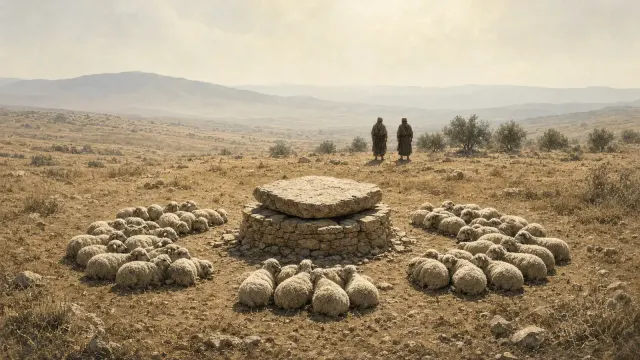
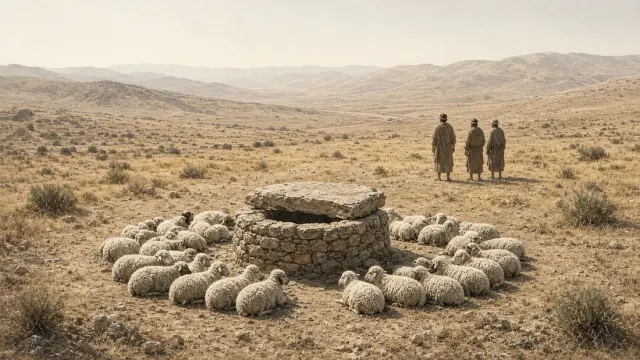
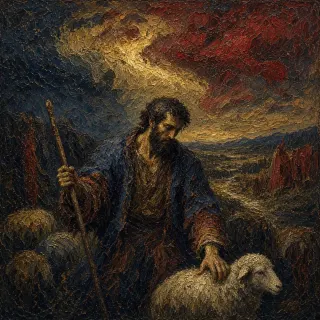
Wells are where this family meets people. Abraham’s servant finds Rebekah at one, Moses meets Zipporah at one, and Jacob arrives at Haran to find three flocks lying by a well with a great stone on its mouth, waiting for enough men to gather to roll it away. He rolls it alone when he sees Rachel coming, waters the flock, kisses her and lifts up his voice and weeps, all before anybody has explained who he is.

Where it appearsGenesis 29 · John 4

Scroll down to the account
The well of Jacob

The movements, in the order the text gives them.

The Account of The well of Jacob

  1. 01

    Genesis 29:2-3

    A great stone upon the well’s mouth

    The custom is explained before it is broken: they waited until all the flocks were gathered, then rolled the stone and watered, then put it back.

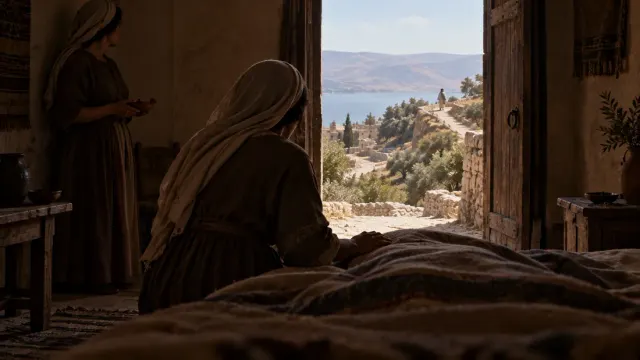
    There is water in the well and still no drinking. The obstacle is not an empty source but a covered entrance and an established routine: the flocks gather, the stone is rolled away, the animals drink, and the stone returns. Genesis pauses to explain the arrangement because the arrangement makes Jacob's next action intelligible. The stone is not background scenery. It governs access.

    The well also gathers information. In the following exchange, Jacob learns that the shepherds come from Haran, know Laban, and can identify Rachel as she approaches. A traveler looking for relatives has reached a place where work brings the neighborhood together. Water and human connection come from the same stop. Nothing in these verses specifies the stone's weight, the well's depth, or a written law regulating its use. The visible facts are enough: several flocks, one shared source, and a practice observed together. The scene begins with an ordinary system already in motion.

    Verse by verse

    1. 29:2

      This well is associated with the Haran district in 29:4. It is not the Samaritan well of John 4.

    2. 29:3

      The verse describes the recurring procedure; 29:8 explains that the shepherds wait for all the flocks to gather.

    Genesis 29:2-3

    King James Version · 2 verses

    29:2And he looked, and behold a well in the field, and, lo, there were three flocks of sheep lying by it; for out of that well they watered the flocks: and a great stone was upon the well’s mouth.

    29:3And thither were all the flocks gathered: and they rolled the stone from the well’s mouth, and watered the sheep, and put the stone again upon the well’s mouth in his place.

    Genesis 29:2-3: A great stone upon the well’s mouth
  2. 02

    Genesis 29:10

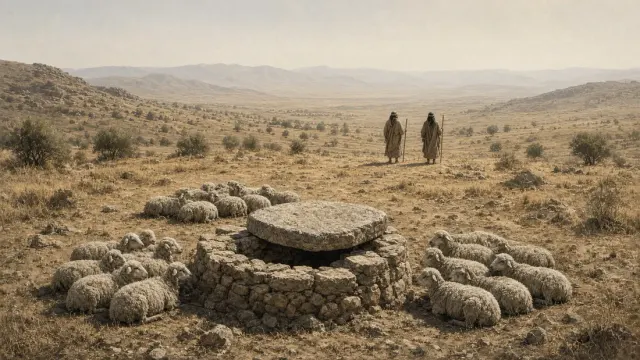
    He rolled the stone from the well’s mouth

    He does the work of a crowd on his own the moment Rachel appears. The text gives no comment and no explanation.

    Jacob has just asked the local shepherds where they come from, and he is already offering advice about their working day. The exchange in 29:7-8 gives this action its dry edge: the newcomer recommends watering the sheep and returning to pasture; the men explain the arrangement; then Rachel arrives and Jacob moves the stone himself. The advice has become manual labor.

    Yet the most insistent detail is not his strength. His mother's brother appears three times in this single verse. Rachel belongs to that household, the sheep belong to it, and the flock he waters belongs to it. The repetition places his action inside the family connection he has traveled to find. Genesis will explicitly name his love for Rachel in 29:18, but it does not attach a speech about romance to the stone. Here kinship and service fill the sentence. He has identified his mother's family and immediately put his hands to its work.

    Verse by verse

    1. 29:10

      His mother's brother is repeated three times, emphasizing Jacob's connection to Laban through Rebekah.

    2. 29:10

      Jacob moves the stone, but the text gives neither its weight nor a statement that the action is miraculous.

    Genesis 29:10

    King James Version · 1 verse

    29:10And it came to pass, when Jacob saw Rachel the daughter of Laban his mother’s brother, and the sheep of Laban his mother’s brother, that Jacob went near, and rolled the stone from the well’s mouth, and watered the flock of Laban his mother’s brother.

    Genesis 29:10: He rolled the stone from the well’s mouth
  3. 03

    Genesis 29:11-12

    He wept

    The kiss and the weeping come before the introduction. Twenty years of his life are decided at this well within a few verses.

    The man who has just shifted the stone now lifts his voice and cries. Genesis puts strength and tears next to each other without apologizing for either. It names the action plainly, but it does not identify a single cause for the weeping. Relief, homesickness, and love are possible readings, not quotations from Jacob's mind. The tears belong to the text; an exact emotional explanation does not.

    The next verse supplies the information that makes the greeting a family encounter: Jacob identifies himself through Rebekah. Calling himself her father's brother uses the wider language of kinship, not a claim that he and Laban share parents. Rachel runs to her father, just as Rebekah had run home after an earlier meeting at a well in Genesis 24:28. The well has become the threshold of a household. The striking movement is from physical effort to audible emotion to a name carried home. Jacob does not enter the family anonymously.

    Verse by verse

    1. 29:11

      Jacob's weeping is explicit; its precise cause is not specified.

    2. 29:12

      Rebekah is Laban's sister, so Jacob is Laban's nephew and Rachel's cousin.

    Genesis 29:11-12

    King James Version · 2 verses

    29:11And Jacob kissed Rachel, and lifted up his voice, and wept.

    29:12And Jacob told Rachel that he was her father’s brother, and that he was Rebekah’s son: and she ran and told her father.

    Genesis 29:11-12: He wept
  4. 04

    John 4:5-9

    Jesus therefore, being wearied, sat thus on the well

    John locates the well by the ground Jacob gave Joseph, notes the hour, and lets the request for a drink carry the scandal.

    This is not the well where Jacob met Rachel. That encounter belonged to the Haran district; John locates this well near Sychar in Samaria. The connection is Jacob's name and legacy, not one hole in the ground surviving a move between countries. Keeping the wells distinct allows the new encounter to retain its own setting.

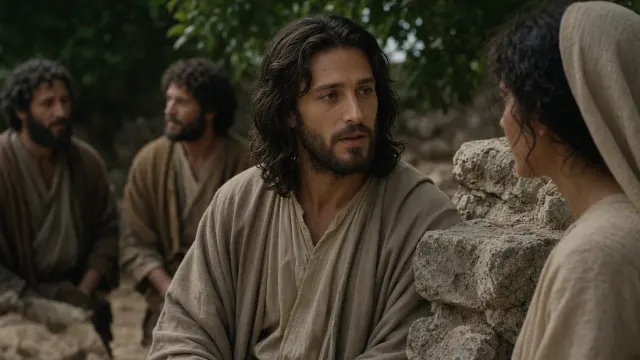
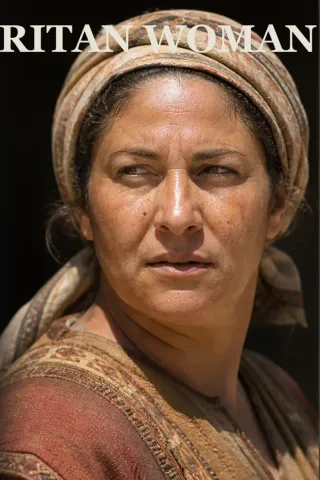
    Jesus sits because he is wearied. The Gospel of John does not treat that bodily detail as an embarrassment to be explained away. The request for water comes from a real journey and meets a woman engaged in a real task. Her answer identifies the social surprise: a Jewish man is asking a Samaritan woman for a drink. The exchange begins with a request, not a public denunciation of her life. Neither her name nor a reason for her arrival at the sixth hour is supplied. The opening gives enough to establish thirst, distance between communities, and a conversation crossing that distance. It does not supply a biography of disgrace.

    Verse by verse

    1. 4:6

      The sixth hour is stated, but the text does not say that the woman came then to avoid other women.

    2. 4:8-9

      Meat means food here. The disciples' purchase in a Samaritan city shows that no dealings cannot mean the absence of every kind of contact.

    John 4:5-9

    King James Version · 5 verses

    4:5Then cometh he to a city of Samaria, which is called Sychar, near to the parcel of ground that Jacob gave to his son Joseph.

    4:6Now Jacob’s well was there. Jesus therefore, being wearied with his journey, sat thus on the well: and it was about the sixth hour.

    4:7There cometh a woman of Samaria to draw water: Jesus saith unto her, Give me to drink.

    4:8(For his disciples were gone away unto the city to buy meat.)

    4:9Then saith the woman of Samaria unto him, How is it that thou, being a Jew, askest drink of me, which am a woman of Samaria? for the Jews have no dealings with the Samaritans.

    John 4:5-9: Jesus therefore, being wearied, sat thus on the well
  5. 05

    John 4:13-15

    A well of water springing up

    The offer is of water that ends the coming back. She asks for it in practical terms and the practical request is not corrected.


    The contrast is not between bad water and good water. Jacob's well has done precisely what a well can do: provide water that must be drawn again. Jesus does not disparage that gift. He names its limit and then describes a different kind of source, one that will be in the recipient rather than at a fixed location outside the town.

    Springing up makes the difference physical enough to picture. This is not a larger jar, a deeper shaft, or a way to shorten the queue. The promise concerns everlasting life. The woman's response remains attached to the work immediately before her: an end to thirst and to repeated journeys for water. The two meanings meet in the same conversation without yet becoming the same understanding. John later connects living water with the Spirit in 7:37-39, giving the image a further scriptural explanation. Here the remarkable claim is already plain. Jesus offers not another trip to the source, but a source within.

    Verse by verse

    1. 4:14

      Everlasting life identifies the promise's scope; the verse is not a claim that ordinary bodily hydration becomes unnecessary.

    2. 4:15

      The woman explicitly links the requested water to avoiding further trips to draw. The verse does not label that response contemptuous.

    John 4:13-15

    King James Version · 3 verses

    4:13Jesus answered and said unto her, Whosoever drinketh of this water shall thirst again:

    4:14But whosoever drinketh of the water that I shall give him shall never thirst; but the water that I shall give him shall be in him a well of water springing up into everlasting life.

    4:15The woman saith unto him, Sir, give me this water, that I thirst not, neither come hither to draw.

    John 4:13-15: A well of water springing up

Why it matters

Two thousand years later a well near Sychar, which John says was Jacob’s well and the parcel of ground Jacob gave to his son Joseph, is where a tired man sits down at noon and asks a Samaritan woman for a drink. The object is the same kind of thing in both scenes: a fixed point in the ground that people have to come to, where a stranger and a local end up talking longer than either intended. The second conversation turns on water that would make the well unnecessary.

3 songs

The music

Every song in the catalogue whose passage falls inside these chapters.

  1. Genesis 29:1-31:55

    Twenty Years in Haran

  2. John 4:1-42

    Living Water

  3. John 4:1-42

    The Water That I Shall Give

    Play here
    Open song pageRead lyrics

Nearby

All the objects

Report an error on this page