New · FreePlay The Witnesses The in-depth puzzle battle quest through Bible history

Places of the Bible

Bethel

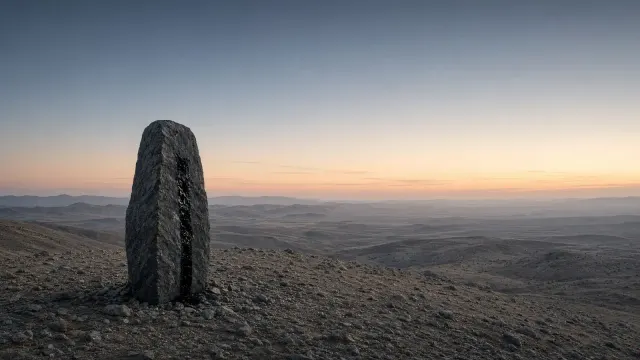
A man sleeping on a stone in open country woke up and said God was here and he had not known it.

Also called Luz, before Jacob renamed it

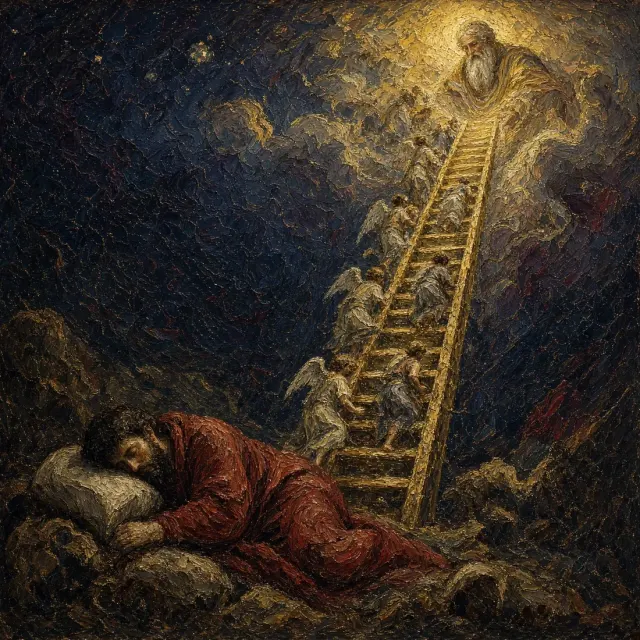
It is a place before it is a name. Jacob is running from his brother with nothing, lights on a certain place because the sun is set, takes of the stones of that place for a pillow, and lies down. The dream is a ladder set up on the earth with its top reaching to heaven, and the angels of God ascending and descending on it, and the LORD standing above it repeating to him the promise made to Abraham and Isaac.

Where it appearsGenesis 28 · Genesis 35

Scroll down to the account
Bethel

The movements, in the order the text gives them.

The Account of Bethel

  1. 01

    Genesis 28:10-12

    He lighted upon a certain place

    Nothing marks it out. He stops because the sun set, not because the place was known, and the stone is a pillow before it is an altar.

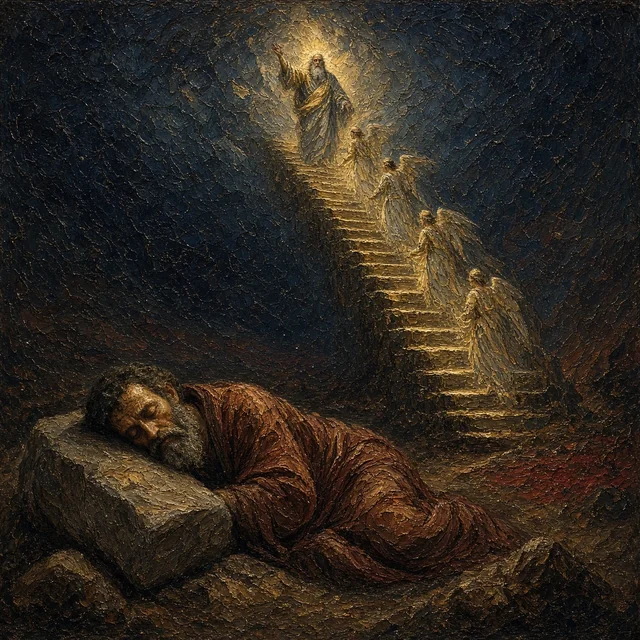
    Jacob does not climb the ladder. That is the first detail worth rescuing from familiar pictures of this passage. He is asleep on the ground while the angels move between earth and heaven. The connection is already there; Jacob neither builds it nor negotiates access to it. His contribution to the evening is finding somewhere to put his head.

    The place has not been chosen because Jacob knows it is holy. The sun has set, and the journey has to stop. The Book of Genesis gives the halt an ordinary reason before giving the place an extraordinary significance. Even the stone belongs to that contrast: hard ground, improvised bedding, and an opening into heaven.

    There is a striking echo of Babel in the top reaching to heaven. There, people organized a building project to establish their name. Here, a man far from home discovers a connection he did not construct. The Gospel of John later returns to this exact movement of angels ascending and descending, but Jesus places it upon the Son of man rather than upon a ladder (John 1:51). The image is not left standing in an isolated dream. Scripture gives it somewhere else to lead.

    Verse by verse

    1. 28:11

      Lighted upon means came upon or arrived at. It does not describe the place becoming illuminated.

    2. 28:12

      The angels are said to ascend before they descend. The order places activity between earth and heaven before Jacob receives any instruction.

    3. 28:12

      John 1:51 explicitly reuses the ascending and descending angels, locating their movement upon the Son of man.
    Genesis 28:10-12

    King James Version · 3 verses

    28:10And Jacob went out from Beer-sheba, and went toward Haran.

    28:11And he lighted upon a certain place, and tarried there all night, because the sun was set; and he took of the stones of that place, and put them for his pillows, and lay down in that place to sleep.

    28:12And he dreamed, and behold a ladder set up on the earth, and the top of it reached to heaven: and behold the angels of God ascending and descending on it.

    Genesis 28:10-12: He lighted upon a certain place
  2. 02

    Genesis 28:13-15

    I am with thee, and will keep thee

    The promise given to Abraham is repeated over a man with nothing, running away, with a clause added about coming back.

    The land beneath Jacob's head is promised to him while he is on his way out of it. That timing matters. Departure does not cancel the promise, and distance will not put him beyond the reach of the God speaking here. The passage joins a particular piece of ground to companionship in all places whither thou goest.

    The language is unmistakably Abraham's: land, descendants beyond counting, and blessing reaching all the families of the earth. Earlier in this chapter, Isaac deliberately gave Jacob the blessing of Abraham. Now the promise comes directly from the God of Abraham and Isaac. No borrowed clothes are involved in this exchange. Jacob receives it under his own name and in his own circumstances.

    Then the immense promise becomes intensely local. I am with thee. I will keep thee. I will bring thee again. The repetition gives the journey a beginning, an accompaniment, and a promised return. Nothing here says that the years away will be easy; the chapters about Laban will be quite specific about that. But the promise is not confined to the place where it was spoken. The land is fixed. God's presence is not.

    Verse by verse

    1. 28:13

      Abraham thy father uses father in the broader ancestral sense. Abraham is Jacob's grandfather.

    2. 28:13

      The Hebrew expression rendered above it can also be understood as beside him. The precise position is disputed; the divine promise is not.

    3. 28:14

      The dust and the four directions repeat the language of the land promise to Abram in Genesis 13:14-16.

    4. 28:15

      Keeping Jacob does not mean keeping him in Canaan. Protection is promised throughout the journey and the return.

    Genesis 28:13-15

    King James Version · 3 verses

    28:13And, behold, the LORD stood above it, and said, I am the LORD God of Abraham thy father, and the God of Isaac: the land whereon thou liest, to thee will I give it, and to thy seed;

    28:14And thy seed shall be as the dust of the earth, and thou shalt spread abroad to the west, and to the east, and to the north, and to the south: and in thee and in thy seed shall all the families of the earth be blessed.

    28:15And, behold, I am with thee, and will keep thee in all places whither thou goest, and will bring thee again into this land; for I will not leave thee, until I have done that which I have spoken to thee of.

    Genesis 28:13-15: I am with thee, and will keep thee
  3. 03

    Genesis 28:16-19

    Surely the LORD is in this place

    He wakes afraid, not comforted. This is none other but the house of God, and this is the gate of heaven.

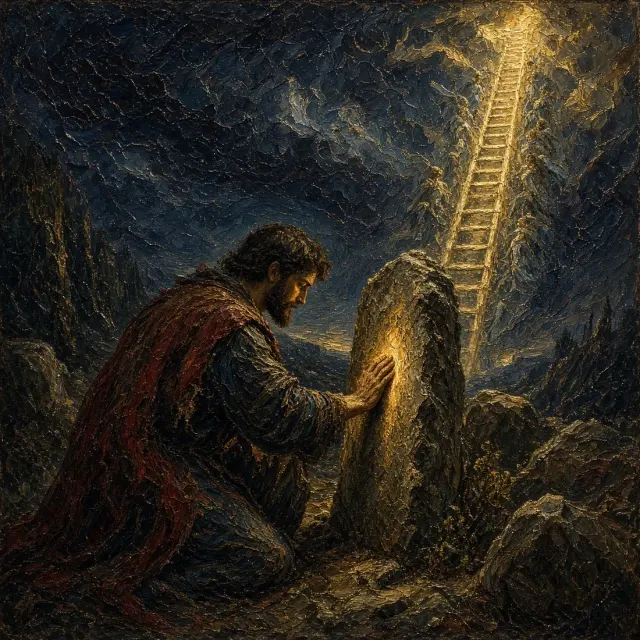
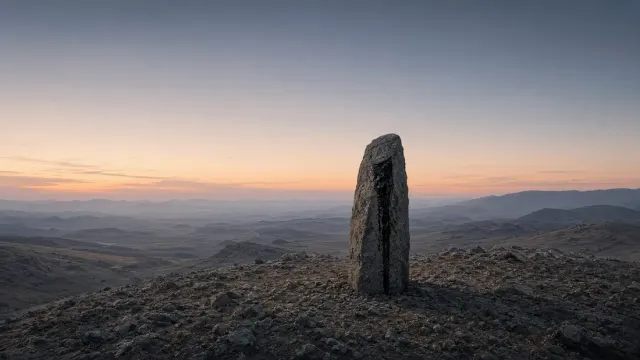
    The stone changes jobs overnight. What supported Jacob's head becomes a standing marker, with oil poured over its top. The material has not become more impressive. Its significance has changed because of what happened beside it. The passage describes the marking of an encounter, not the discovery of a god inside a rock.

    Jacob's words are wonderfully exact: I knew it not. He does not say that the LORD has only just arrived. The deficiency was in Jacob's knowledge, and the dream has exposed it. His fear follows recognition. Dreadful here belongs to awe before divine presence, not to a verdict that the location is evil or unpleasant.

    House of God is a remarkable name for a place where the only accommodation mentioned is a stone. No building has been erected, and no priest has admitted him through a door. The gate of heaven names the access shown in the dream, not an architectural feature Jacob has found in the landscape. Luz receives another name because the place now carries a remembered disclosure. Bethel begins with a man discovering that an ordinary stopping place was not ordinary at all.

    Verse by verse

    1. 28:16

      I knew it not distinguishes the presence of the LORD from Jacob's awareness of that presence.

    2. 28:17

      Dreadful in this context means awe-inspiring or fearsome. It does not carry only the modern conversational sense of very bad.

    3. 28:19

      Bethel means house of God. Luz is identified as the earlier name of the city associated with the location.

    Genesis 28:16-19

    King James Version · 4 verses

    28:16And Jacob awaked out of his sleep, and he said, Surely the LORD is in this place; and I knew it not.

    28:17And he was afraid, and said, How dreadful is this place! this is none other but the house of God, and this is the gate of heaven.

    28:18And Jacob rose up early in the morning, and took the stone that he had put for his pillows, and set it up for a pillar, and poured oil upon the top of it.

    28:19And he called the name of that place Beth-el: but the name of that city was called Luz at the first.

    Genesis 28:16-19: Surely the LORD is in this place
  4. 04

    Genesis 28:20-22

    If God will be with me

    The vow is conditional and specific, down to bread to eat and raiment to put on, and it ends with a tenth.

    After descendants filling the earth comes a request for something to wear. The change of scale is almost startling: God's speech reaches every direction, while Jacob's vow mentions bread, clothing, and getting home in peace. Those are not imaginary needs inserted to soften the account. They are the things Jacob actually names.

    The opening if has kept interpreters occupied for centuries. Some hear a bargain from a man not yet ready to trust without conditions; others hear the ordinary conditional form of a vow, acknowledging what God has promised and stating the response. The grammar contains a condition. It does not, by itself, supply a diagnosis of Jacob's motives. The sequence is firmer ground: God has already spoken before Jacob offers anything.

    That order keeps the tenth in its proper place. It is promised from what God will give, not presented as the fee that persuaded God to appear. The vow also moves from the God of Abraham and Isaac to my God. The family relationship is becoming a declared personal allegiance. Its geography remains painfully specific: not merely back to Canaan, but to my father's house in peace. The man who left a divided household names the homecoming he seeks.

    Verse by verse

    1. 28:20

      The Hebrew im normally introduces an if-clause. Whether this vow expresses bargaining or commitment in customary vow language remains an interpretive question.

    2. 28:21

      My God changes the wording from inherited ancestry to Jacob's own declared relationship with the LORD.

    3. 28:22

      The passage does not identify a recipient who will receive the tenth on God's behalf, or describe its actual delivery.

    Genesis 28:20-22

    King James Version · 3 verses

    28:20And Jacob vowed a vow, saying, If God will be with me, and will keep me in this way that I go, and will give me bread to eat, and raiment to put on,

    28:21So that I come again to my father’s house in peace; then shall the LORD be my God:

    28:22And this stone, which I have set for a pillar, shall be God’s house: and of all that thou shalt give me I will surely give the tenth unto thee.

    Genesis 28:20-22: If God will be with me
  5. 05

    Genesis 35:1-7

    Put away the strange gods

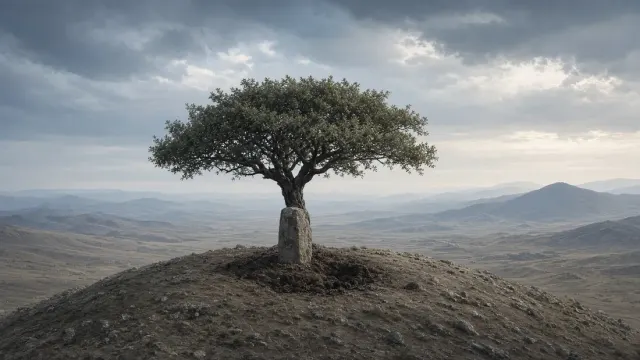
    Told to return and build the altar, he cleans the household out first. Earrings and idols go under the oak that is by Shechem.

    The return to Bethel begins by leaving things behind. Foreign gods and earrings go under a tree at Shechem before the household takes the road. Jacob is not simply revisiting a memorable campsite. He is preparing a household to approach the God who met him there, and that household has objects it cannot carry into this encounter unchanged.

    His explanation looks backward with unusual precision. The God who promised to be with him has been with him in the way which I went. Years of travel and service are gathered into that phrase. Bethel matters because of the God encountered there, not because divine presence stopped at its boundary. The altar's name makes the distinction explicit: Elbethel, the God of Bethel.

    There is also a hard shadow over the journey. The sons have just carried out the massacre at Shechem, and the surrounding cities do not pursue because the terror of God falls upon them. Protection here is not an endorsement of what the sons have done; Jacob will condemn their violence in Genesis 49. The household reaches the appointed place under protection, not under a declaration of innocence. The return brings the promise back into view without pretending the intervening years were clean.

    Verse by verse

    1. 35:2

      Changing garments and becoming clean belong to preparation for the encounter. The text does not reduce the required change to clothing alone.

    2. 35:4

      The foreign gods and earrings are surrendered together. Their individual owners and the origin of each object are not supplied.

    3. 35:5

      The stated reason the cities do not pursue is the terror of God, not a newly described military advantage.

    4. 35:7

      Elbethel means God of Bethel, or God of the house of God. The altar's name directs attention to the God of the place.

    Genesis 35:1-7

    King James Version · 7 verses

    35:1And God said unto Jacob, Arise, go up to Beth-el, and dwell there: and make there an altar unto God, that appeared unto thee when thou fleddest from the face of Esau thy brother.

    35:2Then Jacob said unto his household, and to all that were with him, Put away the strange gods that are among you, and be clean, and change your garments:

    35:3And let us arise, and go up to Beth-el; and I will make there an altar unto God, who answered me in the day of my distress, and was with me in the way which I went.

    35:4And they gave unto Jacob all the strange gods which were in their hand, and all their earrings which were in their ears; and Jacob hid them under the oak which was by Shechem.

    35:5And they journeyed: and the terror of God was upon the cities that were round about them, and they did not pursue after the sons of Jacob.

    35:6So Jacob came to Luz, which is in the land of Canaan, that is, Beth-el, he and all the people that were with him.

    35:7And he built there an altar, and called the place El-beth-el: because there God appeared unto him, when he fled from the face of his brother.

    Genesis 35:1-7: Put away the strange gods

Why it matters

What he does on waking is the reason the place has a sheet. He is afraid, says surely the LORD is in this place and I knew it not, sets up the stone he slept on as a pillar, pours oil on it, and calls the name of that place Bethel, the house of God. Then he makes a vow with conditions in it. Twenty years later he is told to go back and dwell there, and he arrives with a household that has to bury its foreign gods under an oak first.

3 songs

The music

Every song in the catalogue whose passage falls inside these chapters.

  1. Genesis 28:10-22

    A Ladder in the Night

  2. Genesis 28:10-22

    Jacob's Ladder

  3. Genesis 28:10-22

    The Gate of Heaven

Nearby

All the places

Report an error on this page