
Exodus 3:1–4:17
The burning bush

Ages 8 to 11
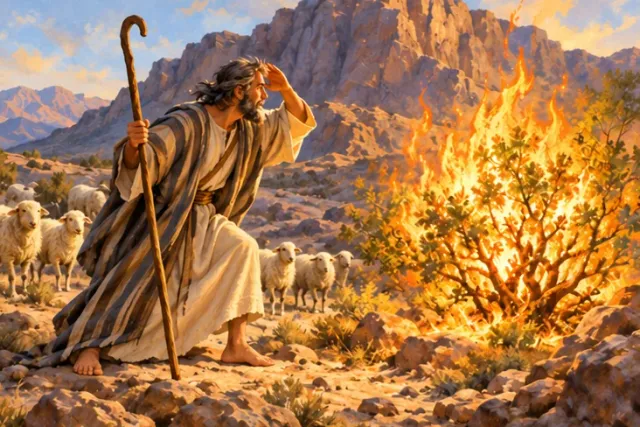
The account
Moses was caring for the flock of Jethro, his father in law, the priest of Midian. He led the flock to Horeb, the mountain of God. There the angel of the Lord appeared to him in a flame of fire from inside a bush. The bush burned, but it was not used up by the fire.
Moses turned aside to look. God called to him from the bush, and Moses answered. God told him not to come closer and to take off his shoes because the ground was holy. God said that he was the God of Abraham, Isaac and Jacob. Moses hid his face because he was afraid to look upon God.
God told Moses that he had seen the suffering of his people in Egypt and had heard their cry. He would deliver them and send Moses to Pharaoh. Moses asked why he should be the one to go. God promised to be with him.
Moses also asked what name he should give the people. God identified himself as I Am That I Am and told Moses what to say.
When Moses worried that the people would not believe him, God gave signs. Moses’ rod became a serpent and then a rod again. His hand changed and was restored. God also told him about water becoming blood.
Moses said he was slow of speech. God promised to teach him what to say. When Moses still asked for someone else, God appointed Aaron to speak for him before the people.
Memory verse
Now therefore go, and I will be with thy mouth, and teach thee what thou shalt say.
Exodus 4:12
Talk about it
- What was unusual about the bush Moses saw?
- What did God say he had seen and heard about his people in Egypt?
- What signs did God give Moses when Moses worried that the people would not believe him?
Try this
Fold a sheet of paper into three parts and label them “What Moses saw,” “What God said,” and “What Moses did.” Draw or write one or two things from the account in each part, then compare the sections to see how the events fit together.
What can we learn?
A lesson we can draw is that being unsure does not mean we have to pretend to be confident. Moses brought his questions and objections to God, and the account shows God answering him and providing help.
Ages 12 to 15
The account
Moses was keeping the flock of Jethro, his father in law, the priest of Midian. He led the flock to the back of the desert and came to Horeb, the mountain of God. The angel of the Lord appeared to him in a flame of fire from the middle of a bush. Moses saw that the bush was burning but was not consumed, so he turned aside to see why.
When the Lord saw Moses turn aside, God called to him from the bush. Moses answered, and God told him not to come nearer. He was to remove his shoes because the place was holy ground. God identified himself as the God of Moses’ father, the God of Abraham, Isaac and Jacob. Moses hid his face because he was afraid to look upon God.
God said that he had seen the affliction of his people in Egypt, heard their cry because of their taskmasters, and knew their sorrows. He had come down to deliver them and bring them to a good and large land. He told Moses to go to Pharaoh and bring the children of Israel out of Egypt. This mattered because the Israelites were living under oppression, and God was telling Moses that he had seen what was happening to them and would act.
Moses asked who he was to go to Pharaoh. God promised to be with him and said that after the people came out of Egypt, they would serve God on that mountain. Moses then asked what he should say if Israel asked for God’s name. God identified himself as I Am That I Am and told Moses to gather Israel’s elders. God said the elders would listen, but the king of Egypt would not let the people go at first. God would stretch out his hand and perform wonders, and afterward the king would let them go. God also said Israel would not leave empty-handed.
Moses still worried that the people would not believe that the Lord had appeared to him. God gave signs. Moses’ rod became a serpent and then became a rod again when he took it by the tail. Moses’ hand became leprous as snow and was then restored. God also said that water taken from the river and poured on dry land could become blood.
Moses objected that he was not eloquent and was slow of speech. God reminded him that he made man’s mouth and promised to be with Moses’ mouth and teach him what to say. Moses still asked God to send someone else. The Lord was angry with Moses, but he appointed Aaron the Levite, Moses’ brother, to speak. God said he would teach both of them what to do, and Moses was to take the rod with him for the signs.
Memory verse
Now therefore go, and I will be with thy mouth, and teach thee what thou shalt say.
Exodus 4:12
Think about it
- Why did God tell Moses not to come closer and to remove his shoes?
- What does God’s statement that he had seen Israel’s affliction and heard their cry show about God in this account?
- Why do you think Moses kept raising objections after God told him to go to Pharaoh?
- What do the signs and God’s promise to help Moses speak show about how God responded to Moses’ concerns?
Going deeper
God identifies himself as the God of Abraham, Isaac and Jacob, connecting Moses’ call with the promises made earlier in Genesis. He tells Moses that he will bring the children of Israel out of Egypt and into the land he names for them, so this moment points both backward to the patriarchs and forward to the deliverance that fills the next part of Exodus. God also says that after Moses brings the people out, they will serve God on that mountain, which points ahead to Israel gathering before God at the mountain later in Exodus.
What can we learn?
One lesson we can draw is that questions and limitations do not disappear just because a task matters. Moses repeatedly raised concerns, while the account shows God answering those concerns with his presence, signs, instruction and the help of Aaron.