
Genesis 2:4–3:24
Adam and Eve, and leaving Eden
Ages 8 to 11
The account
God formed a man from the dust of the ground and breathed life into him. God planted a garden in Eden and put the man there to care for it. Many trees grew there. Two special trees were the tree of life and the tree of the knowledge of good and evil.
God told the man he could eat from the trees of the garden, except from the tree of the knowledge of good and evil. God said it was not good for the man to be alone. He brought animals to Adam to name, and then made a woman from one of Adam's ribs and brought her to him.
Later, the serpent spoke to the woman about God's command. The woman saw that the forbidden fruit looked good, took it, and ate. She gave some to her husband, and he ate too. The Bible says fruit, but it does not say what kind.
Afterward, Adam and his wife realized they were naked and made coverings from fig leaves. When they heard the LORD God in the garden, they hid. God questioned them. Adam blamed the woman, and the woman said the serpent had deceived her.
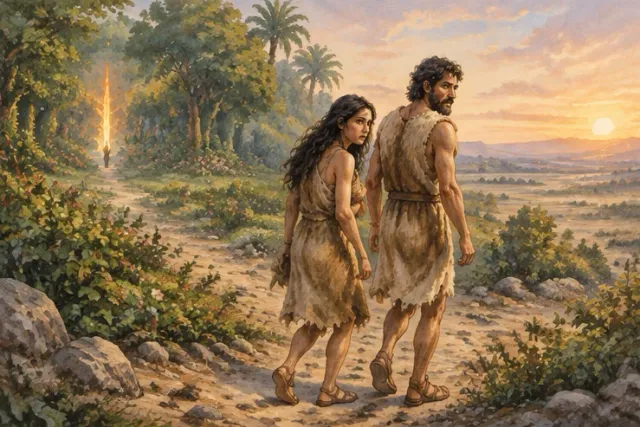
God pronounced a curse on the serpent. He told Adam and his wife that life would now include pain, hard work, and death. Adam called his wife Eve. God made clothing from skins for them. Then God sent Adam out of Eden to work the ground. Cherubims and a flaming sword guarded the way to the tree of life.
Memory verse
And the LORD God called unto Adam, and said unto him, Where art thou?
Genesis 3:9
Talk about it
- What job did God give Adam in the garden of Eden?
- What did the serpent say to the woman, and what did she and Adam do?
- What changed after Adam and Eve ate the fruit?
Try this
Fold a sheet of paper in half. On one side, draw or list things Genesis says were in Eden, such as trees, a river and animals. On the other side, draw or list things that appear after Adam and Eve ate the fruit, such as fig-leaf coverings, thorns, hard work and leaving the garden.
What can we learn?
One lesson we can draw from this account is that choices have consequences, and blaming someone else does not undo what we chose. It is wise to listen carefully to good instructions and be truthful about our own actions.
Ages 12 to 15
The account
Genesis first describes a world with no man to till the ground. God formed the man from the dust and breathed into him the breath of life. Then God planted a garden eastward in Eden and placed the man there. The garden had trees pleasant to the sight and good for food, including the tree of life and the tree of the knowledge of good and evil. A river watered Eden and divided into four branches named Pison, Gihon, Hiddekel and Euphrates. These details give the account a specific setting.
God put the man in the garden to dress it and keep it. He allowed him to eat from every tree except the tree of the knowledge of good and evil, warning that eating from it would bring death. That command gave Adam a clear boundary in the place where God had given him work and food.
God said it was not good for the man to be alone. He brought the animals and birds to Adam, who named them, but no suitable help was found for him. God caused Adam to sleep, took one of his ribs, made a woman, and brought her to the man. Genesis then speaks of a man and wife becoming one flesh.
The serpent, described as more subtil than any beast of the field, questioned the woman about God's command. The woman answered, but the serpent told her they would not surely die. She saw that the tree was good for food, pleasant to the eyes and desired for wisdom. She ate its fruit and gave some to her husband with her, and he ate. Genesis never names the kind of fruit.
Their eyes were opened. They knew they were naked, sewed fig leaves into coverings, and hid among the trees when they heard the LORD God in the garden. God called to Adam and questioned him. Adam pointed to the woman, and the woman said the serpent had deceived her.
God pronounced consequences on the serpent, the woman and Adam. The woman would face sorrow in childbirth, and God said her desire would be to her husband and he would rule over her. The ground was cursed for Adam's sake. He would eat through sorrow and hard labor among thorns and thistles until he returned to the dust from which he had been taken.
Adam named his wife Eve because she was the mother of all living. God made coats of skins and clothed them. Then God sent Adam from Eden to till the ground. Cherubims and a flaming sword were placed at the east of the garden to keep the way of the tree of life.
Memory verse
And the LORD God took the man, and put him into the garden of Eden to dress it and to keep it.
Genesis 2:15
Think about it
- Why did God's command about the tree matter before the serpent spoke to the woman?
- What do Adam and Eve's responses after eating the fruit show about how people may react when they know they have disobeyed?
- Why might Genesis include concrete details such as work, rivers, named trees and a guarded entrance?
- What do God's questions, his judgments, and his clothing of Adam and Eve show about how God responds in this account?
Going deeper
Later parts of the Bible return to Adam when explaining the entrance of sin and death into human life. Romans 5:12–19 contrasts Adam's disobedience with Christ's obedience, while 1 Corinthians 15:21–22 connects Adam with death and Christ with resurrection. Revelation 12:9 and 20:2 identify the ancient serpent with the Devil and Satan. These later passages make the events in Eden part of a larger pattern that continues through the Bible.
What can we learn?
This account gives a plain picture of how one choice can affect more than the moment in which it is made. It also shows people questioning a clear command and then shifting blame after disobeying it. One lesson we can draw is to take responsibility for our choices and to consider consequences before we act.