
Luke 2:1–7
Jesus is born

Ages 8 to 11
The account
Caesar Augustus made a decree that all the world should be taxed. People went to their own cities to be counted. Joseph left Nazareth in Galilee and went into Judaea, to Bethlehem, the city of David. He went there because he belonged to the house and family line of David. Mary, who was espoused to Joseph, went with him. She was expecting a child.
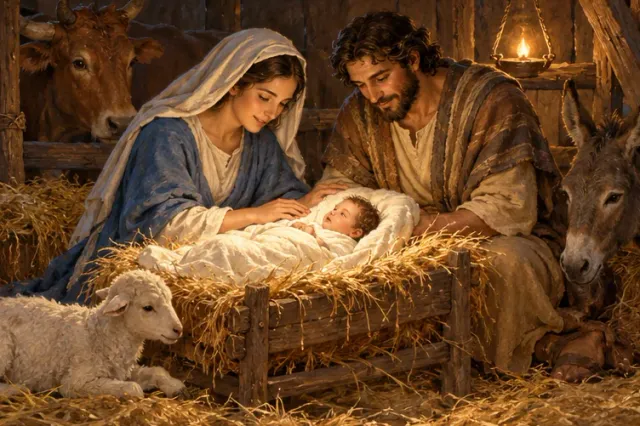
While they were in Bethlehem, the time came for Mary to give birth. She brought forth her firstborn son, Jesus. She wrapped him in swaddling clothes and laid him in a manger. Luke gives one simple reason for this unusual place to lay a newborn: there was no room for them in the inn.
The account is careful and simple. It does not give names for an innkeeper or describe animals standing nearby. It tells us that a decree had sent people to their own cities, that Joseph went to Bethlehem because of his family line, and that Mary gave birth while they were there.
Jesus did not begin life in the kind of place people might expect for someone important. His first bed was a manger. Luke 2:1–7 keeps the focus close on Mary, Joseph, Bethlehem, the birth, the swaddling clothes, and the place where Jesus was laid.
Memory verse
And she brought forth her firstborn son, and wrapped him in swaddling clothes, and laid him in a manger; because there was no room for them in the inn.
Luke 2:7
Talk about it
- Why did Joseph go to Bethlehem?
- What did Mary do after Jesus was born?
- Where was Jesus laid, and why?
Try this
Fold a sheet of paper into four boxes. Draw one simple picture in each box for Nazareth, the trip to Bethlehem, Jesus being born, and Jesus laid in the manger, then number the boxes in order.
What can we learn?
A lesson we can draw from this account is that important things do not always begin in impressive places. It can also help us pay attention to what the Bible actually says instead of adding familiar details that are not in the passage.
Ages 12 to 15
The account
Luke begins this account with a decision made by Caesar Augustus. He issued a decree that all the world should be taxed. Luke also notes that this taxing was first made when Cyrenius was governor of Syria. People went to their own cities, and that public order affected Joseph and Mary directly.
Joseph traveled from Nazareth in Galilee into Judaea, to Bethlehem, which Luke calls the city of David. Joseph went because he was of the house and lineage of David. Mary, his espoused wife, traveled with him while she was expecting a child. Luke does not tell us how long the journey took or describe the road. He does tell us exactly why Joseph went to Bethlehem. The family connection to David is not a decorative detail. It explains the destination and places the birth in David's own city of Bethlehem itself.
While Joseph and Mary were there, the time came for Mary to give birth. She brought forth her firstborn son, wrapped him in swaddling clothes, and laid him in a manger. Luke says there was no room for them in the inn. He does not add the many details that later customs and pictures often supply. He does not name an innkeeper, list animals, or describe the building. The account stays with the details it gives.
That simplicity makes the contrast stand out. Caesar Augustus is introduced with the power to issue a decree across the world under his rule, yet the child at the center of the account is born without a royal setting. Joseph's connection to David brings the family to Bethlehem, but the newborn is laid in a manger rather than a palace or grand house.
For the people in the account, the decree meant travel and registration. Within the account, the names Nazareth, Bethlehem, David, and the circumstances of the birth locate Jesus in a real family line and place. The passage does not ask the reader to fill in the missing scenery. Its few details are enough to show where Jesus was born, who was there, and how quietly his birth began.
Memory verse
And she brought forth her firstborn son, and wrapped him in swaddling clothes, and laid him in a manger; because there was no room for them in the inn.
Luke 2:7
Think about it
- Why does Luke mention Caesar Augustus and the taxing at the beginning of the account?
- What does Joseph's connection to David explain about the trip to Bethlehem?
- Why is it useful to notice which familiar Christmas details are not actually stated in Luke 2:1–7?
- What does the contrast between Caesar's public power and Jesus' quiet birth help you notice about the account?
Going deeper
Bethlehem and David connect this birth to earlier parts of the Bible. In 2 Samuel 7, God made promises concerning David's house and kingdom, and Micah 5:2 points to Bethlehem in connection with a coming ruler. Luke 2 places Jesus' birth in Bethlehem and identifies Joseph with David's line, details that become part of the wider Bible's presentation of Jesus as the promised Christ.
What can we learn?
A lesson we can draw is that the Bible often makes its point through precise, ordinary details rather than extra decoration. This account also encourages careful reading: what Scripture says matters, and what it does not say should not be turned into fact.