
Genesis 6:9–9:17
Noah and the ark, and the rainbow promise
Ages 8 to 11
The account
Noah lived at a time when the earth was corrupt and filled with violence. The Bible says Noah was a just man who walked with God. He had three sons: Shem, Ham, and Japheth.
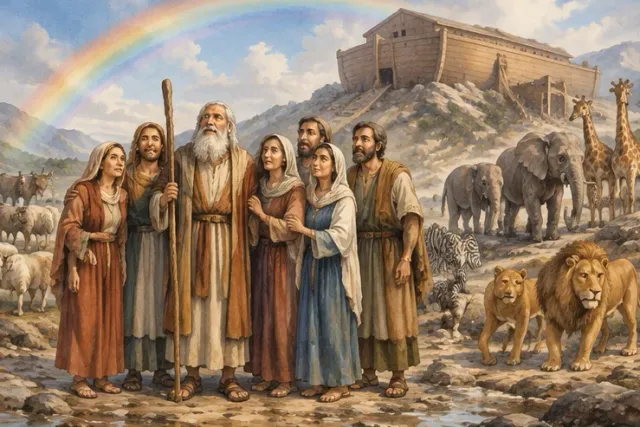
God told Noah that a flood was coming. He gave Noah careful instructions for an ark made of gopher wood, covered with pitch inside and outside. It was to have rooms, a door, a window, and three levels. God also told Noah to bring his wife, his sons, their wives, and living creatures into the ark. He gave special instructions about clean and unclean animals and birds. Noah did what God commanded.
Then the flood came. Rain fell for forty days and forty nights. The waters rose over the earth, and living creatures outside the ark died. The Lord shut Noah and the others inside the ark.
God remembered Noah and the animals with him. The waters went down, and the ark rested on the mountains of Ararat. Noah sent out a raven and later a dove. One evening the dove returned with an olive leaf. Later it did not return.
When the earth was dry, God told Noah and his family to leave the ark. Noah built an altar. God blessed Noah and his sons and made a covenant with them and every living creature. He set his bow in the cloud, the rainbow, as the sign that floodwaters would never again destroy all flesh.
Memory verse
I do set my bow in the cloud, and it shall be for a token of a covenant between me and the earth.
Genesis 9:13
Talk about it
- What did God tell Noah to build?
- Who went into the ark with Noah?
- What sign did God set in the cloud after the flood?
Try this
Draw a six-box timeline with an ark, rain, a mountain, a dove with an olive leaf, dry ground, and a rainbow. Under each picture, write one thing Genesis says happened, then use your pictures to retell the account in order.
What can we learn?
One lesson we can draw is that doing what is right matters, even when the task is big. The rainbow can remind us of the covenant God made with Noah, his family, their descendants, and every living creature.
Ages 12 to 15
The account
Genesis introduces Noah in a world marked by corruption and violence. Noah is described as a just man, perfect in his generations, who walked with God. He had three sons, Shem, Ham, and Japheth. The passage does not name a city or country for this part of his life. Its setting is the whole earth as Genesis describes it, and the violence of the people matters because God announces that he will bring a flood that will destroy life on dry land.
God tells Noah to make an ark of gopher wood, coat it with pitch inside and out, and build rooms, a door, a window, and lower, second, and third levels. The ark is to be three hundred cubits long, fifty cubits wide, and thirty cubits high. God says he will establish his covenant with Noah and tells him to enter with his wife, his sons, and his sons' wives. Living creatures are also to come into the ark, and Noah is to gather food. Genesis later gives more specific instructions about clean and unclean animals and birds. Noah does what God commands.
Seven days before the flood, God tells Noah that rain will fall for forty days and forty nights. Noah, his family, and the animals enter, and the Lord shuts him in. The fountains of the great deep are broken up, the windows of heaven are opened, and the waters rise until even the high hills are covered. The living creatures on dry land outside the ark die. The waters prevail for one hundred and fifty days.
Then God remembers Noah and every living thing with him. A wind passes over the earth, the waters decrease, and the ark rests on the mountains of Ararat. As the land begins to appear, Noah sends out a raven and then a dove. The dove first returns because it finds no resting place. After another seven days it returns with an olive leaf. After seven more days Noah sends it out again, and it does not return.
When the earth is dry, God tells Noah, his family, and the animals to leave the ark and multiply on the earth. Noah builds an altar and offers burnt offerings from clean animals and birds. God blesses Noah and his sons. He then establishes his covenant with them, their descendants, and every living creature. Never again will floodwaters destroy all flesh. God sets his bow in the cloud, the rainbow, as the token of that covenant.
Memory verse
I do set my bow in the cloud, and it shall be for a token of a covenant between me and the earth.
Genesis 9:13
Think about it
- Why does Genesis connect the flood with the corruption and violence it describes?
- Why does Noah's repeated obedience matter in the account?
- What does God's covenant with Noah, his descendants, and every living creature show about the scope of the promise?
- Why do you think Genesis records the waters rising and falling, along with the raven, the dove, and the drying ground?
Going deeper
Elsewhere in the Bible, Noah becomes a reference point for both judgment and preservation. Isaiah 54:9 looks back to the waters of Noah when speaking of God's sworn commitment. Hebrews 11:7 remembers Noah preparing the ark by faith, while 1 Peter 3:20 recalls eight people preserved through the flood and 2 Peter 2:5 calls Noah a preacher of righteousness. These later passages treat the Genesis account as part of a wider pattern in which God judges evil, preserves life, and keeps his word.
What can we learn?
One lesson we can draw is that violence and corruption are serious, and that Noah's steady obedience matters throughout the account. We can also learn to remember promises carefully: Genesis presents the bow in the cloud as the sign of God's covenant with Noah, his descendants, and every living creature.