
Matthew 21:1–11
Palm Sunday

Ages 8 to 11
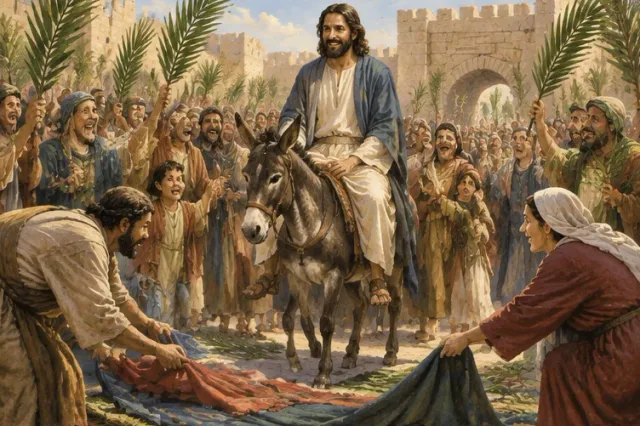
The account
Jesus and his disciples came near Jerusalem. When they reached Bethphage by the Mount of Olives, Jesus sent two disciples ahead. He told them they would find a donkey tied there, with her colt. They were to untie them and bring them to him. If anyone asked why, they were to say that the Lord had need of them.
This happened in keeping with words spoken by the prophet about a King coming meekly on a donkey. The disciples did what Jesus told them. They brought the animals and placed their clothes on them. Jesus then rode toward Jerusalem.
A very great crowd spread clothes on the road. Others cut branches from trees and spread them along the way. The people went before Jesus and followed behind him. They called out to the Son of David and praised the one who came in the name of the Lord.
When Jesus entered Jerusalem, the whole city was stirred. People asked who he was. The crowd answered that he was Jesus, the prophet from Nazareth of Galilee.
The account shows a busy entrance into Jerusalem. Jesus came as the King described by the prophet, but he came meekly. The crowd gave him a public welcome, and the city noticed.
Memory verse
And the multitude said, This is Jesus the prophet of Nazareth of Galilee.
Matthew 21:11
Talk about it
- What did Jesus tell the two disciples to bring to him?
- What did the crowd put on the road as Jesus came toward Jerusalem?
- What did the crowd say when people in the city asked who Jesus was?
Try this
Draw the road into Jerusalem and add the things Matthew says the people placed on it. Beside the picture, write three words that describe the welcome Jesus received.
What can we learn?
We can learn to pay attention to who Jesus is rather than only to the excitement around him. The account also shows that importance and gentleness can belong together.
Ages 12 to 15
The account
Jesus and his disciples were nearing Jerusalem. At Bethphage, near the Mount of Olives, Jesus sent two disciples into a village ahead of them. He said they would find a donkey tied there, with her colt. They were to loose the animals and bring them to him. If anyone questioned them, they were to say that the Lord had need of them, and the animals would be sent.
Matthew explains that this matched what had been spoken by the prophet: Zion's King would come meekly on a donkey. The disciples followed Jesus' instructions. They brought the animals, put their clothes on them, and Jesus rode toward the city.
Then the road itself became part of the welcome. A very great multitude spread clothes in the way. Others cut branches from trees and spread them along the road. Crowds moved ahead of Jesus and followed behind. They cried out to the Son of David, used the word Hosanna, and blessed the one coming in the name of the Lord. Their words gave Jesus a public, royal welcome.
When Jesus entered Jerusalem, the city was moved. People asked who he was. The multitude answered that he was Jesus, the prophet of Nazareth of Galilee.
The scene mattered because Jerusalem was Israel's central city, and Jesus' entrance drew attention from the people there. Matthew deliberately connects the moment with prophetic words about the coming King. At the same time, that King is described as meek. The account therefore places royal honor and humility side by side.
The crowd's actions also matter. They did more than watch Jesus pass. They spread clothing and branches on the road, went before him and followed him, and shouted words tied to hope and praise. Matthew does not say that everyone in Jerusalem understood Jesus in the same way. Instead, he records a city asking who this was and a multitude answering with what they knew: Jesus was the prophet from Nazareth of Galilee.
That question, who Jesus is, becomes especially important as Matthew's account continues into the final days before his crucifixion and resurrection.
Memory verse
And the multitude said, This is Jesus the prophet of Nazareth of Galilee.
Matthew 21:11
Think about it
- Why does Matthew connect Jesus' entrance with the words of a prophet?
- What do the crowd's actions and words show about how they were responding to Jesus?
- Why is it significant that the promised King is described as meek?
- What does the city's question about Jesus show about the different levels of understanding in the crowd?
Going deeper
Matthew connects this entrance with Zechariah 9:9, where Zion's King is described as coming meekly. The crowd's words also echo Psalm 118:26, and the title Son of David points back to the royal promises associated with David's line. Matthew brings those parts of Scripture together around Jesus' entrance into Jerusalem.
What can we learn?
Public excitement and clear understanding are not always the same thing. This account encourages careful attention to Jesus' identity, his humility, and what Scripture says about him.