
The big picture
A border town held by Syria, a neighbouring power, draws the attention of Ahab, king of northern Israel. Jehoshaphat, king of Judah, the southern kingdom, agrees to help but asks for God's word first. Many prophets promise success. Micaiah, another prophet called to the royal gathering, gives a different answer. The king must choose which voice to trust. His final battle is followed by brief accounts of the rulers who continue in both kingdoms.
In this chapter
- Many Prophets Promise Victory 1 Kings 22:1-12
After three years without war, Ahab proposes an attack on Ramoth-gilead, a town held by Syria.
- Micaiah Gives the Unwanted Answer 1 Kings 22:13-18
The messenger urges Micaiah to agree with the other prophets and speak well of the plan.
- A Vision Explains the False Promises 1 Kings 22:19-23
Micaiah describes God on his throne with the heavenly host around him.
- The Warning Brings Prison 1 Kings 22:24-28
Zedekiah strikes Micaiah on the cheek and challenges his claim to speak by God's Spirit.
- A Disguise Does Not Save Ahab 1 Kings 22:29-36
The two kings enter battle, but Ahab disguises himself while Jehoshaphat wears royal robes.
- The King's Blood Confirms the Warning 1 Kings 22:37-40
Ahab's body is taken to Samaria and buried.
- Jehoshaphat's Faithfulness and Limits 1 Kings 22:41-50
Jehoshaphat rules Judah for twenty-five years and follows the good course of Asa, his father.
- Ahaziah Continues His Parents' Worship 1 Kings 22:51-53
Ahaziah succeeds Ahab in Israel and reigns for two years from Samaria.
Central truth
Ahab rejects Micaiah's warning and dies in battle, while the divided kingdoms continue under rulers judged by their loyalty to God.

Scripture beside the summary
1 Kings · King James Version · 531 Kings 22:1-12
Many Prophets Promise Victory
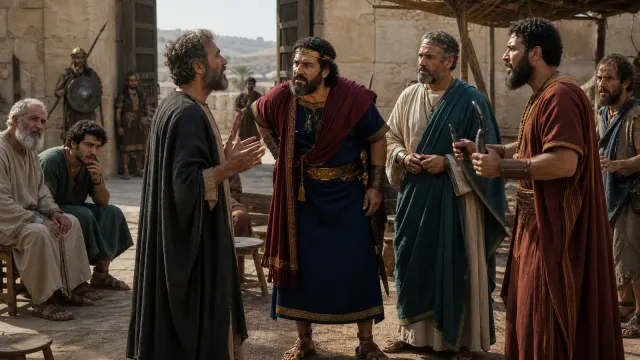
After three years without war, Ahab proposes an attack on Ramoth-gilead, a town held by Syria. Jehoshaphat offers Judah's help but asks that they first seek God's word. About four hundred prophets promise victory. Jehoshaphat asks for another prophet of God. Ahab names Micaiah but says he hates him because his messages are always bad for him. They send for him. Meanwhile Zedekiah, one of the gathered prophets, makes iron horns to act out the promised defeat of Syria. The crowd of prophets agrees.
In everyday life
A climbing expedition leader hears every team member approve a risky ascent. His visiting partner asks for the guide who has warned against it before. The leader resents that voice but sends for him while the others prepare equipment. Micaiah's message concerns God's word, not a climber's estimate of conditions.
Notice
1 Kings 22:8 Ahab judges Micaiah by whether his messages please him. The king's dislike appears before the prophet arrives, exposing the pressure surrounding this request for truth.
1 Kings 22:1-12
King James Version1And they continued three years without war between Syria and Israel.
2And it came to pass in the third year, that Jehoshaphat the king of Judah came down to the king of Israel.
3And the king of Israel said unto his servants, Know ye that Ramoth in Gilead is ours, and we be still, and take it not out of the hand of the king of Syria?
4And he said unto Jehoshaphat, Wilt thou go with me to battle to Ramoth-gilead? And Jehoshaphat said to the king of Israel, I am as thou art, my people as thy people, my horses as thy horses.
5And Jehoshaphat said unto the king of Israel, Enquire, I pray thee, at the word of the LORD to day.
6Then the king of Israel gathered the prophets together, about four hundred men, and said unto them, Shall I go against Ramoth-gilead to battle, or shall I forbear? And they said, Go up; for the Lord shall deliver it into the hand of the king.
7And Jehoshaphat said, Is there not here a prophet of the LORD besides, that we might enquire of him?
8And the king of Israel said unto Jehoshaphat, There is yet one man, Micaiah the son of Imlah, by whom we may enquire of the LORD: but I hate him; for he doth not prophesy good concerning me, but evil. And Jehoshaphat said, Let not the king say so.
9Then the king of Israel called an officer, and said, Hasten hither Micaiah the son of Imlah.
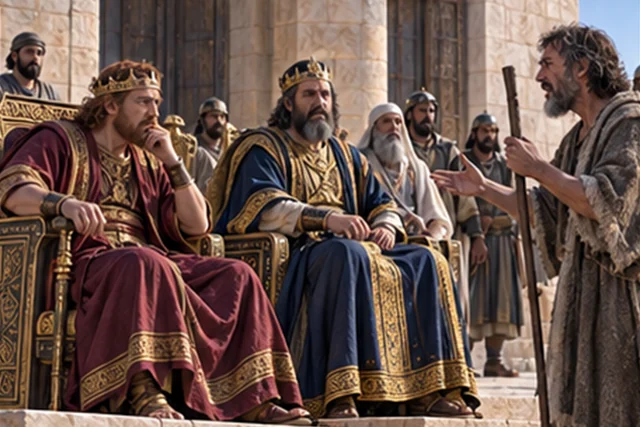
10And the king of Israel and Jehoshaphat the king of Judah sat each on his throne, having put on their robes, in a void place in the entrance of the gate of Samaria; and all the prophets prophesied before them.
11And Zedekiah the son of Chenaanah made him horns of iron: and he said, Thus saith the LORD, With these shalt thou push the Syrians, until thou have consumed them.
12And all the prophets prophesied so, saying, Go up to Ramoth-gilead, and prosper: for the LORD shall deliver it into the king’s hand.
1 Kings 22:13-18
Micaiah Gives the Unwanted Answer
The messenger urges Micaiah to agree with the other prophets and speak well of the plan. Micaiah replies that he will say only what God tells him. At first he echoes their promise of success. Ahab recognises that this is not his true answer and demands the truth. Micaiah then describes Israel scattered like sheep with no shepherd, each person sent home in peace. The missing shepherd points to the king's death. Ahab complains that this proves his expectation of bad news.
In everyday life
A ship's navigator is told to approve a departure because everyone else has agreed. He repeats their confident answer, then lays out the dangerous chart when the captain presses him for his real view. Agreement under pressure would hide the risk. Micaiah reports a vision from God, including the king's death.
Notice
1 Kings 22:17 The scattered people are allowed to return home in peace. The warning centres on the loss of their ruler, rather than saying every soldier will die.
1 Kings 22:13-18
King James Version13And the messenger that was gone to call Micaiah spake unto him, saying, Behold now, the words of the prophets declare good unto the king with one mouth: let thy word, I pray thee, be like the word of one of them, and speak that which is good.
14And Micaiah said, As the LORD liveth, what the LORD saith unto me, that will I speak.
15So he came to the king. And the king said unto him, Micaiah, shall we go against Ramoth-gilead to battle, or shall we forbear? And he answered him, Go, and prosper: for the LORD shall deliver it into the hand of the king.
16And the king said unto him, How many times shall I adjure thee that thou tell me nothing but that which is true in the name of the LORD?
17And he said, I saw all Israel scattered upon the hills, as sheep that have not a shepherd: and the LORD said, These have no master: let them return every man to his house in peace.
18And the king of Israel said unto Jehoshaphat, Did I not tell thee that he would prophesy no good concerning me, but evil?
1 Kings 22:19-23
A Vision Explains the False Promises
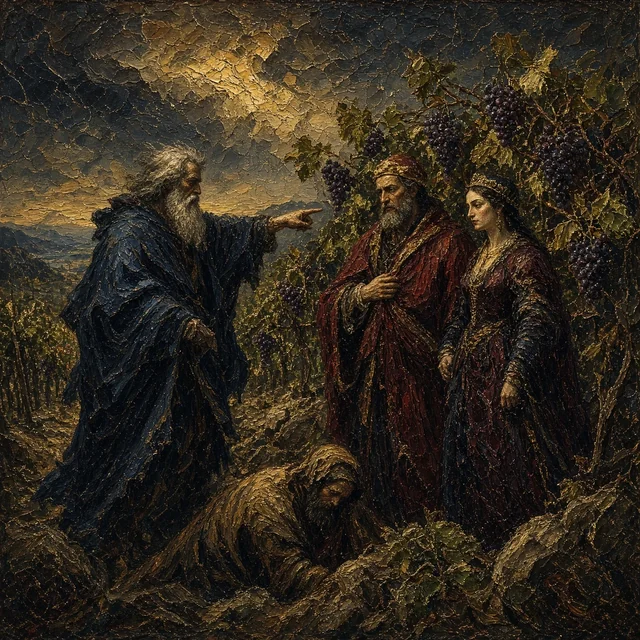
Micaiah describes God on his throne with the heavenly host around him. God asks who will entice Ahab into the battle where he will fall. A spirit offers to become a lying voice in the prophets' mouths. God permits the plan and says it will succeed. Micaiah tells Ahab that the promises he has heard belong to this deception. The vision presents even the false messages within God's judgment. Yet Ahab hears the deception exposed before he goes into battle.
In everyday life
A fraud examiner plays a recording that shows several glowing reports came from one dishonest source. The investor hears how the agreement was manufactured before signing the deal. He can no longer call the praise independent proof. Micaiah's vision places the deception under God's judgment, not only human fraud.
Notice
1 Kings 22:23 Micaiah openly names the deception while Ahab can still hear him. The king is told that the welcome message from his prophets is false.
1 Kings 22:19-23
King James Version19And he said, Hear thou therefore the word of the LORD: I saw the LORD sitting on his throne, and all the host of heaven standing by him on his right hand and on his left.
20And the LORD said, Who shall persuade Ahab, that he may go up and fall at Ramoth-gilead? And one said on this manner, and another said on that manner.
21And there came forth a spirit, and stood before the LORD, and said, I will persuade him.
22And the LORD said unto him, Wherewith? And he said, I will go forth, and I will be a lying spirit in the mouth of all his prophets. And he said, Thou shalt persuade him, and prevail also: go forth, and do so.
23Now therefore, behold, the LORD hath put a lying spirit in the mouth of all these thy prophets, and the LORD hath spoken evil concerning thee.
1 Kings 22:24-28
The Warning Brings Prison
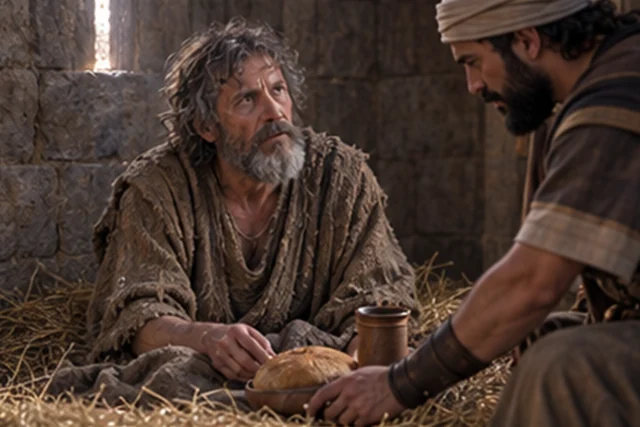
Zedekiah strikes Micaiah on the cheek and challenges his claim to speak by God's Spirit. Micaiah replies that events will expose the truth when Zedekiah hides in an inner room. Ahab orders Micaiah to prison on meagre bread and water until he returns safely. The prophet answers that a safe return would prove God had not spoken through him. He calls everyone to witness his words. The king can silence him for now, but the outcome will test the warning.
In everyday life
A chemical plant adviser is removed from a meeting after refusing to sign a reassuring report. She asks that her warning remain in the record before handing over her pass. Losing access does not change the fault she has identified. Micaiah is struck and imprisoned for declaring God's word.
Notice
1 Kings 22:28 Micaiah states a clear test for his own claim. If Ahab returns safely, the prophet says his message did not come from God.
1 Kings 22:24-28
King James Version24But Zedekiah the son of Chenaanah went near, and smote Micaiah on the cheek, and said, Which way went the Spirit of the LORD from me to speak unto thee?
25And Micaiah said, Behold, thou shalt see in that day, when thou shalt go into an inner chamber to hide thyself.
26And the king of Israel said, Take Micaiah, and carry him back unto Amon the governor of the city, and to Joash the king’s son;
27And say, Thus saith the king, Put this fellow in the prison, and feed him with bread of affliction and with water of affliction, until I come in peace.
28And Micaiah said, If thou return at all in peace, the LORD hath not spoken by me. And he said, Hearken, O people, every one of you.
1 Kings 22:29-36
A Disguise Does Not Save Ahab
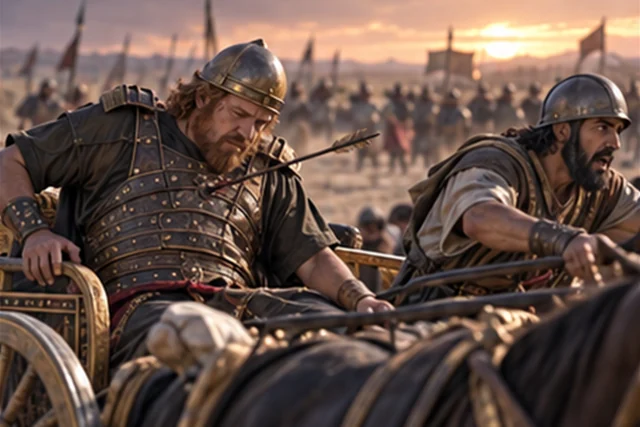
The two kings enter battle, but Ahab disguises himself while Jehoshaphat wears royal robes. Syria's chariot leaders have orders to target Israel's king. They first pursue Jehoshaphat, then turn away when they recognise their mistake. An archer shoots without selecting Ahab and hits a gap in his armour. Wounded, Ahab asks to be taken out, but remains propped in his chariot as fighting continues. He dies that evening. At sunset, an order sends the army home, matching the vision of people without a shepherd.

In everyday life
An alert escort studies a crowd after changing a threatened client's clothing and route. Every planned risk seems covered, yet an unrelated accident forces the convoy to stop. Precautions cannot control every event around them. Ahab's apparently chance wound fulfils a warning that God has already made known.
Notice
1 Kings 22:34 The archer does not knowingly choose the king, yet the shot finds a gap. Ahab's disguise cannot keep the announced outcome from reaching him.
1 Kings 22:29-36
King James Version29So the king of Israel and Jehoshaphat the king of Judah went up to Ramoth-gilead.
30And the king of Israel said unto Jehoshaphat, I will disguise myself, and enter into the battle; but put thou on thy robes. And the king of Israel disguised himself, and went into the battle.
31But the king of Syria commanded his thirty and two captains that had rule over his chariots, saying, Fight neither with small nor great, save only with the king of Israel.
32And it came to pass, when the captains of the chariots saw Jehoshaphat, that they said, Surely it is the king of Israel. And they turned aside to fight against him: and Jehoshaphat cried out.
33And it came to pass, when the captains of the chariots perceived that it was not the king of Israel, that they turned back from pursuing him.
34And a certain man drew a bow at a venture, and smote the king of Israel between the joints of the harness: wherefore he said unto the driver of his chariot, Turn thine hand, and carry me out of the host; for I am wounded.
35And the battle increased that day: and the king was stayed up in his chariot against the Syrians, and died at even: and the blood ran out of the wound into the midst of the chariot.
36And there went a proclamation throughout the host about the going down of the sun, saying, Every man to his city, and every man to his own country.
1 Kings 22:37-40
The King's Blood Confirms the Warning
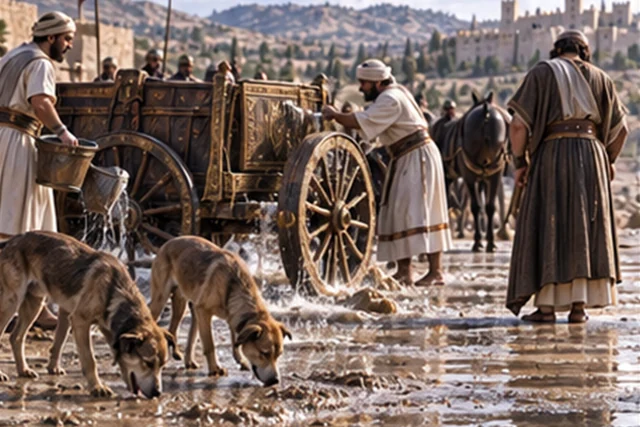
Ahab's body is taken to Samaria and buried. As his chariot is washed at the pool, dogs lick his blood. The account connects this with God's earlier word. His reign also included an ivory-decorated house and towns he built, and fuller records are named for those achievements. They do not replace the judgment attached to his death. His son Ahaziah takes the throne. The king leaves buildings and a successor, but the warning remains part of how his life is closed.
In everyday life
A conservator sorts a dead magnate's possessions for a public display and sets aside a document proving serious wrongdoing. Fine rooms and notable projects cannot make that record disappear. The display must hold both achievement and harm. Ahab's blood confirms a divine warning in a way no archive can reproduce.
Notice
1 Kings 22:38 The washing of a chariot becomes part of the warning's fulfilment. A routine task after the king's death carries meaning beyond cleaning battle equipment.
1 Kings 22:37-40
King James Version37So the king died, and was brought to Samaria; and they buried the king in Samaria.
38And one washed the chariot in the pool of Samaria; and the dogs licked up his blood; and they washed his armour; according unto the word of the LORD which he spake.
39Now the rest of the acts of Ahab, and all that he did, and the ivory house which he made, and all the cities that he built, are they not written in the book of the chronicles of the kings of Israel?
40So Ahab slept with his fathers; and Ahaziah his son reigned in his stead.
1 Kings 22:41-50
Jehoshaphat's Faithfulness and Limits
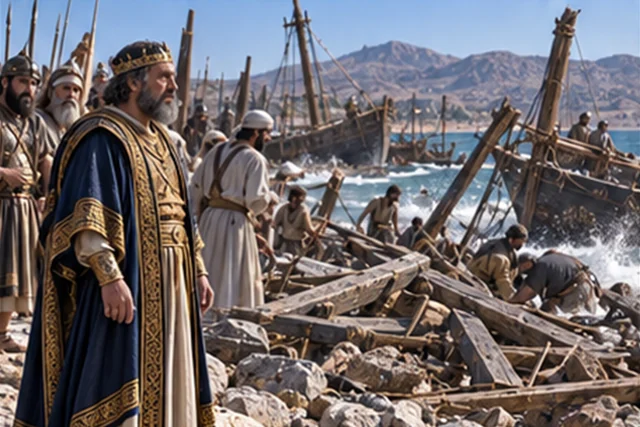
Jehoshaphat rules Judah for twenty-five years and follows the good course of Asa, his father. He does what God approves, though hilltop worship continues. He removes the remaining male shrine prostitutes and makes peace with Israel's king. He also builds ships to seek gold, but they break up at Ezion-geber, the port where they are based. He refuses Ahaziah's offer of crews. After his death, he is buried in the old royal district, and his son Jehoram succeeds him.
In everyday life
A harbour charity trustee reviews a year's honest work beside the wreck of its new launch. Sound service has not kept every plan from failure, and some older problems remain unresolved. She records both the progress and the loss. Jehoshaphat is assessed by faithfulness to God across an entire reign.
Notice
1 Kings 22:43 Jehoshaphat receives approval while the surviving hilltop worship is still named. The account can recognise a faithful direction without claiming every wrong has been removed.
1 Kings 22:41-50
King James Version41And Jehoshaphat the son of Asa began to reign over Judah in the fourth year of Ahab king of Israel.
42Jehoshaphat was thirty and five years old when he began to reign; and he reigned twenty and five years in Jerusalem. And his mother’s name was Azubah the daughter of Shilhi.
43And he walked in all the ways of Asa his father; he turned not aside from it, doing that which was right in the eyes of the LORD: nevertheless the high places were not taken away; for the people offered and burnt incense yet in the high places.
44And Jehoshaphat made peace with the king of Israel.
45Now the rest of the acts of Jehoshaphat, and his might that he shewed, and how he warred, are they not written in the book of the chronicles of the kings of Judah?
46And the remnant of the sodomites, which remained in the days of his father Asa, he took out of the land.
47There was then no king in Edom: a deputy was king.
48Jehoshaphat made ships of Tharshish to go to Ophir for gold: but they went not; for the ships were broken at Ezion-geber.
49Then said Ahaziah the son of Ahab unto Jehoshaphat, Let my servants go with thy servants in the ships. But Jehoshaphat would not.
50And Jehoshaphat slept with his fathers, and was buried with his fathers in the city of David his father: and Jehoram his son reigned in his stead.
1 Kings 22:51-53
Ahaziah Continues His Parents' Worship
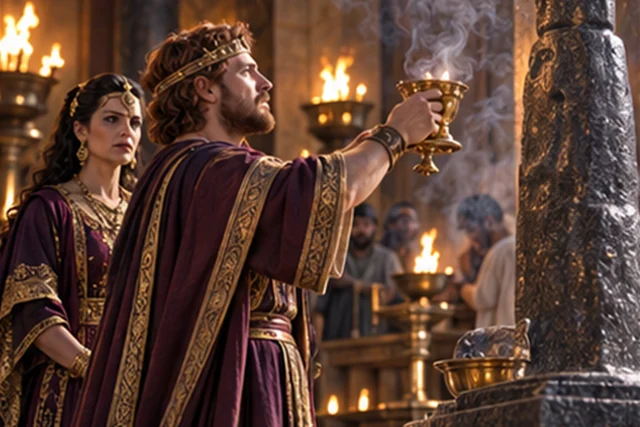
Ahaziah succeeds Ahab in Israel and reigns for two years from Samaria. He follows the ways of both his father and mother. He also repeats Jeroboam's sin, which had led the northern people away from God. He serves and worships Baal, continuing the practice Ahab promoted. The account says this provokes Israel's God to anger. The new king's name changes the royal record, but the worship that shaped his parents' reign continues under their son. Ahab's death has not brought a fresh course.
In everyday life
A bakery heir opens his father's locked recipe ledger and keeps the dishonest weight marks written beside each loaf. Customers see a new name above the door, but the hidden practice remains. Inheriting a trade has included inheriting its wrongs. Ahaziah's failure concerns worship of Baal and Israel's bond with God.
Notice
1 Kings 22:52 Both parents are named in the account of Ahaziah's conduct. His inherited pattern includes Jezebel's influence as well as the path set by Ahab.
1 Kings 22:51-53
King James Version51Ahaziah the son of Ahab began to reign over Israel in Samaria the seventeenth year of Jehoshaphat king of Judah, and reigned two years over Israel.
52And he did evil in the sight of the LORD, and walked in the way of his father, and in the way of his mother, and in the way of Jeroboam the son of Nebat, who made Israel to sin:
53For he served Baal, and worshipped him, and provoked to anger the LORD God of Israel, according to all that his father had done.
Details worth noticing
The opening image
1 Kings 22:1 begins with “And they continued three years without war between Syria and Israel.”
Where the chapter turns
1 Kings 22:27 forms a natural hinge: “And say, Thus saith the king, Put this fellow in the prison, and feed him with bread of affliction and with water of affliction, until I come in peace.”
The final note
1 Kings 22:53 leaves the reader with “For he served Baal, and worshipped him, and provoked to anger the LORD God of Israel, according to all that his father had done.”
A word trail through the chapter
The words king, Israel, LORD, Jehoshaphat, Micaiah, gilead help reveal the chapter’s repeated concerns.
KJV words made clear
- at a venture
- Without a particular target in mind, as with the archer's shot.
- adjure
- To charge someone solemnly to tell the truth.
Music and video connected to the passage
Related media appears when its Scripture reference overlaps this study. Music and video can illuminate a theme while the biblical text remains the foundation.