New · FreePlay The Witnesses The in-depth puzzle battle quest through Bible history

People of the Bible

Jezebel

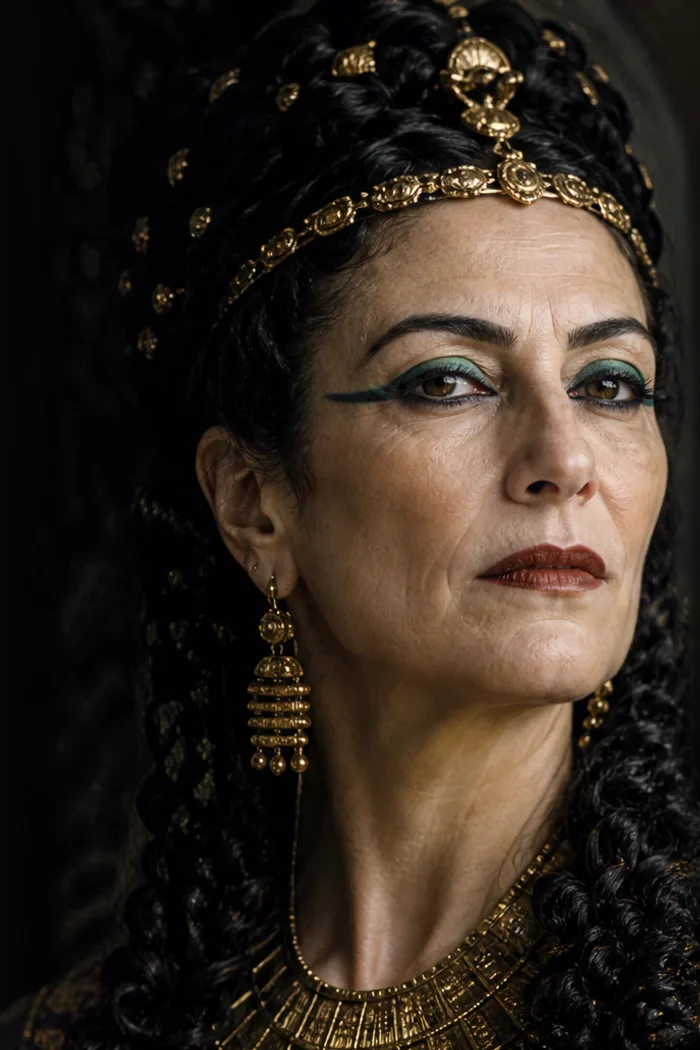
A Sidonian princess who ran a state religion, wrote letters in her husband’s name, and met the end she did with her eyes painted.

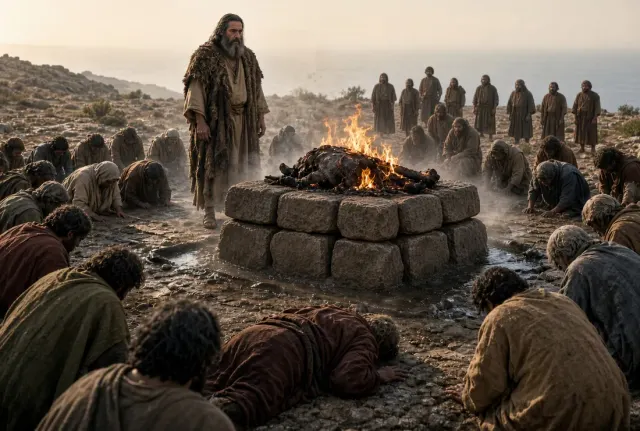
Jezebel is the daughter of the king of the Sidonians, married to Ahab as an alliance, and she does not convert. She brings four hundred and fifty prophets of Baal and four hundred of Asherah to eat at her table, and she cuts off the prophets of the LORD. After Carmel she sends Elijah a message promising to do to him by this time tomorrow what he did to them, and the man who had just faced down a nation runs for his life. When her husband cannot buy a vineyard, she writes letters in his name, seals them with his seal, and arranges a fast, two false witnesses and a stoning.

Where she appears1 Kings 16 to 21 · 2 Kings 9

Scroll down to the account
Jezebel

The movements, in the order the text gives them.

The Account of Jezebel

  1. 01

    1 Kings 18:4, 19

    The table and the cave

    She cuts off the prophets of the LORD, and Obadiah hides a hundred of them in two caves and feeds them. Her own eight hundred and fifty eat at her table.

    The contrast is not merely between two sets of prophets. It is between the conditions under which they can eat. One group needs caves, concealment, bread, and water. Four hundred associated with the groves eat at Jezebel's table. The royal household is not standing at an equal distance from the competing claims. It is providing for one side while the queen cuts off the other.

    Obadiah makes that household more complicated than a single block of obedience. The surrounding verses identify him as its governor, yet he uses his own actions to preserve the lives Jezebel threatens. The two supplied verses do not explain every hiding place or describe the queen's entire policy. They give something more concrete: a hundred men fed out of sight and a large company fed under royal patronage. In a chapter marked by famine, the distribution of bread says a great deal.

    Verse by verse

    1. 18:4

      The surrounding verse, 18:3, calls Obadiah governor of Ahab's house. No identification with the author of the Book of Obadiah is supplied.

    2. 18:19

      Eating at a royal table signals provision and patronage. The four hundred prophets associated with the groves are explicitly linked with Jezebel's table here.

    1 Kings 18:4, 19

    King James Version · 2 verses

    18:4For it was so, when Jezebel cut off the prophets of the LORD, that Obadiah took an hundred prophets, and hid them by fifty in a cave, and fed them with bread and water.)

    18:19Now therefore send, and gather to me all Israel unto mount Carmel, and the prophets of Baal four hundred and fifty, and the prophets of the groves four hundred, which eat at Jezebel’s table.

    1 Kings 18:4, 19: The table and the cave
  2. 02

    1 Kings 19:1-4

    So let the gods do to me

    Ahab tells her everything, including the killing at the brook. She sends a messenger with an oath and a deadline, and Elijah goes a day’s journey into the wilderness and asks to die.

    Jezebel's answer to Carmel is a deadline. The report reaches her through Ahab, and her response is neither an inquiry nor a recorded reconsideration of Baal. It is an oath to make Elijah's life like the lives of the slain prophets by the next day. The invocation of the gods comes immediately after a confrontation in which Baal gave no answer. The defeat has not changed the name under which she threatens.

    Elijah's flight gives the threat its human weight. He crosses into Judah, leaves his servant at Beersheba, and continues alone. Then the man who has gone for his life asks the LORD to take that life. The apparent reversal should not be explained away by an invented diagnosis. Both actions are in the text. He escapes Jezebel's announced killing and brings his request to God instead. The brief words, I am not better than my fathers, place the man of Carmel among mortal predecessors. The fire has not made him less human.

    Verse by verse

    1. 19:1

      Ahab's report is the stated channel by which Jezebel hears about the killing. The passage does not place her among the witnesses on Carmel.

    2. 19:3

      Beersheba is explicitly located in Judah, marking Elijah's movement beyond Ahab's northern kingdom. He leaves the servant there before the further wilderness journey.

    3. 19:4

      The wish to die is expressed directly to the LORD. The verse gives the request and its stated reason, but no clinical diagnosis or full account of Elijah's inward condition.

    1 Kings 19:1-4

    King James Version · 4 verses

    19:1And Ahab told Jezebel all that Elijah had done, and withal how he had slain all the prophets with the sword.

    19:2Then Jezebel sent a messenger unto Elijah, saying, So let the gods do to me, and more also, if I make not thy life as the life of one of them by to morrow about this time.

    19:3And when he saw that, he arose, and went for his life, and came to Beer-sheba, which belongeth to Judah, and left his servant there.

    19:4But he himself went a day’s journey into the wilderness, and came and sat down under a juniper tree: and he requested for himself that he might die; and said, It is enough; now, O LORD, take away my life; for I am not better than my fathers.

    1 Kings 19:1-4: So let the gods do to me
  3. 03

    1 Kings 21:5-16

    Do you now govern Israel

    She finds her husband refusing food over a vineyard. She writes to the elders and nobles of Naboth’s own city, and they do exactly as the letters say.

    Jezebel promises a vineyard and orders a fast. The distance between those two things contains the whole plot. Ahab's private refusal of bread is answered by a public religious observance, but the letters have already fixed the accusation, the witnesses, and the death. No inquiry is needed because no uncertainty is allowed. Naboth is to be made guilty on schedule.

    The king's name and seal provide the authority; the elders and nobles provide local execution of the plan. First Kings repeatedly calls them the men of his city. These are not anonymous strangers imported to do something the community could never imagine. They live where Naboth lives, receive the instructions, and carry them out. The charge names God and the king as the offended parties, while the offense actually being committed serves the king's acquisition.

    The return message has almost no ornament: Naboth is stoned, and is dead. Jezebel translates that report into permission to take possession. The vineyard which he refused to sell is still described through his refusal, but the man who could refuse has been removed. The papers have achieved exactly what the letters requested.

    Verse by verse

    1. 21:8

      The letters use Ahab's name and seal. The account does not explain how Jezebel obtained the seal or quote a separate authorization from Ahab.

    2. 21:10

      Sons of Belial describes worthless or wicked men in this Hebrew expression. It is a character description, not a genealogy of two men's biological father.

    3. 21:11

      The city's elders and nobles are explicitly named as participants. The text does not reduce the killing to Jezebel's actions alone.

    4. 21:13

      The false charge is publicly repeated before the people. First Kings has already disclosed its fabrication in the instructions sent before the hearing.

    1 Kings 21:5-16

    King James Version · 12 verses

    21:5But Jezebel his wife came to him, and said unto him, Why is thy spirit so sad, that thou eatest no bread?

    21:6And he said unto her, Because I spake unto Naboth the Jezreelite, and said unto him, Give me thy vineyard for money; or else, if it please thee, I will give thee another vineyard for it: and he answered, I will not give thee my vineyard.

    21:7And Jezebel his wife said unto him, Dost thou now govern the kingdom of Israel? arise, and eat bread, and let thine heart be merry: I will give thee the vineyard of Naboth the Jezreelite.

    21:8So she wrote letters in Ahab’s name, and sealed them with his seal, and sent the letters unto the elders and to the nobles that were in his city, dwelling with Naboth.

    21:9And she wrote in the letters, saying, Proclaim a fast, and set Naboth on high among the people:

    21:10And set two men, sons of Belial, before him, to bear witness against him, saying, Thou didst blaspheme God and the king. And then carry him out, and stone him, that he may die.

    21:11And the men of his city, even the elders and the nobles who were the inhabitants in his city, did as Jezebel had sent unto them, and as it was written in the letters which she had sent unto them.

    21:12They proclaimed a fast, and set Naboth on high among the people.

    21:13And there came in two men, children of Belial, and sat before him: and the men of Belial witnessed against him, even against Naboth, in the presence of the people, saying, Naboth did blaspheme God and the king. Then they carried him forth out of the city, and stoned him with stones, that he died.

    21:14Then they sent to Jezebel, saying, Naboth is stoned, and is dead.

    21:15And it came to pass, when Jezebel heard that Naboth was stoned, and was dead, that Jezebel said to Ahab, Arise, take possession of the vineyard of Naboth the Jezreelite, which he refused to give thee for money: for Naboth is not alive, but dead.

    21:16And it came to pass, when Ahab heard that Naboth was dead, that Ahab rose up to go down to the vineyard of Naboth the Jezreelite, to take possession of it.

  4. 04

    2 Kings 9:30-37

    The window at Jezreel

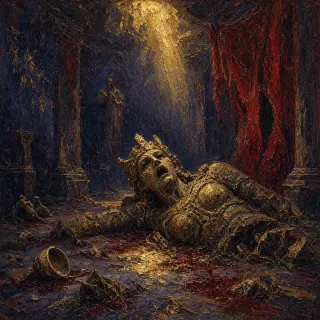
    She hears he is coming and prepares deliberately. Had Zimri peace, who slew his master. Two or three eunuchs throw her down at his word, and he goes in to eat.

    Jezebel's last recorded words are a reference to history, not an appeal for mercy. Calling Jehu Zimri places him beside a man who killed his master and enjoyed a reign of seven days. The comparison is pointed. Her cosmetics are described, but her spoken argument concerns the fate of a royal usurper. An imagined seduction scene would replace the words actually given.

    Jehu does not debate the comparison. He addresses the attendants above, and the question of allegiance is answered by their actions. The window from which Jezebel speaks becomes the place from which she is thrown. Blood reaches the wall and the horses; Jehu goes inside to eat and drink. The sequence is given without any attempt to make it genteel.

    Only afterward does he order burial because she is a king's daughter. Even at this point her birth still carries a claim to treatment that an ordinary corpse might not receive. But the order comes too late to produce the intended burial. The final phrase denies even a recognizable body over which someone could say, This is Jezebel. Royal rank remains in the sentence. It no longer controls the outcome.

    Verse by verse

    1. 9:30

      The Hebrew specifies paint at the eyes; tired her head means that she adorned or arranged her head. No motive for these preparations is explicitly supplied.

    2. 9:31

      Zimri is a historical comparison, not Jehu's personal name. The allusion invokes the short-lived overthrow recorded in 1 Kings 16.

    3. 9:34

      Jehu gives her royal parentage as the stated reason for burial. The account does not turn that order into a successful burial.

    4. 9:36

      Jehu identifies the outcome with Elijah's word. First Kings 21:23 gives the earlier announcement concerning Jezebel and the dogs at Jezreel.

    2 Kings 9:30-37

    King James Version · 8 verses

    9:30And when Jehu was come to Jezreel, Jezebel heard of it; and she painted her face, and tired her head, and looked out at a window.

    9:31And as Jehu entered in at the gate, she said, Had Zimri peace, who slew his master?

    9:32And he lifted up his face to the window, and said, Who is on my side? who? And there looked out to him two or three eunuchs.

    9:33And he said, Throw her down. So they threw her down: and some of her blood was sprinkled on the wall, and on the horses: and he trode her under foot.

    9:34And when he was come in, he did eat and drink, and said, Go, see now this cursed woman, and bury her: for she is a king’s daughter.

    9:35And they went to bury her: but they found no more of her than the skull, and the feet, and the palms of her hands.

    9:36Wherefore they came again, and told him. And he said, This is the word of the LORD, which he spake by his servant Elijah the Tishbite, saying, In the portion of Jezreel shall dogs eat the flesh of Jezebel:

    9:37And the carcase of Jezebel shall be as dung upon the face of the field in the portion of Jezreel; so that they shall not say, This is Jezebel.

    2 Kings 9:30-37: The window at Jezreel

Why it matters

Jezebel is the only figure in Kings who is a genuine religious programme rather than a lapse. The northern kings mostly drift; she imports, funds and enforces. Her name becomes shorthand for exactly that, and Revelation uses it for a teaching in a church rather than for a queen. The account gives her a last scene that refuses to flinch: she hears Jehu is coming, paints her eyes, does her hair, and meets him at a window with a line about a king who murdered his master.

12 songs

The music

Every song in the catalogue whose passage falls inside these chapters.

  1. 1 Kings 14:21-16:28

    Blood upon Every Throne

  2. 1 Kings 16:29-17:24

    The Ravens and the Widow's Barrel

  3. 1 Kings 17

    The Widow's Last Measure

  4. 1 Kings 18

    Answer by Fire

  5. 1 Kings 18

    Fire Fell on Carmel

    Play hereOpen song pageRead lyrics
  6. 1 Kings 18:1-46

    The LORD, He Is God

  7. 1 Kings 19

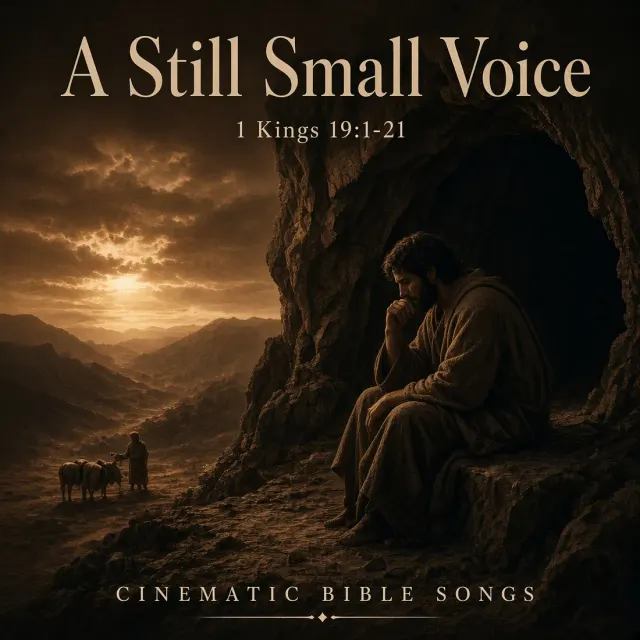
    A Still Small Voice

  8. 1 Kings 20:1-22:54

    Hast Thou Killed and Also Taken Possession?

  9. 1 Kings 21

    The Vineyard Stolen

  10. 2 Kings 8:1-9:13

    The Man Who Shall Smite the House of Ahab

  11. 2 Kings 9-10

    Jezebel at the Window

  12. 2 Kings 9:14-10:36

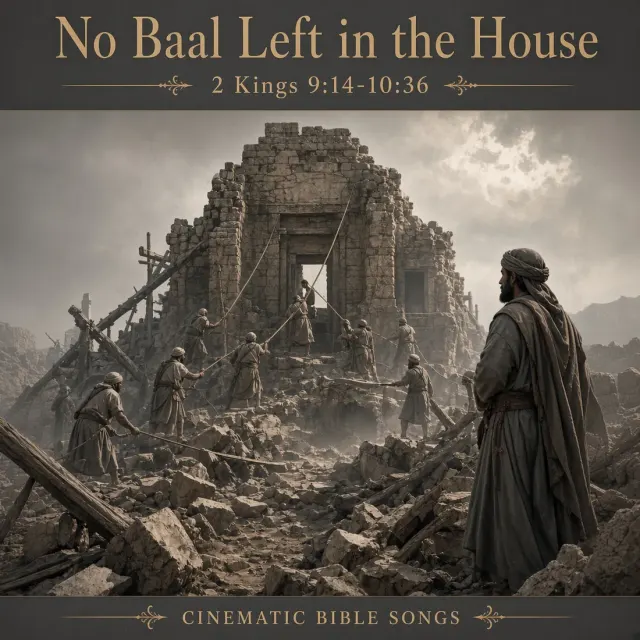
    No Baal Left in the House

The videos

The videos

Every release whose passage falls inside these chapters, playing here.

Nearby

All the people

Report an error on this page