New · FreePlay The Witnesses The in-depth puzzle battle quest through Bible history

People of the Bible

Jehu

Was anointed in a back room, drove like a madman, and destroyed Baal out of Israel without ever leaving the calves of Jeroboam.

Jehu is a commander sitting with the other officers when a young prophet arrives, calls him into an inner chamber, pours oil on his head, says he is king and is to strike the house of Ahab, and then opens the door and runs. His men ask what the mad fellow wanted. Within a day he has killed two kings, ridden into Jezreel, had Jezebel thrown from a window, and written letters to Samaria that end with seventy heads in baskets at the gate. Then he gathers every worshipper of Baal into one building on the pretext of a great sacrifice.

Where he appears2 Kings 9 to 10

Scroll down to the account
Jehu

The movements, in the order the text gives them.

The Account of Jehu

  1. 01

    2 Kings 9:1-13

    Why did this mad fellow come

    Anointed indoors and in a hurry. His fellow officers press him until he tells them, and they throw their garments under him on the stairs and blow a trumpet.

    The messenger's exit is part of his commission. He is to pour the oil, pronounce the appointment, open the door, and flee. There is no public ceremony prepared for him to supervise. The declaration begins in an inner room, away from the officers who will soon be spreading their garments beneath Jehu. A private word is about to become a public change of allegiance.

    The commission names the people as the LORD's people before it names the violence against Ahab's house. Jehu receives neither ownership of Israel nor a general permission to kill at will. The stated judgment concerns a particular house and the blood of the LORD's servants. Those particulars matter beside the swiftness of the appointment.

    Outside, the officers dismiss the visitor as this mad fellow, then insist on hearing what he said. Their behavior changes when the message concerns the man in front of them. Garments come off, trumpets sound, and the prophet they had just disparaged supplies the announcement they now acclaim. The messenger has left. His words have stayed.

    Verse by verse

    1. 9:2

      Jehu's father is Jehoshaphat and his grandfather Nimshi. This Jehoshaphat is not identified as the king of Judah with the same name.

    2. 9:4

      The messenger is called a young prophet but is not named. Identifying him with a later named prophet goes beyond this passage.

    3. 9:7

      The announced judgment specifically mentions the blood of the LORD's prophets and servants at Jezebel's hand. The commission is not presented as an unlimited authorization for violence.

    4. 9:13

      The garments and trumpets turn the private announcement into public acclamation. The officers themselves perform these actions after hearing Jehu's report.

    2 Kings 9:1-13: Why did this mad fellow come

    2 Kings 9:1-13

    King James Version · 13 verses

    9:1And Elisha the prophet called one of the children of the prophets, and said unto him, Gird up thy loins, and take this box of oil in thine hand, and go to Ramoth-gilead:

    9:2And when thou comest thither, look out there Jehu the son of Jehoshaphat the son of Nimshi, and go in, and make him arise up from among his brethren, and carry him to an inner chamber;

    9:3Then take the box of oil, and pour it on his head, and say, Thus saith the LORD, I have anointed thee king over Israel. Then open the door, and flee, and tarry not.

    9:4So the young man, even the young man the prophet, went to Ramoth-gilead.

    9:5And when he came, behold, the captains of the host were sitting; and he said, I have an errand to thee, O captain. And Jehu said, Unto which of all us? And he said, To thee, O captain.

    9:6And he arose, and went into the house; and he poured the oil on his head, and said unto him, Thus saith the LORD God of Israel, I have anointed thee king over the people of the LORD, even over Israel.

    9:7And thou shalt smite the house of Ahab thy master, that I may avenge the blood of my servants the prophets, and the blood of all the servants of the LORD, at the hand of Jezebel.

    9:8For the whole house of Ahab shall perish: and I will cut off from Ahab him that pisseth against the wall, and him that is shut up and left in Israel:

    9:9And I will make the house of Ahab like the house of Jeroboam the son of Nebat, and like the house of Baasha the son of Ahijah:

    9:10And the dogs shall eat Jezebel in the portion of Jezreel, and there shall be none to bury her. And he opened the door, and fled.

    9:11Then Jehu came forth to the servants of his lord: and one said unto him, Is all well? wherefore came this mad fellow to thee? And he said unto them, Ye know the man, and his communication.

    9:12And they said, It is false; tell us now. And he said, Thus and thus spake he to me, saying, Thus saith the LORD, I have anointed thee king over Israel.

    9:13Then they hasted, and took every man his garment, and put it under him on the top of the stairs, and blew with trumpets, saying, Jehu is king.

  2. 02

    2 Kings 9:16-26

    The driving is like the driving of Jehu

    The watchman on the tower reports two messengers who do not come back and then a style of driving he recognises. Joram meets him in Naboth’s portion and asks if it is peace.

    The watchman recognizes the driving before he can report a face-to-face identification. Jehu has a manner of arrival that serves almost as a signature. The line has genuine dry humor, but the movements around it are serious: two messengers sent by Joram are absorbed into the approaching company, and neither returns. The king's requests for information enlarge the force coming toward him.

    Peace keeps recurring, first in the messengers' question and finally from Joram himself. Jehu refuses to let the word mean merely a friendly arrival while Jezebel's practices continue. Joram calls the encounter treachery and turns; Jehu's arrow answers the attempted escape. Unlike the unnamed archer who struck Ahab, this archer chooses his royal target and draws with his full strength.

    Only then does the land receive its full explanation. The meeting has occurred on Naboth's ground, and Jehu recalls a word he and Bidkar heard while following Ahab. The plot is not interchangeable scenery. It has an owner still named after death, and blood still being cited after possession changed hands.

    Verse by verse

    1. 9:16

      Beyond this range, 2 Kings 9:27 places Ahaziah's fatal flight at Megiddo; 2 Chronicles 22:9 describes his capture while hiding in Samaria and his being brought to Jehu. The accounts should remain distinct rather than be supplied with an unrecorded itinerary.

    2. 9:20

      Son of Nimshi is a shortened family designation here. Verse 2 gives the fuller line through Jehoshaphat, Nimshi's son.

    3. 9:21

      The text identifies the meeting place as Naboth's portion before Jehu explains its significance. The location is not first supplied by his later speech.

    4. 9:24

      Joram and Jehoram name the same king in this passage. They should not be treated as two different victims.

    5. 9:26

      This recollection expressly includes the blood of Naboth's sons, a detail not stated in 1 Kings 21. Jehu attributes the quoted judgment to the LORD.

    2 Kings 9:16-26

    King James Version · 11 verses

    9:16So Jehu rode in a chariot, and went to Jezreel; for Joram lay there. And Ahaziah king of Judah was come down to see Joram.

    9:17And there stood a watchman on the tower in Jezreel, and he spied the company of Jehu as he came, and said, I see a company. And Joram said, Take an horseman, and send to meet them, and let him say, Is it peace?

    9:18So there went one on horseback to meet him, and said, Thus saith the king, Is it peace? And Jehu said, What hast thou to do with peace? turn thee behind me. And the watchman told, saying, The messenger came to them, but he cometh not again.

    9:19Then he sent out a second on horseback, which came to them, and said, Thus saith the king, Is it peace? And Jehu answered, What hast thou to do with peace? turn thee behind me.

    9:20And the watchman told, saying, He came even unto them, and cometh not again: and the driving is like the driving of Jehu the son of Nimshi; for he driveth furiously.

    9:21And Joram said, Make ready. And his chariot was made ready. And Joram king of Israel and Ahaziah king of Judah went out, each in his chariot, and they went out against Jehu, and met him in the portion of Naboth the Jezreelite.

    9:22And it came to pass, when Joram saw Jehu, that he said, Is it peace, Jehu? And he answered, What peace, so long as the whoredoms of thy mother Jezebel and her witchcrafts are so many?

    9:23And Joram turned his hands, and fled, and said to Ahaziah, There is treachery, O Ahaziah.

    9:24And Jehu drew a bow with his full strength, and smote Jehoram between his arms, and the arrow went out at his heart, and he sunk down in his chariot.

    9:25Then said Jehu to Bidkar his captain, Take up, and cast him in the portion of the field of Naboth the Jezreelite: for remember how that, when I and thou rode together after Ahab his father, the LORD laid this burden upon him;

    9:26Surely I have seen yesterday the blood of Naboth, and the blood of his sons, saith the LORD; and I will requite thee in this plat, saith the LORD. Now therefore take and cast him into the plat of ground, according to the word of the LORD.

  3. 03

    2 Kings 9:30-37

    Throw her down

    Jezebel meets him at a window painted and dressed. He asks who is on his side, two or three eunuchs answer, and he goes in to eat and drink before ordering her buried.

    Jehu answers a historical accusation by speaking to the people at the window. Jezebel has compared him to Zimri, a servant who killed his master. Instead of defending himself to her, Jehu tests the allegiance of the attendants within her reach. The decisive movement comes from inside the royal household. The woman at the window cannot command those standing beside her to remain on her side.

    The violence is then followed by a meal. Second Kings puts the blood on the wall and the horses before Jehu's eating and drinking, and only afterward records his instruction to bury her. He calls her cursed and a king's daughter in the same order. Condemnation and recognition of rank sit together without canceling each other.

    The servants return with something an order cannot undo: the body is no longer there in the form required for the intended burial. Jehu answers their report with Elijah's word. The outcome is interpreted through the prophecy, not through the effectiveness of his funeral arrangements. He has been issuing commands throughout the scene. The last fact is beyond recall.

    Verse by verse

    1. 9:31

      First Kings 16:15-18 records Zimri's seven-day reign and death during Omri's siege. Jezebel's words invoke that history against Jehu.

    2. 9:32

      The text says two or three eunuchs looked out. It does not give a fixed number or individual names.

    3. 9:34

      Jehu's stated reason for burial is her royal parentage. This is an order issued after the killing, not a description of a completed funeral.

    4. 9:36

      The identification with Elijah's prophecy is spoken by Jehu. The earlier announcement appears in 1 Kings 21:23.

    2 Kings 9:30-37

    King James Version · 8 verses

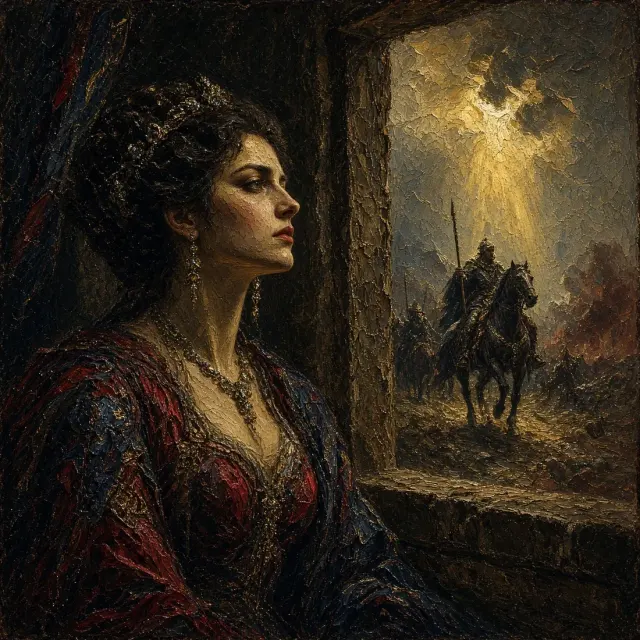
    9:30And when Jehu was come to Jezreel, Jezebel heard of it; and she painted her face, and tired her head, and looked out at a window.

    9:31And as Jehu entered in at the gate, she said, Had Zimri peace, who slew his master?

    9:32And he lifted up his face to the window, and said, Who is on my side? who? And there looked out to him two or three eunuchs.

    9:33And he said, Throw her down. So they threw her down: and some of her blood was sprinkled on the wall, and on the horses: and he trode her under foot.

    9:34And when he was come in, he did eat and drink, and said, Go, see now this cursed woman, and bury her: for she is a king’s daughter.

    9:35And they went to bury her: but they found no more of her than the skull, and the feet, and the palms of her hands.

    9:36Wherefore they came again, and told him. And he said, This is the word of the LORD, which he spake by his servant Elijah the Tishbite, saying, In the portion of Jezreel shall dogs eat the flesh of Jezebel:

    9:37And the carcase of Jezebel shall be as dung upon the face of the field in the portion of Jezreel; so that they shall not say, This is Jezebel.

    2 Kings 9:30-37: Throw her down
  4. 04

    2 Kings 10:1-11

    Two heaps at the gate

    He writes to the guardians of Ahab’s seventy sons daring them to fight. They do not. He has the heads laid in two heaps at the entrance of the gate until morning and then speaks to the people about righteousness.

    Jehu's first letter lists the resources of the men who could resist him: royal heirs, chariots, horses, a fortified city, and armor. It then tells them to choose a king and fight. Their refusal is not left to an invented motive. They are exceedingly afraid, and the deaths of two kings are the reason they give. The next letter turns their declaration of service into an order to kill the men they have been raising.

    The seventy are therefore delivered by the hands appointed to protect and educate them. Baskets carry their heads to Jezreel, and two heaps make the delivery public. The scene is not less violent because Jehu can stand at a distance from the individual killings. His written demand has already been supplied.

    That matters when he addresses the people in the morning. He admits his conspiracy against his master and directs attention toward whoever killed the others. The account has already answered that point: the guardians killed them at his command. Jehu also identifies the destruction with Elijah's word. Prophetic fulfillment and the documented chain of human actions remain together on the page.

    Verse by verse

    1. 10:1

      The KJV reads rulers of Jezreel in a letter sent to Samaria. The different place names should be retained rather than silently made identical.

    2. 10:6

      The seventy are identified as royal sons or members of the royal generation under guardians. Their individual ages are not supplied, so they should not all be pictured as infants.

    3. 10:7

      The guardians carry out the actual killings, but Jehu's preceding letter explicitly demands the heads. The written sequence preserves both levels of participation.

    4. 10:9

      Jehu's public speech does not replace the earlier account of his instructions. His acknowledgment of one killing does not mean the other deaths happened without his involvement.

    2 Kings 10:1-11

    King James Version · 11 verses

    10:1And Ahab had seventy sons in Samaria. And Jehu wrote letters, and sent to Samaria, unto the rulers of Jezreel, to the elders, and to them that brought up Ahab’s children, saying,

    10:2Now as soon as this letter cometh to you, seeing your master’s sons are with you, and there are with you chariots and horses, a fenced city also, and armour;

    10:3Look even out the best and meetest of your master’s sons, and set him on his father’s throne, and fight for your master’s house.

    10:4But they were exceedingly afraid, and said, Behold, two kings stood not before him: how then shall we stand?

    10:5And he that was over the house, and he that was over the city, the elders also, and the bringers up of the children, sent to Jehu, saying, We are thy servants, and will do all that thou shalt bid us; we will not make any king: do thou that which is good in thine eyes.

    10:6Then he wrote a letter the second time to them, saying, If ye be mine, and if ye will hearken unto my voice, take ye the heads of the men your master’s sons, and come to me to Jezreel by to morrow this time. Now the king’s sons, being seventy persons, were with the great men of the city, which brought them up.

    10:7And it came to pass, when the letter came to them, that they took the king’s sons, and slew seventy persons, and put their heads in baskets, and sent him them to Jezreel.

    10:8And there came a messenger, and told him, saying, They have brought the heads of the king’s sons. And he said, Lay ye them in two heaps at the entering in of the gate until the morning.

    10:9And it came to pass in the morning, that he went out, and stood, and said to all the people, Ye be righteous: behold, I conspired against my master, and slew him: but who slew all these?

    10:10Know now that there shall fall unto the earth nothing of the word of the LORD, which the LORD spake concerning the house of Ahab: for the LORD hath done that which he spake by his servant Elijah.

    10:11So Jehu slew all that remained of the house of Ahab in Jezreel, and all his great men, and his kinsfolks, and his priests, until he left him none remaining.

  5. 05

    2 Kings 10:18-31

    Ahab served Baal a little

    He proclaims a great sacrifice, fills the house of Baal from end to end, checks that no servant of the LORD is inside, and posts eighty men outside. Then the text notes the calves were not removed.

    Ahab served Baal a little is not a sincere review of the previous reign. The next verse states the deception and its purpose. Jehu promises more service in order to gather the worshipers into one building, then arranges the clothing, the search, and the guards so that the people he intends to kill are contained there. The language of a great sacrifice covers preparations for a massacre.

    The destruction reaches the building as well as the people. Its sacred objects are removed and broken, and the temple site is made a draught house. Baal's public establishment is not merely closed for repairs. But the next word, Howbeit, prevents that destruction from becoming a claim of complete faithfulness. The calves at Bethel and Dan remain. Jehu has removed Ahab's Baal without leaving Jeroboam's sin.

    The chapter places divine commendation and a severe qualification within two verses of each other. Ahab's house has been dealt with as commanded, and four generations are promised; Jehu nevertheless does not walk in the law with all his heart. The text has room for both statements. A large act of destruction does not receive permission to swallow the rest of the account.

    Verse by verse

    1. 10:19

      The intent to destroy Baal's worshipers is explicitly stated. It is not a motive reconstructed from the outcome alone.

    2. 10:27

      Draught house means a latrine or place for bodily waste. The change marks the degradation of the former cult site, not ordinary reuse as another sanctuary.

    3. 10:29

      The retained calves are expressly located at Bethel and Dan. Destroying Baal's establishment does not remove the worship condemned since Jeroboam.

    4. 10:30

      Hosea 1:4 announces judgment on Jehu's house for the blood of Jezreel. The relationship between that announcement and this commendation is an interpretive difficulty, not a reason to omit either text.

    5. 10:31

      With all his heart is the chapter's explicit qualification. Jehu's zeal in particular actions is not presented as complete obedience to the law.

    2 Kings 10:18-31: Ahab served Baal a little

    2 Kings 10:18-31

    King James Version · 14 verses

    10:18And Jehu gathered all the people together, and said unto them, Ahab served Baal a little; but Jehu shall serve him much.

    10:19Now therefore call unto me all the prophets of Baal, all his servants, and all his priests; let none be wanting: for I have a great sacrifice to do to Baal; whosoever shall be wanting, he shall not live. But Jehu did it in subtilty, to the intent that he might destroy the worshippers of Baal.

    10:20And Jehu said, Proclaim a solemn assembly for Baal. And they proclaimed it.

    10:21And Jehu sent through all Israel: and all the worshippers of Baal came, so that there was not a man left that came not. And they came into the house of Baal; and the house of Baal was full from one end to another.

    10:22And he said unto him that was over the vestry, Bring forth vestments for all the worshippers of Baal. And he brought them forth vestments.

    10:23And Jehu went, and Jehonadab the son of Rechab, into the house of Baal, and said unto the worshippers of Baal, Search, and look that there be here with you none of the servants of the LORD, but the worshippers of Baal only.

    10:24And when they went in to offer sacrifices and burnt offerings, Jehu appointed fourscore men without, and said, If any of the men whom I have brought into your hands escape, he that letteth him go, his life shall be for the life of him.

    10:25And it came to pass, as soon as he had made an end of offering the burnt offering, that Jehu said to the guard and to the captains, Go in, and slay them; let none come forth. And they smote them with the edge of the sword; and the guard and the captains cast them out, and went to the city of the house of Baal.

    10:26And they brought forth the images out of the house of Baal, and burned them.

    10:27And they brake down the image of Baal, and brake down the house of Baal, and made it a draught house unto this day.

    10:28Thus Jehu destroyed Baal out of Israel.

    10:29Howbeit from the sins of Jeroboam the son of Nebat, who made Israel to sin, Jehu departed not from after them, to wit, the golden calves that were in Beth-el, and that were in Dan.

    10:30And the LORD said unto Jehu, Because thou hast done well in executing that which is right in mine eyes, and hast done unto the house of Ahab according to all that was in mine heart, thy children of the fourth generation shall sit on the throne of Israel.

    10:31But Jehu took no heed to walk in the law of the LORD God of Israel with all his heart: for he departed not from the sins of Jeroboam, which made Israel to sin.

Why it matters

Jehu is the instrument that works and the man who stops halfway. He is given four generations on the throne for doing what was right in carrying out the sentence on Ahab, which is the longest dynasty the north gets. And the same chapter says he took no heed to walk in the law of the LORD with all his heart, and did not depart from the golden calves. Hosea later names Jezreel against his house, so even the obedience is weighed and found to have gone too far.

3 songs

The music

Every song in the catalogue whose passage falls inside these chapters.

  1. 2 Kings 8:1-9:13

    The Man Who Shall Smite the House of Ahab

  2. 2 Kings 9-10

    Jezebel at the Window

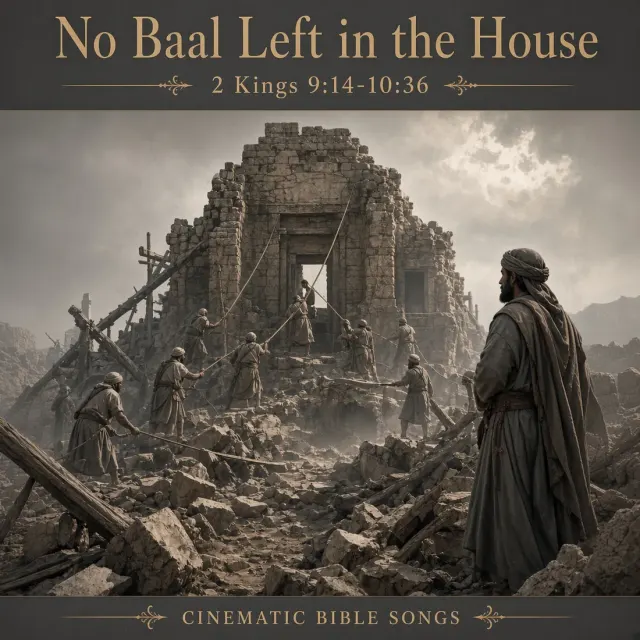
  3. 2 Kings 9:14-10:36

    No Baal Left in the House

Nearby

All the people

Report an error on this page