
1 Kings

22 Chapters
1 Kings: The Whole Book, Chapter by Chapter
Two Celebrations, One Throne
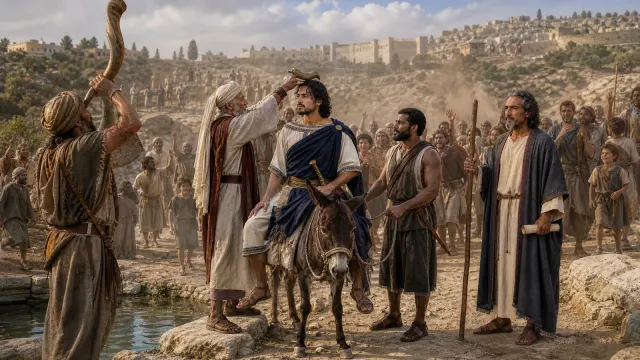
The Book of 1 Kings begins with David still king but visibly failing in strength, and that gap between bodily weakness and continuing authority creates room for a succession crisis. Adonijah fills the opening with chariots, runners, powerful supporters, and a feast that looks royal until its exclusions are noticed. Nathan and Bathsheba bring David back into the decision, reminding him of his oath concerning Solomon and forcing a private intention into public action. David responds with unmistakable symbols of authorization: his own mule, his own servants, Zadok’s anointing, the trumpet, and Solomon’s occupation of the throne. The city’s celebration reaches Adonijah’s banquet as unwelcome news, and his supporters scatter. Yet the chapter does not end with revenge. Adonijah seeks refuge at the altar and receives conditional mercy from Solomon. The throne changes hands through competing claims, remembered promises, public ceremony, and a final act of restraint that leaves the defeated claimant alive but accountable for what he does next.
One complete chapter pageOpen chapter →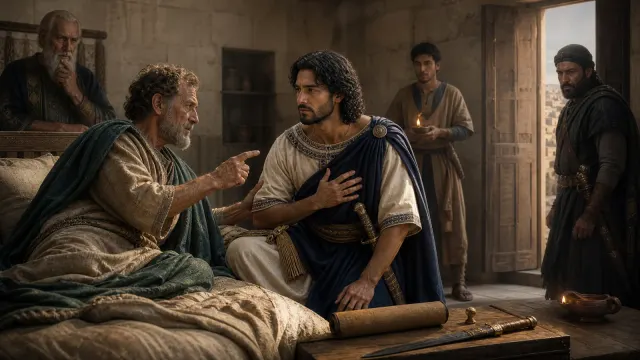
An Established Kingdom and Unfinished Accounts
David dies after charging Solomon to keep the law of Moses and to deal with several obligations his reign leaves unfinished. That mixture sets the tone for a chapter where covenant language, personal memory, political consolidation, and bloodshed repeatedly overlap. Adonijah’s request for Abishag is interpreted by Solomon as a renewed claim to the throne and ends in his death. Abiathar is judged worthy of death but spared because of his service to David, while his removal from the priesthood is explicitly tied to the older judgment on Eli’s house. Joab seeks refuge at the altar, yet Solomon orders his execution for the killings of Abner and Amasa, then gives the army to Benaiah and the priesthood to Zadok. Shimei receives a clear restriction, keeps it for three years, and dies after knowingly leaving Jerusalem. The chapter begins and ends by calling Solomon’s kingdom established, but it refuses to make that establishment look clean or automatic. It is built through obedience demanded, loyalties remembered, conditions imposed, offices reassigned, and old accounts finally settled.
One complete chapter pageOpen chapter →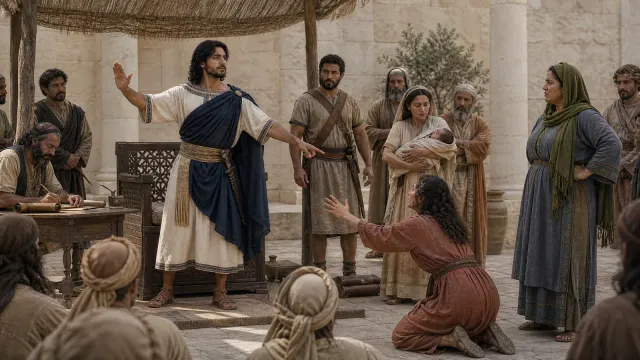
Wisdom Asks to Listen Before It Judges
Solomon’s reign enters its wisdom phase in a setting the Book of 1 Kings deliberately leaves mixed. He loves the LORD, yet worships at high places, and his marriage to Pharaoh’s daughter is already part of the royal landscape. At Gibeon, God invites him to ask for a gift, and Solomon answers from a sense of inadequacy. He is governing God’s people, not merely possessing a kingdom, so he asks for an understanding, listening heart able to distinguish good from bad. God grants extraordinary wisdom, adds riches and honor, and leaves long life under a stated condition of obedience. The chapter then moves from promise to practice. Two women bring mutually exclusive claims over a living child with no independent witness available. Solomon’s threatened division of the child exposes the difference between possession and maternal compassion, allowing him to identify the true mother without carrying out the threat. Israel recognizes God’s wisdom in the judgment. The gift first appears publicly not as abstract knowledge, but as the capacity to hear a hopelessly tangled case and preserve a life.
One complete chapter pageOpen chapter →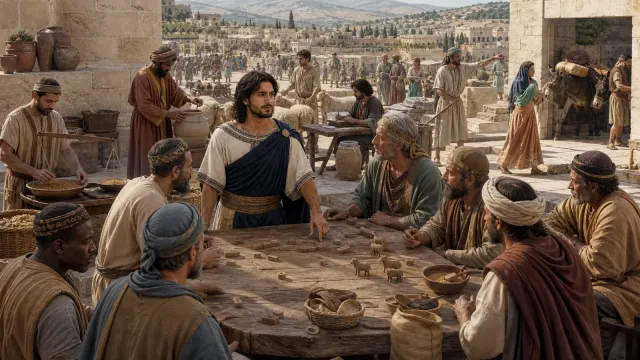
The Table, the Territory, and the Reach of Wisdom
The Book of 1 Kings expands Solomon’s wisdom from a courtroom gift into the operating system of a kingdom. Named officials divide military, priestly, documentary, household, and revenue responsibilities, while twelve regional officers supply the royal establishment one month at a time. The reign’s prosperity is then described from two directions. Judah and Israel are numerous, secure, eating and rejoicing under vine and fig tree, while Solomon’s table, horses, and attendants consume provisions on a scale that requires continuous administration. Peace and burden are not yet presented as contradictions, but the machinery behind abundance is fully visible. The chapter closes by widening wisdom beyond politics. Solomon speaks thousands of proverbs and songs and ranges in observation from Lebanon’s cedar to hyssop growing from a wall, from animals to birds, creeping things, and fish. His reputation draws hearers from other nations. By the end of the chapter, wisdom has become governmental, economic, literary, observational, and international, and the kingdom sustaining it is shown in equally practical detail.
One complete chapter pageOpen chapter →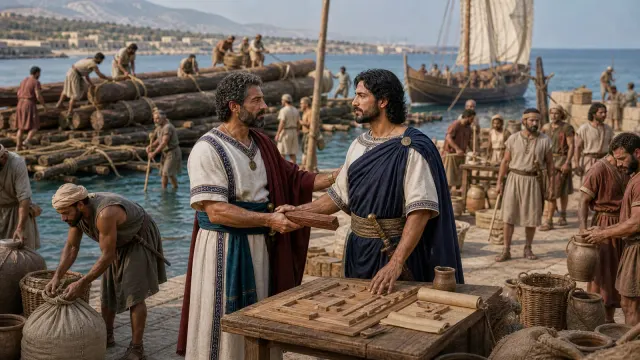
The Temple Begins with Peace, Timber, and Labor
Solomon’s temple project begins in the conditions created by peace. Hiram of Tyre, long friendly with David, becomes the partner through whom cedar, fir, transport expertise, and skilled labor can be secured. Solomon explains the project as the completion of a promise David could not fulfill during years of war, and he freely acknowledges that Sidonian workers know timber better than his own people. The agreement is reciprocal: wood moves toward Israel while wheat and oil support Hiram’s household, and the Book of 1 Kings connects the resulting league with the wisdom God has given Solomon. Then the chapter turns from correspondence to labor. Tens of thousands of workers rotate through Lebanon, carry burdens, quarry stone, supervise crews, and prepare materials for the foundation. The shift keeps the human cost of royal construction visible. A temple conceived through promise and diplomacy still has to be built by organized labor. By the chapter’s close, no finished sanctuary stands yet, but its cedar, stone, treaty relationships, schedules, and workforce are all in place.
One complete chapter pageOpen chapter →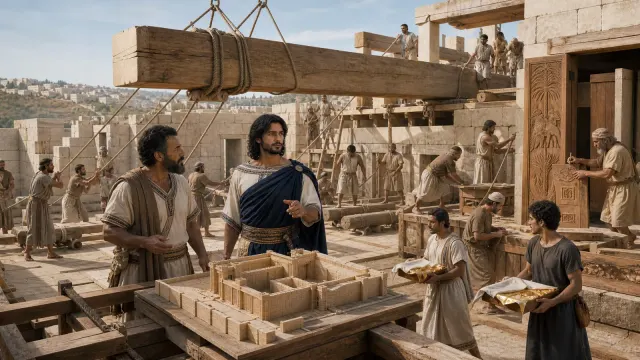
A House Takes Shape Around a Covenant
The temple rises through a chapter obsessed with order. Its beginning is dated both from Solomon’s reign and from the Exodus, locating royal construction inside Israel’s longer covenant history. Measurements define the main hall, porch, side chambers, inner sanctuary, doors, and courts, while prepared stone allows the work at the house itself to proceed without the sound of iron tools. Yet the chapter’s theological center arrives as an interruption rather than a decoration. The LORD tells Solomon that obedience remains the condition attached to the promises concerning his house and declares an intention to dwell among Israel. No amount of cedar, carving, or gold can replace that demand. The account then moves inward through increasingly rich surfaces toward the room prepared for the ark of the covenant, with great cherubim spanning the space and living forms carved across walls and doors. After seven years the structure is complete according to plan. Still, the ark has not entered and the temple has not been dedicated, leaving a deliberate distinction between finishing a building and fulfilling the purpose for which it was built.
One complete chapter pageOpen chapter →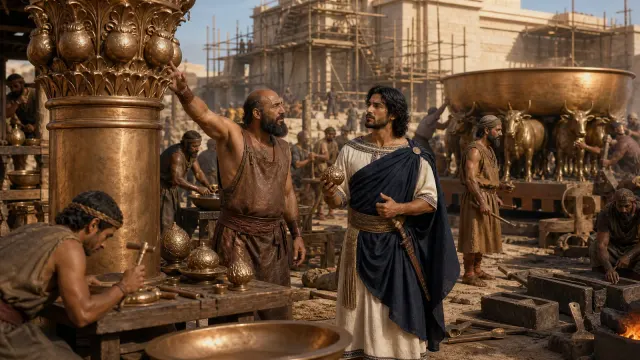
The Hands That Furnish the House
The Book of 1 Kings widens from the temple to Solomon’s royal building complex, then returns to the sanctuary through the hands of Hiram the craftsman. Solomon’s palace buildings take thirteen years and include spaces for display, judgment, residence, and Pharaoh’s daughter, placing royal architecture beside the seven-year temple project without supplying a simplistic verdict on the comparison. Hiram then demonstrates another form of wisdom through metalwork. He makes the two named pillars, the great bronze sea on twelve oxen, ten matching wheeled stands with lavers, and a long series of vessels whose measurements and ornament receive patient attention. The account preserves practical details because sacred service depends on practical objects. Lions, palms, cherubim, flowers, brass, and gold unite beauty with use, while the final inventory reaches all the way to utensils and hinges. David’s dedicated treasures are brought in at the end, joining two reigns within the completed work. The building and furnishings are now ready, but the ark still waits outside, keeping dedication distinct from construction.
One complete chapter pageOpen chapter →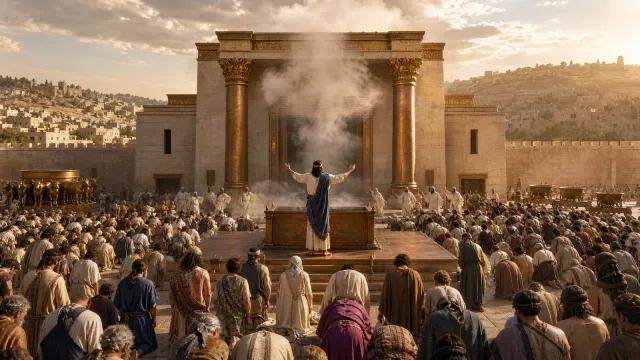
A House for Prayer, Not a Container for God
The temple becomes a sanctuary when the ark enters it and the glory of the LORD fills the house so completely that the priests cannot continue ministering. Solomon then interprets the building through promise rather than possession. David desired to build, Solomon was appointed to complete the work, and the ark at the center carries the covenant made after the Exodus. In the prayer that follows, Solomon states the temple’s limit as clearly as its significance: even heaven cannot contain God, so the house is a place toward which prayer is directed while God hears from heaven. The petitions move through legal disputes, defeat, drought, famine, disease, foreigners, warfare, sin, and eventual captivity. The dedication therefore looks far beyond its own moment of prosperity. It imagines people praying from situations in which the temple cannot function as a charm against consequences. Solomon asks for forgiveness, justice, instruction, compassion, and wholehearted allegiance. The chapter closes with sacrifices and a fourteen-day feast so abundant that extra court space is needed, and the people depart joyful. Celebration and warning stand together without canceling each other.
One complete chapter pageOpen chapter →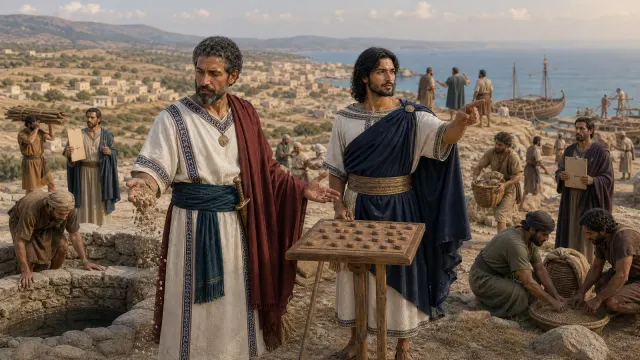
The Answer After the Dedication
After the temple’s dedication, the LORD answers Solomon with both acceptance and warning. The house has been hallowed, but neither temple nor dynasty is exempt from the consequences of abandoning the covenant. The chapter then surveys what the mature reign looks like in practice: twenty years of building, a strained transaction with Hiram over Galilean cities, an enormous construction program supported by differentiated labor arrangements, regular worship, and maritime trade reaching Ophir. The Book of 1 Kings keeps grandeur and complication in the same frame. Hiram’s partnership does not prevent disappointment, Pharaoh’s gift of Gezer carries a violent background, and the labor supporting royal works is not experienced under one uniform status. Israelites serve through military, administrative, and earlier rotating obligations, while surviving non-Israelite populations are subjected to bondservice. Solomon’s fleet again depends on Hiram’s specialized sailors, and gold continues to flow into the kingdom. The result is a reign at full scale, impressive enough to fulfill earlier promises and complex enough that prosperity cannot be mistaken for automatic covenant security.
One complete chapter pageOpen chapter →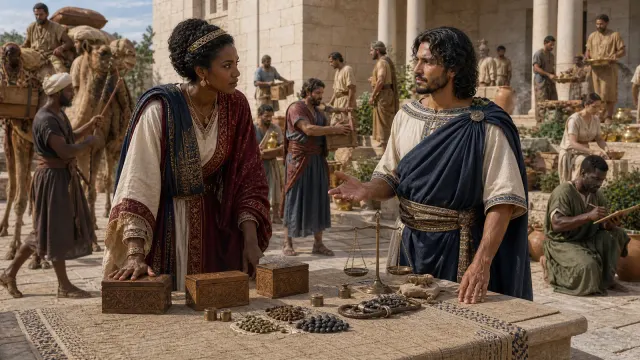
A Reputation Exceeded, and Wealth Multiplied
The queen of Sheba arrives to test Solomon’s famous wisdom and discovers that the reports have understated what she sees. His answers, court, servants, table, architecture, and ceremonial order overwhelm her expectations, yet her praise gives the throne a moral purpose: Solomon was appointed because of the LORD’s love for Israel, to practice judgment and justice. The chapter then moves into a sustained inventory of abundance. Gold, spices, precious stones, rare wood, instruments, shields, an extraordinary throne, vessels, tribute, fleets, horses, and chariots accumulate until silver itself seems commonplace in Jerusalem. The queen’s visit therefore opens the chapter with wisdom examined and closes into a world where wealth is nearly everywhere. That abundance is not presented as imaginary or automatically wicked, but the final concentration on Egyptian horses, chariots, silver, and gold brings Deuteronomy’s instructions for kings into view. The chapter becomes a hinge. Solomon’s fame has reached its brightest international expression, while the categories of royal multiplication now stand ready for the next chapter’s account of a heart turned away.
One complete chapter pageOpen chapter →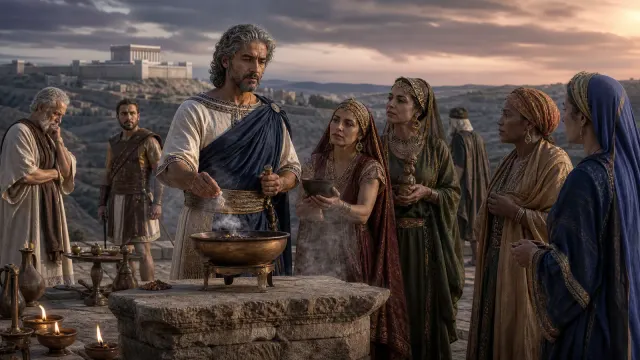
The Heart Turns, and the Kingdom Begins to Tear
The chapter turns Solomon’s greatest strength, his heart, into the site of his decisive failure. His many marriages lead him after other gods, and the king who built the temple also builds high places for rival worship near Jerusalem. Because the LORD had appeared to Solomon twice and explicitly warned him, the resulting judgment is presented as conscious covenant disobedience rather than ignorance. Most of the kingdom will be torn away after his death, though David’s line and Jerusalem remain protected by earlier promises. The rest of the chapter shows that fracture entering history from several directions. Hadad and Rezon carry unresolved consequences from David’s wars into Solomon’s later years, while Jeroboam rises from within Solomon’s own labor administration. Ahijah’s torn garment gives the coming division a visible sign and offers Jeroboam a conditional promise of an enduring house if he obeys. Solomon instead seeks Jeroboam’s death, driving him into Egyptian refuge. The forty-year reign closes without repairing the announced breach, leaving Rehoboam to inherit a kingdom whose splendor remains intact on the surface and whose unity has already been sentenced.
One complete chapter pageOpen chapter →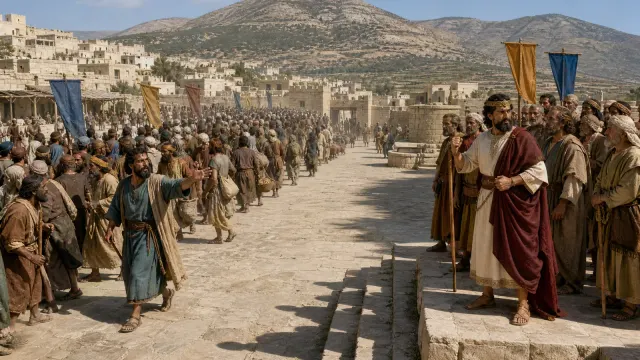
The Kingdom Breaks Where the King Will Not Listen
The kingdom breaks at the point where Rehoboam refuses to listen. Israel gathers at Shechem prepared to make him king and asks only that Solomon’s heavy yoke be lightened. Older counselors advise service as the path to durable loyalty, while Rehoboam’s peers urge him to advertise greater severity. He chooses the threat of heavier burdens, the northern tribes reject Davidic rule, Adoram is killed, and Rehoboam flees to Jerusalem. The Book of 1 Kings identifies the division as fulfillment of Ahijah’s prophecy while still preserving the human chain of choices through which it happens. Rehoboam then assembles an army to recover the kingdom, but Shemaiah calls the northern Israelites brothers and orders the force home. The king listens this time. Jeroboam, meanwhile, faces a different crisis of trust. Afraid that pilgrimage to Jerusalem will return the people’s hearts to Rehoboam, he creates golden calves, alternate shrines, a new priesthood, and his own festival calendar. Political insecurity produces a religious system the book directly calls sin.
One complete chapter pageOpen chapter →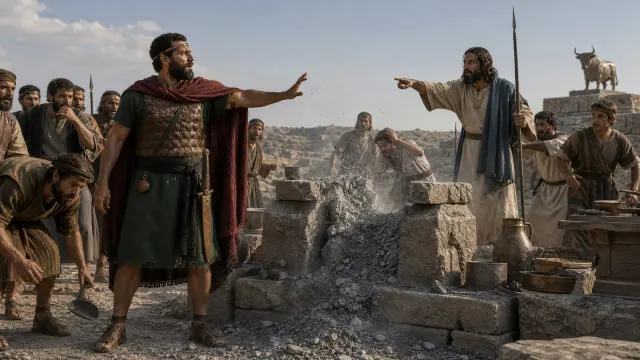
A True Word, a Lying Prophet, and an Unturned King
A man of God confronts Jeroboam’s altar with a prophecy naming Josiah and an immediate sign that authenticates the distant warning. Jeroboam’s attempt to seize him ends with a useless hand and a broken altar, and the king must ask the very messenger he threatened to pray for his restoration. The man of God then refuses royal food and reward because his commission forbids eating, drinking, or returning by the same route. He keeps that command until an older prophet claims an angel has revised it. The Book of 1 Kings calls the claim a lie. Yet at the meal, a genuine word of judgment does come through the same older prophet, and the deceived messenger dies by a lion for disobeying the command he originally received. The old prophet retrieves and buries him, asks eventually to share his grave, and insists that the prophecy against Bethel will still come true. The chapter closes with the most consequential refusal to return: despite signs, mercy, warning, and death, Jeroboam does not turn from his high-place system.
One complete chapter pageOpen chapter →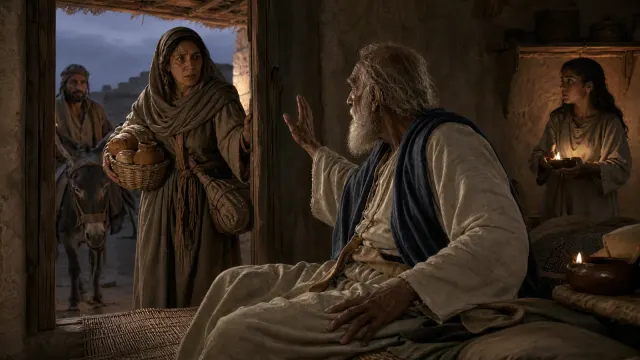
A Disguise Fails, and Gold Gives Way to Brass
Jeroboam tries to hide the identity of the one person sent to seek a prophetic word, but the disguise is useless before Ahijah ever sees her. The blind prophet has already been told who is coming and why. What begins as an inquiry about a sick child opens into judgment on Jeroboam’s house and, beyond it, Israel’s future uprooting. The child alone in that household is marked for burial and mourning, and his death occurs exactly at the threshold named in the prophecy. The chapter then turns south and refuses to let Jerusalem’s chosen status excuse Judah. Rehoboam’s kingdom adopts condemned practices, Shishak removes treasures from temple and palace, and Solomon’s golden shields are replaced with brass. Royal ceremony continues, but the cheaper metal makes the decline visible without a speech explaining it.
One complete chapter pageOpen chapter →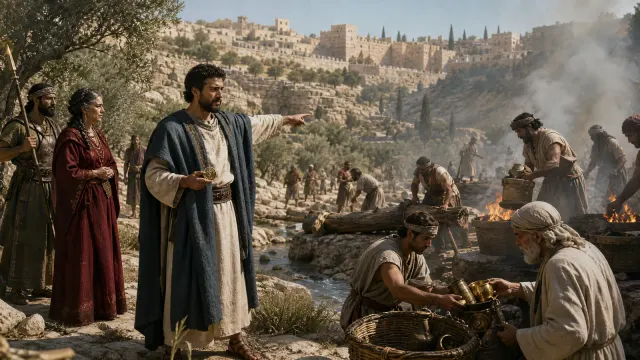
A Lamp in Jerusalem, and Another Northern Dynasty
The chapter places dynastic continuity beside sharply different royal assessments. Abijam walks in his father’s sins, yet David’s lamp remains in Jerusalem because the continuing house rests on an older promise rather than the present king’s faithfulness. Asa then receives a favorable judgment and carries reform into the royal household itself, removing Maachah from her position because of her idol. His reign is still described with limits: the high places remain, and treasure dedicated to the temple later becomes the price of Syrian help against Baasha. In Israel, Nadab inherits Jeroboam’s course and is killed during the siege of Gibbethon. Baasha destroys Jeroboam’s household in fulfillment of Ahijah’s word, then immediately preserves the same religious pattern. A new dynasty has arrived in Tirzah, but the worship that brought judgment on the old one remains.
One complete chapter pageOpen chapter →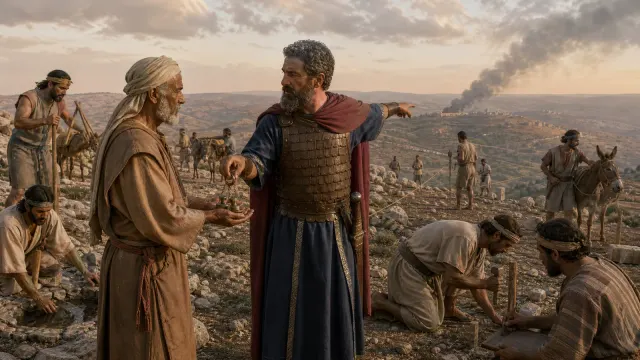
Short-Lived Thrones and a Deepening Breach
Baasha’s rise does not shield his house from the judgment that fell on Jeroboam’s. Jehu the prophet announces that Baasha, though raised from obscurity, has become like the dynasty he destroyed. Elah is then murdered by Zimri, a commander inside his own military structure, and Zimri wipes out Baasha’s household. His reward is a throne that lasts only seven days. The army at Gibbethon makes Omri king, Tirzah is taken, and Zimri dies inside the burning palace. Even Omri must first survive a divided succession before establishing Samaria as a new capital. Political strength grows while the book’s religious assessment worsens. Ahab inherits Samaria, marries Jezebel, builds a house and altar for Baal, and treats Jeroboam’s sins as only the beginning. The chapter closes with Hiel rebuilding Jericho under Joshua’s old word.
One complete chapter pageOpen chapter →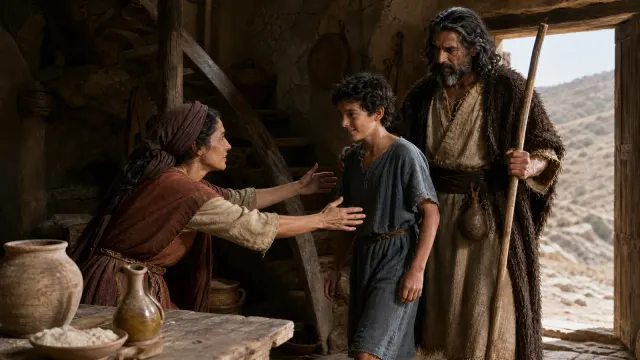
Life Sustained Where the Rain Does Not Fall
Elijah enters the Book of 1 Kings by announcing that rain and dew will stop, and the drought immediately becomes a test of whose word governs the land. He is not insulated from the conditions he announces. Ravens bring food at Cherith, but the brook still dries because no rain falls. The next provision comes through a widow in Zarephath, a woman who expects the small amount of meal and oil in her house to become a final meal for herself and her son. Elijah gives a specific promise, and those ordinary containers continue to supply food through the famine. Then the chapter moves beyond hunger. The widow’s son dies despite the continuing provision. Elijah carries him upstairs, cries to the LORD, and the child’s life returns. The widow’s final confession joins Elijah’s identity with the truth of the LORD’s word in his mouth.
One complete chapter pageOpen chapter →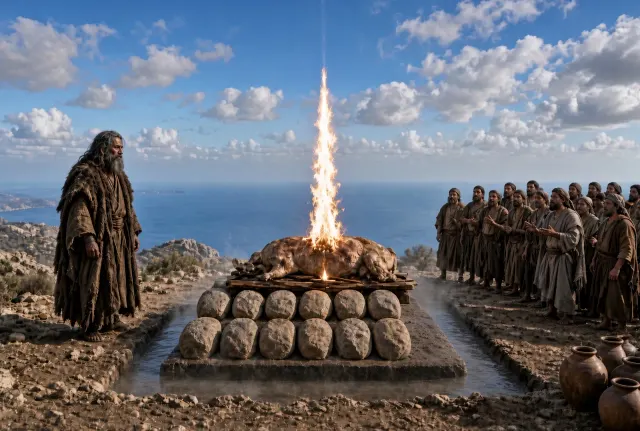
The Answer by Fire, and the Return of Rain
The return of rain is promised before Elijah appears before Ahab, so Carmel is not a device for forcing the drought to end. The chapter first shows the famine’s pressure through Ahab’s search for grass and Obadiah’s dangerous work of preserving the LORD’s prophets. When Ahab calls Elijah Israel’s troubler, Elijah turns the accusation back on the royal abandonment of the LORD. At Carmel, the people initially say nothing. Baal’s prophets cry, leap, and wound themselves for hours, but no voice answers. Elijah repairs a broken altar with twelve stones, drenches the offering, and prays briefly. Fire consumes not only the sacrifice but the wood, stones, dust, and water. The people finally speak: the LORD is God. Baal’s prophets are killed at Kishon. Only then does repeated watching toward the sea end with a hand-sized cloud, darkened skies, and great rain.
One complete chapter pageOpen chapter →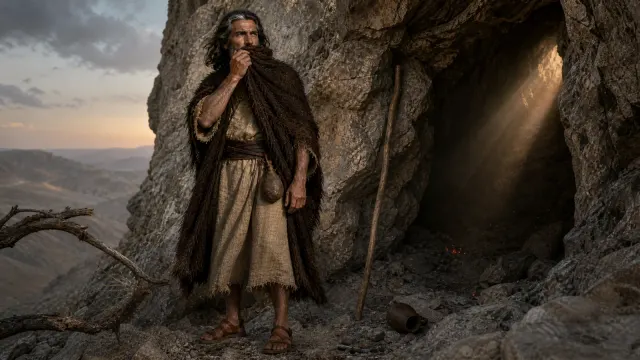
Beyond the Fire, a Voice and Unfinished Work
The triumph at Carmel is followed immediately by a royal death threat. Jezebel’s message drives Elijah south until he is alone in the wilderness asking to die. The first answer is physical rather than argumentative: sleep, food, water, then more food for a journey too great for him. At Horeb, Elijah describes covenant abandonment, murdered prophets, and his own isolation. Wind, earthquake, and fire pass before the “still small voice,” but the quiet encounter does not end in private consolation. Elijah repeats his complaint and receives instructions involving Hazael, Jehu, and Elisha, along with the correction that seven thousand in Israel have not bowed to Baal. His field of vision has been too small for the full account. The chapter ends at a plow. Elijah casts his mantle on Elisha, and Elisha turns the equipment of his former work into the means of a farewell meal before following.
One complete chapter pageOpen chapter →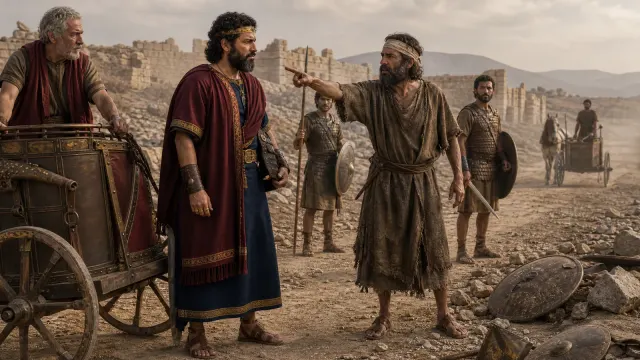
Two Victories, and a Prisoner the King Releases
Ahab is twice given victory over a Syrian force that appears vastly superior, and both victories are framed as demonstrations of the LORD’s identity rather than endorsements of Ahab’s character. Ben-hadad first besieges Samaria, expands his demands, and boasts before the fighting begins. An unnamed prophet announces deliverance, and a small Israelite force sends the Syrians fleeing. Syria returns after deciding that Israel’s God is strong only in the hills. The second victory answers that claim directly on the plain. Ben-hadad ends up hidden in an inner chamber, then emerges through servants who appeal to Israelite mercy. Ahab calls the defeated king his brother, raises him into his chariot, makes a covenant, and releases him. A wounded prophet then presents a disguised case about a lost prisoner. Ahab pronounces the penalty himself before learning that his own release of Ben-hadad is the case under judgment.
One complete chapter pageOpen chapter →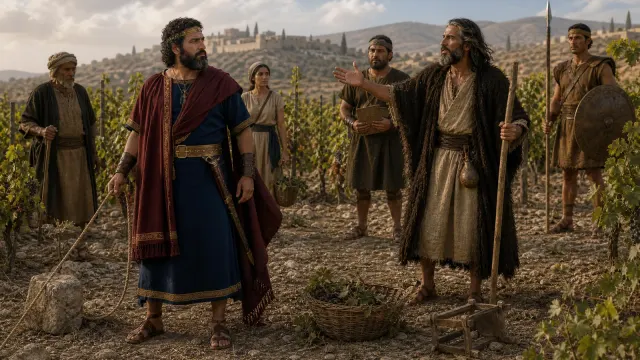
A Vineyard Acquired Through a False Judgment
The conflict begins with a perfectly ordinary royal desire for nearby land and becomes a demonstration of how public institutions can be bent toward a private seizure. Ahab offers money or another vineyard, but Naboth refuses because the ground is his fathers’ inheritance. Ahab goes home heavy and displeased. Jezebel answers by writing in his name, using his seal, summoning local elders, proclaiming a fast, and arranging two false witnesses. Naboth is executed through the forms of public justice, and Ahab goes down to take possession. Elijah meets him in the vineyard that the divine word still calls Naboth’s. The charge joins what the scheme tried to distribute among different hands: killing and taking possession. Severe judgment follows against Ahab, Jezebel, and the royal house. Yet when Ahab humbles himself with sackcloth and fasting, the LORD explicitly notices it and delays the household judgment until his son’s days.
One complete chapter pageOpen chapter →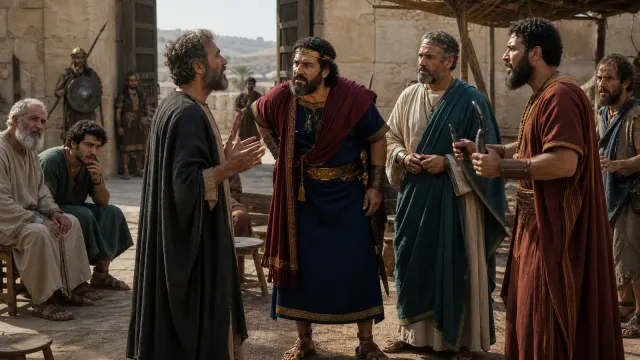
A King Disguised, a Word Fulfilled
Ahab wants Ramoth-gilead back and receives nearly unanimous prophetic support for the campaign, but the chapter keeps separating agreement from truth. Jehoshaphat asks for another inquiry, and Micaiah is summoned despite Ahab’s complaint that he never speaks good concerning him. Micaiah first echoes the favorable answer, then describes Israel scattered without a shepherd and a heavenly council in which a lying spirit draws Ahab toward the battle. The warning is public, but Ahab imprisons the prophet and goes anyway. He disguises himself while Jehoshaphat remains in royal robes. Syrian captains are fooled by the clothing, yet an archer who does not know whom he is striking sends an arrow through a joint in Ahab’s armor. Ahab dies by evening, his blood is licked at Samaria, and the chapter closes with Jehoshaphat’s reign and Ahaziah’s succession. Israel’s throne continues, and so does Baal worship.
One complete chapter pageOpen chapter →Source: eBible.org · eng-kjv2006