The big picture
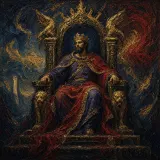
David, the king of Israel, the people he has ruled for many years, is now frail. His servants seek care for him while his sons face a different question. Someone must rule after him. Adonijah, one of his sons, begins acting as king without his father's consent. Bath-sheba, mother of Solomon, another son, hears of the danger. The choice must become public before a rival claim takes hold.
In this chapter
- Abishag Cares for the Frail King 1 Kings 1:1-4
David cannot get warm even beneath layers of clothing.
- Adonijah Gathers Support for His Claim 1 Kings 1:5-10
Adonijah declares that he will be king.
- Bath-Sheba and Nathan Ask David to Act 1 Kings 1:11-27
Nathan warns Bath-sheba that Adonijah is claiming rule without David's knowledge.
- Solomon Is Publicly Anointed King 1 Kings 1:28-40
David recalls God's help in his own troubles and renews his oath to Bath-sheba.
- The Feast Hears News of Solomon's Throne 1 Kings 1:41-48
Adonijah's guests hear the trumpet and the city's uproar as their meal ends.
- Adonijah Seeks Mercy at the Altar 1 Kings 1:49-53
The guests scatter in fear.
Central truth
David's public choice of Solomon stops Adonijah's bid for the throne and leaves the defeated rival dependent on his brother's mercy.
Scripture beside the summary
1 Kings · King James Version · 531 Kings 1:1-4
Abishag Cares for the Frail King
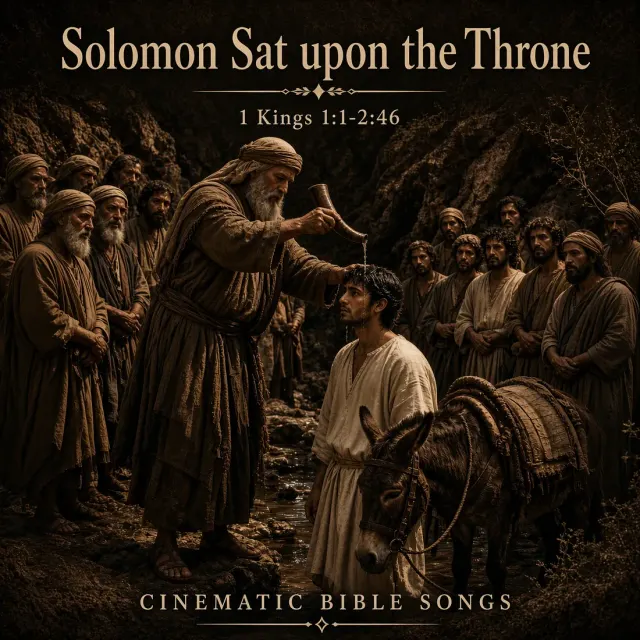
David cannot get warm even beneath layers of clothing. His servants propose finding a young woman to care for him and lie beside him for warmth. They search through Israel and bring Abishag, a young woman from Shunem. She is described as beautiful and attends to his needs. The account makes clear that David does not have sex with her. The king still holds his title, but his failing strength is visible. Others must now provide even the warmth his body cannot keep for itself.
In everyday life
A home nurse tucks another blanket around a retired judge who still feels cold. She checks his comfort while his old case books lie untouched nearby. Public standing does not remove his need for bodily care. Abishag's role includes lying beside the king, a practice this modern nursing visit does not reproduce.
Notice
1 Kings 1:4 The account expressly says David does not have sex with Abishag. Her place beside him is described as care rather than a sexual union.
1 Kings 1:1-4
King James Version1Now king David was old and stricken in years; and they covered him with clothes, but he gat no heat.
2Wherefore his servants said unto him, Let there be sought for my lord the king a young virgin: and let her stand before the king, and let her cherish him, and let her lie in thy bosom, that my lord the king may get heat.
3So they sought for a fair damsel throughout all the coasts of Israel, and found Abishag a Shunammite, and brought her to the king.
4And the damsel was very fair, and cherished the king, and ministered to him: but the king knew her not.
1 Kings 1:5-10
Adonijah Gathers Support for His Claim
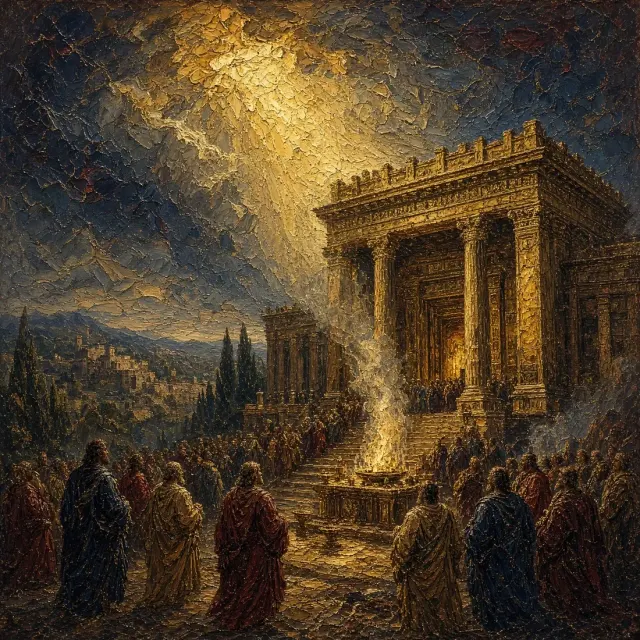
Adonijah declares that he will be king. He gathers horses, chariots, and fifty runners to display his claim. David has never challenged his conduct. Joab, the army commander, and Abiathar, a priest, give him support. Other trusted men stay apart, including Nathan, a prophet who speaks for God. Adonijah holds a feast and invites royal sons and officials. Yet he leaves out Solomon and several of David's close supporters. The guest list marks a divided court, not a choice agreed by the whole royal household.
In everyday life
The founder's eldest son orders new signs naming himself director while his father is ill upstairs. He invites selected staff to a meal and leaves his brother out. The printed signs make his claim visible before any formal handover. Adonijah seeks a national throne, where losing the contest can cost lives.
Notice
1 Kings 1:10 Solomon's absence is deliberate within the list of excluded guests. The feast is not a neutral family meal that happens to overlook one brother.
1 Kings 1:5-10
King James Version5Then Adonijah the son of Haggith exalted himself, saying, I will be king: and he prepared him chariots and horsemen, and fifty men to run before him.
6And his father had not displeased him at any time in saying, Why hast thou done so? and he also was a very goodly man; and his mother bare him after Absalom.
7And he conferred with Joab the son of Zeruiah, and with Abiathar the priest: and they following Adonijah helped him.
8But Zadok the priest, and Benaiah the son of Jehoiada, and Nathan the prophet, and Shimei, and Rei, and the mighty men which belonged to David, were not with Adonijah.
9And Adonijah slew sheep and oxen and fat cattle by the stone of Zoheleth, which is by En-rogel, and called all his brethren the king’s sons, and all the men of Judah the king’s servants:
10But Nathan the prophet, and Benaiah, and the mighty men, and Solomon his brother, he called not.
1 Kings 1:11-27
Bath-Sheba and Nathan Ask David to Act
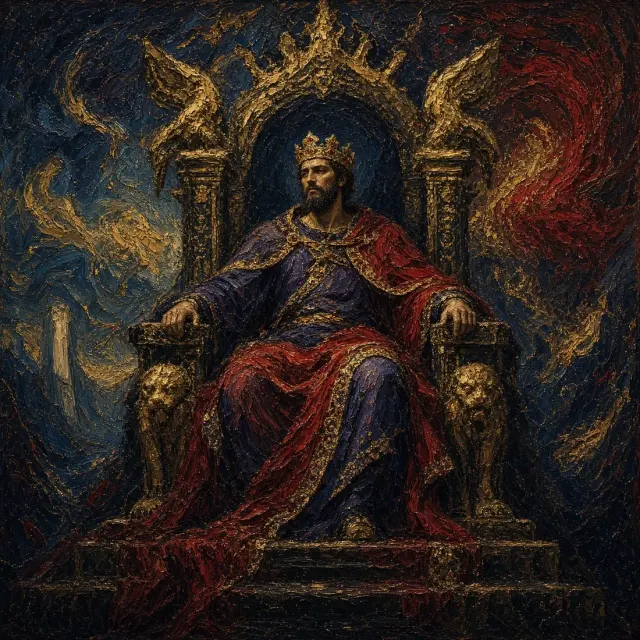
Nathan warns Bath-sheba that Adonijah is claiming rule without David's knowledge. Her life and Solomon's life are at risk. He tells her to remind David of his oath that Solomon would reign. She enters the king's room and reports the feast and its missing guests. She asks David to name his successor before his death leaves them treated as offenders. Nathan then arrives and confirms the report. He asks whether David ordered this new kingship without telling his trusted servants. Their appeal forces the hidden crisis before the king.
In everyday life
A family solicitor brings a signed succession agreement to a bedridden shop owner. His daughter explains that her brother has already changed the staff rota and claimed control. The solicitor confirms the facts while the owner can still answer. David's decision governs a kingdom and the safety of rival royal households.
Notice
1 Kings 1:27 Nathan asks whether David has acted without informing him. The question gives the king a chance to state clearly whether Adonijah has his approval.
1 Kings 1:11-27
King James Version11Wherefore Nathan spake unto Bath-sheba the mother of Solomon, saying, Hast thou not heard that Adonijah the son of Haggith doth reign, and David our lord knoweth it not?
12Now therefore come, let me, I pray thee, give thee counsel, that thou mayest save thine own life, and the life of thy son Solomon.
13Go and get thee in unto king David, and say unto him, Didst not thou, my lord, O king, swear unto thine handmaid, saying, Assuredly Solomon thy son shall reign after me, and he shall sit upon my throne? why then doth Adonijah reign?
14Behold, while thou yet talkest there with the king, I also will come in after thee, and confirm thy words.
15And Bath-sheba went in unto the king into the chamber: and the king was very old; and Abishag the Shunammite ministered unto the king.
16And Bath-sheba bowed, and did obeisance unto the king. And the king said, What wouldest thou?
17And she said unto him, My lord, thou swarest by the LORD thy God unto thine handmaid, saying, Assuredly Solomon thy son shall reign after me, and he shall sit upon my throne.
18And now, behold, Adonijah reigneth; and now, my lord the king, thou knowest it not:
19And he hath slain oxen and fat cattle and sheep in abundance, and hath called all the sons of the king, and Abiathar the priest, and Joab the captain of the host: but Solomon thy servant hath he not called.
20And thou, my lord, O king, the eyes of all Israel are upon thee, that thou shouldest tell them who shall sit on the throne of my lord the king after him.
21Otherwise it shall come to pass, when my lord the king shall sleep with his fathers, that I and my son Solomon shall be counted offenders.
22And, lo, while she yet talked with the king, Nathan the prophet also came in.
23And they told the king, saying, Behold Nathan the prophet. And when he was come in before the king, he bowed himself before the king with his face to the ground.
24And Nathan said, My lord, O king, hast thou said, Adonijah shall reign after me, and he shall sit upon my throne?
25For he is gone down this day, and hath slain oxen and fat cattle and sheep in abundance, and hath called all the king’s sons, and the captains of the host, and Abiathar the priest; and, behold, they eat and drink before him, and say, God save king Adonijah.
26But me, even me thy servant, and Zadok the priest, and Benaiah the son of Jehoiada, and thy servant Solomon, hath he not called.
27Is this thing done by my lord the king, and thou hast not shewed it unto thy servant, who should sit on the throne of my lord the king after him?
1 Kings 1:28-40
Solomon Is Publicly Anointed King
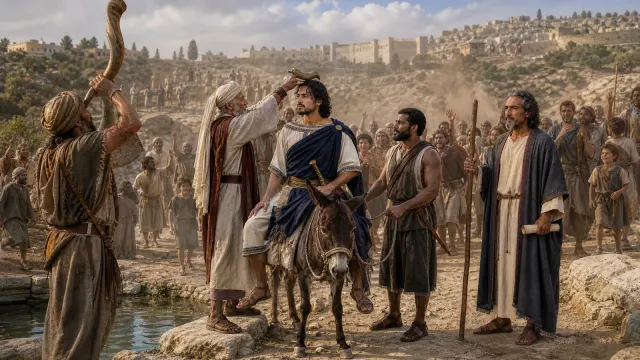
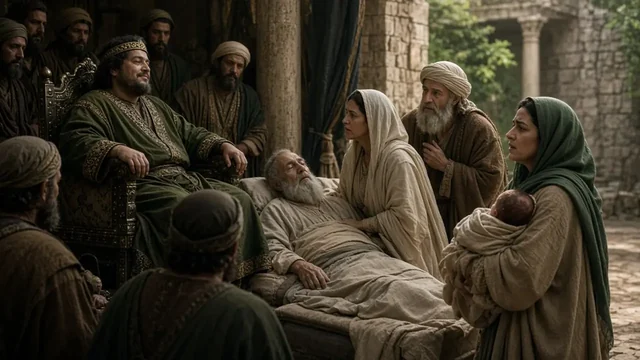
David recalls God's help in his own troubles and renews his oath to Bath-sheba. Solomon will rule, and the change will happen that day. David orders Zadok the priest, Nathan, and Benaiah, a trusted commander, to take Solomon to Gihon, a spring. Solomon rides David's own mule. Zadok pours oil on him as the sign of his royal appointment. A trumpet sounds, and the people acclaim him. The group returns with loud music and joy. David's command has become a public act, with Solomon placed on the throne.

In everyday life
The retiring fire chief hands the station keys to her named successor before the gathered crews. Senior officers stand beside him as the handover is announced over the service radio. Everyone hears who now holds the duty. Solomon is anointed to rule God's people, not promoted within an emergency service.
Notice
1 Kings 1:33 David gives Solomon his own mule for the procession. The use of the king's animal visibly connects the new ruler with the king who appointed him.
1 Kings 1:28-40
King James Version28Then king David answered and said, Call me Bath-sheba. And she came into the king’s presence, and stood before the king.
29And the king sware, and said, As the LORD liveth, that hath redeemed my soul out of all distress,
30Even as I sware unto thee by the LORD God of Israel, saying, Assuredly Solomon thy son shall reign after me, and he shall sit upon my throne in my stead; even so will I certainly do this day.
31Then Bath-sheba bowed with her face to the earth, and did reverence to the king, and said, Let my lord king David live for ever.
32And king David said, Call me Zadok the priest, and Nathan the prophet, and Benaiah the son of Jehoiada. And they came before the king.
33The king also said unto them, Take with you the servants of your lord, and cause Solomon my son to ride upon mine own mule, and bring him down to Gihon:
34And let Zadok the priest and Nathan the prophet anoint him there king over Israel: and blow ye with the trumpet, and say, God save king Solomon.
35Then ye shall come up after him, that he may come and sit upon my throne; for he shall be king in my stead: and I have appointed him to be ruler over Israel and over Judah.
36And Benaiah the son of Jehoiada answered the king, and said, Amen: the LORD God of my lord the king say so too.
37As the LORD hath been with my lord the king, even so be he with Solomon, and make his throne greater than the throne of my lord king David.
38So Zadok the priest, and Nathan the prophet, and Benaiah the son of Jehoiada, and the Cherethites, and the Pelethites, went down, and caused Solomon to ride upon king David’s mule, and brought him to Gihon.
39And Zadok the priest took an horn of oil out of the tabernacle, and anointed Solomon. And they blew the trumpet; and all the people said, God save king Solomon.
40And all the people came up after him, and the people piped with pipes, and rejoiced with great joy, so that the earth rent with the sound of them.
1 Kings 1:41-48
The Feast Hears News of Solomon's Throne
Adonijah's guests hear the trumpet and the city's uproar as their meal ends. Jonathan, Abiathar's son, arrives, and Adonijah expects welcome news. Instead, Jonathan reports that David has made Solomon king. He names those who escorted him, describes the anointing, and says Solomon sits on the throne. David's servants have blessed the new reign. The old king has bowed on his bed and thanked God for seeing his successor take power. The rival feast learns that the decision it tried to anticipate has gone another way.
In everyday life
A campaign organiser at a club dinner hears cheering from the hall next door. A messenger arrives with the signed result: another candidate has been appointed, with the chair's full backing. The table falls quiet around the unused celebration glasses. Adonijah faces royal power and possible death, not merely a lost club post.
Notice
1 Kings 1:48 David thanks God while still alive to see the new king seated. Solomon's appointment is confirmed before a dispute can claim the dead king's unspoken wishes.
1 Kings 1:41-48
King James Version41And Adonijah and all the guests that were with him heard it as they had made an end of eating. And when Joab heard the sound of the trumpet, he said, Wherefore is this noise of the city being in an uproar?
42And while he yet spake, behold, Jonathan the son of Abiathar the priest came: and Adonijah said unto him, Come in; for thou art a valiant man, and bringest good tidings.
43And Jonathan answered and said to Adonijah, Verily our lord king David hath made Solomon king.
44And the king hath sent with him Zadok the priest, and Nathan the prophet, and Benaiah the son of Jehoiada, and the Cherethites, and the Pelethites, and they have caused him to ride upon the king’s mule:
45And Zadok the priest and Nathan the prophet have anointed him king in Gihon: and they are come up from thence rejoicing, so that the city rang again. This is the noise that ye have heard.
46And also Solomon sitteth on the throne of the kingdom.
47And moreover the king’s servants came to bless our lord king David, saying, God make the name of Solomon better than thy name, and make his throne greater than thy throne. And the king bowed himself upon the bed.
48And also thus said the king, Blessed be the LORD God of Israel, which hath given one to sit on my throne this day, mine eyes even seeing it.
1 Kings 1:49-53
Adonijah Seeks Mercy at the Altar
The guests scatter in fear. Adonijah goes to the altar and grips its horns, the raised corners, seeking protection. He asks Solomon to swear that he will not kill him. Solomon does not give an unconditional promise. If Adonijah behaves as a worthy man, he will be safe; wrongdoing will bring death. Messengers bring him from the altar to the king. Adonijah bows before the brother whose claim he had tried to displace. Solomon sends him home, leaving mercy joined to a warning about his future conduct.
In everyday life
The suspended partner waits in the mediator's room while the new owner decides whether he can remain in the business. He asks for a firm promise against dismissal. The answer offers a return only if he keeps the stated conditions. Solomon can order death, a power no business owner has.
Notice
1 Kings 1:52 Solomon's answer ties safety to Adonijah's future conduct. The release ends the immediate danger without clearing a path for another attempt at the throne.
1 Kings 1:49-53
King James Version49And all the guests that were with Adonijah were afraid, and rose up, and went every man his way.
50And Adonijah feared because of Solomon, and arose, and went, and caught hold on the horns of the altar.
51And it was told Solomon, saying, Behold, Adonijah feareth king Solomon: for, lo, he hath caught hold on the horns of the altar, saying, Let king Solomon swear unto me to day that he will not slay his servant with the sword.
52And Solomon said, If he will shew himself a worthy man, there shall not an hair of him fall to the earth: but if wickedness shall be found in him, he shall die.
53So king Solomon sent, and they brought him down from the altar. And he came and bowed himself to king Solomon: and Solomon said unto him, Go to thine house.
Details worth noticing
The opening image
1 Kings 1:1 begins with “Now king David was old and stricken in years; and they covered him with clothes, but he gat no heat.”
Where the chapter turns
1 Kings 1:27 forms a natural hinge: “Is this thing done by my lord the king, and thou hast not shewed it unto thy servant, who should sit on the throne of my lord the king after him?”
The final note
1 Kings 1:53 leaves the reader with “So king Solomon sent, and they brought him down from the altar. And he came and bowed himself to king Solomon: and Solomon said unto him, Go to thine…”
A word trail through the chapter
The words king, Solomon, LORD, Adonijah, throne, priest help reveal the chapter’s repeated concerns.
KJV words made clear
- cherish
- Care for and keep warm, as Abishag does for the old king.
Music and video connected to the passage
Related media appears when its Scripture reference overlaps this study. Music and video can illuminate a theme while the biblical text remains the foundation.