
The big picture
Victories east of Jordan, the river they must cross, have given Israel, the people preparing to settle, its first territories. Moses, the nation's leader, recalls the defeat of Og, the king who fought them in Bashan, his northern kingdom. Israel, the people preparing to cross westward, must now share both land and military duty. Moses also recounts his own request to enter. God refuses it and directs him to strengthen Joshua, the man who will lead the crossing.
In this chapter
- Og's Fortified Kingdom Is Destroyed Deuteronomy 3:1-7
Og came out with his army to meet Israel at Edrei, a city in his kingdom.
- The Captured Land Is Shared Eastward Deuteronomy 3:8-17
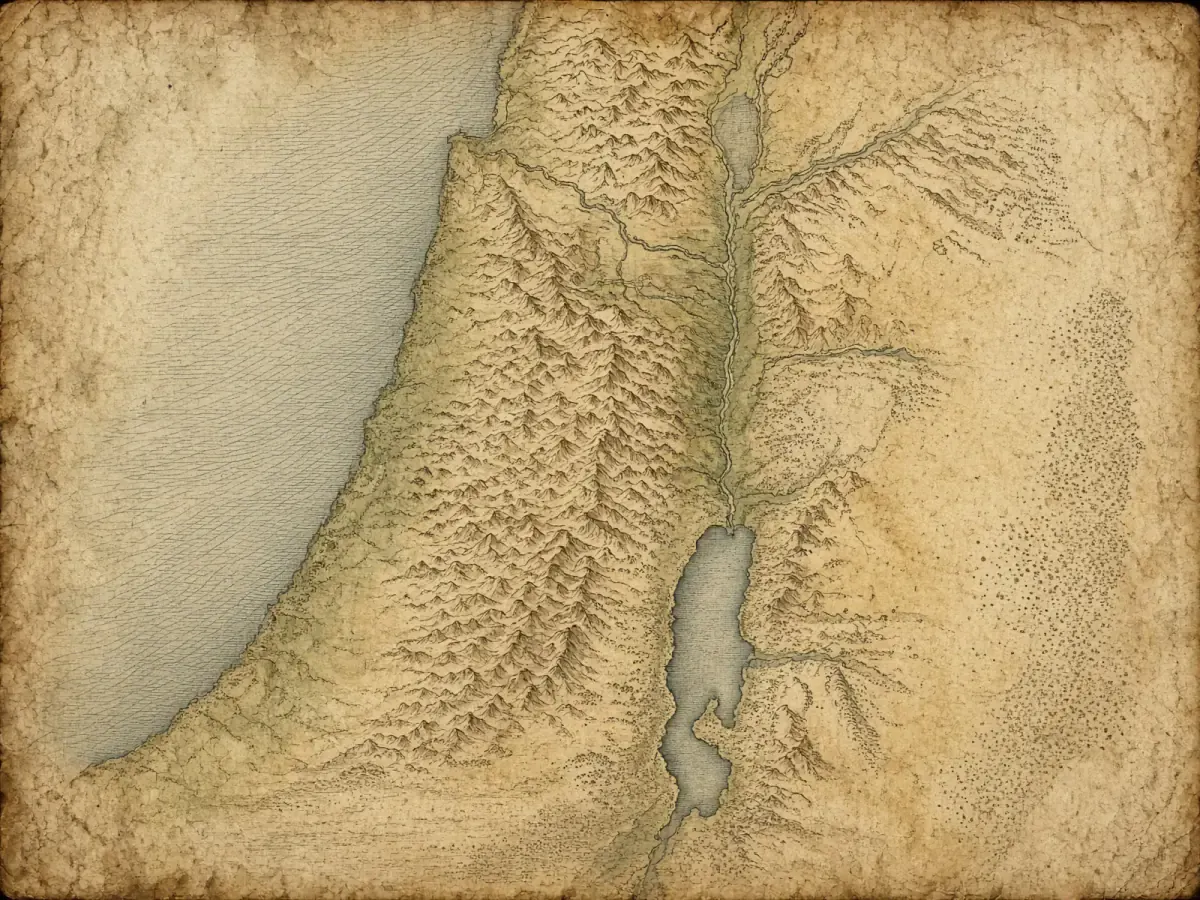
Moses describes the broad territory taken from the two kings, stretching between a river in the south and a mountain in the north.
- Settled Tribes Must Help Their Relatives Deuteronomy 3:18-22
Moses reminds the eastern tribes that receiving their own land did not end their duty to the rest of Israel.
- Moses Must See the Land from Outside Deuteronomy 3:23-29
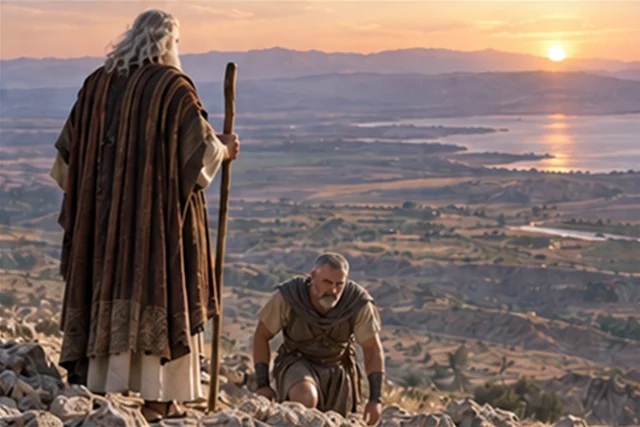
Moses recalls asking God to let him cross and see the good land.
Central truth
God gives Israel land and shared obligations, while Moses must accept that Joshua will lead the people into the territory he can only see.
Scripture beside the summary
Deuteronomy · King James Version · 29Deuteronomy 3:1-7
Og's Fortified Kingdom Is Destroyed
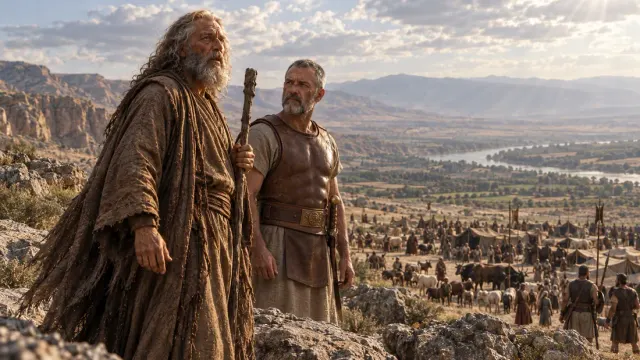
Og came out with his army to meet Israel at Edrei, a city in his kingdom. God told Moses not to fear him and promised victory like the earlier defeat of Sihon. Israel captured sixty fortified cities as well as many unwalled towns. High walls, gates, and bars did not stop the conquest. Moses says the people killed the men, women, and children, while keeping livestock and other goods. The account describes complete destruction of the inhabitants, not a victory limited to soldiers. Its confidence in God's help stands alongside that severe outcome.
In everyday life
The bereaved researcher spreads a town map beside a list of missing households. Strong outer walls remain on the plan, but they offered no lasting protection to those whose names she reads. She marks each residential street before closing the file. The conquest is reported as God's victory, not explained by a modern investigation.
Notice
Deuteronomy 3:5 The walls, gates, and bars are named before the destruction is described. Their strength makes clear that the towns were defended, yet those defenses did not save their inhabitants.
Deuteronomy 3:1-7
King James Version1Then we turned, and went up the way to Bashan: and Og the king of Bashan came out against us, he and all his people, to battle at Edrei.
2And the LORD said unto me, Fear him not: for I will deliver him, and all his people, and his land, into thy hand; and thou shalt do unto him as thou didst unto Sihon king of the Amorites, which dwelt at Heshbon.
3So the LORD our God delivered into our hands Og also, the king of Bashan, and all his people: and we smote him until none was left to him remaining.
4And we took all his cities at that time, there was not a city which we took not from them, threescore cities, all the region of Argob, the kingdom of Og in Bashan.
5All these cities were fenced with high walls, gates, and bars; beside unwalled towns a great many.
6And we utterly destroyed them, as we did unto Sihon king of Heshbon, utterly destroying the men, women, and children, of every city.
7But all the cattle, and the spoil of the cities, we took for a prey to ourselves.
Deuteronomy 3:8-17
The Captured Land Is Shared Eastward
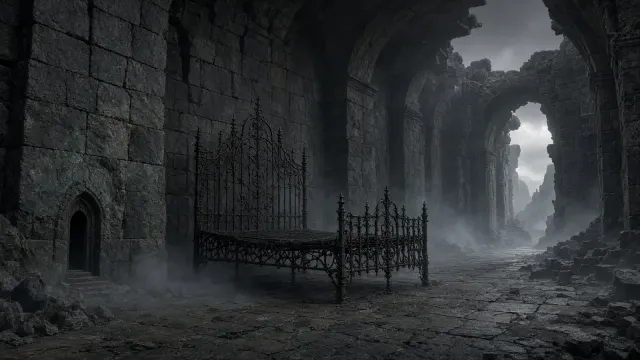
Moses describes the broad territory taken from the two kings, stretching between a river in the south and a mountain in the north. Og's unusually large iron bed is mentioned as a reminder of his stature among the remaining giants. Moses then recalls assigning the land among the Reubenites, Gadites, and half of Manasseh, groups within Israel. Rivers, towns, and plains mark their shares. The details turn victory into named places where households can live. They also distinguish this eastern settlement from the land the other tribes still await.
In everyday life
Three cousins trace the streams dividing their inherited grazing land on a deed. One keeps the river meadows, another the hillside, and the third the northern fields. Their shares become usable because the boundaries are named. Moses is allocating a kingdom taken in war under God's command, not dividing a family estate.
Notice
Deuteronomy 3:11 The iron bed's measurements preserve a concrete reminder of Og's unusual size. Moses includes this detail within a record of land taken despite the strength of its former king.
Deuteronomy 3:8-17
King James Version8And we took at that time out of the hand of the two kings of the Amorites the land that was on this side Jordan, from the river of Arnon unto mount Hermon;
9(Which Hermon the Sidonians call Sirion; and the Amorites call it Shenir;)
10All the cities of the plain, and all Gilead, and all Bashan, unto Salchah and Edrei, cities of the kingdom of Og in Bashan.
11For only Og king of Bashan remained of the remnant of giants; behold, his bedstead was a bedstead of iron; is it not in Rabbath of the children of Ammon? nine cubits was the length thereof, and four cubits the breadth of it, after the cubit of a man.
12And this land, which we possessed at that time, from Aroer, which is by the river Arnon, and half mount Gilead, and the cities thereof, gave I unto the Reubenites and to the Gadites.
13And the rest of Gilead, and all Bashan, being the kingdom of Og, gave I unto the half tribe of Manasseh; all the region of Argob, with all Bashan, which was called the land of giants.
14Jair the son of Manasseh took all the country of Argob unto the coasts of Geshuri and Maachathi; and called them after his own name, Bashan-havoth-jair, unto this day.
15And I gave Gilead unto Machir.
16And unto the Reubenites and unto the Gadites I gave from Gilead even unto the river Arnon half the valley, and the border even unto the river Jabbok, which is the border of the children of Ammon;
17The plain also, and Jordan, and the coast thereof, from Chinnereth even unto the sea of the plain, even the salt sea, under Ashdoth-pisgah eastward.
Deuteronomy 3:18-22
Settled Tribes Must Help Their Relatives
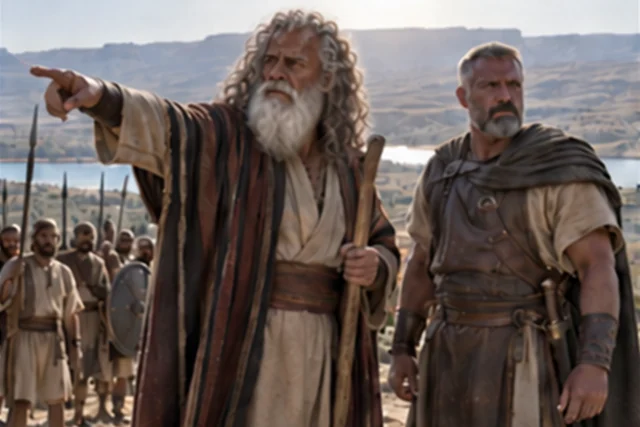
Moses reminds the eastern tribes that receiving their own land did not end their duty to the rest of Israel. Their fighting men must cross ahead of their relatives, while wives, children, and livestock remain in the towns already granted. They can return after the other tribes also receive rest and land. Moses then tells Joshua to remember what God did to the two defeated kings. The same God will act against the kingdoms ahead. Shared help and remembered victory prepare the people for a task that is not yet complete.
In everyday life
An older brother finishes moving his family into their new flat, then carries his sister's boxes up the neighbouring stairs. His own unpacked rooms can wait until her household is sheltered too. Receiving his share has not ended the family obligation. The eastern tribes owe armed service, with dangers no house move carries.
Notice
Deuteronomy 3:20 The men return only after their relatives also receive rest. The condition ties one group's enjoyment of its land to the unfinished needs of the others.
Deuteronomy 3:18-22
King James Version18And I commanded you at that time, saying, The LORD your God hath given you this land to possess it: ye shall pass over armed before your brethren the children of Israel, all that are meet for the war.
19But your wives, and your little ones, and your cattle, (for I know that ye have much cattle,) shall abide in your cities which I have given you;
20Until the LORD have given rest unto your brethren, as well as unto you, and until they also possess the land which the LORD your God hath given them beyond Jordan: and then shall ye return every man unto his possession, which I have given you.
21And I commanded Joshua at that time, saying, Thine eyes have seen all that the LORD your God hath done unto these two kings: so shall the LORD do unto all the kingdoms whither thou passest.
22Ye shall not fear them: for the LORD your God he shall fight for you.
Deuteronomy 3:23-29
Moses Must See the Land from Outside
Moses recalls asking God to let him cross and see the good land. He praised God's greatness and hoped to witness more of what God had begun. God refused and told him not to raise the matter again. Moses would climb Pisgah, a height overlooking the surrounding country, and look in every direction. But he would not cross Jordan. Instead, he must charge Joshua with the work and encourage him. His remaining responsibility is to strengthen the successor who will bring the people into the inheritance denied to him.
In everyday life
The retiring farmer stands at the boundary of the new field she helped secure but will never cultivate. She hands the drainage plans to her successor and explains where the ground needs care. Her loss does not remove the need to prepare him. God bars Moses from entry, unlike a retirement chosen or required by age.
Notice
Deuteronomy 3:28 Moses is told to strengthen Joshua after his own request is refused. The answer gives him a continuing responsibility toward the leader who will do what he cannot.
Deuteronomy 3:23-29
King James Version23And I besought the LORD at that time, saying,
24O Lord GOD, thou hast begun to shew thy servant thy greatness, and thy mighty hand: for what God is there in heaven or in earth, that can do according to thy works, and according to thy might?
25I pray thee, let me go over, and see the good land that is beyond Jordan, that goodly mountain, and Lebanon.
26But the LORD was wroth with me for your sakes, and would not hear me: and the LORD said unto me, Let it suffice thee; speak no more unto me of this matter.
27Get thee up into the top of Pisgah, and lift up thine eyes westward, and northward, and southward, and eastward, and behold it with thine eyes: for thou shalt not go over this Jordan.
28But charge Joshua, and encourage him, and strengthen him: for he shall go over before this people, and he shall cause them to inherit the land which thou shalt see.
29So we abode in the valley over against Beth-peor.
Details worth noticing
The opening image
Deuteronomy 3:1 begins with “Then we turned, and went up the way to Bashan: and Og the king of Bashan came out against us, he and all his people, to battle at Edrei.”
Where the chapter turns
Deuteronomy 3:11 forms a natural hinge: “For only Og king of Bashan remained of the remnant of giants; behold, his bedstead was a bedstead of iron; is it not in Rabbath of the children of Ammon…”
The final note
Deuteronomy 3:29 leaves the reader with “So we abode in the valley over against Beth-peor.”
A word trail through the chapter
The words LORD, Bashan, cities, land, time, Gilead help reveal the chapter’s repeated concerns.
KJV words made clear
- fenced
- Protected by walls, gates, and other defenses, rather than enclosed by a light boundary fence.
Music and video connected to the passage
Related media appears when its Scripture reference overlaps this study. Music and video can illuminate a theme while the biblical text remains the foundation.