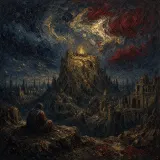
The big picture
The lament looks at Jerusalem, Judah's capital, through the claim that the Lord himself has brought its defences down. Zion, another name for the holy city, has lost palace, temple, gates, and public worship. Elders sit silent while children faint from hunger. The speaker searches for words that could comfort such loss and finds no adequate comparison. False prophets and gloating enemies deepen the wound. The chapter finally calls the city to pour out its grief before the God whose anger it has described.
In this chapter
- The Lord Acts Like an Enemy Lamentations 2:1-5
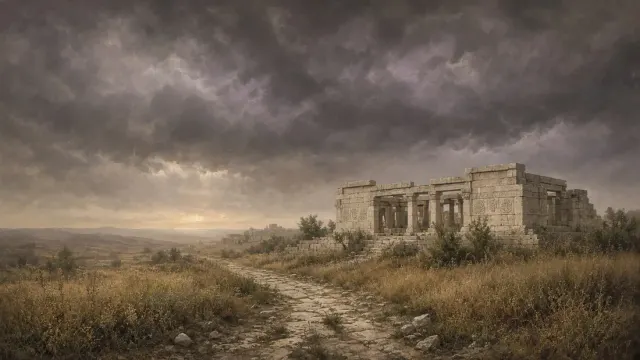
The Lord's anger covers the city like a cloud and casts its former splendour to the ground.
- Worship and Public Order Fall Silent Lamentations 2:6-10
God removes his meeting place as though it were a temporary garden shelter.
- Hungry Children Expose the Failure of False Hope Lamentations 2:11-14
The speaker's eyes are spent with tears and his body recoils at the city's destruction.
- Mocking Enemies Do Not Own the Final Explanation Lamentations 2:15-17
Passers-by clap, hiss, and shake their heads at the fallen city.
- The City Pours Its Horror Before God Lamentations 2:18-22
Tears must flow without rest, and cries rise through the night watches.
Central truth
The city names God as the source of its devastating judgement and turns to him with tears over suffering that no human comfort can adequately answer.
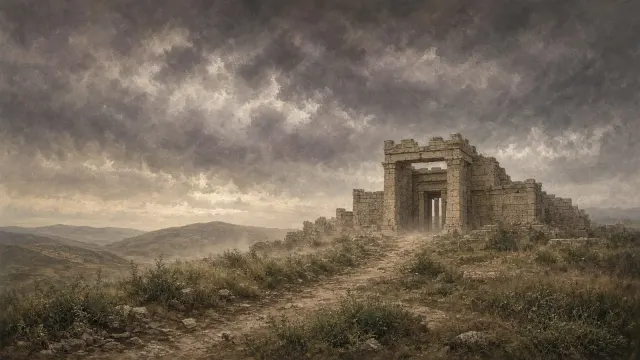

Scripture beside the summary
Lamentations · King James Version · 22Lamentations 2:1-5
The Lord Acts Like an Enemy
The Lord's anger covers the city like a cloud and casts its former splendour to the ground. Homes, strongholds, rulers, and national strength are brought down. He withdraws the protecting hand that had stood between the people and their enemies. Fire and a drawn bow picture him turning against them himself. Those once cherished are killed, palaces are swallowed up, and mourning increases. The people once relied on him for protection. Now he acts against them. The claim is more severe than saying that help did not arrive.
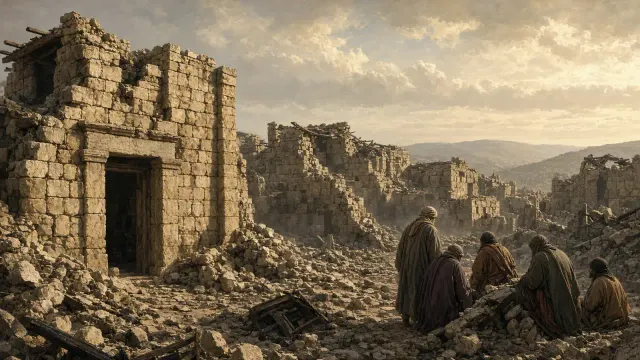
In everyday life
A disaster chaplain listens to survivors who say the place they trusted most has become the centre of their loss. She does not rush to replace that language with a reassuring slogan. Their sense of betrayal must be heard. The lament explicitly attributes the city's destruction to God acting in anger, not only to a survivor's perception.
Notice
Lamentations 2:5 The Lord is compared to an enemy after particular acts of destruction are named. The comparison gathers the shock of protection turning into opposition.
Lamentations 2:1-5
King James Version1How hath the Lord covered the daughter of Zion with a cloud in his anger, and cast down from heaven unto the earth the beauty of Israel, and remembered not his footstool in the day of his anger!
2The Lord hath swallowed up all the habitations of Jacob, and hath not pitied: he hath thrown down in his wrath the strong holds of the daughter of Judah; he hath brought them down to the ground: he hath polluted the kingdom and the princes thereof.
3He hath cut off in his fierce anger all the horn of Israel: he hath drawn back his right hand from before the enemy, and he burned against Jacob like a flaming fire, which devoureth round about.
4He hath bent his bow like an enemy: he stood with his right hand as an adversary, and slew all that were pleasant to the eye in the tabernacle of the daughter of Zion: he poured out his fury like fire.
5The Lord was as an enemy: he hath swallowed up Israel, he hath swallowed up all her palaces: he hath destroyed his strong holds, and hath increased in the daughter of Judah mourning and lamentation.
Lamentations 2:6-10
Worship and Public Order Fall Silent
God removes his meeting place as though it were a temporary garden shelter. Feasts and sabbaths, the appointed holy days, disappear from the city's life. He rejects altar and sanctuary while enemy noise fills the worship space. The ruined walls are described as deliberately measured for destruction. Gates sink and bars break. Rulers are among foreign nations, the law no longer guides public life, and prophets find no vision from God. Elders sit in dust and rough mourning clothes, while young women bow their heads. The loss includes direction and speech as well as buildings.
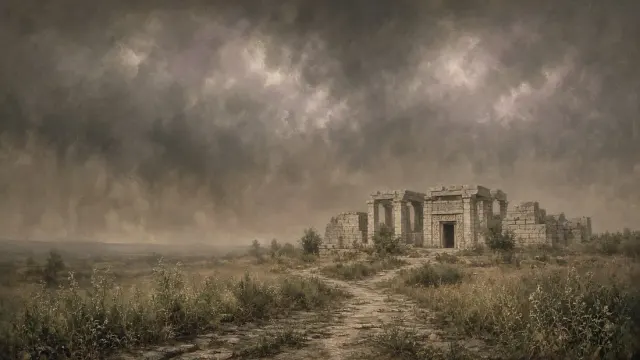
In everyday life
The congregation steward opens the locked cupboard containing unused service books and a calendar whose gatherings never happened. The familiar rhythm that once held people together has stopped. She sits with elders who have no words for it. God rejects his own sanctuary and gives no prophetic vision here; losing access to rooms does not convey all that loss.
Notice
Lamentations 2:7 Enemy noise in God's house is compared to the sound of a feast. The place is still loud. The gathering expresses defeat instead of worship.
Lamentations 2:6-10
King James Version6And he hath violently taken away his tabernacle, as if it were of a garden: he hath destroyed his places of the assembly: the LORD hath caused the solemn feasts and sabbaths to be forgotten in Zion, and hath despised in the indignation of his anger the king and the priest.
7The Lord hath cast off his altar, he hath abhorred his sanctuary, he hath given up into the hand of the enemy the walls of her palaces; they have made a noise in the house of the LORD, as in the day of a solemn feast.
8The LORD hath purposed to destroy the wall of the daughter of Zion: he hath stretched out a line, he hath not withdrawn his hand from destroying: therefore he made the rampart and the wall to lament; they languished together.
9Her gates are sunk into the ground; he hath destroyed and broken her bars: her king and her princes are among the Gentiles: the law is no more; her prophets also find no vision from the LORD.
10The elders of the daughter of Zion sit upon the ground, and keep silence: they have cast up dust upon their heads; they have girded themselves with sackcloth: the virgins of Jerusalem hang down their heads to the ground.
Lamentations 2:11-14
Hungry Children Expose the Failure of False Hope
The speaker's eyes are spent with tears and his body recoils at the city's destruction. Children and infants faint in the streets, asking mothers for food and drink before their strength fails in their arms. He asks what comparison could offer comfort when the wound seems as vast as the sea. Who can heal it? The prophets had given empty visions instead of exposing the people's sin and turning them back. Their false messages helped lead to exile. The lament places their soothing failure beside suffering no pleasant words can now repair.

In everyday life
A famine counsellor sits with parents after children have died and hears how earlier assurances kept the danger out of public discussion. She does not offer a tidy comparison to make the loss seem manageable. She records the failed warnings and remains with the grief. The lament also names concealed sin and false prophecy before God.
Notice
Lamentations 2:14 The prophets failed to expose wrongdoing that needed change. Their comforting visions are judged by what they concealed, not praised because they once made people feel safer.
Lamentations 2:11-14
King James Version11Mine eyes do fail with tears, my bowels are troubled, my liver is poured upon the earth, for the destruction of the daughter of my people; because the children and the sucklings swoon in the streets of the city.
12They say to their mothers, Where is corn and wine? when they swooned as the wounded in the streets of the city, when their soul was poured out into their mothers’ bosom.
13What thing shall I take to witness for thee? what thing shall I liken to thee, O daughter of Jerusalem? what shall I equal to thee, that I may comfort thee, O virgin daughter of Zion? for thy breach is great like the sea: who can heal thee?
14Thy prophets have seen vain and foolish things for thee: and they have not discovered thine iniquity, to turn away thy captivity; but have seen for thee false burdens and causes of banishment.
Lamentations 2:15-17
Mocking Enemies Do Not Own the Final Explanation
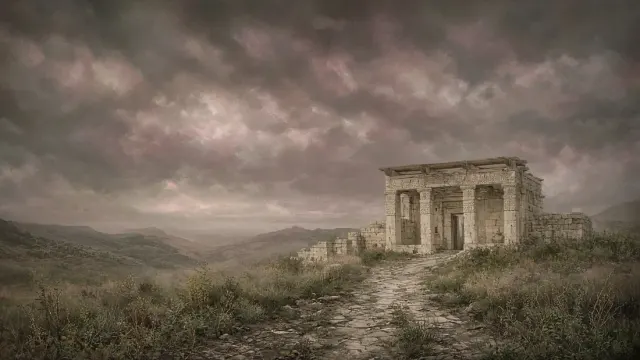
Passers-by clap, hiss, and shake their heads at the fallen city. They ask whether this is the place once celebrated for beauty and joy. Enemies boast that they have swallowed it and finally seen the day they wanted. The lament then gives a different account of the event's source. The Lord has fulfilled the word spoken long before. He has brought down the city without pity and raised its enemies' strength. Their delight is recorded, but they do not become the ultimate authors of the judgement merely because they claim the victory.
In everyday life
A heritage volunteer hears visitors make cruel jokes beside a ruined landmark once loved by its residents. She notes how their comments turn another community's loss into entertainment. The old photographs still show why the place mattered. Lamentations identifies God's fulfilled warning behind the fall, while the volunteer can address only the visitors' conduct.
Notice
Lamentations 2:17 The Lord's earlier word is placed after the enemies' boasts. Their claim to have achieved their desired day does not replace the lament's account of divine judgement.
Lamentations 2:15-17
King James Version15All that pass by clap their hands at thee; they hiss and wag their head at the daughter of Jerusalem, saying, Is this the city that men call The perfection of beauty, The joy of the whole earth?
16All thine enemies have opened their mouth against thee: they hiss and gnash the teeth: they say, We have swallowed her up: certainly this is the day that we looked for; we have found, we have seen it.
17The LORD hath done that which he had devised; he hath fulfilled his word that he had commanded in the days of old: he hath thrown down, and hath not pitied: and he hath caused thine enemy to rejoice over thee, he hath set up the horn of thine adversaries.
Lamentations 2:18-22
The City Pours Its Horror Before God
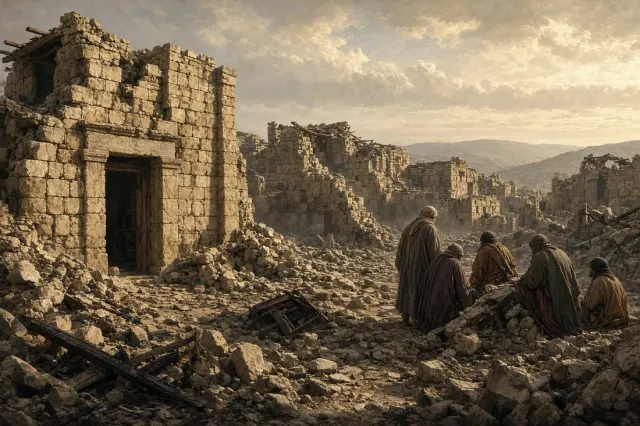
Tears must flow without rest, and cries rise through the night watches. It must pour its heart out before God and lift its hands for hungry children. The prayer asks him to consider whom he has afflicted. It names famine so severe that mothers eat their children, and priests and prophets killed in the sanctuary. Young and old lie in the streets. The city says God summoned terror as though calling a feast, leaving no escape. Those once carried and raised have been consumed by the enemy.
In everyday life
A night-shift grief worker keeps a room open for families who cannot sleep after catastrophic loss. She lets them name what happened without forcing the accounts into comforting language. The gathering holds pain that daylight activity has not relieved. The city directs its horrific questions to God as the one who brought the judgement, not to a human caregiver.
Notice
Lamentations 2:19 The call to pour out the heart comes with raised hands for children's lives. Lament becomes direct appeal rather than only a description of ruined walls and institutions.
Lamentations 2:18-22
King James Version18Their heart cried unto the Lord, O wall of the daughter of Zion, let tears run down like a river day and night: give thyself no rest; let not the apple of thine eye cease.
19Arise, cry out in the night: in the beginning of the watches pour out thine heart like water before the face of the Lord: lift up thy hands toward him for the life of thy young children, that faint for hunger in the top of every street.
20Behold, O LORD, and consider to whom thou hast done this. Shall the women eat their fruit, and children of a span long? shall the priest and the prophet be slain in the sanctuary of the Lord?
21The young and the old lie on the ground in the streets: my virgins and my young men are fallen by the sword; thou hast slain them in the day of thine anger; thou hast killed, and not pitied.
22Thou hast called as in a solemn day my terrors round about, so that in the day of the LORD’s anger none escaped nor remained: those that I have swaddled and brought up hath mine enemy consumed.
Details worth noticing
The opening image
Lamentations 2:1 begins with “How hath the Lord covered the daughter of Zion with a cloud in his anger, and cast down from heaven unto the earth the beauty of Israel, and remembered not…”
Where the chapter turns
Lamentations 2:12 forms a natural hinge: “They say to their mothers, Where is corn and wine? when they swooned as the wounded in the streets of the city, when their soul was poured out into their…”
The final note
Lamentations 2:22 leaves the reader with “Thou hast called as in a solemn day my terrors round about, so that in the day of the LORD’s anger none escaped nor remained: those that I have swaddled…”
A word trail through the chapter
The words LORD, daughter, Zion, anger, enemy, ground help reveal the chapter’s repeated concerns.
KJV words made clear
- rampart
- A raised defensive bank or wall protecting a city.
- sackcloth
- Coarse clothing worn as a sign of grief or distress.
- sucklings
- Infants who still depend on milk for food.
Music and video connected to the passage
Related media appears when its Scripture reference overlaps this study. Music and video can illuminate a theme while the biblical text remains the foundation.